
Key Takeaways
Thermal imaging drone technology has become the detection backbone of modern counter-drone systems, enabling 24/7 threat identification regardless of lighting conditions.
- The global C-UAS market is projected to grow from $6.64 billion in 2025 to $20.31 billion by 2030, with electro-optical and infrared sensors commanding significant investment across defense and critical infrastructure applications.
- LWIR systems excel at detecting small drone airframes through thermal contrast, while MWIR performs better for tracking hot engine signatures at extended ranges.
- OEMs must balance detection performance, integration complexity, and supply chain reliability when selecting thermal components for CUAS platforms.
Selecting a vertically integrated thermal imaging partner reduces program risk while accelerating time-to-deployment for mission-critical counter-drone applications.
The counter-drone threat landscape has fundamentally shifted. What began as a niche security concern has evolved into a priority for defense forces, critical infrastructure operators, and public safety agencies worldwide. Unauthorized drone incursions near military installations, airports, and government facilities now occur with alarming frequency, and traditional detection methods struggle to keep pace with rapidly advancing UAV capabilities.
At the heart of effective counter-drone detection sits thermal imaging drone technology. Electro-optical and infrared sensors provide the visual confirmation that radar and RF detection alone cannot deliver. For OEMs developing next-generation CUAS platforms, understanding how to evaluate, select, and integrate thermal imaging solutions determines whether their systems succeed in the field or fail when it matters most.
This guide cuts through the complexity to give program managers, engineers, and business development leaders a practical framework for building competitive counter-drone platforms with thermal imaging drone capabilities that perform under real-world conditions.
Why Has Thermal Imaging Drone Technology Become Essential for CUAS Operations?
Counter-drone systems rely on multiple detection modalities working in concert. Radar identifies airborne objects at range. Radio frequency sensors detect communication links between drones and operators. Acoustic systems listen for distinctive propeller signatures. Each technology contributes valuable data, but none provides the definitive visual identification that thermal imaging delivers.
A drone thermal camera sees what other sensors cannot. Operating in complete darkness, through light fog, and in cluttered visual environments, thermal detection identifies the heat signatures of drone motors, batteries, and airframes against ambient backgrounds. This capability proves critical for distinguishing actual threats from false positives like birds, debris, or atmospheric interference that plague radar-only systems.
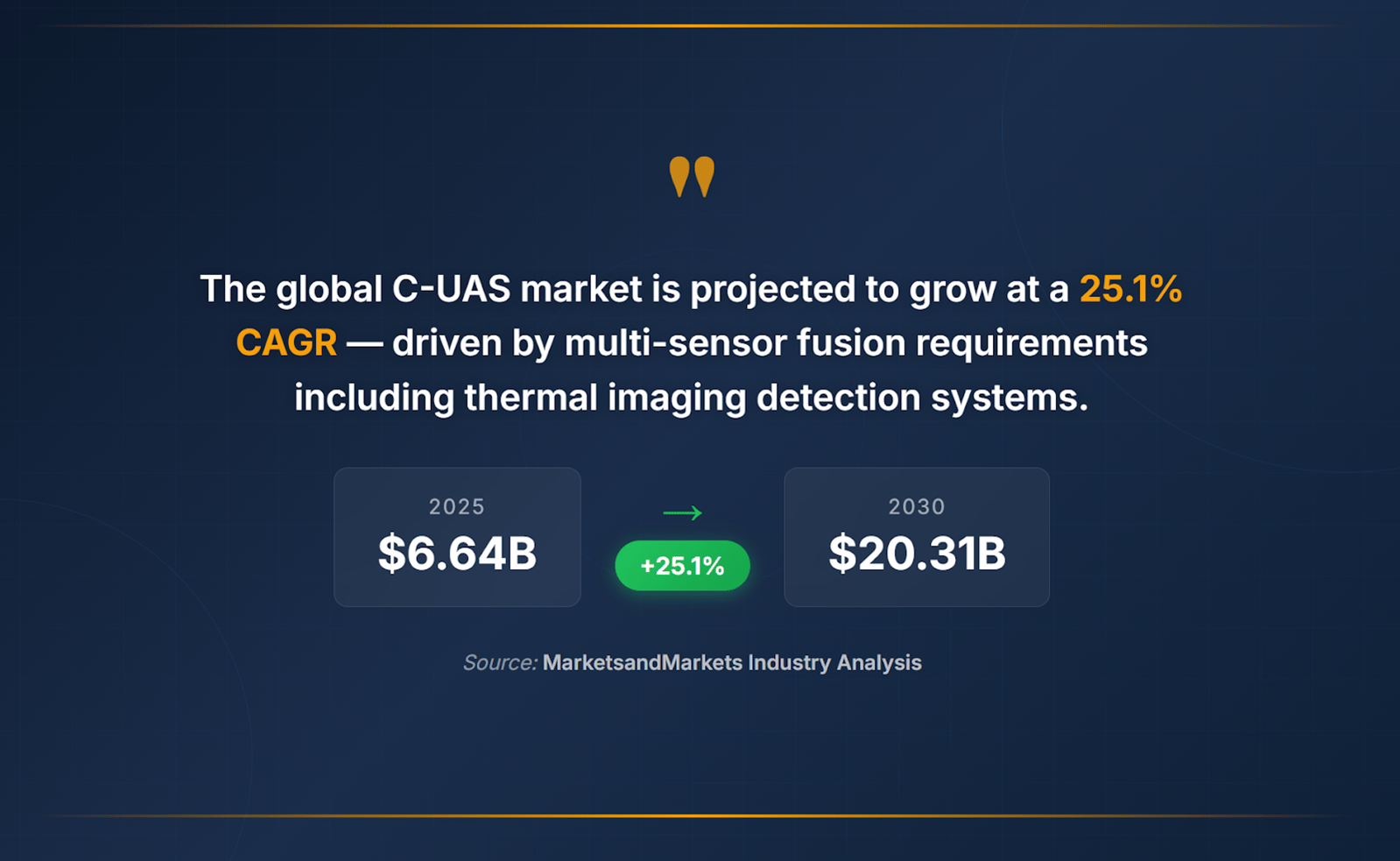
The market reflects this operational reality. According to industry analysis, the global C-UAS market is projected to reach $20.31 billion by 2030, growing at a 25.1% CAGR as organizations recognize that multi-sensor fusion requires reliable thermal detection to complete the identification chain.
For aerospace and defense applications specifically, infrared drone camera technology enables engagement decisions that depend on positive visual confirmation. Rules of engagement typically require operators to verify targets before deploying countermeasures. Thermal imaging provides that verification capability in conditions where daylight cameras fail completely.
What Distinguishes LWIR From MWIR for Counter-Drone Detection?
OEMs developing CUAS platforms face a fundamental technology choice between Long-Wave Infrared and Mid-Wave Infrared thermal imaging. Each operates in different portions of the infrared spectrum and delivers distinct performance characteristics that matter for counter-drone applications.
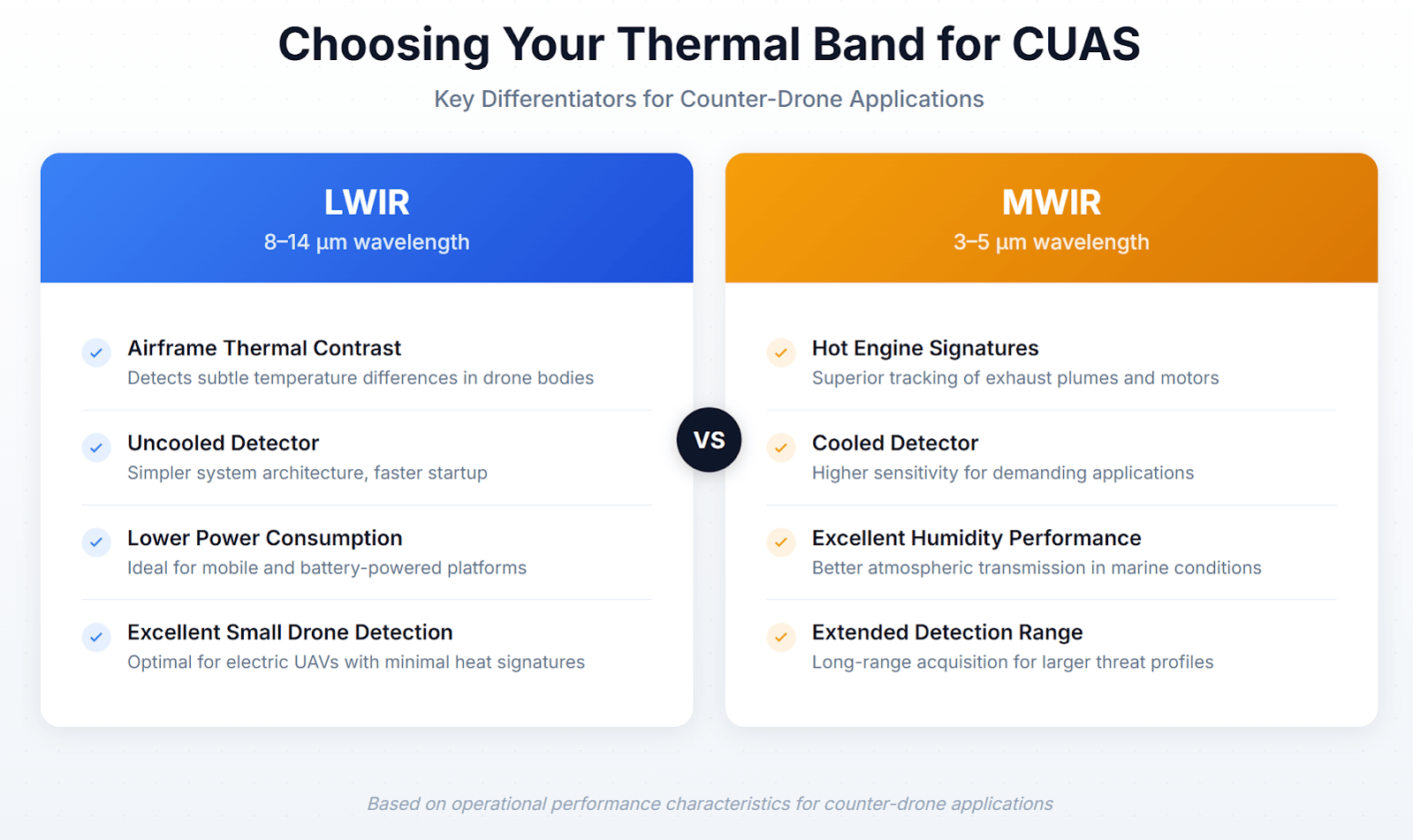
Long-wave infrared systems operate in the 8-14 micrometer wavelength range, detecting thermal radiation from objects at ambient temperatures. LWIR excels at identifying small drones through airframe thermal contrast rather than engine heat alone. This proves particularly valuable for detecting electric-powered UAVs with minimal heat signatures from motors and batteries.
Mid-wave infrared operates in the 3-5 micrometer band, offering superior sensitivity to high-temperature objects. MWIR systems track hot engine exhaust plumes and running motors with exceptional clarity, often providing longer detection ranges for drones generating significant heat.
|
Factor |
LWIR (8-14 µm) |
MWIR (3-5 µm) |
|
Best Detection Target |
Airframe thermal contrast |
Hot engine signatures |
|
Typical Configuration |
Uncooled detector |
Cooled detector |
|
System Complexity |
Lower |
Higher |
|
Power Consumption |
Lower |
Higher |
|
Humidity Performance |
Good |
Excellent |
|
Small Drone Detection |
Excellent |
Good for heated targets |
For many CUAS applications, the choice depends on operational priorities. UAV thermal imaging missions requiring extended-range tracking of larger drones with combustion engines favor MWIR solutions. Platforms focused on detecting small consumer-grade electric drones at shorter ranges often achieve better results with LWIR systems that identify subtle thermal contrasts from batteries and electronics.
Many advanced counter-drone platforms now incorporate both technologies, using mid-wave infrared for long-range acquisition and LWIR for close-range identification and tracking. This dual-band approach maximizes detection probability across diverse threat profiles but increases system complexity and cost.
How Should OEMs Evaluate Thermal Imaging Solutions for CUAS Integration?
Selecting thermal imaging components for counter-drone platforms extends far beyond comparing resolution specifications. Program managers who focus exclusively on pixel counts often discover that real-world performance depends on factors their initial evaluation overlooked.
The urgency driving these evaluations is substantial. Congressional oversight reports confirm that DOD is developing, acquiring, and fielding defensive counter-UAS weapon systems at an accelerated pace, with Congress evaluating whether to authorize increased funding for detection and mitigation capabilities. This momentum creates opportunity for OEMs positioned to deliver proven thermal imaging solutions.
Integration complexity drives more program delays than inadequate sensor performance. A thermal imaging drone solution with impressive standalone specifications may prove difficult to integrate with existing command and control systems, gimbal assemblies, or data processing pipelines. OEMs benefit from evaluating the complete integration pathway before committing to specific thermal components.
Environmental qualification matters enormously for field-deployed systems. Counter-drone platforms operate in conditions that destroy commercial-grade components within weeks. Thermal cameras specified for CUAS applications require proven performance across temperature extremes, continuous vibration exposure, and harsh weather conditions that mirror actual deployment scenarios.
Supply chain reliability has emerged as a critical evaluation factor. Programs dependent on single-source thermal components face schedule risk when supply disruptions occur. Manufacturers controlling their complete value chain from raw materials through finished assemblies provide production stability that component assemblers cannot match.
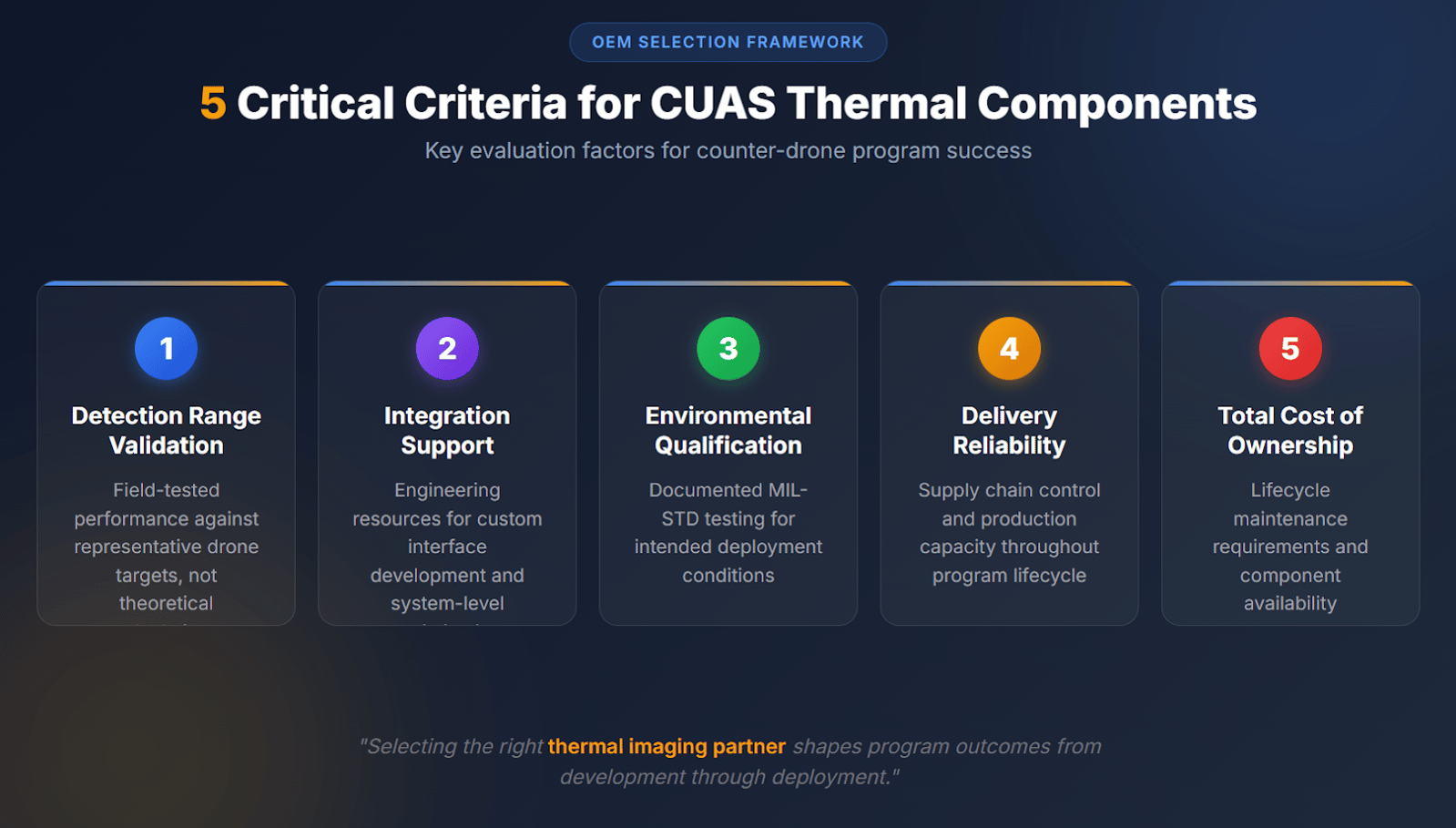
Five Critical Evaluation Criteria for CUAS Thermal Components:
- Detection Range Validation: Actual field-tested range performance against representative drone targets, not theoretical calculations based on sensor resolution alone.
- Integration Support: Manufacturer engineering resources available for custom interface development, mounting configurations, and system-level optimization.
- Environmental Qualification: Documented performance under MIL-STD environmental stress testing appropriate for intended deployment conditions.
- Delivery Reliability: Production capacity and supply chain control ensuring consistent delivery timelines throughout program lifecycle.
- Total Cost of Ownership: Maintenance requirements, expected service life, and component availability over the operational period.
What Integration Challenges Do CUAS Platform Developers Face?
Building effective counter-drone systems requires thermal imaging drone technology that functions as part of a larger sensor ecosystem. The integration challenges extend across mechanical, electrical, and software domains.
Gimbal compatibility represents a common friction point. Infrared drone camera modules must interface mechanically and electrically with stabilized pointing systems while maintaining performance under continuous motion. Weight distribution affects gimbal servo sizing. Thermal dissipation influences both camera performance and gimbal bearing life. Programs that underestimate these interactions discover problems during integration testing rather than specification review.
Data pipeline architecture determines how effectively thermal video contributes to threat assessment. Modern CUAS platforms process sensor data through AI-enabled classification algorithms that distinguish drones from other airborne objects. Thermal surveillance camera systems must deliver imagery in formats and framerates compatible with these processing chains while maintaining the image quality that algorithms require for accurate classification.
Power management becomes increasingly critical as platforms prioritize mobility. Portable and vehicle-mounted counter-drone systems operate under strict power budgets. Cooled MWIR systems delivering superior long-range performance consume significantly more power than uncooled LWIR alternatives. Platform architects must balance detection capability against operational endurance when power availability constrains design options.
Regulatory compliance adds another integration dimension. Export control classifications for thermal imaging components vary by technology type, performance level, and end-use application. Programs specifying thermal components without considering ITAR and EAR implications face potential delays or redesigns when export licensing reveals unanticipated restrictions.

What Makes Cooled and Uncooled Systems Different for Counter-Drone Applications?
The cooled versus uncooled decision influences virtually every aspect of CUAS platform design, from size and weight to operational maintenance and lifecycle cost.
Uncooled thermal detectors operate at ambient temperature using microbolometer technology. These systems offer compelling advantages for many counter-drone applications. Lower power consumption extends operational endurance for mobile platforms. Reduced mechanical complexity improves reliability and decreases maintenance requirements. Compact form factors enable integration into smaller platforms and more flexible mounting configurations.
Cooled detectors maintain their focal plane arrays at cryogenic temperatures, dramatically reducing thermal noise and enabling detection of smaller temperature differences at greater distances. For CUAS platforms requiring maximum detection range or operating against targets with minimal thermal signatures, cooled systems deliver performance that uncooled alternatives cannot match.
|
Characteristic |
Uncooled Systems |
Cooled Systems |
|
Power Draw |
2-8 watts typical |
40-80+ watts typical |
|
Startup Time |
Seconds |
Minutes |
|
Maintenance |
Minimal |
Cooler service intervals |
|
Form Factor |
Compact |
Larger |
|
Detection Range |
Short to medium |
Medium to extended |
|
Operational Life |
50,000+ hours typical |
Cooler-dependent |
For many OEMs, the practical choice depends on platform constraints and mission profiles. Drone thermal camera applications requiring long flight endurance typically favor uncooled systems that preserve battery capacity. Ground-based or vehicle-mounted CUAS installations with reliable power access may justify cooled systems delivering superior range performance.
How Do Material Innovations Affect Thermal Imaging for CUAS?
The thermal imaging supply chain faces pressure from material availability that directly impacts CUAS program planning. Traditional infrared optics rely heavily on germanium, a material with concentrated global supply sources and increasing demand across multiple industries.
Material innovation has produced alternatives that reduce supply chain vulnerability while maintaining optical performance. Advanced chalcogenide glass formulations deliver infrared transmission characteristics suitable for demanding defense applications without germanium dependency. OEMs evaluating thermal imaging partners benefit from understanding how component manufacturers address material supply risks.
Vertical integration provides additional supply chain security. Manufacturers controlling raw material production through finished camera assembly can manage material flows and maintain production continuity during supply disruptions that affect component assemblers dependent on external suppliers.
For programs with extended production timelines or significant unit volumes, supply chain stability often determines whether delivery schedules hold. The premium for working with vertically integrated thermal imaging partners typically pays returns through reduced schedule risk and consistent product quality across production lots.
Frequently Asked Questions
What detection range should CUAS thermal cameras achieve?
Detection range depends heavily on target characteristics, atmospheric conditions, and system configuration. Most operational CUAS platforms specify thermal detection ranges from 1-5 kilometers for small consumer drones, with extended-range systems achieving 10+ kilometers against larger targets with significant heat signatures. Actual field performance varies significantly from theoretical calculations.
Can uncooled thermal cameras effectively detect small drones?
Yes, modern uncooled LWIR systems detect small electric drones effectively at ranges appropriate for many CUAS applications. The key is matching system capabilities to operational requirements rather than assuming cooled systems are always necessary. Many successful counter-drone deployments rely entirely on uncooled thermal imaging.
How does weather affect thermal detection of drones?
Heavy rain significantly degrades thermal imaging performance regardless of technology type. Light fog affects MWIR more than LWIR in many conditions. Snow, dust, and aerosols create variable effects depending on concentration and particle characteristics. Effective CUAS platforms account for weather limitations through multi-sensor fusion rather than relying solely on thermal detection.
What framerates do CUAS applications require from thermal cameras?
Most counter-drone tracking applications require minimum 30Hz framerates to maintain smooth target tracking. Higher framerates (60Hz+) benefit applications involving rapid target maneuvers or high-speed pursuit scenarios. AI-based classification algorithms may specify particular framerate requirements for optimal performance.
Build Your Counter-Drone Advantage
The counter-drone mission demands thermal imaging solutions engineered for consistent performance under challenging operational conditions. For OEMs developing CUAS platforms, selecting the right thermal imaging partner shapes program outcomes from initial development through field deployment and long-term sustainment.
LightPath Technologies delivers premium optical and thermal imaging solutions built specifically for aerospace, defense, and critical infrastructure applications. With over four decades of experience, vertically integrated manufacturing capabilities, and proprietary Black Diamond™ chalcogenide glass technology, LightPath provides the engineering depth and supply chain reliability that mission-critical counter-drone programs require. Connect with our thermal imaging specialists to discuss how engineered solutions can strengthen your CUAS platform.