

Key Takeaways
Infrared imaging and night vision serve fundamentally different purposes — and choosing the wrong one can compromise your entire platform.
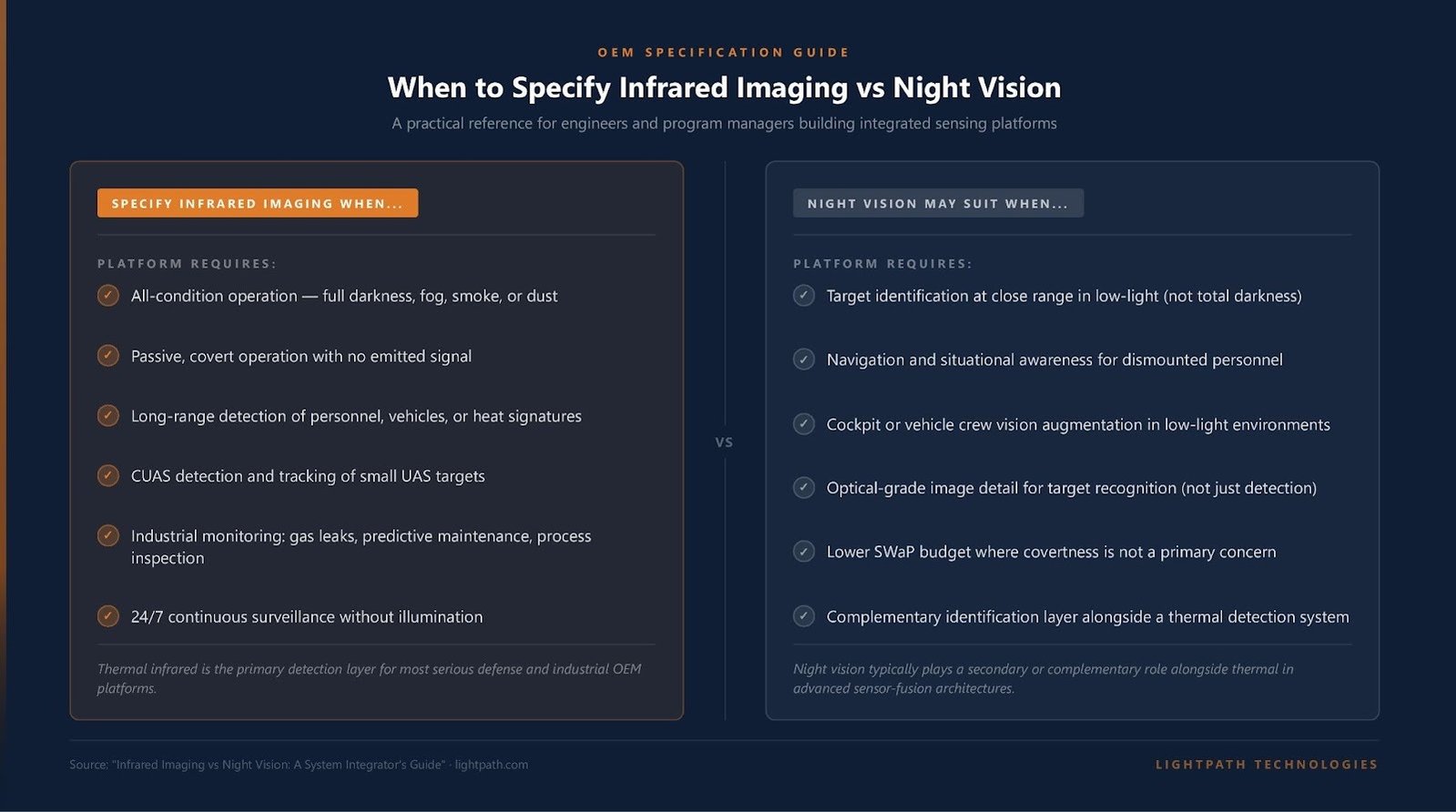
- Infrared imaging detects heat signatures passively and performs in complete darkness, fog, smoke, and adverse weather without any external illumination source — making it the stronger choice for most defense, surveillance, and industrial monitoring applications.
- Night vision amplifies available ambient light and excels at target identification and navigation in low-light conditions, but requires some ambient light and active IR illuminators in full darkness, which can compromise covert operations.
- For OEMs building integrated platforms, the IR imaging comparison goes beyond performance specs — integration complexity, SWaP requirements, supply chain stability, and application environment all shape the right decision.
- Most platforms serving serious defense or industrial use cases end up specifying infrared thermal imaging; night vision plays a complementary role where detailed optical identification is needed alongside detection capability.
For most defense and industrial platform requirements — night operation, fog, smoke, and low-visibility environments — infrared imaging is the specification to build around.
When program managers and engineering teams start evaluating sensing technologies for a new platform, they often run into the same terminology confusion: infrared imaging vs night vision. The two get used interchangeably in product marketing, but they describe fundamentally different technologies with different strengths, different integration profiles, and different ideal use cases. According to recent analysis of the military EO/IR market, infrared systems now account for the largest share of defense sensing applications — a reflection of how central the infrared imaging vs night vision distinction has become to platform specification decisions.
The global thermal imaging market is projected to grow from approximately $5.8 billion in 2025 to over $11 billion by 2035, driven heavily by demand in defense, aerospace, and industrial sectors. That growth reflects something real: the applications that matter most to serious OEMs, including surveillance platforms, CUAS systems, industrial monitoring, and ISR payloads, are increasingly being built around thermal infrared imaging rather than traditional night vision. Understanding why starts with understanding how these two technologies actually work.
What Is the Core Difference Between Infrared Imaging and Night Vision?
These two technologies detect completely different things. Night vision systems amplify available ambient light (moonlight, starlight, infrared LED illumination) and convert it into a visible image. They work on the same basic principle as a visible-light camera, just with much higher sensitivity. The result is an image that looks optical, preserving detail and contrast in low-light environments where the human eye struggles.
Infrared imaging, specifically thermal infrared imaging, doesn't amplify light at all. It detects the heat energy emitted by every object above absolute zero and converts those temperature differences into a visual representation. There is no reliance on any light source whatsoever. A person, a vehicle, a hot pipe, or a gas leak all produce distinct thermal signatures that an infrared sensor reads whether it is noon on a clear day or midnight in a smoke-filled environment.
This distinction has real consequences for platform design. Night vision needs some light to work with, and in total darkness or heavily obscured environments, active IR illuminators are required. Those illuminators emit near-infrared light that is detectable by opposing sensors. Infrared imaging is passive. It emits nothing. For defense applications where covert operation matters, this difference is significant.
The Role of Spectral Bands in IR Imaging
For engineers specifying thermal components, it is also worth knowing that not all infrared imaging is the same. Long-wave infrared (LWIR, 8–14 µm) is the workhorse of the industry, detecting ambient-temperature objects reliably and well-suited for surveillance, perimeter security, industrial monitoring, and most defense platform requirements. Mid-wave infrared (MWIR, 3–5 µm) provides higher sensitivity and is typically used for long-range detection and precision targeting applications. Broadband infrared (BBIR, 2–14 µm) covers the full infrared spectrum and suits applications like optical gas imaging. Understanding LWIR thermal imaging and its applications is a practical starting point for most platform specifications.
Infrared Imaging vs Night Vision: Key Performance Differences
The thermal vs night vision comparison becomes most useful when you map it to real operational conditions. Here is how the two technologies stack up across the criteria that matter most to OEMs and system integrators:
|
Factor |
Infrared Imaging (Thermal) |
Night Vision |
|
Light Dependency |
None — fully passive |
Requires ambient light or active IR illuminator |
|
Total Darkness Performance |
Full capability |
Degraded without illuminator |
|
Fog / Smoke / Dust |
Minimal degradation — IR wavelengths penetrate obscurants |
Significant degradation |
|
Detection vs. Identification |
Excellent for detection; lower image detail |
Better for identification and recognition |
|
Covert Operation |
Passive — emits no detectable signal |
Active illuminators are detectable by sensors |
|
Camouflage Penetration |
Detects heat regardless of visual camouflage |
Subject to visual concealment |
|
Temperature Range |
Wide range, including sub-zero and industrial heat |
Not applicable |
|
Typical Applications |
Surveillance, CUAS, gas leak detection, ISR, predictive maintenance |
Navigation, target identification, cockpit vision |
|
Integration Complexity |
Higher — cooled systems require more SWaP |
Lower — generally more compact |
For most defense and industrial platforms, infrared imaging delivers the broader capability set. Night vision tends to fill a complementary role, providing the image detail needed for target identification once a thermal system has handled detection.
When Does Night Vision Make More Sense Than Infrared Imaging?
Infrared imaging is the stronger specification for most serious applications, but night vision has legitimate advantages worth understanding before finalizing platform requirements.
Night vision systems generally produce images that are easier to interpret for operators doing fine identification work: reading license plates, distinguishing individual features, or navigating complex terrain. Because they amplify visible-light detail, the resulting image more closely resembles what a human operator expects to see. In cockpit applications and ground vehicle navigation, this has historically made night vision the preferred choice.
Night vision equipment also typically has a lower SWaP footprint in its most basic form. For small drone platforms where payload budget is extremely tight, the weight difference can be meaningful. However, advances in uncooled infrared technology have significantly closed this gap. Modern uncooled LWIR modules are compact and power-efficient enough to fit into drone payloads and vehicle-mounted systems that would have been impractical even five years ago.
Where the IR imaging comparison really shifts in favor of thermal is in all-weather and all-condition performance. Night vision fails or degrades in fog, heavy rain, smoke, and strong backlighting. For any platform deployed in serious operational environments, including border surveillance, maritime operations, industrial facilities, or battlefield scenarios, infrared imaging's robustness is the baseline requirement.
How Does the Cooled vs. Uncooled Choice Factor In?
For engineers moving past the infrared imaging vs night vision question and focusing on thermal system design, the cooled versus uncooled decision is the next critical specification point. This choice fundamentally shapes SWaP budget, detection range, and program cost.
Uncooled infrared systems use microbolometer detectors that operate at ambient temperature. They are lighter, lower power, lower cost to procure and maintain, and require no cooldown time before operation. These characteristics make them well-suited for drone integration, vehicle-mounted surveillance, industrial monitoring applications, and most LWIR imaging roles. Their shutterless operation, meaning no interruption to the image stream for recalibration, is particularly valuable in surveillance and tracking platforms where continuous coverage matters.
Cooled systems use cryogenic cooling to reduce detector noise and achieve much higher sensitivity and longer detection ranges. They are heavier, consume more power, and cost more, but they provide performance that uncooled systems simply cannot match for long-range precision targeting, MWIR detection, and other high-end defense applications. The aerospace and defense sector continues to rely on cooled MWIR systems for programs where range and sensitivity are mission-defining requirements. According to coverage from Military Aerospace Electronics, advances in size, weight, power, and cost (SWaP-C) have been the consistent driver pushing both infrared and night vision technologies into more demanding applications, a trend that continues to shape how OEMs approach thermal and optical system design today.
The right choice depends entirely on what the platform needs to do. Selecting an expensive cooled system for a role an uncooled system handles well is a cost and integration burden that serves no one. Conversely, specifying an uncooled system for a long-range targeting role means mission failure.
Where Infrared Imaging Outperforms Night Vision for OEM Platforms
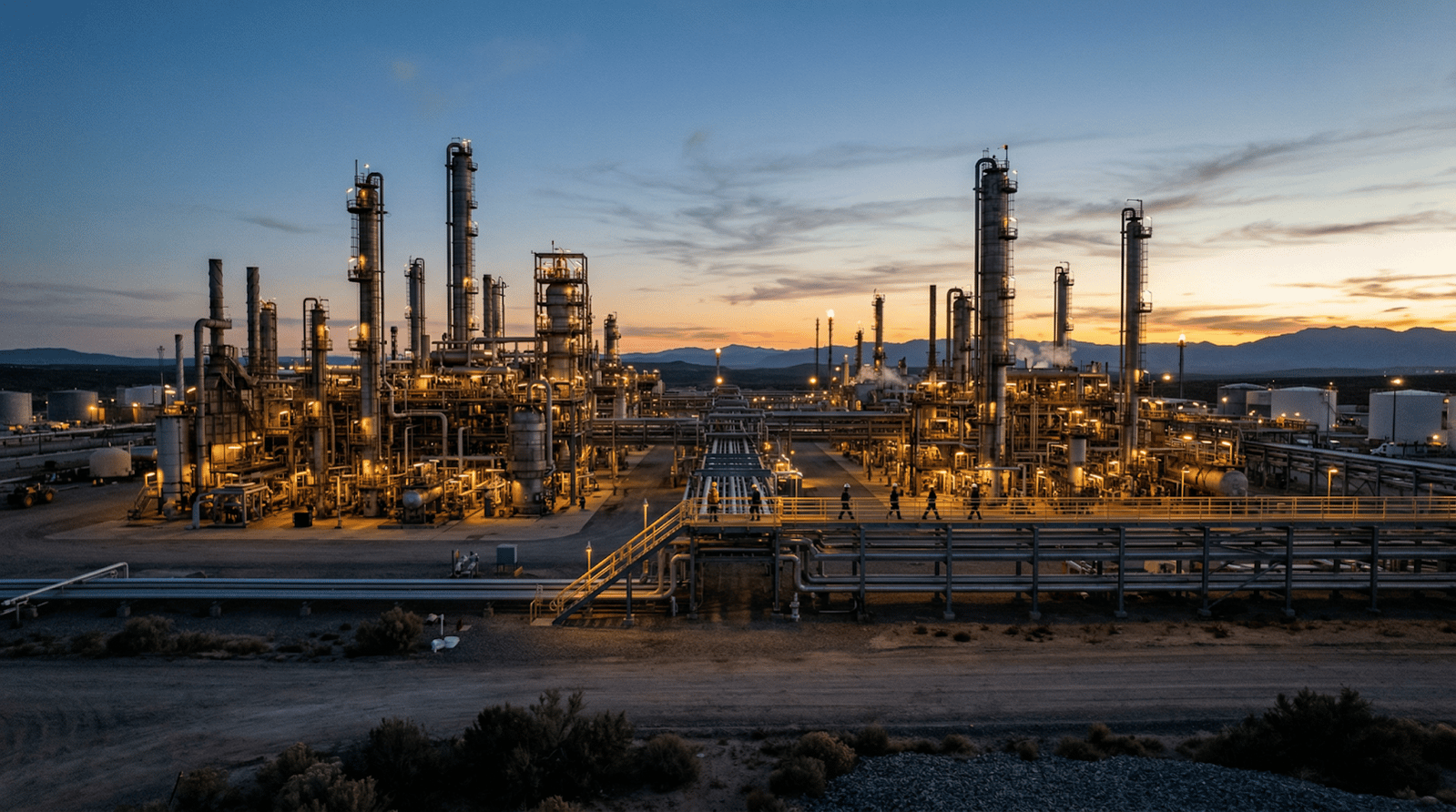
For the OEMs and system integrators building platforms across defense and industrial markets, the practical arguments for infrared imaging as the primary sensing technology are strong. Here is where the advantage is most clear:
Surveillance and Perimeter Security — Infrared imaging detects threats passively at distance, through weather, without illuminating the sensor's position. Night vision requires active illumination for full-darkness performance, which can compromise the installation's covertness and reveal its presence.
Counter-Drone Systems (CUAS) — Detecting small UAS targets against cluttered backgrounds demands technology that responds to heat signatures rather than light reflection. Thermal imaging has become the detection layer of choice in most advanced CUAS architecture.
Drone-Mounted ISR Payloads — Modern uncooled thermal modules provide the SWaP profile needed for drone integration, offering real operational capability at altitudes and ranges where night vision falls short in adverse conditions. IR camera selection for drone platforms requires careful matching of optics, sensor, and mission profile.
Industrial Gas Leak Detection — Certain infrared wavelengths are uniquely effective at detecting gas plumes that are completely invisible to any camera operating in the visible or near-infrared spectrum. This is a capability that has no meaningful night vision equivalent and is driving significant OEM demand in oil and gas and utilities.
Predictive Maintenance — Thermal imaging detects anomalous heat signatures in electrical systems, motors, bearings, and process equipment long before failure occurs. Night vision technology provides no comparable capability here.
What OEMs Should Evaluate When Specifying Either Technology
The IR imaging comparison should not end at the sensor level. For OEMs integrating either technology into production platforms, several additional factors determine program success:
- Optical system quality — Infrared imaging performance depends heavily on the quality of the optics delivering energy to the detector. Lens material, coating design, and cold-shield efficiency in cooled systems are all critical. Inferior optics undermine detector performance regardless of sensor specifications.
- Supply chain stability — Traditional infrared optics have relied heavily on germanium, which faces supply constraints and export restrictions. Proprietary chalcogenide glass alternatives have become strategically important for OEMs needing to reduce material dependencies. Germanium-free optical assemblies are increasingly central to supply chain strategy.
- Vertical integration — Working with a partner who controls the supply chain from raw optical materials through finished camera assemblies reduces the coordination complexity and quality risk that come with managing multiple vendors across a thermal system build.
- Regulatory compliance — High-performance thermal imaging systems, particularly MWIR cooled cameras, fall under ITAR and EAR export regulations. Early understanding of compliance requirements is essential for programs with international deployment requirements.
Infrared Imaging and Night Vision: Better Together?
Some advanced platforms combine both technologies. Hybrid or sensor-fusion systems pair thermal infrared for wide-area detection with higher-resolution optical or near-infrared imaging for identification. This approach is common in airborne ISR, naval EO/IR systems, and high-end CUAS platforms where operators need both all-weather detection range and the target detail of optical imaging. Research from defense and optics publications confirms that thermal imaging in harsh operational environments consistently outperforms visible-spectrum alternatives because longer IR wavelengths pass through atmospheric interference that scatters visible light.
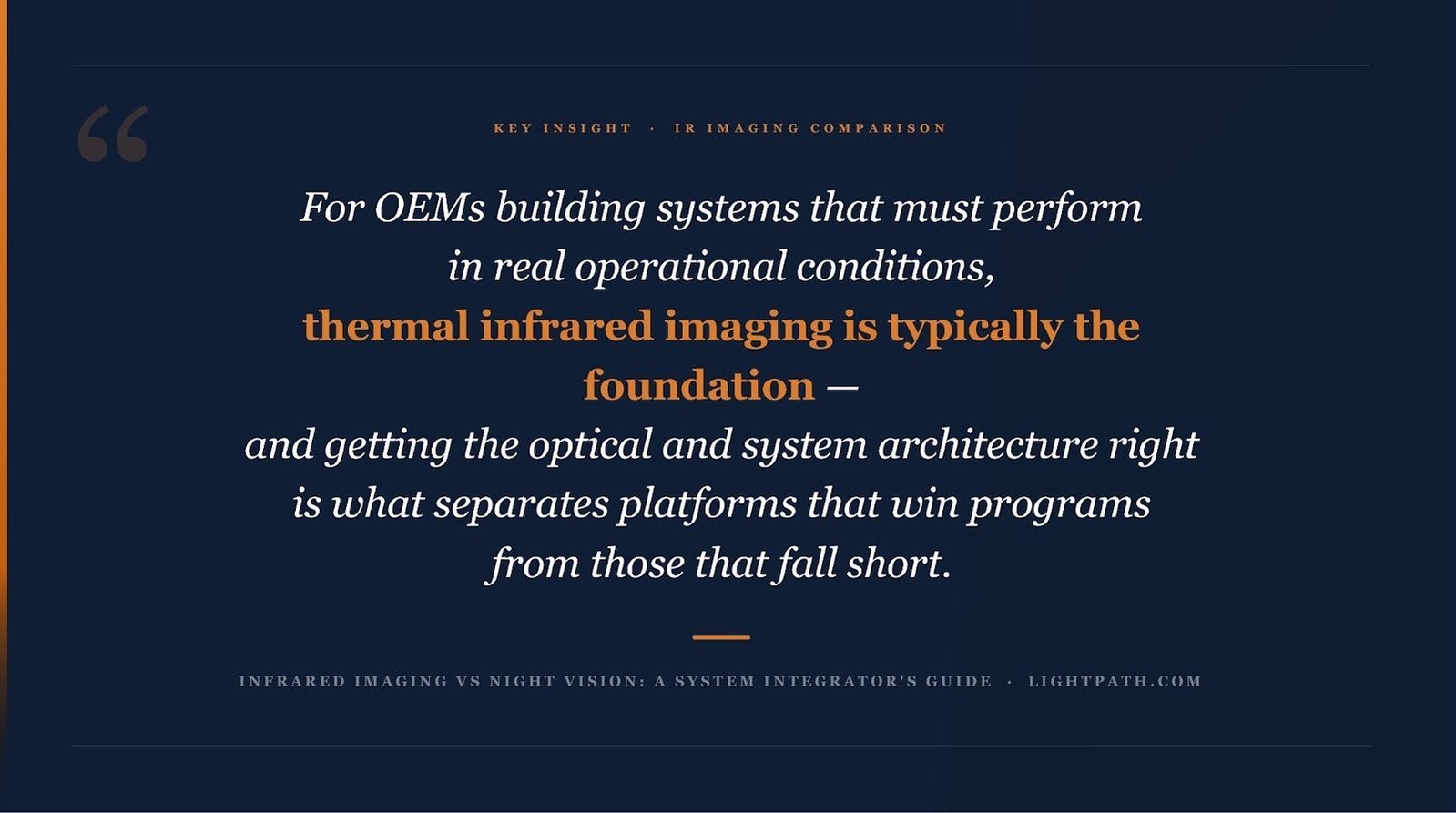
For most OEM programs, the thermal infrared layer is the primary investment and capability driver. The night-vision channel adds identification value at closer ranges in favorable conditions, but does not replace what infrared imaging provides as the detection foundation.
Frequently Asked Questions
What is the main difference between infrared imaging and night vision? Night vision amplifies available ambient light to produce a visible image in low-light conditions. Infrared thermal imaging detects heat energy emitted by objects and creates an image based on temperature differences. Thermal imaging is entirely passive and works in complete darkness, fog, and smoke where night vision struggles or fails. In the thermal vs night vision comparison, these are fundamentally different tools suited to different operational roles.
Which is better for defense applications — infrared imaging or night vision? For most defense applications, thermal infrared imaging is the stronger specification. It detects threats passively at range without any illumination source that could reveal the sensor's position. In the thermal vs night vision decision for defense, night vision plays a complementary identification role but lacks the all-condition reliability serious platforms require. Many advanced defense systems use both in a sensor-fusion architecture.
Can infrared imaging work in daylight? Yes. Thermal infrared imaging is fully passive and works regardless of lighting conditions because it detects heat rather than reflected light. This is one of its key advantages in the thermal vs night vision comparison: night vision is primarily a low-light solution, while infrared imaging performs consistently around the clock.
What is the difference between LWIR and MWIR infrared imaging? LWIR (8–14 µm) is the most common thermal imaging band, well-suited for ambient-temperature detection in surveillance, industrial monitoring, and most defense platforms. MWIR (3–5 µm) provides higher sensitivity and longer detection ranges, typically used in precision targeting and high-performance defense applications where cooled detectors are standard.
Why does optical quality matter in an infrared imaging system? The optics system determines how effectively infrared energy reaches the detector. In a cooled system, cold-shield efficiency affects how much thermal noise enters the optical path. Inferior optics create image artifacts and limit effective range regardless of detector quality. For OEMs, the full optical-to-camera system needs to be designed as an integrated solution to achieve specified performance.
Ready to Specify the Right Imaging Technology for Your Platform?
The infrared imaging vs night vision question is not abstract. It shapes every downstream decision in your platform design: sensor selection, optical system design, power budgeting, integration architecture, and supply chain strategy. For OEMs building systems that must perform in real operational conditions, thermal infrared imaging is typically the foundation, and getting the optical and system architecture right is what separates platforms that win programs from those that fall short.
LightPath Technologies has spent four decades engineering precision optical and thermal imaging solutions for the OEMs and system integrators who build the world's most demanding platforms. From proprietary Black Diamond chalcogenide glass through precision lens assemblies and complete cooled and uncooled camera systems, we deliver vertically integrated solutions engineered to give your platform a genuine competitive advantage. Reach out to our engineering team to discuss how we can support your next program.