

Key Takeaways
Choosing between LWIR vs SWIR comes down to what your system needs to detect and the environment it operates in.
- LWIR (8–14 µm) detects emitted thermal radiation, ideal for passive heat detection, surveillance, and continuous monitoring without external illumination.
- SWIR (0.9–1.7 µm) captures reflected infrared light, excelling at material identification, semiconductor inspection, and imaging through haze.
- Cost and integration differ significantly: uncooled LWIR offers lower lifecycle costs, while SWIR sensors (InGaAs-based) carry higher costs but unlock precision inspection capabilities.
- OEMs should evaluate spectral band selection based on target temperature profiles, environmental conditions, supply chain stability, and program requirements.
The infrared imaging market reached $7.94 billion in 2024 and is projected to surpass $12.78 billion by 2032, according to Fortune Business Insights. That growth is driven by demand across defense, industrial automation, and surveillance sectors where OEMs are actively specifying infrared components for next-generation platforms.
One of the most common decisions these teams face early in program development is which infrared spectral band to build around. The LWIR vs SWIR comparison comes up frequently because these two bands serve fundamentally different purposes, yet both appear in requirements documents across overlapping markets. Getting this decision right at the outset saves development time and reduces integration risk.
For organizations building premium optical and thermal imaging solutions into complex platforms, understanding the practical differences between these two spectral bands is essential for sound engineering and procurement decisions.
What Is the Difference Between LWIR vs SWIR?
The distinction between LWIR and SWIR starts with how each technology interacts with the physical world. These two spectral bands sit at opposite ends of the infrared spectrum and detect fundamentally different types of energy.
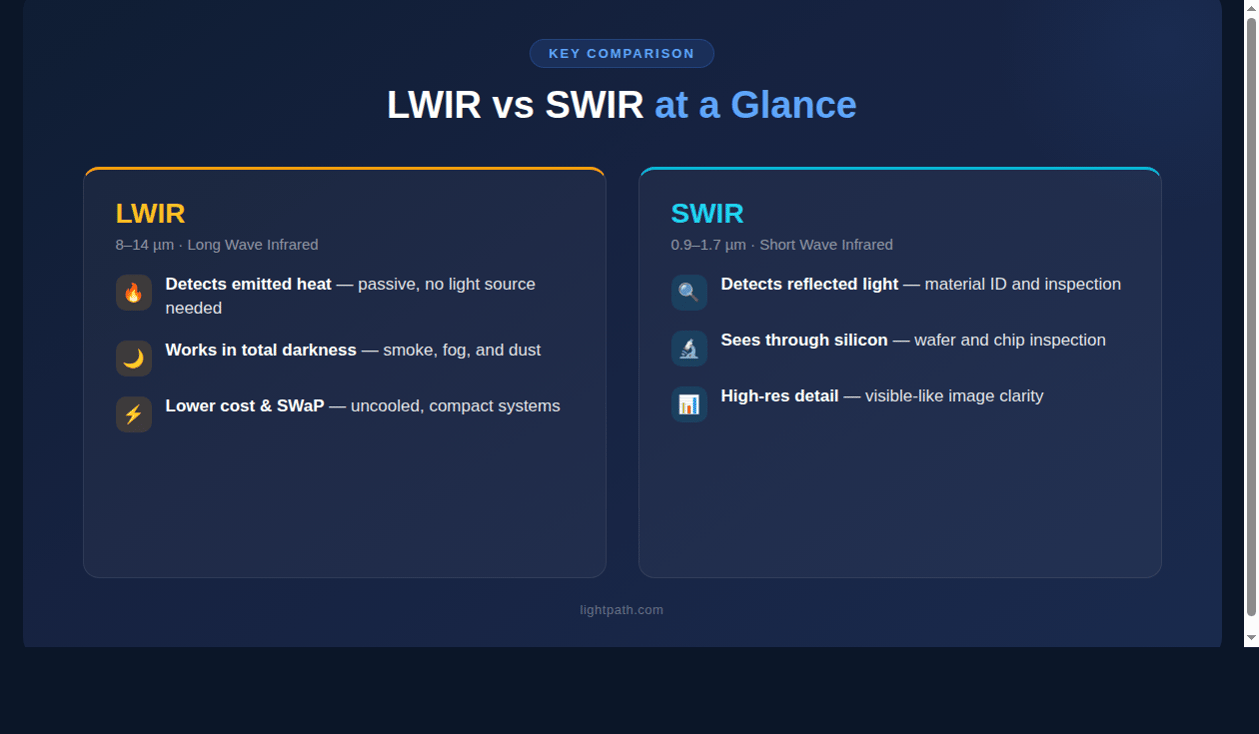
Long wave infrared (LWIR) operates in the 8–14 µm wavelength range and detects thermal radiation emitted by objects based on their temperature. Objects at ambient temperatures (people, vehicles, buildings, machinery) emit most of their thermal radiation in this band. That means LWIR sensors can "see" heat signatures without any external light source, making them effective in complete darkness, through light fog, and in smoke-heavy environments.
Short wave infrared (SWIR) operates in the 0.9–1.7 µm range and detects reflected infrared light, similar to how a visible-light camera works. Despite sharing the "infrared" label, SWIR is not thermal imaging. It does not detect heat. SWIR sensors require an illumination source, whether natural (nightglow or starlight) or artificial (laser illumination). This reflected-light approach gives SWIR sensors the ability to capture high-resolution detail and identify material properties invisible to both visible and thermal cameras.
Think of it this way: LWIR tells you something is hot. SWIR tells you what something is made of. That distinction drives every downstream decision about system design and application fit.
How Do LWIR and SWIR Systems Actually Work?
Understanding the detection mechanism behind each band helps OEMs make better integration decisions. Sensor architecture, cooling requirements, and optical materials differ substantially between LWIR and SWIR, affecting development timelines and total cost of ownership.
LWIR Detection and Architecture
Long wave infrared cameras typically use uncooled detectors that absorb incoming thermal radiation and convert temperature changes into electrical signals. Because they operate at room temperature without cryogenic cooling, uncooled LWIR systems keep size, weight, and power (SWaP) requirements low. This is a significant advantage for aerospace and defense platforms where payload constraints are tight.
SWIR Detection and Architecture
Short wave infrared cameras rely on specialized detector arrays designed to capture reflected light in the SWIR range. These sensors produce images with visible-light-like clarity and contrast, making them valuable for precision inspection tasks. Research published in Applied Sciences found that SWIR imaging achieved 99% accuracy in distinguishing real from artificial objects based on material properties, compared to just 77% with visible spectrum cameras. That kind of material classification performance is why SWIR has become essential for quality control and sorting applications. However, SWIR sensors are generally more expensive to manufacture than their LWIR counterparts and often require thermoelectric cooling, adding complexity and cost.
The optical requirements also differ. SWIR systems can use glass-based optics in some configurations, while LWIR systems require specialized infrared-transmitting materials such as germanium, zinc selenide, or chalcogenide glass. Material selection directly impacts supply chain stability and long-term program costs.
LWIR vs SWIR: Side-by-Side Feature Comparison
When evaluating SWIR vs LWIR for a specific program, a direct comparison of key performance and integration factors helps clarify which band aligns with your requirements.
|
Feature |
LWIR (8–14 µm) |
SWIR (0.9–1.7 µm) |
|
Detection Method |
Emitted thermal radiation (passive) |
Reflected infrared light (active/passive) |
|
Illumination Required |
No |
Yes (natural or artificial) |
|
Primary Detector Type |
Uncooled microbolometer |
InGaAs photodiode array |
|
Cooling Requirement |
Typically uncooled |
Often thermoelectric cooling |
|
Image Characteristics |
Thermal contrast (heat maps) |
High-resolution, visible-like detail |
|
Atmospheric Performance |
Strong in smoke, dust, light fog |
Strong in haze; penetrates glass and silicon |
|
Best For |
Heat detection, surveillance, monitoring |
Material inspection, sorting, identification |
|
Relative System Cost |
Lower (uncooled systems) |
Higher (specialized sensors) |
|
SWaP Profile |
Compact, low-power |
Moderate, depends on cooling |
|
Integration Complexity |
Lower |
Moderate to high |
This comparison highlights why LWIR vs SWIR is rarely an apples-to-apples decision. Each band solves a different problem, and the right choice depends on what your system needs to accomplish.
Which Industries Benefit Most from LWIR vs SWIR?
Both spectral bands serve critical roles across defense, industrial, and commercial sectors, but they dominate different application categories. With infrared imaging adoption accelerating across every major sector, understanding where each technology delivers the most value helps OEMs target the right opportunities.
Where LWIR Leads
Long wave infrared technology is the workhorse of thermal imaging. Its passive detection capability and lower system costs make it the default choice for applications including:
- Defense and surveillance: Perimeter security, border monitoring, counter-UAS detection, and night operations rely heavily on uncooled LWIR cameras for continuous, passive thermal detection. Programs like shipboard EO/IR systems and ground-based surveillance platforms depend on LWIR performance.
- Industrial monitoring: Predictive maintenance for electrical systems, transformer monitoring, and process control. LWIR detects overheating components and insulation failures without interrupting operations.
- Gas leak detection: Optical gas imaging (OGI) cameras operating in specific LWIR sub-bands detect methane and other hydrocarbon emissions at refineries, pipelines, and industrial facilities.
Where SWIR Leads
Short wave infrared technology fills a niche where material identification and high-resolution reflected imaging provide capabilities that thermal bands cannot match.
- Semiconductor inspection: SWIR radiation passes through silicon, making it essential for wafer inspection and quality control in chip manufacturing.
- Food and agriculture: Moisture detection, bruise identification, and sorting applications leverage SWIR's ability to identify material composition differences invisible to other methods.
- Automotive (emerging): ADAS and autonomous vehicle programs are evaluating SWIR for improved object detection in adverse weather where visible sensors fail.
The SWIR imaging market is growing rapidly. According to MarketsandMarkets, the global SWIR market was valued at $631 million in 2024 and is projected to exceed $1 billion by 2029.
Where They Overlap
Some applications benefit from multi-spectral approaches combining both bands into unified sensor suites. Defense platforms conducting ISR missions increasingly integrate multiple spectral bands for comprehensive situational awareness. For these architectures, working with vertically integrated suppliers streamlines procurement and reduces integration risk. This is another reason the SWIR vs LWIR decision should happen early in program planning.

What Should OEMs Consider When Choosing Between LWIR and SWIR?
Selecting the right infrared band is a system-level decision that goes beyond sensor specifications. For OEMs evaluating SWIR vs LWIR, several factors should drive the conversation during early program planning.
Target and Environment
Start with what you need to detect. If your application involves identifying heat signatures from people, vehicles, or equipment at ambient temperatures, long wave infrared is almost always the right call. If you need to identify material composition, inspect through glass or silicon, or capture high-contrast reflected images, SWIR is the better fit.
Environmental conditions matter too. LWIR performs well through smoke and particulates. SWIR handles haze effectively but struggles in dense fog without supplemental illumination.
Integration and SWaP Constraints
For programs where size, weight, and power are primary constraints, uncooled LWIR systems offer meaningful advantages. Drone payloads, man-portable devices, and vehicle-mounted systems benefit from the compact, low-power profiles of uncooled LWIR technology. SWIR systems with cooling requirements carry a weight and power penalty that may be acceptable for fixed installations but challenging for mobile platforms.
Supply Chain and Cost Considerations
Material availability should factor into long-term program planning. LWIR optics have traditionally relied on germanium, which faces supply constraints and price volatility. Alternative materials like chalcogenide glass address this by providing comparable optical performance with more stable sourcing. SWIR sensor manufacturing remains more expensive than LWIR detector production, though costs are declining as adoption grows.
Uncooled LWIR systems generally require less maintenance and have longer operational lifespans. For programs deploying hundreds of sensors across distributed networks, these lifecycle cost differences add up quickly.
Export and Compliance
Both LWIR and SWIR technologies fall under export control regulations, including ITAR and EAR in the United States. The specific classifications differ between spectral bands and performance levels. Programs with international distribution requirements should evaluate export compliance early, as regulatory constraints can limit your addressable market and affect component sourcing decisions.
Frequently Asked Questions
Can LWIR and SWIR be combined in a single system?
Yes. Multi-spectral and dual-band sensor architectures are increasingly common in defense and advanced industrial applications. Combining LWIR's passive thermal detection with SWIR's material identification capabilities provides comprehensive situational awareness, though multi-band systems increase complexity and cost.
Is SWIR considered thermal imaging?
No. Although SWIR falls within the infrared spectrum, it is not thermal imaging. SWIR sensors detect reflected infrared light, functioning more like a visible-light camera than a thermal camera. Only LWIR and MWIR systems detect emitted thermal radiation and qualify as true thermal imaging technologies. This is an important distinction for OEMs specifying infrared systems, because SWIR and thermal imaging serve fundamentally different detection purposes.
Is SWIR the same as near-infrared (NIR)?
Not exactly. While the wavelength ranges partially overlap (NIR is generally 0.7–1.0 µm, SWIR is 0.9–1.7 µm), the detector technologies and applications differ. SWIR sensors using InGaAs arrays offer capabilities beyond what standard silicon-based NIR sensors can achieve, particularly for material identification.
Which infrared band is better for drone applications?
It depends on the mission. For thermal surveillance, search and rescue, and security operations, LWIR is the standard choice due to its passive detection and lower power consumption. For agricultural monitoring or precision inspection, SWIR may provide more actionable data about crop health or material conditions.
How does germanium scarcity affect LWIR system costs?
Germanium supply constraints have historically created cost and availability challenges for LWIR optics. Alternative infrared-transmitting materials such as chalcogenide glass now offer comparable optical performance with more predictable sourcing. OEMs planning production-volume programs should evaluate suppliers offering germanium-free optical solutions to reduce supply chain risk.
Ready to Choose the Right Infrared Band for Your Next Program?
The LWIR vs SWIR decision shapes your program's detection capabilities, integration timeline, and total cost of ownership. For most defense, security, and industrial monitoring applications, long wave infrared provides the passive thermal detection and simpler integration OEMs need. Short wave infrared earns its place in precision inspection, material identification, and emerging automotive applications.
The most effective approach is working with a partner who offers vertically integrated manufacturing from materials through complete camera systems. LightPath Technologies delivers that, with over 40 years of infrared innovation and a partnered approach that helps OEMs win. Start a conversation with their engineering team today.