

Key Takeaways
What an OGI camera can detect depends largely on its optics, so choosing a gas detection thermal camera manufacturer belongs early in program planning.
- Gas-band optics, spectral filters, and cooled MWIR detectors perform best when one team designs them together.
- Refineries, compressor stations, well pads, and pipelines each need a different camera configuration.
- Germanium supply has turned infrared lens material into a design risk, and U.S.-made chalcogenide glass gives OEMs a practical alternative.
- Sending your target gases, deployment model, and regulatory regime up front is the fastest path to a specified system.
If an OGI product is on your roadmap, confirm where the optics and lens material will come from before the design is frozen.
Oil and gas operators face tighter leak detection rules and more documentation for every survey. The energy sector accounts for around 40% of methane emissions from human activity, and regulators in North America and Europe now expect routine leak detection programs backed by records. That pressure lands on the OEMs and integrators who build optical gas imaging (OGI) products, and much of what their cameras can detect comes down to the optics inside them.
This page is for engineering and sourcing teams evaluating a gas detection thermal camera manufacturer for MWIR optics, spectral filters, lens assemblies, or complete camera cores. It covers what that supplier should provide and what to send when you're ready to scope a system.
What Does a Gas Detection Thermal Camera Manufacturer Supply for OGI?
A gas detection thermal camera manufacturer supplies the optical chain that makes gas visible: the infrared material, the gas-band lens and filter, the thermal imaging lens assemblies that couple them to a detector, and often the complete camera. OEMs can buy at whichever level matches their own engineering depth, from raw glass to finished cameras.
|
Supply level |
What you receive |
Best fit when
|
|---|---|---|
|
Infrared glass and blanks |
Lens-grade infrared material |
You grind or mold your own optics |
|
Lens elements, filters, and coatings |
Gas-band filters and coated elements built to print |
You own the optical design |
|
Lens assemblies |
Matched multi-element optics ready to mount |
You build the camera but not the optics |
|
Camera cores and complete cameras |
Cooled MWIR or uncooled LWIR cameras ready to integrate |
You focus on the platform, enclosure, and software |
Gas-Band Optics and Spectral Filtering
The spectral filter and gas-band optics determine which gases a camera can see. Methane and most light hydrocarbons absorb infrared energy in narrow portions of the mid-wave band (3 to 5 µm), and the filter passes those portions while blocking the rest of the spectrum. Coatings on each lens surface then have to transmit as much of that band as possible. Any energy lost in the lens stack reduces the sensitivity available to the detector.
Cooled MWIR Camera Assemblies
Most regulated surveys and longer-range inspections use cooled MWIR cameras. Cooling the detector lowers its noise floor so faint plumes stand out, and a cold shield matched to the lens keeps stray heat from degrading the edges of the image. Teams building MWIR camera systems should ask suppliers how the lens, filter, and cold shield were designed to work together.
Uncooled LWIR for Wide Deployment
Uncooled long-wave cameras, operating from 8 to 14 µm, trade some sensitivity for lower cost, lower power draw, and no cryocooler to service. They suit gases with strong long-wave signatures and programs that need many fixed nodes spread across a facility. Plenty of programs deploy both, with uncooled units providing persistent coverage and cooled units handling confirmation and survey work.
How Do the Optics Affect OGI Camera Sensitivity?
Optics matter so much in OGI because the gas signal is weak. A plume changes the infrared energy reaching the detector only slightly, and each lens surface and filter in the path absorbs or reflects a little of that difference.
Many OGI camera suppliers build cameras from lenses, filters, and detectors bought from different vendors, and that approach works well for standard configurations. It gets harder when a program needs a custom field of view, a new target gas, or a smaller package, since no single vendor is responsible for how the parts perform together. A vertically integrated gas detection thermal camera manufacturer can change the material, filter, coating, and lens design in one engineering cycle.
Some limits come from the scene itself. Low thermal contrast between the gas and its background, high wind, steam, heavy rain, and bright high-radiance backgrounds all reduce what any OGI camera can detect. Better optics extend the range of conditions where a camera performs reliably, and a supplier should be able to document where that range ends. The detection physics are covered in more detail in How MWIR Camera Systems Detect Leaks.
Which Oil & Gas Sites Need Which Camera System?
Refineries and LNG terminals usually call for fixed, broad-coverage optical gas imaging systems, compressor stations need durable continuous monitoring, and well pads and pipelines need compact systems for mobile and aerial surveys. The table shows how each facility type shapes a camera system for oil & gas sites.
|
Site type |
Typical deployment |
Optical priority
|
|---|---|---|
|
Refineries and petrochemical plants |
Fixed monitoring and handheld surveys |
Broad hydrocarbon coverage and sensitivity against cluttered backgrounds |
|
Compressor stations and gas processing |
Fixed continuous monitoring plus surveys |
Long-duty reliability and stable performance across temperature swings |
|
Upstream well pads |
Handheld, vehicle, and aerial surveys |
Compact, lightweight, low-power assemblies |
|
Pipelines and rights-of-way |
Vehicle and aerial platforms |
Long standoff range in a small package |
|
LNG terminals and tank farms |
Fixed perimeter monitoring |
Wide coverage and sealed, weather-resistant optics |
What Makes a Gas Imaging Camera for Refineries Different?
A gas imaging camera for refineries needs broad hydrocarbon coverage, enough sensitivity to separate a plume from cluttered and warm backgrounds, and hazardous-area certification. Refineries combine many compounds, dense piping, and hot surfaces. Certification often drives the schedule as much as the optics do, so confirm which approvals a supplier's design already supports.
Fixed Monitoring at Facility Scale
Fixed cameras need long-duty reliability, optics sealed against dust and moisture, and alert outputs that connect to a site's existing control systems. Those requirements apply whenever a camera system for oil & gas sites has to run around the clock between scheduled surveys. For fenceline and facility-scale layouts, Continuous Methane Monitoring walks through how fixed OGI deployments are typically structured.
How Does Germanium Supply Risk Affect OGI Camera Suppliers?
Germanium supply risk narrows which lens designs OGI camera suppliers can build reliably, and at what cost. Germanium has long been the default infrared lens material. After China banned germanium exports to the United States in late 2024, U.S. imports of germanium metal fell an estimated 67% in 2025, and average prices roughly doubled over the same period. For an OGI product expected to stay in production for years, that kind of policy swing is a sourcing risk worth planning around.
The same federal survey notes that chalcogenide glass has been used as a substitute for germanium in infrared applications. Chalcogenide glass transmits across the infrared wavebands camera designers need and can be molded instead of individually machined. Germanium-free chalcogenide glass produced in Orlando, Florida gives OEMs a domestic option for lenses that would otherwise depend on a constrained material.
What Should You Send an Infrared Gas Camera Supplier to Specify a System?
Start with the requirements that drive the optical design: target gases, deployment, range, and regulations. An infrared gas camera supplier can work from a short, specific brief much faster than from a general request for quotes. The seven inputs below give an engineering team enough to propose a first configuration.
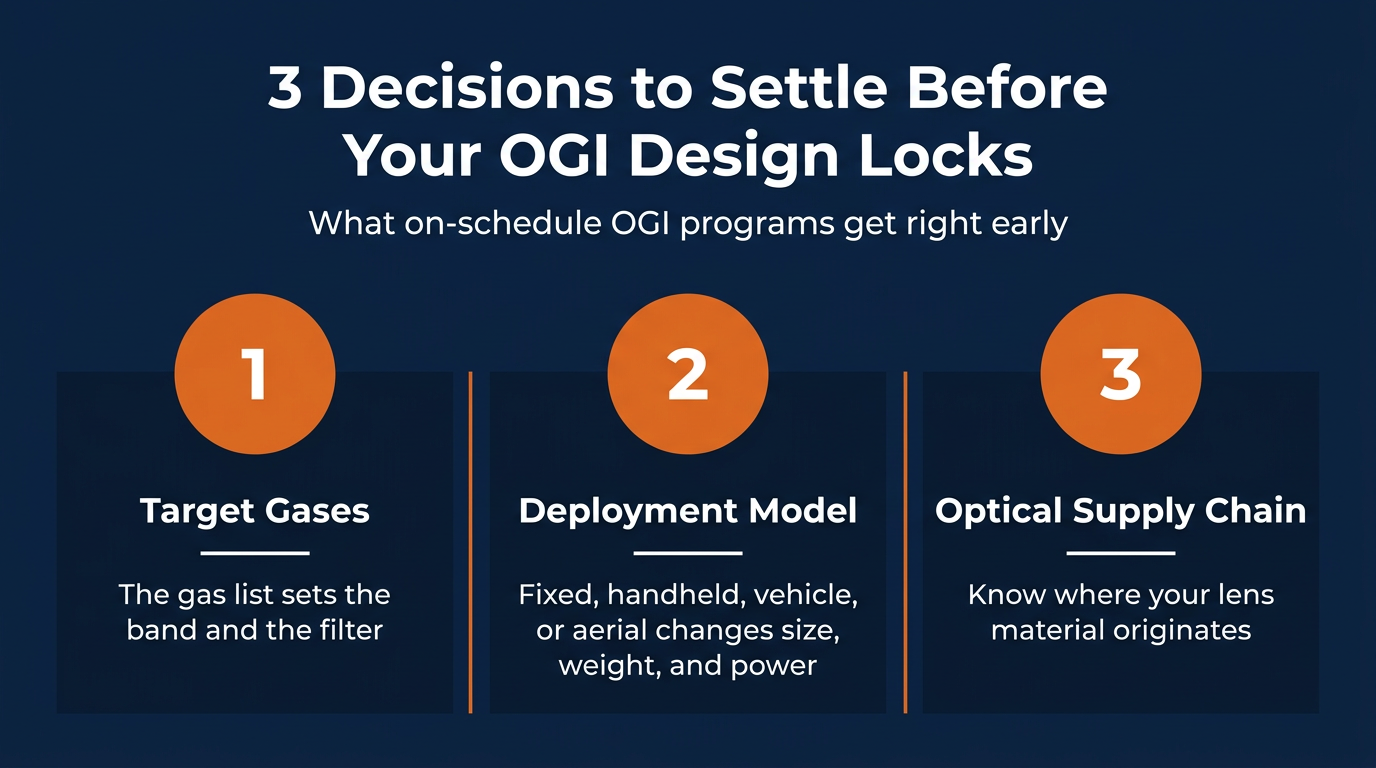
- Target gas list. Name every compound your customers must detect, since the gas list sets the band and the filter.
- Deployment model. Whether a camera system for oil & gas sites is fixed, handheld, vehicle-mounted, or aerial changes size, weight, power, and mounting requirements.
- Standoff distance and field of view. How far and how wide the camera must see determines lens focal length and aperture.
- Environmental and hazardous-area needs. List temperature range, ingress protection, and required hazardous-location approvals.
- Regulatory regime. Note whether the system must support U.S. federal survey protocols, the EU methane regulation, or both. The EU rules require frequent equipment surveys with most leaks repaired within 5 or 15 working days.
- Volumes and timeline. Production rates shape whether custom or off-the-shelf optics make sense.
- Supply-chain constraints. Flag germanium-free, domestic content, or export classification requirements, and ask where the lens material originates.
For a deeper comparison of cooled and uncooled platforms, deployment models, and compliance criteria, see How to Choose an OGI System.

Frequently Asked Questions About OGI Camera Suppliers
A few more questions come up often in early supplier conversations.
Which Gases Can an OGI Camera System Detect?
Cooled MWIR systems detect methane, propane, butane, and many other hydrocarbons and VOCs. Uncooled LWIR systems suit gases such as sulfur hexafluoride and ammonia, and they can image methane at higher concentrations. Because refinery streams are dominated by hydrocarbons and VOCs, a gas imaging camera for refineries is usually built around MWIR.
Should a Gas Detection Thermal Camera Manufacturer Build Custom or Off-the-Shelf Optics?
Custom optics make sense when your program needs a new target gas, a specific field of view, or a smaller package than existing designs allow. Off-the-shelf assemblies work when an existing design already fits your platform. An infrared gas camera supplier that offers both can start from a proven design and modify only what your program requires.
How Should OGI Camera Performance Be Validated?
Ask whether the exact camera configuration you plan to ship has been tested at a certified facility against the applicable federal survey protocol. Get the documented operating range for wind, distance, and thermal contrast in writing, since that range determines where your customers can rely on the system.
Put Engineers Who Build the Optics on Your Next OGI Program
OGI programs tend to stay on schedule when the target gases, deployment model, and optical supply chain are settled early. A gas detection thermal camera manufacturer that designs the optics and builds the cameras can work through all three with your engineering team. LightPath Technologies designs and builds MWIR gas-band optics, filters, lens assemblies, and cooled and uncooled OGI cameras, with custom and off-the-shelf options and manufacturing in the United States and Europe. Both its cooled MWIR and uncooled LWIR OGI cameras had their performance validated at a certified test facility in 2025, in line with the EPA's Subpart OOOOb process. Talk with our OGI engineers to get your system specified.