

Key Takeaways
Aerospace R&D programs are increasingly relying on high speed thermal imaging camera systems to capture data that traditional testing methods miss entirely.
- The thermography NDT market for aerospace reached $1.42 billion in 2024 and is projected to hit $2.76 billion by 2033, driven by demand for faster, more accurate materials testing.
- High frame rate thermal camera technology enables engineers to freeze-frame rapid thermal events like turbine blade rotation and composite curing that occur in milliseconds.
- Cooled infrared detectors remain essential for high-speed aerospace research because uncooled microbolometers lack the response time for fast-moving thermal transients.
- OEMs and system integrators should prioritize vertically integrated partners who control materials, optics, and assembly to reduce supply chain risk across multi-year programs.
Why Aerospace R&D Teams Are Rethinking Thermal Testing
Aerospace materials and components face conditions that would destroy most commercial-grade equipment. Temperatures swing from extreme cold to searing heat within seconds. Composite panels endure repeated stress cycling that creates micro-fractures invisible to the naked eye. Turbine blades spin at thousands of RPM while maintaining tolerances measured in fractions of a millimeter.
Capturing reliable thermal data during these events has always been a challenge, but a high speed thermal imaging camera changes the equation entirely. According to recent aerospace market analysis, the thermography NDT market for aerospace was valued at $1.42 billion in 2024, with thermal imaging in science and testing applications growing at 8.1% annually. That growth reflects a fundamental shift in how aerospace organizations approach thermal imaging solutions for research, development, and quality assurance.
The driving force is straightforward. Aerospace programs are getting more complex, timelines are compressing, and the cost of test failures keeps climbing. R&D teams need imaging systems that capture every thermal event with enough speed and sensitivity to make that data actionable.
How Does a High Speed Thermal Imaging Camera Work in Aerospace Testing?
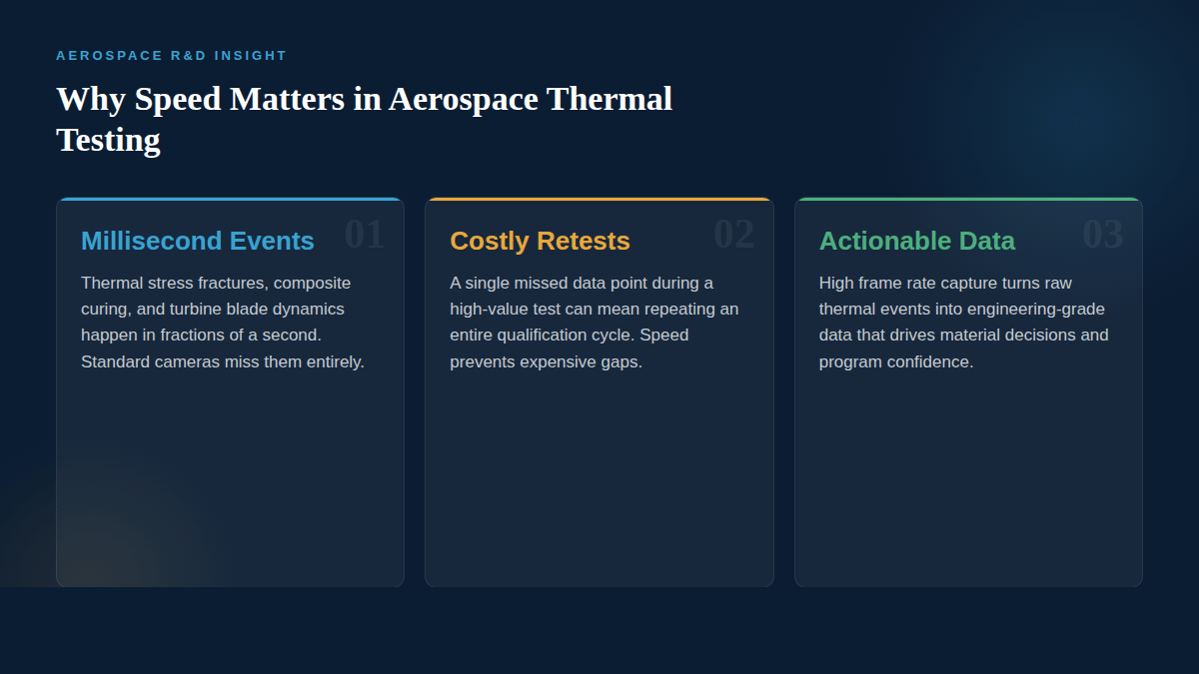
Every object emits infrared radiation based on its temperature. A thermal imaging camera detects that radiation and converts it into a visual temperature map. Standard thermal cameras refresh at 30 to 60 frames per second, which works well for routine inspections. But aerospace R&D events often happen in milliseconds, making standard frame rates completely inadequate.
What Makes "High Speed" Different
A high frame rate thermal camera captures hundreds or even thousands of frames per second, paired with integration times measured in microseconds. This lets engineers freeze-frame thermal events that happen too quickly for standard equipment to register.
The detector technology behind the camera matters enormously for aerospace applications. Cooled photon-counting detectors, typically using Indium Antimonide (InSb), respond to infrared energy almost instantaneously. They operate in the mid-wave infrared (MWIR) band at 3–5 µm, which aligns with peak emissions from high-temperature targets like engines, exhaust systems, and heated test specimens. Uncooled microbolometer-based cameras, while more affordable and widely used for field applications, respond much more slowly because they rely on physical temperature changes in the detector element itself. For R&D environments where thermal imaging in science applications demands precision timing, cooled systems remain the standard.
Cooled vs. Uncooled: Choosing the Right System for R&D
The choice between cooled and uncooled systems is one of the most consequential decisions in any aerospace testing program. Here is how they compare for R&D-specific requirements:
|
Feature |
Cooled (InSb/MCT) Detectors |
Uncooled (Microbolometer) Detectors |
|
Practical frame rate |
100–1,000+ fps (full frame) |
Up to ~60 fps |
|
Integration time |
Microseconds |
Milliseconds |
|
Best for |
Fast transients, stop-motion analysis |
Continuous monitoring, steady-state |
|
Temperature sensitivity |
Higher (detects smaller variations) |
Moderate |
|
SWaP profile |
Larger, higher power draw |
Compact, low power |
|
Typical R&D use |
Turbine testing, ballistic analysis, thermal stress |
Process monitoring, environmental testing |
|
Cost and maintenance |
Higher initial cost, periodic cooler service |
Lower cost, minimal maintenance |
For programs requiring a high speed thermal imaging camera that can stop-motion on rotating turbine blades or capture the thermal signature of a supersonic projectile, cooled detectors are the proven choice. Uncooled systems serve a complementary role in longer-duration monitoring where frame rate is less critical.
What Aerospace R&D Applications Benefit Most from High Frame Rate Thermal Cameras?
The applications for high speed thermal imaging in aerospace R&D are broad, but several areas have seen particularly significant impact.
Thermal Stress Testing of Aerospace Materials
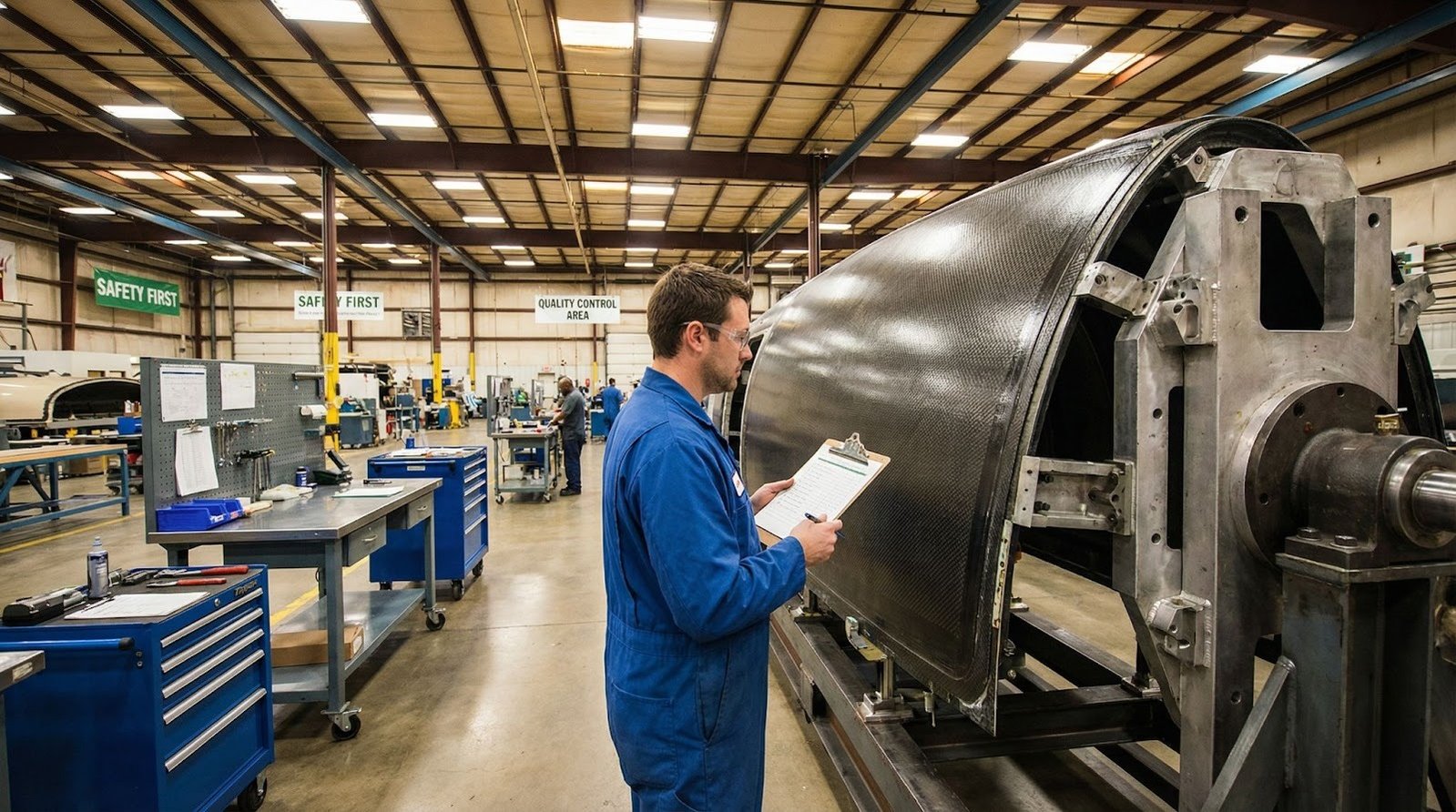
Modern aircraft use carbon fiber reinforced polymers (CFRPs), ceramic matrix composites, and advanced alloys that behave very differently under thermal stress than traditional metals. When these materials undergo rapid temperature cycling during qualification testing, internal defects like delamination, void formation, and micro-cracking generate thermal signatures that appear and disappear within fractions of a second.
A high frame rate thermal camera captures these signatures as they develop, giving engineers a real-time window into material behavior under stress. NASA's Hi-Rate Composite Aircraft Manufacturing (HiCAM) program, for instance, uses infrared cameras during advanced composite fabrication to monitor temperature profiles and ensure consistent material properties. For teams working on aerospace and defense programs with demanding material qualifications, this kind of real-time thermal visibility can be the difference between catching a defect early and discovering it after production has already scaled.
Turbine and Propulsion Component Analysis
Jet engine turbine blades operate at extreme temperatures while rotating at speeds that make direct measurement nearly impossible. A high speed thermal camera positioned to capture blade surfaces during rotation can freeze-frame each blade's thermal profile, revealing hotspots, cooling passage inefficiencies, or coating degradation that would otherwise go undetected.
This type of testing is essential during both development and life-cycle qualification. Engineers need to verify that cooling channels distribute heat evenly, that thermal barrier coatings maintain integrity, and that blade-to-blade temperature uniformity meets specification. Without the speed to stop-motion on individual blades, thermal data becomes blurred and averaged, hiding the very anomalies engineers need to find.
Non-Destructive Testing and Component Validation
Thermal imaging in science and engineering has become a cornerstone of non-destructive testing (NDT) in aerospace. According to the American Society for Nondestructive Testing, infrared and thermal testing methods are now standard for inspecting materials destined for high-temperature aerospace applications.
Active thermography, where an external heat source stimulates the test specimen while a thermal camera records the surface response, is particularly effective for finding subsurface defects in bonded structures and composite panels. When combined with high-speed imaging capability, active thermography reveals how heat flows through a structure at speeds that expose hidden delamination, disbonds, and voids with remarkable clarity.
5 Things to Look for When Sourcing High Speed Thermal Imaging for Aerospace R&D
Not every high-speed thermal camera is suited for aerospace research environments. Program managers and engineering leads evaluating systems for their R&D facilities should consider these factors:
- Detector type and response time. Cooled InSb or MCT detectors provide the microsecond-level integration times that aerospace testing demands. Verify that full-frame performance meets your speed requirements, since some cameras only achieve their highest frame rates by windowing down to a smaller portion of the detector.
- Optical quality and customization. The lens and optical path are every bit as important as the detector. Look for partners who engineer precision optical components matched specifically to your detector and application, rather than relying on generic off-the-shelf optics that may introduce artifacts or reduce performance at high speeds.
- System-level integration support. Aerospace R&D facilities integrate thermal cameras into complex test setups with triggering, data acquisition, and synchronization requirements. Cameras built as complete systems rather than assembled from disparate components perform more reliably in these environments.
- Material supply chain stability. Infrared optics traditionally depend on germanium, which faces well-documented supply constraints and price volatility. For multi-year programs, sourcing from manufacturers who offer germanium-free alternatives like chalcogenide glass provides meaningful supply chain protection.
- Calibration and data integrity. Accurate radiometric data is the entire point of thermal imaging in science and R&D. Ensure your camera partner provides traceable calibration, robust NUC (non-uniformity correction) procedures, and compatible data formats.

How Is the Market for High Speed Thermal Imaging in Aerospace Evolving?
The global thermal imaging market reached an estimated $8.29 billion in 2025, with the aerospace and defense segment accounting for roughly 39% of revenue. Within that, demand for advanced high-speed infrared imaging systems is accelerating as R&D programs grow more sophisticated and regulatory scrutiny around material certification tightens.
Several trends are shaping this evolution:
|
Trend |
Impact on Aerospace R&D |
|
Composite material adoption |
More complex thermal signatures require faster, more sensitive imaging |
|
Digital twin development |
Thermal test data feeds simulation models, requiring higher temporal resolution |
|
Additive manufacturing growth |
3D-printed components need thermal validation during both printing and testing |
|
Supply chain diversification |
Demand for non-germanium optics to reduce program risk |
|
AI-enhanced analysis |
Machine learning applied to high-speed thermal data accelerates defect identification |
The shift toward composite-heavy airframe designs is particularly significant. Leading commercial aircraft now incorporate composites in roughly half of their structural weight, and that trend is accelerating across both commercial and military platforms. Every bonded joint, every cured panel, and every structural repair must be validated, and high-speed thermal cameras provide the most comprehensive non-contact method for doing so.

What Role Does Vertical Integration Play in Thermal Imaging for R&D?
One factor that often gets overlooked in the camera selection process is the importance of vertical integration in the manufacturing partner. When a single supplier controls the raw optical materials, lens design and fabrication, coatings, assembly, and camera integration, the result is a thermal imaging system optimized from the ground up rather than assembled from potentially mismatched parts.
For aerospace R&D programs that span multiple years, this matters practically. Engineering changes happen faster when the optics and camera teams work under the same roof. Quality control is more consistent when every component comes from a single source. And supply chain risk drops dramatically when proprietary materials like advanced chalcogenide glass eliminate dependence on constrained commodities like germanium. The partners who deliver the most value to aerospace R&D teams combine deep optical expertise with manufacturing depth to support programs from prototype through production.
FAQ
What frame rate does a high speed thermal imaging camera need for aerospace testing?
Most aerospace R&D applications require a minimum of 100 frames per second at full detector resolution, with many turbine and ballistic testing scenarios demanding 500 fps or higher. The specific requirement depends on the speed of the thermal event being captured and the level of temporal resolution needed for accurate data analysis.
Can uncooled thermal cameras be used for high-speed aerospace research?
Uncooled microbolometer cameras are limited to approximately 30–60 fps in practice because the detector elements need time to physically change temperature in response to the scene. For high-speed events like thermal stress propagation or rotating component analysis, cooled detectors with microsecond integration times are necessary to capture accurate data.
Why is germanium-free optics important for aerospace thermal imaging programs?
Germanium is the traditional lens material for infrared optics, but it faces supply constraints driven by geopolitical factors and competing demand from semiconductor manufacturing. Multi-year aerospace programs benefit from alternative materials like chalcogenide glass, which delivers comparable optical performance without the supply chain vulnerability that can disrupt production timelines.
Ready to Strengthen Your Aerospace R&D Testing Capabilities?
Aerospace organizations that invest in the right high speed thermal imaging camera systems gain a measurable advantage in testing speed, data quality, and program confidence. Whether your team is validating next-generation composites, qualifying propulsion components, or advancing thermal protection systems, the quality of your imaging directly affects the quality of your outcomes.
LightPath Technologies delivers vertically integrated optical and thermal imaging solutions built for the demands of aerospace R&D. With four decades of engineering expertise and proprietary materials, LightPath provides the precision and reliability that mission-critical testing requires. Connect with our engineering team to discuss how we can support your program.