

Key Takeaways
For OEMs and system integrators, the infrared optics supply chain has become a strategic vulnerability that demands immediate attention.
- China controls more than 70% of the world's germanium supply, and export restrictions have triggered price spikes and procurement uncertainty across defense and industrial programs.
- The FY2026 NDAA requires DOD to eliminate reliance on optical glass sourced from covered nations by 2030, creating hard compliance deadlines for every contractor in the chain.
- Vertically integrated domestic suppliers who manufacture raw materials through finished assemblies offer the most reliable path to reducing program risk and maintaining compliance.
- If your current IR sourcing strategy still depends on foreign-sourced germanium, your program timeline is more fragile than you think.
A July 2025 Government Accountability Office report found that the Department of Defense still lacks meaningful visibility into its supply chain of more than 200,000 suppliers, particularly at the raw materials level. For procurement leaders managing multi-year programs involving infrared and thermal imaging technology, this finding should be a wake-up call. The infrared optics supply chain that supports everything from drone-based ISR systems to shipboard targeting faces compounding pressures: geopolitical export controls, new legislative mandates, rising tariffs, and a chronic shortage of critical raw materials. Programs are being delayed, costs are climbing, and the OEMs that fail to diversify their sourcing strategies are the ones left scrambling when the next disruption hits.
What's Driving Infrared Optics Supply Chain Disruptions?
The supply chain challenges facing IR optics programs today stem from three converging forces.
The Germanium Problem
Germanium has been the go-to material for infrared optics for decades, offering excellent transmission in both the LWIR (8–14 µm) and MWIR (3–5 µm) bands. The problem is where it comes from.
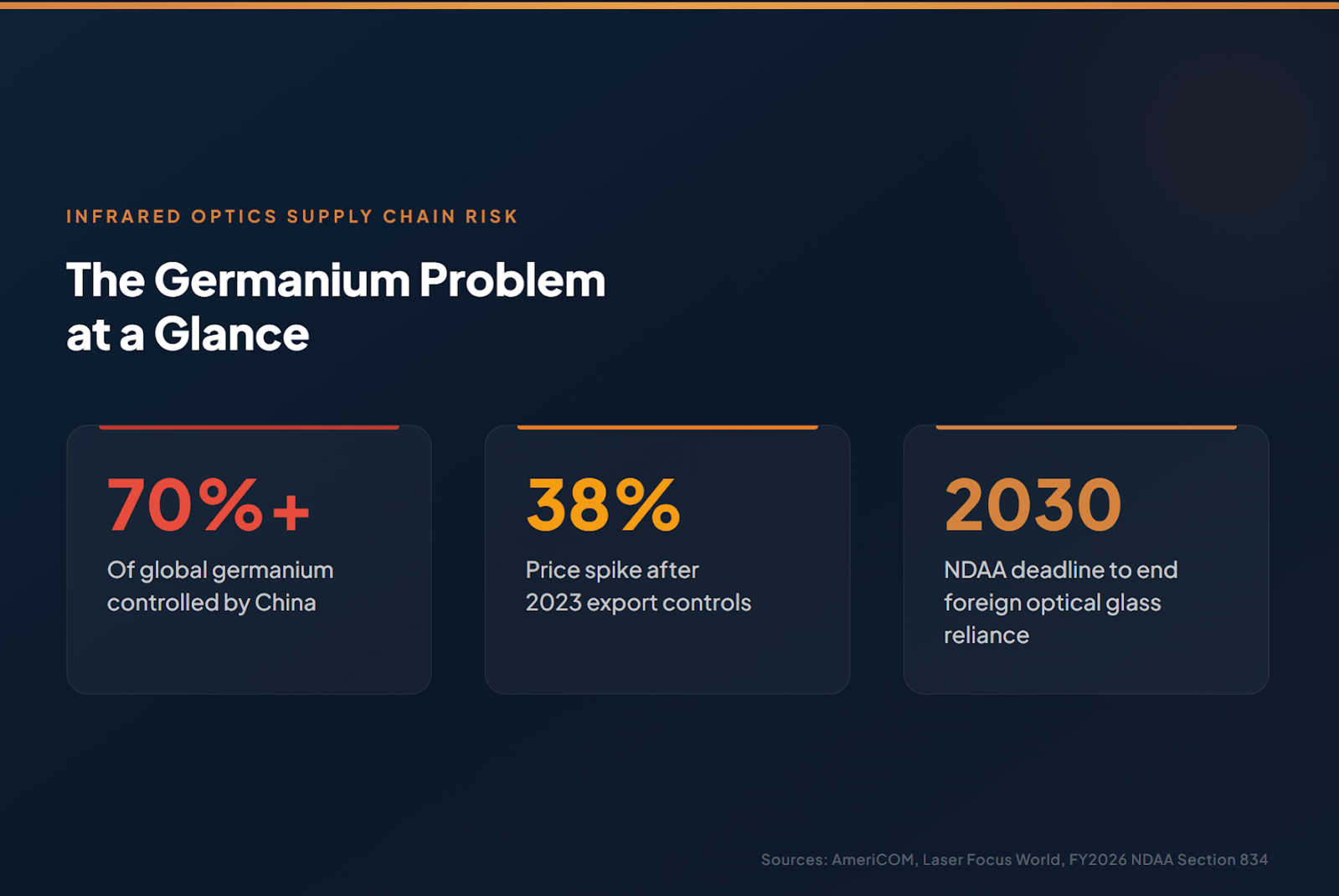
China controls more than 70% of global germanium production, and export restrictions imposed in mid-2023 caused ingot prices to surge by 38% within a year. The U.S. has virtually no domestic refining capacity, having been undercut by subsidized Chinese production over the past two decades. For OEMs building an infrared defense camera platform or a drone surveillance camera system on a multi-year timeline, this creates real procurement risk. You can spec a germanium-based design today and find the material unavailable or twice the price by the time you reach production.
Alternative materials, particularly chalcogenide glass, offer comparable infrared transmission without germanium dependency. Some proprietary formulations now approach germanium's refractive index, making them practical alternatives for many thermal imaging applications without requiring a complete optical redesign.
Geopolitical and Regulatory Pressure
The germanium shortage sits within a broader pattern of critical mineral dependencies that governments are now actively unwinding. Executive Order 14241, signed in March 2025, designated mineral production as a priority area for the Industrial Base Analysis and Sustainment Program. The FY2026 NDAA goes further, directing DOD to expand germanium recycling and assess supply chain vulnerabilities.
Contracts that were compliant two years ago may not be compliant two years from now. Procurement teams that proactively shift toward domestic, NDAA-ready suppliers position their programs for smoother compliance.
Tariff Escalation
The 2025 round of U.S. tariffs imposed significant new duties on imported infrared components, including cooled detectors, optical lenses, and specialized semiconductors. For programs already operating on tight margins, these costs flow directly to the bottom line, making domestically manufactured alternatives increasingly competitive on price alone before you even factor in the risk reduction.
How Do New NDAA Requirements Affect IR Component Procurement?
Section 834 of the FY2026 NDAA represents the most significant legislative action to date specifically targeting the infrared optics supply chain for defense applications. As legal analysts have detailed, it directs the Secretary of Defense to develop and implement a strategy to eliminate DOD's reliance on optical glass and optical systems sourced from covered nations (China, Russia, Iran, North Korea, and Belarus) by January 1, 2030.
What makes this provision particularly impactful is its scope. The restriction covers raw materials such as optical glass itself, meaning that even if your camera assembly is manufactured in the U.S., the germanium lenses inside it could create a compliance issue if the raw material originated from a covered nation.
Section 1412 reinforces this direction by requiring expanded recycling programs for optical-grade germanium and mandating reports on stockpile shortfalls. The message from Congress is clear: the defense industrial base needs to move away from adversarial sourcing for critical optical materials.
|
NDAA Provision |
What It Requires |
Deadline |
|
Section 834 |
Strategy to eliminate reliance on optical glass from covered nations |
January 1, 2030 |
|
Section 1412 |
Expand germanium recycling programs; report on stockpile shortfalls |
Ongoing |
|
Section 832 |
Expedited acceptance and qualification of critical readiness items |
Immediate |
For contractors supplying an infrared defense camera to a DOD program, compliance now requires documented material provenance throughout the entire supply chain, from raw glass to finished assembly.

What Should OEMs Evaluate in an Infrared Optics Supply Chain Partner?
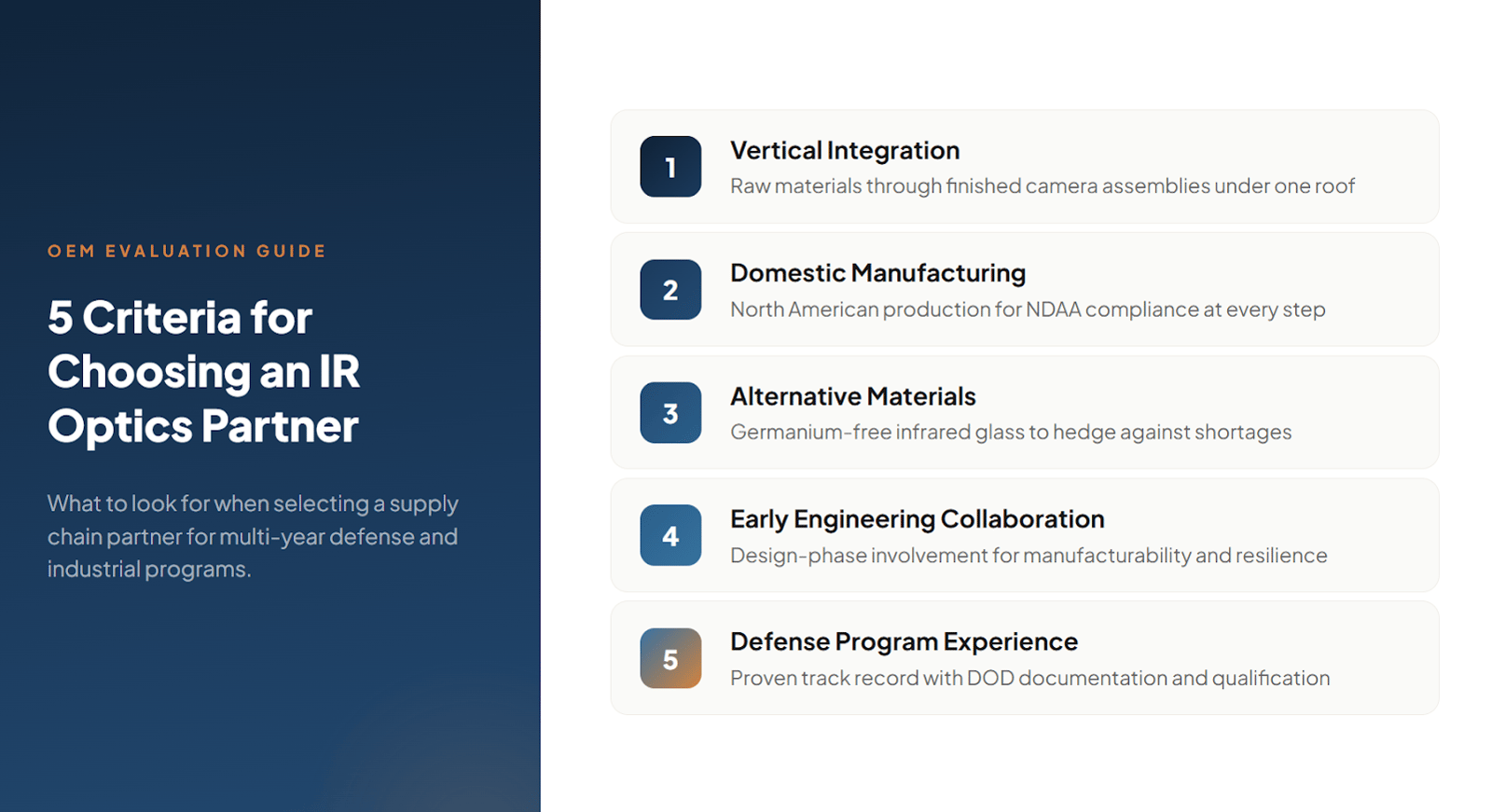
Selecting the right optical supplier for a multi-year program has always mattered, but the current environment has raised the stakes. Here are five criteria that separate resilient partners from risky ones.
1. Vertical Integration from Materials to Finished Systems. Suppliers who control the entire production chain, from raw infrared glass through lens fabrication, coating, assembly, and camera integration, dramatically reduce your coordination risk. When one company owns every step, you eliminate cascading delays that occur when a Tier 3 material supplier misses a delivery. For programs requiring a drone surveillance camera or an ir camera for drone applications with tight SWaP constraints, this integration is particularly valuable.
2. Domestic Manufacturing with NDAA Compliance. Ask where the glass is melted, where the lenses are ground and polished, where the coatings are applied, and where final assembly happens. A supplier with North American manufacturing from materials to finished product eliminates compliance uncertainty.
3. Alternative Material Capabilities. Suppliers who offer proprietary germanium-free infrared glass give you a built-in hedge against material shortages and price volatility. The best partners have already invested in developing and qualifying these alternatives, so you are not paying for R&D time on your program schedule.
4. Engineering Collaboration from Design Phase. The earlier an optical supplier is involved in your system design, the more efficiently they can optimize for manufacturability, cost, and supply chain resilience. Partners who engage at the requirements phase consistently deliver better outcomes.
5. Proven Defense Program Experience. Suppliers who already participate in major defense programs understand the documentation, quality control, and environmental testing requirements. This experience translates into fewer surprises during qualification and production.
How Does Single-Source vs. Multi-Vendor Sourcing Compare?
When structuring your infrared optics supply chain, the choice between a single vertically integrated partner and a multi-vendor approach has real implications for risk and efficiency.
|
Factor |
Vertically Integrated Partner |
Multi-Vendor Approach |
|
Lead Time |
Shorter; no inter-vendor coordination |
Longer; dependent on slowest supplier |
|
NDAA Compliance |
Single audit trail for material provenance |
Must verify compliance at every tier |
|
Quality Control |
Unified QC from raw material to finished system |
Potential inconsistencies between vendors |
|
Cost Predictability |
More stable; less spot market exposure |
Subject to individual vendor fluctuations |
|
Design Flexibility |
Optimized for available materials and processes |
Constrained by catalog offerings per vendor |
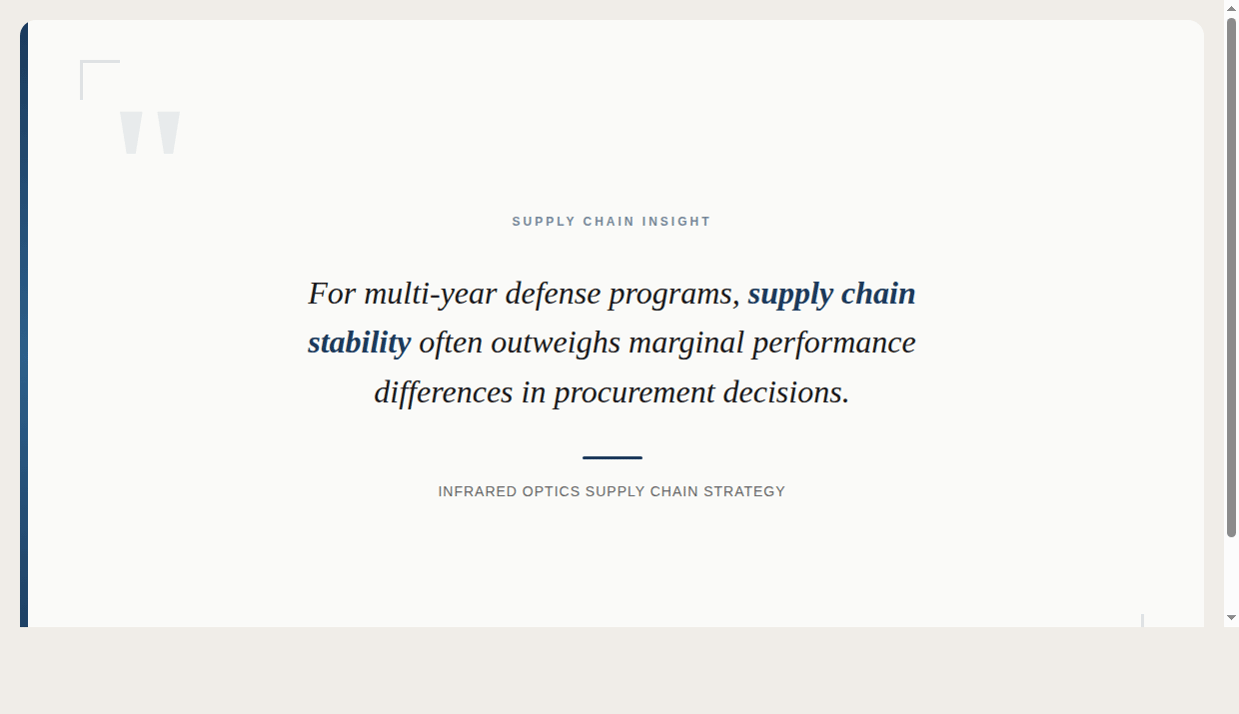
For most defense and aerospace thermal imaging programs, the vertically integrated model offers clear advantages when the partner controls proprietary materials and maintains domestic manufacturing.
How Are Drone and Defense Programs Adapting Their Procurement?
The rapid expansion of drone-based ISR and counter-drone programs has put new pressure on the infrared optics supply chain. Program volumes are increasing, deployment timelines are compressing, and platforms demand optical systems that meet strict size, weight, and power requirements.
The Drone Surveillance Camera Boom
Border security expansion is driving demand for hundreds of additional surveillance towers, each requiring integrated thermal imaging. The ir camera for drone platforms used in these systems must deliver reliable LWIR or broadband infrared performance in a compact package. Programs specifying a drone surveillance camera with infrared capability increasingly favor suppliers who can deliver complete optical assemblies, reflecting hard-won lessons from programs that experienced integration issues when assembling components from separate vendors.
Defense Camera Programs Under Pressure
Major defense programs including shipboard EO/IR systems, ground vehicle thermal sights, and CUAS platforms face simultaneous pressure to accelerate procurement while meeting tightening compliance requirements. The infrared defense camera market is growing as modernization programs move from development to production, yet the supply base capable of delivering NDAA-compliant, domestically manufactured IR camera systems remains small. OEMs who lock in relationships with qualified suppliers early gain a significant advantage.
Industrial Monitoring and Gas Imaging
Defense is not the only sector affected. Industrial OEMs building optical gas imaging systems and predictive maintenance platforms face similar supply chain pressures. While NDAA compliance may not apply directly, the same germanium availability issues and tariff impacts affect cost and delivery for industrial thermal imaging systems. Smart industrial OEMs are adopting the same diversification strategies as their defense counterparts.
Frequently Asked Questions
Why is germanium availability a concern for infrared optics programs?
China controls over 70% of global germanium production, and export restrictions since 2023 have caused significant price volatility. The U.S. lacks domestic germanium refining capacity, creating a strategic vulnerability for any IR program dependent on germanium-based lenses. Alternative infrared glass materials offer a practical path to reducing this dependency.
What does the FY2026 NDAA mean for IR optics procurement?
Section 834 directs DOD to eliminate reliance on optical glass from covered nations by January 1, 2030. This applies to raw materials, so even a domestically assembled system could be non-compliant if its optical glass originated from a covered source. Contractors should begin verifying material provenance now.
How do vertically integrated suppliers reduce program risk for ir camera for drone applications?
Vertically integrated manufacturers control every step from raw infrared materials through finished assemblies. For drone programs with tight SWaP requirements, this eliminates coordination delays between vendors, ensures consistent quality, and provides a single compliance audit trail for NDAA requirements.
Build a Resilient IR Sourcing Strategy with LightPath
The procurement landscape for infrared optics is not returning to "normal." Germanium constraints, NDAA mandates, and tariff pressures are structural shifts that will define the market for years. OEMs that act now to partner with vertically integrated, domestic manufacturers will enjoy shorter lead times, more predictable costs, and cleaner compliance records.
LightPath Technologies offers the kind of partnership that today's defense, aerospace, and industrial programs demand. With proprietary Black Diamond chalcogenide glass, in-house manufacturing from raw materials through finished camera systems, and four decades of defense program experience, LightPath helps your programs stay on schedule and on budget. Start a conversation with our team today to discuss how we can strengthen your next program.