
Key Takeaways
Thermal imaging aerospace defense applications are accelerating as global military spending reaches historic levels, making supplier selection one of the most consequential decisions for OEM program success.
- Global military expenditure hit $2.7 trillion in 2024, with thermal imaging procurement growing across ISR infrared systems, counter-drone platforms, and ground vehicle programs.
- Supply chain resilience and NDAA compliance are now as important as performance specifications when evaluating defense thermal cameras and imaging partners.
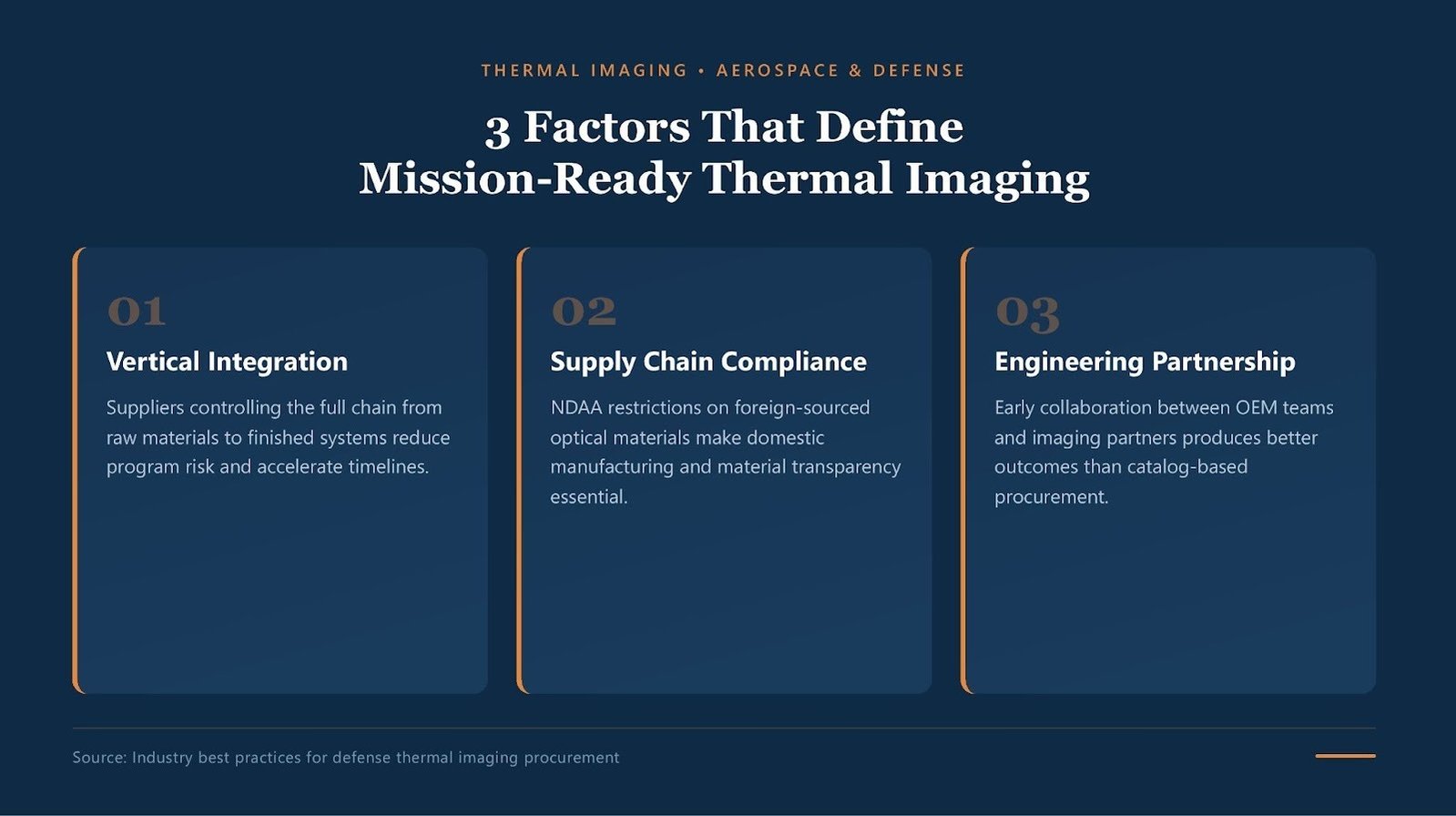
- Vertically integrated manufacturers that control everything from raw materials to finished camera systems reduce program risk and accelerate delivery timelines.
- Early collaboration between OEM engineering teams and imaging partners consistently produces better outcomes than catalog-based procurement approaches.
If your next defense program depends on thermal imaging, this guide covers the strategic and procurement factors that separate successful platform builds from costly delays.
Defense budgets worldwide are climbing at a pace not seen in decades. According to SIPRI's 2024 analysis, global military expenditure reached $2.7 trillion last year, a 9.4% year-over-year increase driven by escalating geopolitical tensions across Europe, the Indo-Pacific, and the Middle East. For aerospace and defense organizations building the next generation of surveillance, targeting, and reconnaissance platforms, that spending surge translates directly into growing demand for reliable thermal imaging aerospace defense solutions that perform in environments where failure carries serious consequences.
Program managers, engineering leads, and procurement professionals navigating this market face a challenge that goes beyond comparing sensor specifications. Selecting the right thermal imaging partner for a multi-year defense program involves evaluating supply chain stability, regulatory compliance, manufacturing depth, and engineering support. This guide covers the key priorities experienced aerospace and defense teams are weighing as they build procurement strategies for ISR infrared systems, surveillance platforms, and integrated defense programs.
Why Is Thermal Imaging Aerospace Defense Demand Growing So Fast?
The expansion of thermal imaging across defense applications reflects a shift in how modern militaries approach battlefield awareness, border protection, and threat detection. Thermal sensors have moved from specialized equipment to essential components integrated across nearly every category of defense system.
NATO member nations are increasing defense spending aggressively, with a record number of members meeting the alliance's 2% GDP spending guideline last year. Counter-drone programs have emerged as a top procurement priority, with the Department of Defense releasing a formal strategy for countering unmanned systems in December 2024. Demand for persistent surveillance along contested borders and maritime routes continues expanding, with thermal imaging serving as the backbone of many of these systems.
For OEMs and system integrators, defense customers now expect more capable thermal systems, faster delivery, and supply chain transparency as baseline requirements.
What Applications Are Driving Thermal Imaging Aerospace Defense Investment?
The range of defense programs incorporating thermal imaging has broadened significantly over the past several years. Understanding where investment is flowing helps OEMs and integrators align their platform development with customer priorities.
ISR and Surveillance Platforms
Intelligence, Surveillance, and Reconnaissance remains the largest application category for defense thermal imaging. Modern ISR infrared systems require imaging capabilities that operate continuously across day and night cycles, through adverse weather, and across detection ranges that legacy systems could not achieve. Airborne ISR payloads, shipboard electro-optical/infrared (EO/IR) turrets, and ground-based surveillance towers all depend on thermal imaging technology optimized for their specific operational profiles.
Counter-UAS and Drone Defense
Counter-Unmanned Aircraft System (CUAS) programs represent one of the fastest-growing procurement categories. These platforms rely on thermal detection to identify, track, and engage small unmanned aircraft that may evade radar. The imaging systems must deliver fast frame rates, reliable detection of low-contrast targets, and seamless integration with tracking subsystems.

Vehicle and Dismounted Systems
Ground vehicle platforms continue incorporating thermal imaging for driver vision enhancement, weapon sighting systems, and situational awareness. Man-portable thermal devices serve infantry and special operations units requiring lightweight, rugged imaging that operates for extended periods on limited battery power.
Key Defense Thermal Imaging Applications at a Glance
|
Application Area |
Typical Platform |
Key Imaging Requirement |
Procurement Priority |
|
ISR / Surveillance |
Airborne, Shipboard, Fixed |
Long-range, all-weather detection |
Sensor reliability, data output |
|
Counter-UAS |
Ground-based, Mobile |
Fast target acquisition |
Frame rate, integration speed |
|
Ground Vehicles |
Armored, Tactical |
Ruggedized, vibration-resistant |
Environmental durability |
|
Dismounted / Infantry |
Handheld, Helmet-mounted |
Lightweight, low power draw |
SWaP optimization |
|
Maritime / Naval |
Shipboard EO/IR |
Corrosion resistance, range |
Environmental sealing |
What Should OEMs Evaluate Beyond Technical Specifications?
It is tempting to start supplier evaluation by comparing resolution, sensitivity, and detection range on a spec sheet. Those metrics matter, but experienced program managers know that defense thermal cameras selected purely on paper specifications often create integration challenges and timeline risk that erode whatever performance advantage the numbers promised.
Here are the factors that increasingly separate successful defense thermal imaging programs from those that encounter costly delays.
Manufacturing Depth and Vertical Integration
Suppliers that control the full manufacturing chain from raw optical materials through lens fabrication, coatings, assembly, and final camera production offer meaningful advantages. When a single partner manages the entire value chain, engineering changes propagate faster, quality issues get resolved at the source, and program managers deal with one accountable organization rather than coordinating across multiple vendors.
Supply Chain Security and Material Sourcing
Recent legislation, including provisions in the FY2026 National Defense Authorization Act, has placed new restrictions on sourcing optical materials from certain foreign nations. The NDAA specifically added germanium to the list of restricted critical materials that cannot be sourced from adversary nations, a significant development for infrared optics procurement. Programs that rely on germanium-dependent suppliers may encounter cost volatility and compliance hurdles that could have been avoided by specifying alternative materials earlier in the design process.
Procurement teams are increasingly asking suppliers to document material origins, manufacturing locations, and compliance readiness as part of proposals. Partners that demonstrate secure, domestically sourced supply chains earn credibility in competitive evaluations.
Ruggedization and Environmental Qualification
Defense applications demand systems designed from the ground up for harsh operational environments. Ground vehicle systems face continuous vibration, dust, and temperature extremes. Naval applications introduce saltwater corrosion. Airborne platforms create unique thermal management challenges. Systems meeting MIL-STD environmental testing standards and carrying appropriate IP ratings provide the documentation that defense customers require.
How Are Compliance Requirements Reshaping Thermal Imaging Procurement?
Regulatory compliance has evolved from a checkbox exercise into a strategic procurement consideration that influences supplier selection, program timelines, and system architecture decisions. For teams developing ISR infrared systems and other mission-critical platforms, understanding the regulatory landscape early prevents costly surprises downstream.
The FY2026 NDAA's provisions on optical material sourcing represent a significant shift. By requiring the Department of Defense to decouple from certain foreign sources of optical glass and infrared materials by 2030, the legislation creates urgency for programs in development. Given that defense EOIR systems typically take five to ten years from design through deployment, programs entering development today must address sourcing compliance immediately.
Export control regulations, including ITAR and EAR restrictions, add complexity. Thermal imaging systems exceeding certain resolution, frame rate, or sensitivity thresholds face export controls that can limit international sales and extend licensing timelines. Experienced program teams evaluate these regulatory implications during initial sourcing rather than discovering constraints during commercialization.
|
Compliance Area |
Key Requirement |
Impact on Procurement |
|
NDAA Material Sourcing |
Decouple IR materials from covered nations by 2030 |
Requires supplier transparency on material origins |
|
ITAR / EAR Export Controls |
Restrictions on resolution, frame rate, sensitivity |
Limits international market access for controlled systems |
|
MIL-STD Environmental |
Shock, vibration, temperature, humidity testing |
Validates system performance in operational conditions |
|
Cybersecurity (CMMC) |
Data protection across defense supply chain |
Affects supplier qualification and onboarding timelines |
5 Priorities for Procurement Leaders Evaluating Defense Thermal Cameras
Procurement professionals and program managers evaluating thermal imaging partners for ISR infrared systems, surveillance platforms, and other aerospace and defense programs are balancing an increasingly complex set of requirements. Based on how leading programs approach supplier evaluation, here are five priorities that consistently correlate with successful outcomes.
1. Demand Full Supply Chain Visibility
Ask potential partners to document where their raw materials originate, where manufacturing occurs, and how they ensure compliance with current and upcoming sourcing restrictions. Suppliers that proactively provide this information demonstrate the kind of transparency defense customers increasingly expect.
2. Prioritize Engineering Collaboration Over Catalog Selection
Defense programs rarely succeed by selecting catalog products and hoping they fit. The most effective partnerships involve early engineering collaboration where the imaging partner works alongside the OEM team from requirements definition through testing. This collaborative approach surfaces integration challenges early and produces systems optimized for the specific platform.
3. Evaluate Total Program Cost, Not Unit Price
The lowest-price imaging module often generates the highest total program cost once integration engineering, qualification testing, and lifecycle support are factored in. Experienced procurement teams evaluate suppliers on total cost of ownership, including engineering support and documentation that reduce downstream expenses.
4. Assess Manufacturing Location and Capacity
Domestic or allied-nation manufacturing provides compliance advantages and reduces lead times. Beyond location, evaluate whether the supplier has the production capacity to support your program volume without creating bottlenecks during ramp-up.
5. Confirm Long-Term Lifecycle Support Commitments
Defense programs operate on long timelines. The imaging partner you select today needs to support your system through production, deployment, and potential upgrades spanning a decade or more. Evaluate suppliers on their track record with long-term defense programs and their willingness to formalize support commitments in supply agreements.
What Role Does Material Innovation Play in Defense Thermal Imaging?
Material science has become a competitive differentiator in thermal imaging aerospace defense applications, and not only because of regulatory pressure. The availability, cost, and performance characteristics of infrared optical materials directly influence what OEMs can achieve in system design. Traditional germanium optics deliver excellent infrared performance, but supply constraints and geopolitical factors have introduced cost volatility and sourcing uncertainty that complicate long-term program planning.
Alternative materials, particularly chalcogenide glass formulations, have matured to the point where they deliver comparable optical performance without germanium's supply chain risks. Manufacturers that produce proprietary optical materials in-house can offer both the technical performance and the supply security that defense programs require.
The intersection of materials innovation and procurement strategy is increasingly relevant for ISR infrared systems, CUAS platforms, and any program where long production runs require stable, predictable component sourcing over multiple years.
Frequently Asked Questions
What is the difference between cooled and uncooled defense thermal cameras?
Cooled thermal cameras use cryogenically cooled detectors that provide superior sensitivity and longer detection ranges, making them well-suited for advanced targeting and long-range ISR missions. Uncooled systems operate at ambient temperature, offering lighter weight, lower power consumption, and reduced maintenance. They work well for surveillance, vehicle-mounted applications, and platforms where SWaP constraints are a primary consideration.
Why does vertical integration matter when selecting a thermal imaging partner?
Vertically integrated manufacturers control the full production chain from raw optical materials through finished camera assemblies. This gives program managers a single accountable partner, reduces coordination complexity, accelerates engineering changes, and provides greater supply chain stability for multi-year defense programs.
How does the NDAA affect thermal imaging procurement for defense programs?
The FY2026 NDAA includes provisions requiring the DoD to reduce dependence on certain foreign sources for optical glass and infrared materials by 2030. Because defense EOIR systems have long development cycles, programs entering design today should already be evaluating suppliers based on material sourcing compliance and domestic manufacturing capabilities.
What does SWaP mean in the context of defense thermal cameras?
SWaP stands for Size, Weight, and Power, referring to the physical and electrical constraints platform designers must manage. Especially for drone payloads, dismounted equipment, and vehicle-mounted systems, minimizing SWaP while maintaining imaging performance is a critical design challenge that influences technology selection.
Build Your Next Defense Platform with Confidence
Thermal imaging aerospace defense programs succeed when OEMs and their imaging partners share a commitment to engineering depth, supply chain transparency, and long-term collaboration. The regulatory environment and technology landscape all point toward a future where the choice of thermal imaging partner becomes increasingly consequential.
For over 40 years, LightPath Technologies has partnered with aerospace, defense, and industrial leaders to deliver premium optical and thermal imaging solutions built for mission-critical performance. With vertically integrated manufacturing, proprietary Black Diamond™ chalcogenide glass technology, and an engineering team that collaborates from concept through production, LightPath provides the depth and reliability that defense programs demand. Connect with our team to discuss how we can help you build systems that give your program a competitive edge.