
Key Takeaways
The germanium supply chain is no longer a stable foundation for multi-year defense and aerospace programs.
- China is the dominant global producer of germanium, and its export controls created a structural supply crisis that has kept prices well above historical averages through 2025 and into 2026.
- Chalcogenide infrared optics have matured into a proven, high-performance replacement path, with formulations already qualified in DoD platforms.
- OEMs who evaluate germanium alternatives thermal imaging now can plan deliberate transitions rather than being forced into costly emergency redesigns.
- Program teams treating this as a future problem rather than a current one are accepting avoidable risk.
If your infrared lens assemblies still depend on germanium, this guide is for you.
Thermal imaging has become foundational to aerospace and defense platforms, from surveillance payloads and targeting systems to border security and counter-drone operations. But the material that has underpinned most of those systems for decades, germanium, is now one of the most exposed vulnerabilities in the A&D supply chain.
The germanium supply chain has been under significant pressure since China began restricting exports in 2023, with a full ban on U.S. shipments taking effect in December 2024. Even following a temporary partial easing in late 2025, the structural instability remains. For OEM procurement leads and design engineers building platforms with multi-year production timelines, that instability is a program risk, not just a purchasing headache. This guide covers what germanium alternatives thermal imaging programs need to evaluate, what the transition looks like in practice, and what to ask your materials supplier before the next disruption forces the conversation.
Why Is Germanium Such a Problem Right Now?
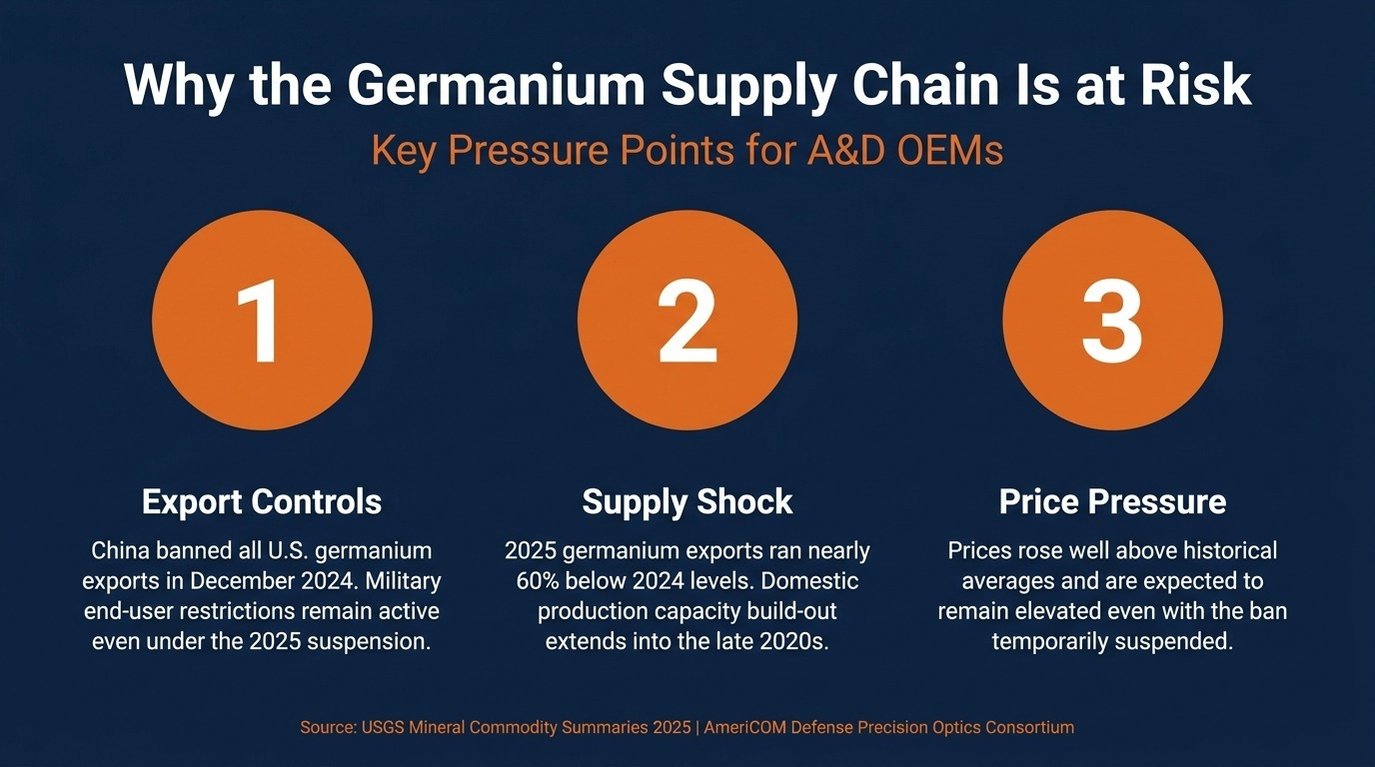
China is the dominant global producer of germanium, and for years that concentration went largely unnoticed because supply was stable and prices were predictable. That changed in stages. China's 2023 export licensing requirements signaled the shift. The December 2024 full ban made it real. Germanium exports in 2025 ran nearly 60% lower than in 2024, meaning a significant portion of normal global supply simply disappeared from accessible markets. Skillings
A USGS economic analysis found that a complete restriction of China's germanium exports could reduce U.S. GDP by $0.4 billion to $1.1 billion, underscoring how deeply the material is embedded in defense and industrial supply chains. China suspended the ban in November 2025, but the relief is conditional. The suspension runs until November 27, 2026, after which Beijing can re-activate stricter controls, and the clause banning exports to military end-users remains in effect. USGSThe Oregon Group
The U.S. government has recognized the problem. Programs underway to close the gap include DLA germanium recycling initiatives, DOE pilot plant funding, Army SBIR contracts to extract germanium from coal ash, and DPA Title III support for wafer production — but that domestic capacity build-out extends well into the late 2020s. For program managers responsible for platforms with decade-long production runs, that timeline gap is not abstract. It is a sourcing problem that needs a solution now, which is why the conversation around infrared lens materials aerospace programs depend on has shifted so sharply toward alternatives. Americom
What Are the Real Germanium Alternatives for Thermal Imaging?
Several infrared-transparent materials are being evaluated and deployed as germanium alternatives thermal imaging applications require. They differ in spectral coverage, environmental performance, processability, and supply stability. Understanding those differences is the first step toward a sound germanium lens replacement decision.
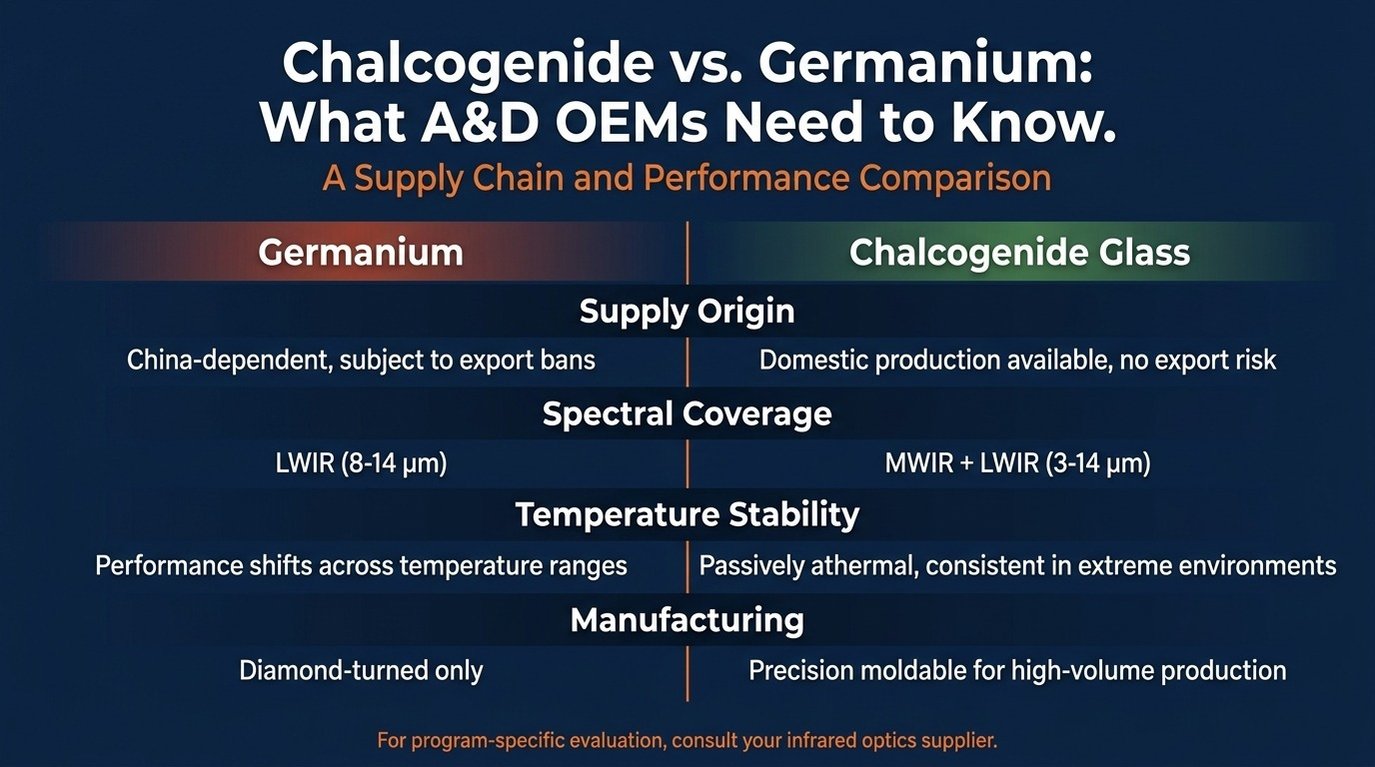
The most significant and widely adopted alternative is chalcogenide glass. Chalcogenide glass has evolved from a niche IR material into a mainstream alternative to germanium, valued for its broad transmission range, stable refractive index, and ability to be moulded into complex shapes that support lightweight, compact lens assemblies. It covers both MWIR (3-5 µm) and LWIR (8-14 µm) bands, making it applicable across the majority of defense and aerospace thermal imaging use cases. UQG Optics
Other materials in the conversation include zinc selenide (ZnSe) and calcium fluoride (CaF2). Both are legitimate with real applications, but neither matches the full optical profile of germanium as closely as chalcogenide does for most LWIR imaging scenarios. For OEMs whose primary need is a functional germanium lens replacement within existing optical system architectures, chalcogenide infrared optics represent the most mature and best-supported path.
|
Material |
Spectral Coverage |
Supply Stability |
Processability |
Best Fit |
|
Germanium |
LWIR (8-14 µm) |
High risk (China- |
Excellent |
Legacy systems |
|
Chalcogenide Glass |
MWIR + LWIR (3-14 µm) |
Stable (domestic options) |
Excellent (moldable) |
Broad A&D/industrial |
|
Zinc Selenide |
Broadband (0.6-21 µm) |
Moderate |
Good |
Laser/research optics |
|
Calcium Fluoride |
Broad UV-IR |
Moderate |
Good |
Environmental/spectroscopy |
What Makes Chalcogenide Infrared Optics a Strong Match for A&D Programs?
Chalcogenide performs well under the environmental stresses typical of defense platforms. It supports high-performance anti-reflective coatings across the long-wave infrared band and is compatible with diamond-like carbon (DLC) coatings for ruggedized outdoor and military environments. It is also passively athermal to a degree that germanium is not, meaning performance stays more consistent across wide temperature ranges — a meaningful advantage for systems deployed in extreme conditions. Some proprietary chalcogenide formulations have been fielded in demanding defense applications, and domestic production capacity exists today that is not subject to foreign export controls. For programs building infrared lens assemblies under NDAA-aligned procurement requirements, that domestic origin matters considerably.
How Should OEMs Approach the Transition?
Switching infrared lens materials is not a drop-in exercise. It involves optical design review, material qualification, and in some cases formal requalification with the end customer. That process takes time, which is exactly why starting now, rather than after a supply disruption, is the right move. Here is a practical framework for evaluating the switch:
Step 1: Audit your current germanium exposure. Map which assemblies and programs depend on germanium components. Prioritize programs with the longest production timelines first, since those carry the most cumulative risk to your germanium supply chain. Drone and UAV payloads are a particularly time-sensitive category, given the pace of platform development and the growing volume of thermal imaging systems for drone applications moving through procurement pipelines.
Step 2: Evaluate optical design compatibility. Chalcogenide glass has a different refractive index and dispersion profile than germanium. An experienced infrared lens manufacturer can model the performance impact and redesign for the new material if needed. In many cases the adjustment is modest, with the result being a robust germanium lens replacement that meets or exceeds original performance specs.
Step 3: Confirm material qualification status. Ask your supplier whether the chalcogenide variant you are considering carries any existing qualification for defense applications. Some formulations already have fielded program history, which can significantly shorten your requalification timeline.
Step 4: Evaluate supply chain depth. Does your supplier manufacture the chalcogenide glass themselves, or source it externally? Vertical integration from raw material to finished assembly is the strongest supply assurance available for infrared lens materials aerospace programs today.
Step 5: Align with your program team. For government programs, early conversation with your customer about material substitution keeps you ahead of compliance questions. The FY26 NDAA's emphasis on supply chain security generally works in favor of domestic chalcogenide transitions.
A Note on Composite IR Optics
Composite IR optics take a different approach: rather than substituting one bulk material for another, they combine materials optimized for specific performance goals, such as broadband transmission or wide-range athermalization. This can make sense for platforms being designed today, particularly those targeting BBIR (2-14 µm) performance. For existing designs already optimized around germanium, a direct chalcogenide substitution is typically the more efficient path to a qualified, production-ready assembly. Composite IR optics are worth flagging with your engineering team early so the choice is deliberate rather than assumed.

What Does Supply Security Actually Look Like?
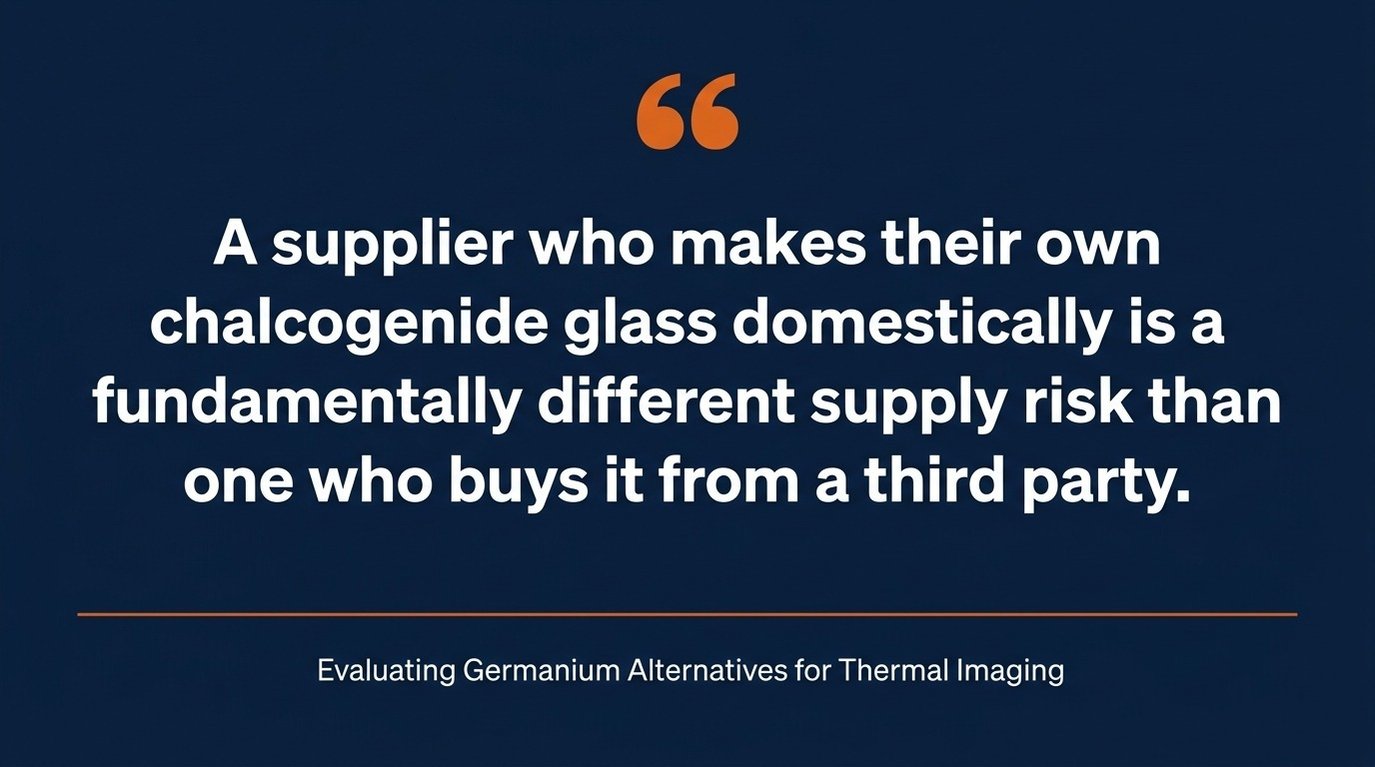
Supply security is not just about having a backup vendor. It is about the entire production chain, from raw material through final coating and assembly. A supplier who sources chalcogenide glass from a third party introduces a dependency that is different from germanium but still a single-point risk. A supplier who manufactures their own chalcogenide glass domestically and processes it through lens fabrication, coating, and assembly in the same facility is a fundamentally different risk profile.
Vertically integrated manufacturers provide faster customization, supply chain reliability, and system-level performance that off-the-shelf solutions cannot match. For OEMs managing multi-year production commitments, that distinction is worth making explicit in supplier conversations. An end-to-end infrared optics partner who controls the full production chain from raw glass through coated assemblies gives your procurement team a more defensible position than assembling the same chain from separate vendors. Lightpath
|
Supplier Profile |
Material Origin |
Design Support |
Supply Risk |
|
Vertically integrated |
Domestic, in-house |
Full engineering collaboration |
Low |
|
Assembly integrator |
Third-party sourced |
Limited |
Moderate |
|
Catalog supplier |
Multi-source |
Minimal |
Higher |
There is also a competitive procurement angle worth raising internally. Germanium prices are expected to remain above pre-ban levels even with the suspension in place, with sustained demand from stockpiling and growing defense applications keeping pressure on the market. OEMs who transition to domestically sourced, germanium-free optics are in a stronger position with U.S. government customers focused on supply chain security and NDAA compliance. That is a procurement argument as much as a risk argument, and it is one more reason to start the germanium alternatives evaluation conversation now rather than after a disruption makes it urgent. NAI 500
Frequently Asked Questions
Is chalcogenide glass a direct drop-in replacement for germanium in existing lens designs? Not without some design adjustment. Chalcogenide has a different refractive index and thermal coefficient, so most transitions involve an optical design review. In many cases the adjustments are modest, especially when working with a supplier experienced in both materials. The requalification effort is manageable and far less disruptive than a mid-program germanium supply chain failure.
Does the FY26 NDAA require switching away from germanium? The FY26 NDAA does not mandate specific material substitutions, but it reinforces the policy push toward supply chain security and domestic sourcing for defense-critical components. Programs using domestically manufactured chalcogenide alternatives are generally better positioned for long-term compliance. The implications for infrared lens materials aerospace programs use are worth reviewing with your program and compliance teams early.
How long does a typical material qualification process take? It varies by program, customer, and the extent of optical redesign required. Some chalcogenide variants carry fielded program history that can meaningfully shorten the path. Programs that begin evaluation during stable supply periods are in a much better position than those responding to a disruption under schedule pressure.
What should OEMs ask a supplier when evaluating chalcogenide alternatives? Do you manufacture the chalcogenide glass yourself or source it externally? Do your formulations have any existing defense program qualification history? Can you model optical performance for our existing design before we commit to a redesign? What are your production volumes and lead times? The answers will quickly reveal whether you are gaining real supply security or simply trading one dependency for another.
Ready to Evaluate Your Options?
The shift away from germanium dependency in thermal imaging is well underway across the A&D supply chain, supported by materials now proven in fielded systems. For OEM engineers and procurement leads ready to evaluate what a transition looks like for their specific programs, LightPath Technologies brings four decades of infrared optics expertise, proprietary domestic chalcogenide glass manufacturing, and a vertically integrated production model spanning materials through complete assemblies. To start that conversation, connect with the LightPath engineering team.