
Key Takeaways
Picking the right LWIR sensor resolution is a mission-level decision, not a spec-sheet exercise.
- Resolution formats like 640x512 and 1280x1024 serve fundamentally different operational requirements, and choosing the wrong one creates downstream integration headaches.
- Pixels on target, not total pixel count, is what actually determines whether your platform can detect, recognize, or identify a threat.
- Optical design and lens-to-sensor matching matter as much as the sensor format itself. Resolution is only meaningful when the entire system is optimized together.
- Supply chain stability and vertical integration from your component partner protect long-term program performance, especially as germanium constraints continue to affect the market.
Defense OEM design engineers who treat resolution as a system-level variable, not an isolated spec, consistently build platforms that outperform those designed around headline numbers alone.
The global IR and thermal imaging systems market reached an estimated $7.51 billion in 2024, and LWIR-based sensors now command the largest share across defense and surveillance verticals. That growth is not accidental. Demand for LWIR technology in ISR platforms, CUAS systems, UAV payloads, and ground-based surveillance has driven rapid expansion of both available sensor formats and the complexity of choosing between them.
For defense OEM design engineers and A&D systems architects, the expansion of the LWIR thermal imaging landscape creates a real challenge: more resolution options, more pixel pitch variants, and more optical configurations to sort through. The question is rarely which sensor has the highest pixel count. The real question is which sensor format delivers the mission outcome your platform is built around.
This guide walks through how to match LWIR camera resolution to real operational requirements, why the decision is inseparable from optics and system design, and what program-level factors separate sensors that look good on paper from systems that perform in the field.
What Does LWIR Camera Resolution Actually Mean in Practice?
LWIR camera resolution, specified in formats like 320x256, 640x512, or 1280x1024, describes the number of pixels on the focal plane array. But the sensor format is only meaningful in context. A 640x512 LWIR sensor with a well-matched optical assembly can outperform a 1280x1024 sensor paired with mediocre optics, especially at the ranges and environmental conditions defense platforms are built to handle.
The standard framework defense engineers use to translate resolution into operational performance is Detection, Recognition, and Identification, or DRI. According to Johnson's Criteria, the underlying model for DRI analysis, detection of a target requires approximately 2 pixels across the critical dimension of that target, while recognition requires around 8 pixels and identification requires around 12.8 pixels. What this means practically is that as required task difficulty increases from detection to identification, the effective operational range shrinks, and the resolution burden on your sensor rises accordingly.
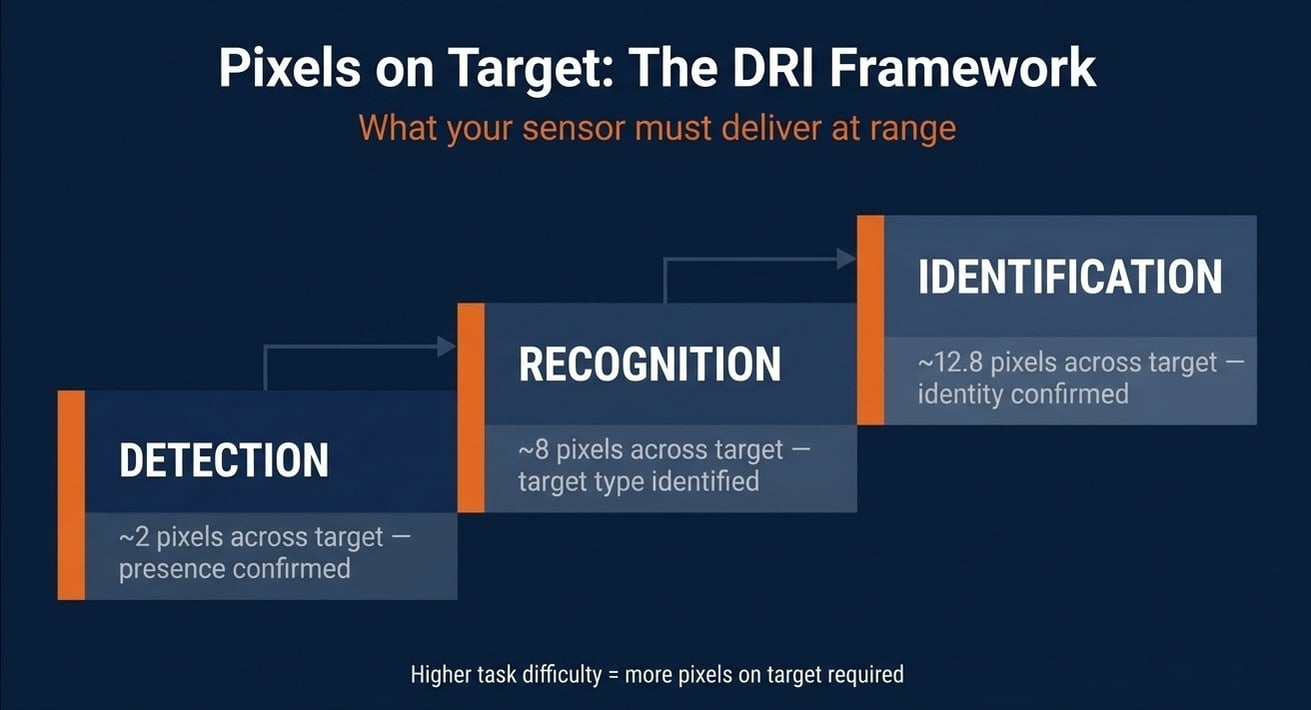
This is why the phrase "pixels on target" matters more than total pixel count. A 1280x1024 LWIR sensor gives you more pixels to work with, but if your optics are not delivering the correct angular resolution, those pixels will not be covering the target at range. The system wins or loses at the optical design level, not at the detector spec sheet.
Getting this right starts well before selecting a format. It starts with your target signature, your required task level, your maximum engagement range, and the SWaP constraints of the platform.
How Common LWIR Sensor Resolution Formats Map to Defense Applications
The market has largely converged on a handful of sensor formats across different application tiers. Understanding what each format is built for helps frame the decision before engineering tradeoffs enter the picture.
320x256 is the lower-resolution tier, suited for short-range detection tasks, man-portable systems, and weight-constrained UAV payloads where SWaP is the dominant driver. These sensors keep power consumption low and thermal management simple. Their effective range for most defense surveillance tasks is limited, but they are frequently the right answer for certain CUAS implementations where short-range drone detection near the sensor head is the primary goal.
640x512 is the mainstream standard for defense integration programs. It supports robust detection at medium ranges, provides enough pixels on target for recognition at operationally relevant distances, and has become the baseline for ISR payloads, vehicle-mounted surveillance systems, and border security platforms. Uncooled 640x512 LWIR sensor resolution systems are widely deployed across tactical drone platforms where the balance of resolution, power draw, and weight budget is critical.
1280x1024 is the high-end tier, appropriate for long-range surveillance, fixed border monitoring towers, naval platforms requiring identification at distance, and ground-based systems with less restrictive SWaP budgets. The 1280x1024 LWIR sensor format provides the pixel density needed to meet identification-level DRI requirements at ranges where 640x512 sensors can only achieve recognition.

The table below gives a simplified overview of how these formats align to common mission types:
|
Sensor Format |
Primary Mission Types |
Typical SWaP Profile |
|---|---|---|
|
320x256 |
CUAS proximity detection, lightweight UAV payloads, handheld applications |
Low power, minimal weight |
|
640x512 |
ISR, tactical drones, vehicle-mount surveillance, border patrol |
Moderate, flexible integration |
|
1280x1024 |
Long-range surveillance towers, naval EO/IR, fixed ISR platforms |
Higher power, larger form factor |
These generalizations guide initial platform decisions, but the final answer depends on the full system context.
Why Optics and Sensor Resolution Must Be Designed Together
Resolution selection is an entry point, not an endpoint. The sensor format you specify sets a ceiling on system performance, but it is the optical assembly that determines whether your system reaches that ceiling in the field.
Pixel pitch is the link between the two. Pixel pitch, the physical size of each pixel on the detector, determines the angular resolution your system can resolve at a given focal length. Common uncooled LWIR detectors use 12 or 17 micrometer pixel pitch formats. A smaller pixel pitch gives you more pixels per unit area and supports higher angular resolution, but it also demands tighter optical tolerances and more precise lens-to-sensor matching.
Cold shield efficiency is another variable that separates datasheet performance from real-world results. A cold-shield-efficient optical design eliminates corner shading and image non-uniformities that degrade situational awareness at the edges of the frame. For defense programs where the full field of view may be carrying operationally significant imagery, cold shield efficiency is not a nice-to-have. LWIR lens design that achieves 100% cold shield efficiency requires careful coordination between optical designer, detector selection, and mechanical packaging.
The consequence for OEM design engineers is that choosing a sensor format and then finding an optics solution to pair with it is a less reliable path than designing the optics and sensor as a system from the beginning. Lens assemblies optimized for specific pixel pitch and detector format deliver meaningfully better performance than off-the-shelf combinations, particularly at the ranges defense programs demand.
What Sets Highest Resolution Uncooled LWIR Thermal Cameras Apart from Cooled Alternatives
For programs evaluating the highest resolution uncooled LWIR thermal camera options, the comparison against cooled systems comes up quickly. Understanding the practical tradeoffs helps program architects make the right platform-level call.
Uncooled microbolometer detectors operate at ambient temperature. They do not require cryogenic cooling systems, which makes them lighter, simpler to maintain, and significantly lower in power consumption. The tradeoff is sensitivity. Uncooled systems typically achieve thermal sensitivity in the range of 30 to 60 mK NETD depending on optics and operating conditions, which is sufficient for most surveillance and ISR missions.
Cooled LWIR and MWIR systems deliver sensitivity well below uncooled levels and excel at detecting smaller thermal signatures at longer ranges. The cost, weight, and power requirements are substantially higher, and cooled systems introduce additional maintenance considerations in deployed environments.
The following comparison summarizes key differences relevant to platform selection:
|
Characteristic |
Uncooled LWIR |
Cooled LWIR/MWIR |
|---|---|---|
|
Thermal Sensitivity (NETD) |
30-60 mK (system level) |
Below 20 mK |
|
SWaP |
Low |
High |
|
Maintenance |
Minimal |
Requires cooling system support |
|
Typical Application Fit |
UAV payloads, vehicle-mount, perimeter ISR |
Long-range targeting, strategic surveillance |
|
Cost per Unit |
Lower |
Higher |
For many defense OEM programs, the highest resolution uncooled LWIR thermal camera format at 1280x1024 satisfies mission requirements at a fraction of the lifecycle cost of a cooled alternative. The answer is mission-specific, but the decision framework is consistent.
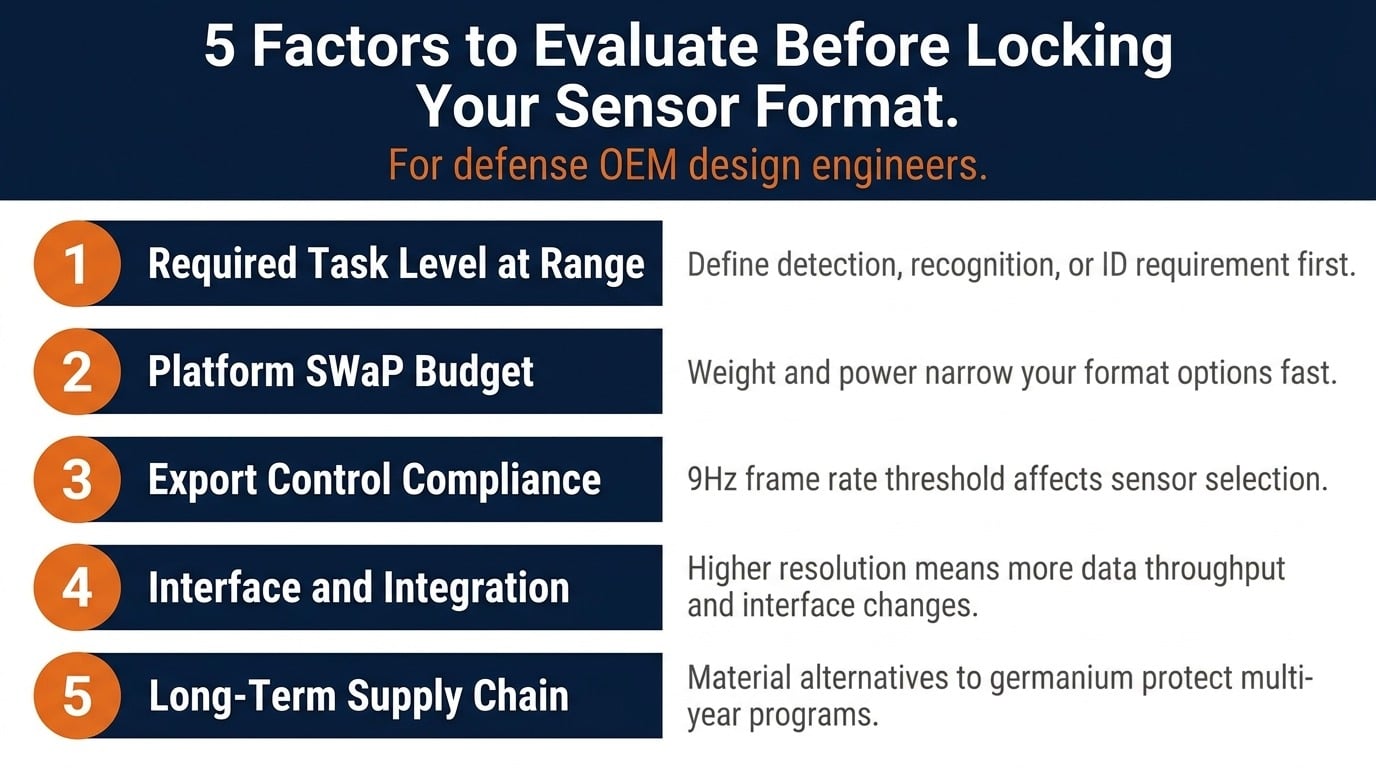
Five Factors Defense OEM Engineers Should Evaluate Before Finalizing Resolution
Sensor format decisions look simple until they interact with program realities. Here is a practical list of the variables worth pressure-testing before your BOM is locked.
- Required task level at maximum range. Detection, recognition, and identification impose progressively higher resolution demands. Define your most demanding task at your longest required range, then work backward to the sensor and optics combination that delivers it.
- Platform SWaP budget. Weight and power constraints narrow the viable sensor format range quickly, especially for UAV and man-portable applications. Higher resolution formats consume more power and add weight at the optics level.
- Export control compliance. Frame rates above 9 Hz combined with certain resolution and sensitivity combinations trigger export controls under EAR, ITAR, and Wassenaar arrangements. This affects sensor selection, especially for programs with international end-user considerations.
- Interface and integration requirements. Resolution upgrades often carry interface changes: higher data throughput, different electrical connections, updated mechanical envelopes. Confirm your integration architecture accommodates the sensor format before it becomes a late-stage redesign.
- Long-term supply chain. Germanium has historically been the dominant material for LWIR optics, but it faces well-documented supply constraints. Programs with multi-year production horizons benefit from infrared optical solutions built on alternative materials that reduce supply risk without sacrificing performance.
How the LWIR Market Is Shaping Sensor Format Demand
Context helps when sensor format decisions carry program-level stakes. Within the broader thermal imaging industry, the thermal scanner segment alone tells a clear story: according to Grand View Research, LWIR technology dominated that segment by revenue share in 2024, driven heavily by defense and security applications. Defense programs continue to be the single largest vertical for thermal imaging adoption across the market.
The shift toward uncooled technology is real and ongoing. Across defense and surveillance programs, the push toward smaller, more capable sensors at lower SWaP is being driven by UAV programs, CUAS systems, and distributed ISR architectures. That trend puts pressure on the 640x512 tier to deliver more at smaller form factors, and it is creating significant demand for 1280x1024 formats in fixed and naval platforms where size constraints are less severe.
Material supply is the other structural shift worth tracking. Programs that engineered around germanium are facing sourcing challenges that affect both cost and delivery timelines. Chalcogenide glass alternatives, which offer equivalent optical performance in LWIR systems, are increasingly available from vertically integrated manufacturers who control the full production chain from raw material through finished thermal imaging lens assemblies.
For defense OEM program managers, these trends reinforce that resolution selection and supplier selection are related decisions. The partner you choose for your optical and detector components shapes both what your platform can do and how reliably you can build it at volume.
Putting It All Together: Engaging Your Supplier Early
The programs that hit schedule and performance targets rarely shop components late in the design cycle. Once you have defined your mission requirements, worked through DRI targets, and pressure-tested your SWaP budget, the next move that most separates successful programs from difficult ones is bringing your optics and sensor partner into the conversation before the architecture is locked.
Early supplier engagement means optical assemblies can be matched to your specific detector format from the start, integration issues surface before they hit the schedule, and supply chain decisions, including material alternatives to germanium, get made proactively rather than reactively. The difference between a component vendor and a program partner shows up most clearly in that early window.
Platform constraints like ruggedization requirements, environmental specs, and export compliance will further narrow the viable solution space as the design matures. What you want is a small, well-qualified set of sensor and optics configurations going into your first engineering evaluation, not a catalog to sort through under schedule pressure.
Frequently Asked Questions
What is the difference between 640x512 and 1280x1024 LWIR sensor resolution for defense applications?
640x512 is the mainstream format for tactical and airborne platforms where SWaP constraints are significant. It supports detection and recognition at operationally relevant ranges for most ISR and surveillance missions. 1280x1024 LWIR provides substantially more pixels on target at longer ranges and is better suited to fixed surveillance towers, naval platforms, and applications requiring identification-level detail at distance.
Does higher LWIR camera resolution always mean better performance?
No. Resolution specifies the sensor's pixel array, but operational performance depends on the full system: pixel pitch, optical design, cold shield efficiency, and lens-to-sensor matching. A well-optimized 640x512 system can outperform a 1280x1024 system with mismatched optics, especially at the ranges and environmental conditions defense programs typically demand.
What thermal sensitivity can I expect from an uncooled LWIR system?
Uncooled LWIR systems typically achieve thermal sensitivity in the range of 30 to 60 mK NETD at the system level, depending on optical design and operating conditions. This is sufficient for most surveillance, ISR, and CUAS detection requirements. Cooled systems offer substantially lower NETD values for applications requiring longer-range detection of low-contrast targets.
How do export control rules affect LWIR sensor resolution selection?
Certain combinations of resolution, thermal sensitivity, and frame rate above 9 Hz trigger export controls under EAR, ITAR, and Wassenaar arrangements. Defense OEM programs with international customers need to factor compliance requirements into sensor selection early in the design process to avoid configuration changes downstream.
Why does optics selection matter as much as the sensor format for LWIR camera resolution?
Because the sensor format only defines the pixel budget. Whether those pixels actually cover your target at range is determined by the angular resolution of the optical system, which is a function of focal length, pixel pitch, and optical design quality. LWIR systems optimized as a complete unit, with optics matched to the specific detector format, consistently outperform systems assembled from independently sourced components.
Start Building Your Platform Around the Right Resolution
Sensor format decisions look straightforward until they ripple through optical design, SWaP budgets, export compliance, and supply chain. Getting them right at the start is significantly cheaper than optimizing around a poor initial choice later in a program.
LightPath Technologies designs and manufactures the optical and thermal imaging components defense OEMs rely on to build competitive platforms. From vertically integrated lens assemblies optimized for specific detector formats to complete cooled and uncooled camera systems, our engineering team works alongside yours from initial requirements through production. If you are making sensor format decisions for your next platform, connect with our team to start the conversation.