
Key Takeaways
Thermal drone payload selection is a program-defining decision, not a component purchase.
- Mission profile determines everything: SAR, defense ISR, CUAS, and border surveillance each demand different architectures, spectral bands, and SWaP trade-offs.
- NDAA compliance and the 9Hz export control threshold are procurement filters that must be addressed before technical specs, not after program award.
- Vertically integrated suppliers who control materials, optics, and camera assembly compress development timelines and reduce the supply chain exposure that catalog-component programs carry.
- Germanium dependence is an increasing program risk; proprietary chalcogenide glass alternatives are now a meaningful differentiator in supplier evaluation.
OEMs who treat thermal payload selection as a supplier partnership decision rather than a spec-sheet search build platforms that outperform and outlast.
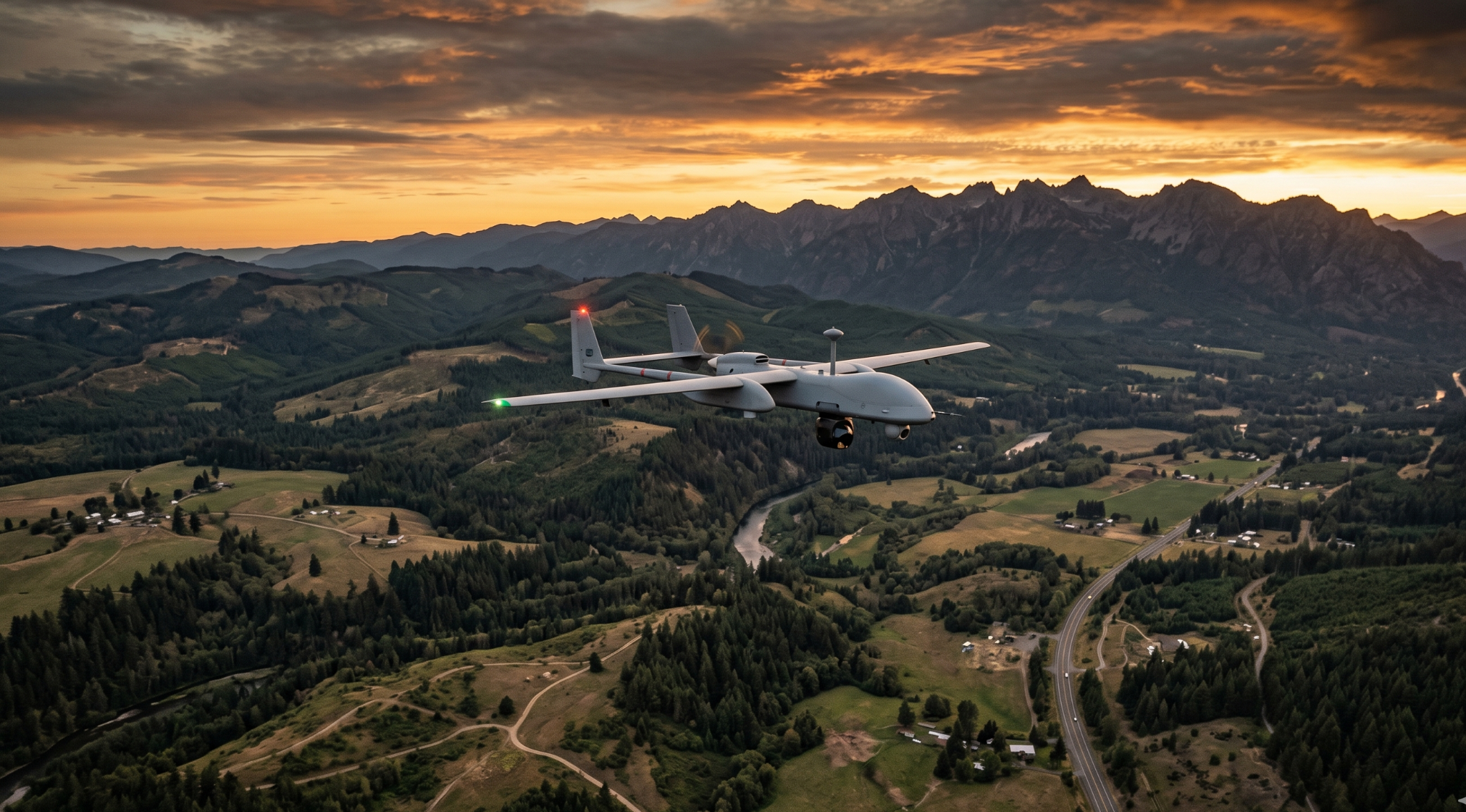
The drone thermal imaging market is expanding at a pace that rewards early, well-considered decisions and punishes late ones. According to Stratistics MRC, the global thermal drone market reached $8.06 billion in 2025 and is projected to reach $19.58 billion by 2032, with defense, surveillance, and public safety among the primary growth drivers. For OEMs and system integrators building the next generation of aerial platforms, that growth creates a narrow competitive window.
The teams that get their optical and thermal imaging solutions right early capture programs. For OEMs evaluating drone UAV thermal imaging systems, the supplier and architecture decisions made in early program stages are the ones that determine whether a platform wins or gets redesigned. The teams that treat the thermal payload as an afterthought spend the rest of development catching up.
This guide is written for program managers, engineering leads, and procurement decision-makers at companies building UAV platforms for defense, search and rescue, and surveillance applications. It covers what actually differentiates a reliable drone with thermal camera integration from one that fails in the field, and what to look for in a supplier before signing.
Who This Guide Is For: This content is directed at OEM product teams and defense integrators who are specifying or sourcing thermal camera modules for UAV platforms. It is not a guide for operators choosing a finished drone.
Why Is the Thermal Payload Decision So Consequential for Drone OEMs?
When you are building a UAV platform, the thermal imaging subsystem shapes everything downstream. Sensor architecture affects power budget, which affects flight time. Optics affect detection range, which affects the mission profile your platform can credibly serve. And supplier selection affects supply chain stability, compliance posture, and whether your program can scale.
A drone with thermal camera capability that works in the lab but fails to integrate cleanly onto your platform, or that creates NDAA documentation headaches at program award, does not just delay delivery. It erodes your competitive position with customers who have tightly defined requirements and even tighter schedules.
The thermal payload decision is, in practice, a platform decision. It locks in your detection performance ceiling, your SWaP envelope, your compliance story, and your ability to customize for the next program iteration. That is why the best OEM programs address it early, collaboratively, and with as much strategic weight as the airframe itself.
What Mission Profile Should Drive Your Thermal Camera Architecture?
Different UAV missions place fundamentally different demands on a thermal imaging drone payload. The first and most important step in any procurement process is defining what your platform actually needs to accomplish.
Here is a breakdown of the major use cases and what each demands:
|
Mission Profile |
Primary Thermal Band |
Cooled vs. Uncooled |
Key Driver |
|
SAR (Search and Rescue) |
LWIR (8–14 µm) |
Uncooled preferred |
Endurance, low-maintenance, rapid deployment |
|
Defense ISR / Long-Range Surveillance |
MWIR (3–5 µm) or LWIR |
Cooled for extended range |
Sensitivity, detection distance |
|
CUAS (Counter-Drone) |
LWIR (8–14 µm) |
Uncooled or cooled |
Small target contrast, rapid acquisition |
|
Border / Perimeter Security |
LWIR (8–14 µm) |
Uncooled preferred |
24/7 endurance, SWaP efficiency |
|
Airborne Gas / Industrial Inspection |
BBIR (2–12 µm) |
Cooled typical |
Spectral flexibility, radiometric accuracy |
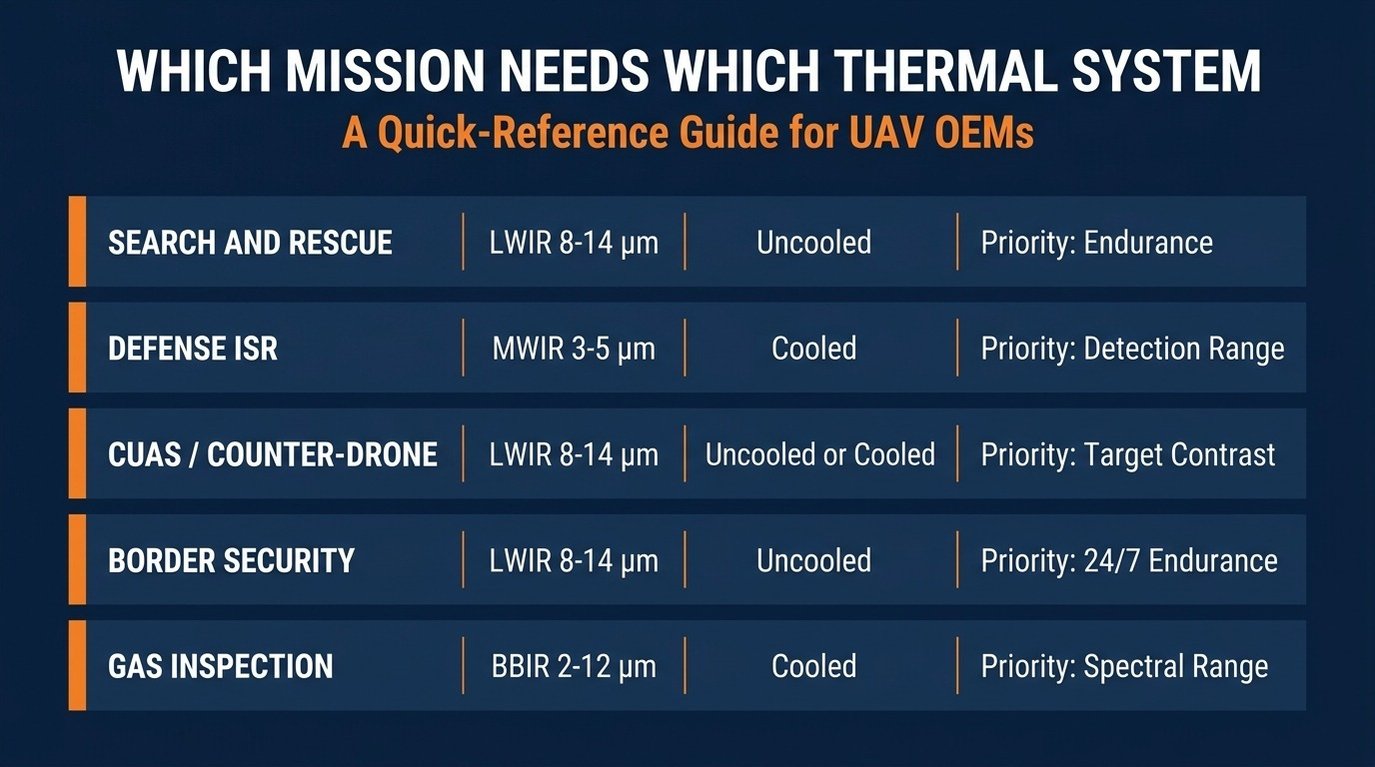
SAR missions optimize for a specific set of values that differ sharply from defense surveillance. Extended flight endurance, rapid cold-start capability, and operational simplicity matter more than maximum detection range. For OEMs developing SAR-capable UAV platforms, selecting a thermal drone camera is an endurance and reliability decision as much as a sensor specification decision. Uncooled LWIR systems dominate this space because their SWaP profile and low maintenance requirements match what rescue operations demand.
The operational case for thermal SAR capability is well documented. DHS Science and Technology research confirms that drones equipped with thermal imagers have become an enabling capability that first responder agencies are increasingly reliant on, providing rapid situational awareness and heat-signature detection across terrain that defeats ground teams. For OEMs building platforms for this segment, that demand is real and growing.
Defense ISR and targeting programs push the calculus in the opposite direction. Long-range identification of personnel or vehicle targets requires the sensitivity advantages of cooled MWIR systems, even at the cost of additional payload weight and power draw. The SWaP penalty is accepted because the detection capability is not achievable any other way.
CUAS platforms present their own distinct requirements. Thermal cameras designed for CUAS must distinguish small drones from birds and other environmental clutter, which requires optimized optics and advanced image processing, capabilities that separate purpose-built systems from repurposed commercial cameras. This makes optics design and sensor matching far more important than raw resolution specifications alone.
How Do SWaP Constraints Shape the Selection of a Thermal Imaging Drone Payload?
The decision to integrate a drone with thermal camera capability forces a conversation about physics. Every gram and every watt on a UAV platform is a trade-off. A thermal camera with outstanding detection performance that drains your battery in 18 minutes or pushes your payload beyond the platform's lift budget is not a solution. SWaP (size, weight, and power) constraints are not secondary considerations in thermal payload selection. For most UAV platforms, they are the primary filter that eliminates options before any specification comparison begins.
Uncooled thermal imaging systems built around microbolometer detectors offer the most favorable SWaP profiles. Uncooled systems operate at ambient temperature, eliminating cooling requirements, which reduces weight and power consumption dramatically while providing sensitivity adequate for most surveillance, inspection, and monitoring applications. For Group 1 through Group 3 UAS platforms where payload budgets are tight, uncooled LWIR is the architecture that fits.
Cooled systems carry a meaningful SWaP penalty from the cryocooler mechanism but deliver sensitivity levels that no uncooled system can match. For long-range targeting and certain ISR mission profiles, that performance gap is decisive. The key is matching the architecture to the mission, not defaulting to either option without a clear operational rationale.
The Role of Optics in SWaP Optimization
Lens selection matters as much as sensor selection in the SWaP equation. A well-matched lens assembly can achieve detection performance equivalent to a higher-resolution sensor at lower weight. OEMs who work with suppliers capable of designing the complete optical system, from glass material to sensor interface, consistently achieve better SWaP outcomes than those who source lenses and sensors separately and attempt integration in-house. This is where thermal camera drone payload design requires thinking at the system level rather than the component level.
What Compliance Requirements Must OEMs Address Before Specifying a Thermal Drone Camera?
Compliance is not a box to check at the end of program development. Two regulatory frameworks in particular must be factored into initial specifications, not surfaced during delivery.
NDAA Compliance and the American Security Drone Act. The FY-2024 NDAA expanded restrictions government-wide, prohibiting federal agencies from procuring UAS from covered foreign entities. As of December 22, 2025, federal agencies may not operate such systems or use federal funds through contractors and grantees to acquire them. For OEM programs selling into U.S. government, defense, or publicly funded public safety applications, the entire supply chain, including thermal camera modules and the materials those modules are built from, must trace cleanly to non-restricted sources. Component sourcing documentation is a procurement requirement.
The 9Hz Export Control Threshold. U.S. export regulations under ITAR and EAR treat thermal imaging systems capable of frame rates above 9Hz as controlled items for export to certain destinations. For drone thermal camera programs with any international market potential, this threshold must be addressed in initial specifications. Programs that discover this constraint at the delivery stage face licensing delays that compress deployment schedules. Engaging a supplier with defense program experience early in the process makes a material difference in whether you hit your timeline.
Both compliance dimensions belong in the first conversation with a potential thermal imaging supplier.
How Should OEMs Evaluate Thermal Camera Suppliers for UAV Programs?
Evaluating suppliers for a drone with thermal camera integration is different from evaluating any other component vendor. The right supplier does not just ship a camera. They contribute to your program's compliance posture, development timeline, and long-term supply chain health.
Here are five evaluation criteria that experienced program managers consistently flag as the real differentiators:
- Vertical integration depth. Does the supplier control their own optical materials, lens manufacturing, and camera assembly? Suppliers dependent on upstream vendors cannot guarantee supply chain stability or customize configurations without external dependencies.
- Material supply chain security. Germanium, the traditional material for infrared optics, faces growing supply concentration risk. Suppliers with proprietary germanium-free alternatives, such as chalcogenide glass formulations, reduce multi-year program exposure to cost and availability volatility.
- NDAA and manufacturing provenance. For any program with U.S. government adjacency, North American or allied-nation manufacturing is a baseline requirement. Documentation of component sourcing should be requested before spec comparisons begin.
- Custom engineering capability. Catalog cameras rarely meet program requirements without modification. Suppliers with in-house engineering teams who can adapt designs to your platform's specific SWaP, interface, and environmental requirements compress integration timelines and reduce redesign risk.
- Lifecycle support commitment. UAV platforms remain in service for years. Spare parts availability, calibration support, and technology refresh planning over the program lifecycle are part of the supplier value proposition that a spec sheet never captures.
The table below frames how different supplier types perform against these criteria:
|
Evaluation Criterion |
Component Distributor |
OEM Camera Brand |
Vertically Integrated Manufacturer |
|
Material supply control |
No |
Partial |
Yes |
|
Custom engineering |
Limited |
Limited |
Yes |
|
NDAA traceability |
Limited |
Variable |
Yes (domestic mfg.) |
|
Lead time control |
No |
No |
Yes |
|
Lifecycle support |
No |
Variable |
Yes |
Which Infrared Band Is Right for Your Drone's Thermal Imaging Mission?
Band selection is the single most consequential specification decision when specifying a drone with thermal camera payload, and it must flow directly from mission requirements, not component availability or catalog defaults. Get this wrong and you end up with a system that is technically functional but operationally mismatched, either underperforming at the ranges your customers need or over-engineered to the point where SWaP trade-offs compromise the platform's core mission endurance.
LWIR (8–14 µm) is the dominant band for most drone thermal imaging applications. It offers reliable detection of ambient-temperature objects, including human heat signatures and vehicle surfaces, with mature, cost-effective uncooled detector technology. It performs well in fog, smoke, and darkness, though performance can be reduced in heavy rain or when target-to-background temperature contrast is very low. This is the right starting point for SAR, border surveillance, and most CUAS platforms.
MWIR (3–5 µm) offers superior sensitivity to high-temperature emission sources, including engine exhaust and vehicle plumes, enabling longer detection ranges for specific targeting applications. It requires cooled detectors, which carries SWaP and cost implications. It is the right answer for programs where those trade-offs are acceptable in exchange for long-range performance.
BBIR systems covering 2–12 µm offer spectral flexibility for specialized applications such as airborne optical gas imaging and specialized inspection missions, where detecting specific molecular signatures requires broader spectral coverage. These configurations carry higher cost and complexity and are appropriate when the mission genuinely requires them.
For most OEM programs, LWIR is the starting assumption. The question is whether your specific detection requirement justifies moving to MWIR or broadband coverage, and whether your platform budget can absorb the associated trade-offs.
Building a Drone Thermal Camera Program That Wins
The thermal payload decision is not a line item in a bill of materials. It is a foundational design choice that determines your platform's detection capability ceiling, compliance posture, supply chain resilience, and ability to compete for programs in your target verticals.
The OEM programs that win consistently define mission requirements before evaluating suppliers. They address compliance early. They choose partners who can demonstrate vertical integration depth, custom engineering capability, and a supply chain story that holds up to program scrutiny. A drone with thermal camera system that delivers on those dimensions is not a component purchase. It is a competitive differentiator that compounds over the program lifecycle. The drone thermal imaging market is moving fast, and the window for competitive differentiation through imaging performance is narrowing.
The teams that treat this as a strategic decision are building platforms that outlast and outperform the ones built on catalog components and last-minute compliance workarounds.
Frequently Asked Questions
What is the difference between a cooled and uncooled drone with thermal camera integration?
Cooled thermal cameras use cryogenic mechanisms to reduce detector noise, enabling higher sensitivity and longer detection ranges. They are heavier, consume more power, and require more maintenance. Uncooled cameras operate at ambient temperature, offering a much more favorable SWaP profile with sensitivity adequate for most surveillance, SAR, and monitoring applications. For most UAV platforms, uncooled LWIR is the right starting point. Cooled systems are justified when mission requirements demand detection ranges or sensitivity levels that uncooled technology cannot achieve.
What does NDAA compliance mean for thermal camera components in a drone program?
NDAA compliance for thermal camera components means that the camera module, and the optical materials it is built from, can be traced to non-restricted supply chains. As of December 2025, federal agencies and programs using federal funds cannot procure or operate drones with components sourced from covered foreign entities. For OEM programs targeting U.S. defense, government, or publicly funded public safety customers, working with North American manufacturers who document component provenance is a baseline requirement.
How does the 9Hz export control rule affect drone thermal camera specifications?
U.S. export regulations treat thermal imaging systems capable of frame rates above 9Hz as controlled items for export to certain destinations. OEM programs with any international market potential need to address this threshold in initial specifications. Programs that specify above-9Hz systems without early export compliance planning face licensing delays that can significantly impact deployment schedules. A supplier with defense program experience can help navigate these requirements during specification development, well before they become schedule risks.
What thermal imaging band is best for search and rescue drone applications?
LWIR (8–14 µm) is the standard band for SAR drone operations. It detects heat signatures from the human body effectively in darkness, fog, and light smoke. Uncooled LWIR systems are preferred for SAR because their low power consumption and light weight maximize flight endurance. Performance can be reduced in heavy rain or extreme environmental conditions where target-to-background temperature contrast narrows significantly.
Why does the optical supplier's material sourcing matter to drone OEMs?
Germanium, the traditional material for infrared optics, faces growing supply concentration and price volatility risk. OEM programs built around germanium-dependent optics face increasing exposure to material availability disruptions mid-program. Suppliers with proprietary germanium-free alternatives, such as chalcogenide glass formulations, provide stable supply pricing and reliable delivery over multi-year program timelines. The FY26 NDAA also directs the DoD to develop a strategy for eliminating reliance on optical glass sourced from covered nations by 2030, making this a compliance consideration as well as a supply chain one.
Ready to Specify Your Drone Thermal Imaging Solution?
LightPath Technologies engineers optical and thermal imaging solutions for UAV programs across defense, search and rescue, and surveillance applications. With over four decades of experience and a fully vertically integrated manufacturing model, from proprietary Black Diamond chalcogenide glass through complete cooled and uncooled camera assemblies, LightPath delivers the imaging performance, supply chain reliability, and custom engineering depth that OEM programs require. If your program has specific detection requirements, platform constraints, or compliance considerations, connect with the LightPath team to start the conversation.