
Key Takeaways
Industrial thermal imaging cameras have become essential infrastructure for OEMs building quality control and predictive maintenance platforms for manufacturing.
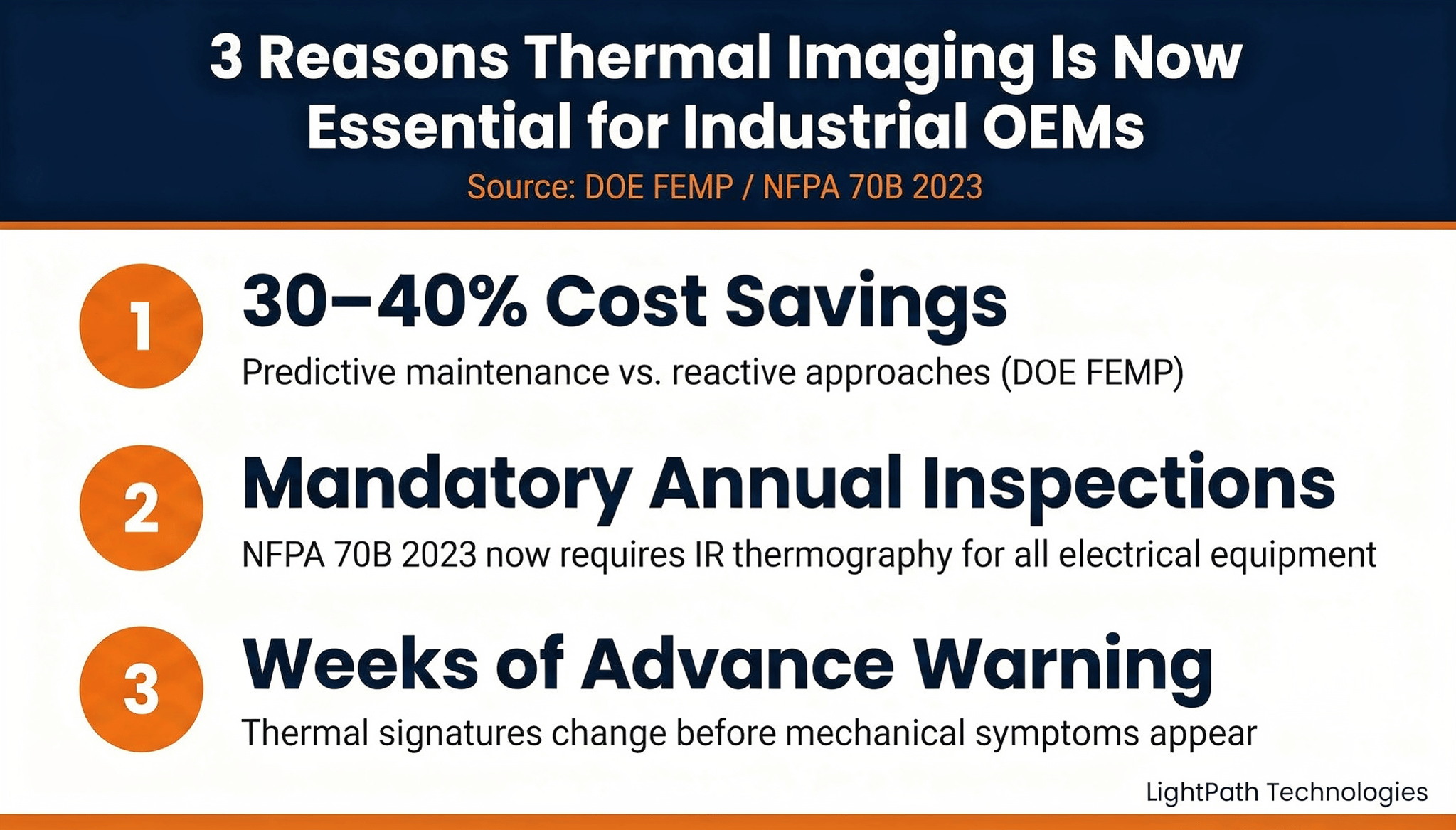
- Predictive maintenance programs powered by thermal imaging deliver 30-40% cost savings over reactive approaches, according to the U.S. Department of Energy's Federal Energy Management Program
- NFPA 70B 2023 now mandates annual infrared thermography inspections for all electrical equipment, shifting from recommended practice to enforceable standard
- Manufacturing inspection workflows across electrical, mechanical, and process environments all benefit from non-contact, continuous thermal monitoring
- OEMs and system integrators specifying thermal cameras for industrial platforms need to evaluate sensor type, integration protocols, and supplier depth to build competitive platforms
Thermal camera technology is the backbone of modern manufacturing quality control, and OEMs who build it in effectively gain a durable edge.
Manufacturing quality control has reached an inflection point. Plants are running hotter, faster, and with less tolerance for downtime than ever before. Traditional inspection methods like manual walkthroughs, scheduled shutdowns, and periodic spot checks cannot deliver the continuous, non-contact visibility that modern production lines demand. Demand for industrial thermal imaging cameras reflects that reality: the global predictive maintenance market was estimated at $14.29 billion in 2025 and is projected to reach $98.16 billion by 2033, driven largely by manufacturers adopting thermal monitoring technologies to shift from reactive to proactive operations.
For OEMs and system integrators building industrial monitoring platforms, the question is no longer whether thermal imaging belongs in the solution stack. It is how to specify, integrate, and deploy it in ways that maximize platform performance and client value.
What Makes an Industrial Thermal Imaging Camera Different?
Thermal imaging cameras detect infrared radiation emitted by objects and translate heat signatures into visual data. Unlike conventional cameras that capture reflected light, a well-specified industrial thermal imaging camera reveals what is happening beneath the surface, overheating bearings, degrading electrical connections, uneven process temperatures, long before any visible symptom appears.
What distinguishes an OEM-grade camera from general-purpose alternatives is its design for continuous, embedded operation in demanding environments. These systems support standard industrial communication protocols like GigE Vision and USB3 for seamless integration with SCADA systems, manufacturing execution systems (MES), and computerized maintenance management systems (CMMS). They carry appropriate IP ratings for dusty, high-vibration, and high-humidity factory environments, and they are engineered for multi-year deployed operation rather than periodic handheld surveys.
Cooled vs. Uncooled: The Core Architecture Decision
The first specification decision for any industrial thermal imaging platform is whether the application calls for a cooled or uncooled sensor. Both have defined roles in manufacturing environments.
Uncooled detectors, typically operating in the long-wave infrared (LWIR) range of 8-14 µm, are the workhorses of industrial monitoring. They are lighter, more compact, consume less power, and require no cryogenic cooling, making them well-suited for 24/7 embedded monitoring applications. Cooled systems, operating in the mid-wave infrared (MWIR) range of 3-5 µm, deliver higher sensitivity and greater thermal resolution for applications involving precision process inspection, long-range detection, or scenarios where minute temperature differentials carry critical information.
|
Feature |
Uncooled (LWIR, 8-14 µm) |
Cooled (MWIR, 3-5 µm) |
|
Best for |
24/7 monitoring, embedded OEM use |
High-sensitivity, precision process inspection |
|
Thermal sensitivity |
Adequate for most detection applications |
Superior for minute temperature differentials |
|
Size and weight |
Compact, SWaP-optimized |
Larger, higher power draw |
|
Maintenance |
Low, no cooling system |
Cooler maintenance required over time |
|
Typical applications |
Electrical inspection, predictive maintenance |
Precision QC, high-temperature process control |
How Do Industrial Thermal Imaging Systems Support Predictive Maintenance?
Predictive maintenance is the primary application driving industrial thermal camera adoption. The financial case is well-established: the U.S. Department of Energy's Federal Energy Management Program has documented that predictive maintenance programs deliver 30-40% cost savings over reactive maintenance approaches. Heat is one of the earliest and most reliable indicators of equipment degradation, and a thermal imaging camera embedded in production infrastructure creates a continuous baseline for critical assets.
When a bearing begins to fail, electrical resistance increases in a degrading connection, or a motor starts drawing excess current, the thermal signature changes before any mechanical symptom surfaces. OEM platforms built around these thermal imaging systems give maintenance teams weeks or months of advance warning, transforming unplanned emergency repairs into scheduled interventions.
Electrical System Monitoring and NFPA 70B Compliance
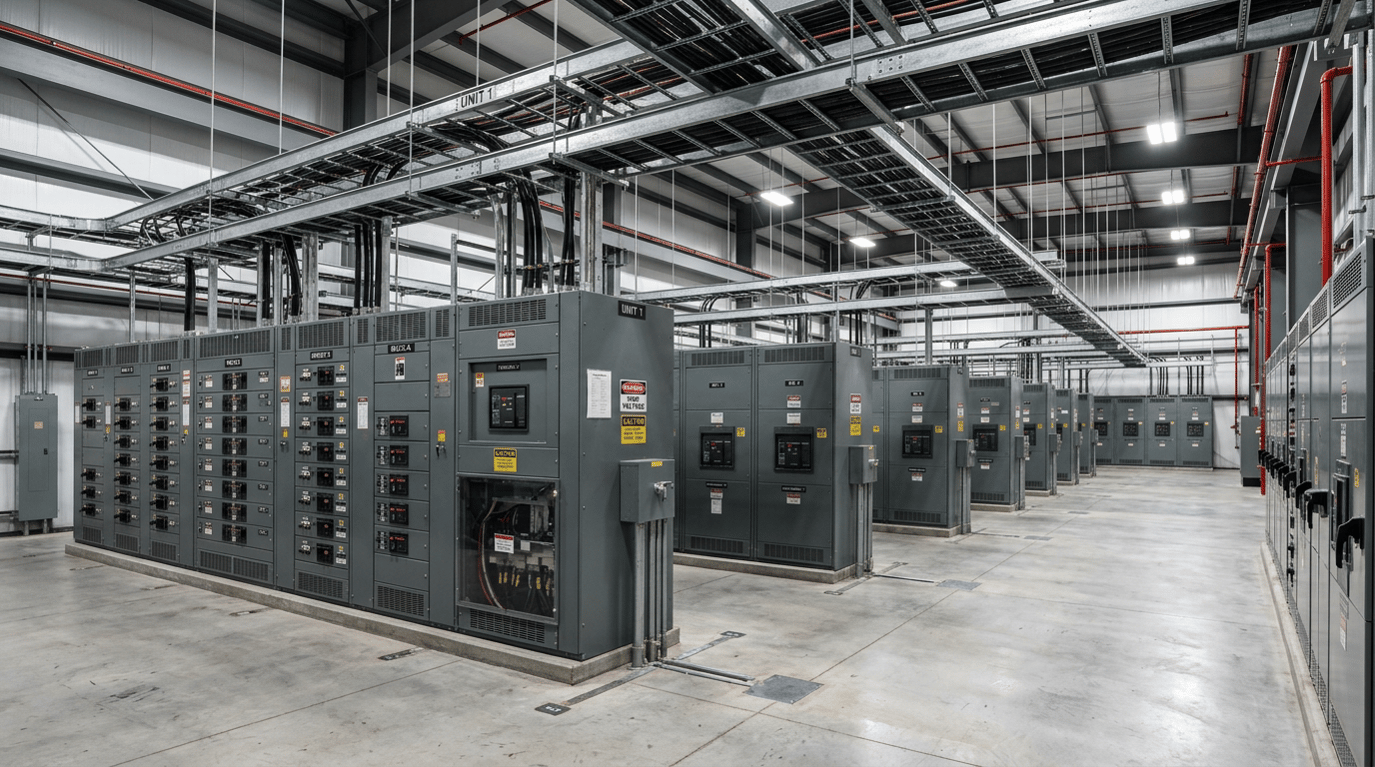
Electrical systems are the most common and highest-value predictive maintenance application for industrial thermal monitoring. Loose connections, overloaded circuits, and failing components generate characteristic heat signatures that build gradually over time. A thermal monitoring platform deployed across a facility's distribution panels, motor control centers, and switchgear creates a continuous audit of electrical system health.
The regulatory landscape reinforces the business case here. The 2023 edition of NFPA 70B made annual infrared thermography inspections of all electrical equipment mandatory rather than recommended. Equipment classified under condition three requires thermographic inspection at least every six months. For OEMs building electrical monitoring platforms, this creates durable, compliance-driven demand from industrial customers who need to meet these requirements systematically rather than through periodic manual surveys.
Rotating Machinery and Process Monitoring
Motors, bearings, conveyor systems, and compressors generate characteristic heat patterns during normal operation. Bearing wear, misalignment, and lubrication problems all produce temperature anomalies that a thermal inspection camera can detect before the degradation progresses to audible noise, vibration, or catastrophic failure. OEM platforms integrating thermal monitoring across rotating equipment give plant operators condition-based maintenance data in real time, enabling scheduling during planned downtime windows rather than crisis responses to unexpected line stops.
In process-intensive manufacturing, metal fabrication, plastics molding, chemical production, temperature control is quality control. An industrial thermal inspection camera deployed in a manufacturing inspection workflow provides continuous feedback on furnaces, ovens, and heat treatment processes. Deviations from established temperature profiles are flagged in real time, allowing process corrections before off-spec product reaches the next production stage. For weld verification, composite curing, and manufacturing inspection workflows, thermal imaging gives quality teams a non-contact, non-destructive window into process integrity that visible-light systems cannot provide.
What Applications Drive the Most Value for OEM Platform Builders?
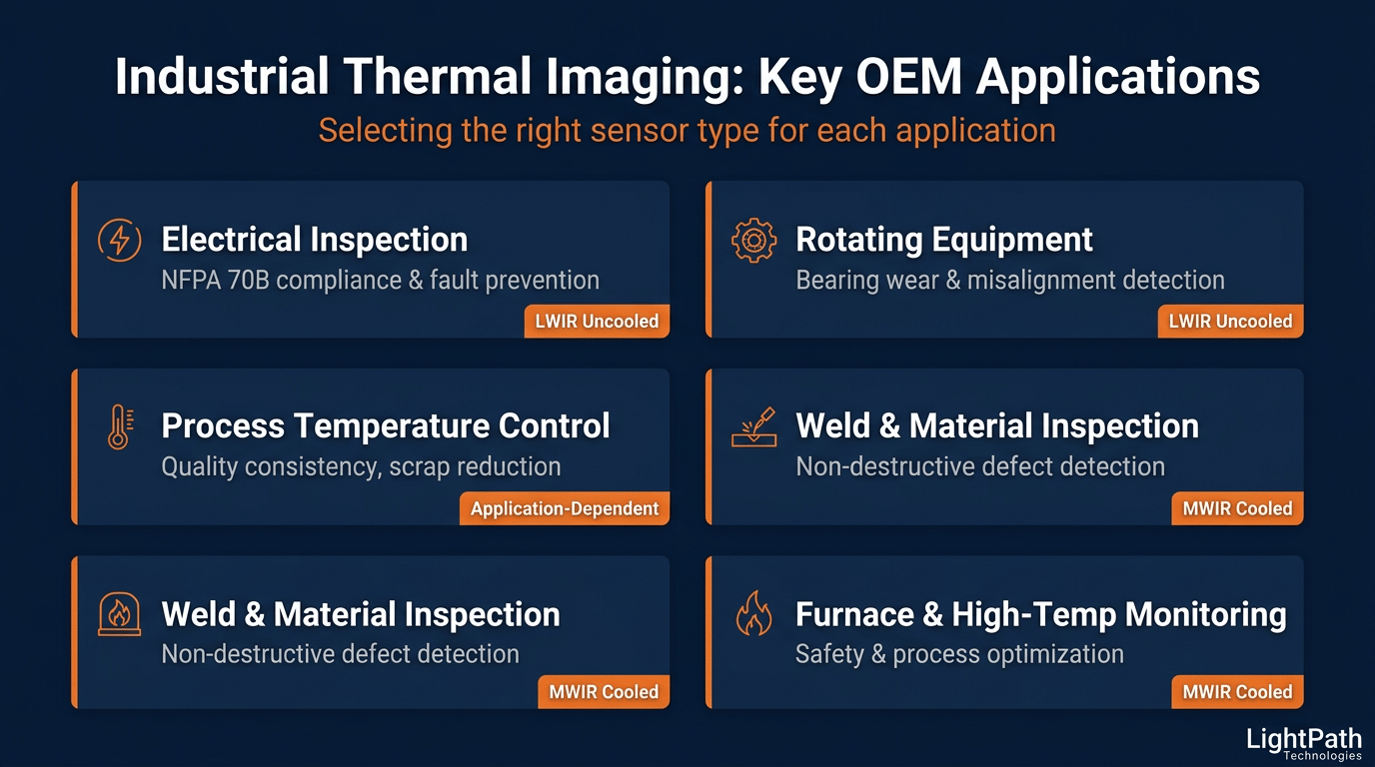
OEMs selecting thermal imaging systems for platform development need to think beyond the sensor itself. The value delivered to end-user manufacturers comes from how effectively thermal data integrates with their operational workflows. Here are the core application areas where well-integrated thermal imaging systems consistently deliver measurable results.
- Electrical infrastructure monitoring. Continuous thermal surveillance of distribution panels, motor control centers, and switchgear identifies developing faults before they cause production-stopping failures. NFPA 70B 2023 compliance requirements are accelerating demand for systematic, documented inspection programs.
- Rotating equipment condition monitoring. Thermal baselines for motors, pumps, and conveyor systems provide objective data for condition-based maintenance scheduling, catching bearing wear and misalignment weeks before failure.
- Process quality control. Real-time thermal feedback on temperature-controlled manufacturing processes catches deviations early, reducing scrap and rework.
- Non-destructive inspection. Thermal imaging systems integrated into production lines identify internal defects, weld quality, and material inconsistencies that conventional vision systems miss entirely.
- Furnace and high-temperature monitoring. Thermal imaging deployed in steel, glass, and chemical production provides continuous surveillance of extreme-temperature processes where manual inspection is impractical.
|
Application |
Primary Value |
Sensor Type |
|
Electrical inspection / NFPA 70B compliance |
Fault prevention, compliance documentation |
Uncooled LWIR |
|
Rotating machinery monitoring |
Planned maintenance, downtime reduction |
Uncooled LWIR |
|
Process temperature control |
Quality consistency, scrap reduction |
Application-dependent |
|
Weld and material inspection |
Non-destructive defect detection |
Cooled MWIR (precision) |
|
Furnace / high-temp monitoring |
Safety, process optimization |
Cooled MWIR |
What Should OEMs Evaluate When Specifying a Thermal Imaging System?
Specifying an industrial thermal imaging camera for OEM platform development goes well beyond matching sensor resolution to application requirements. The full system architecture, including optics, integration protocols, environmental ratings, and supplier depth, determines whether the platform performs reliably at scale.
Spectral band and sensitivity. For most continuous monitoring applications in manufacturing, LWIR uncooled systems deliver adequate performance. A thermal inspection camera operating in the LWIR band covers the widest range of predictive maintenance and quality control use cases. Applications demanding fine temperature discrimination or precision process inspection benefit from cooled MWIR systems.
Resolution. Broad-area electrical monitoring can operate at lower resolution. Precision defect detection and material inspection require higher spatial resolution to capture the detail needed for actionable quality data.
Integration protocols. Thermal cameras for OEM platforms need to support GigE Vision and USB3 interfaces. Compatibility with GigE Vision enables direct connection to SCADA, MES, and CMMS platforms, eliminating middleware complexity that slows development timelines.
Environmental protection. Cameras specified for harsh industrial environments need appropriate IP ratings and mechanical robustness to deliver reliable operation over multi-year deployment cycles in high-temperature, dusty, or high-vibration conditions.
Supplier depth. Platform builders achieve the best results when their thermal imaging supplier can cover the full stack from optical design through final camera assembly. Suppliers who manufacture their own optics, coatings, and camera assemblies offer better integration consistency, faster custom engineering response, and more predictable supply chain performance than assemblers working with components from multiple third parties.
Effective industrial thermal monitoring starts with establishing thermal baselines, capturing the normal thermal signatures of critical equipment across operating conditions. These baselines become the reference against which automated anomaly detection flags deviations. From there, data flows into CMMS and MES platforms through standard protocols, automatically generating maintenance work orders and contributing to equipment health trend analysis. For OEMs building scalable platforms, thermal imaging integration best practices consistently emphasize structured data management: thermal data is most valuable when it connects directly to the operational decisions that prevent downtime and improve quality.
Frequently Asked Questions
What is the difference between an industrial thermal imaging camera and a general-purpose IR camera? OEM-grade thermal cameras are engineered for continuous embedded operation in demanding environments. They support industrial communication protocols, carry appropriate environmental protection ratings, and are specified for long-term deployment, unlike handheld cameras designed for periodic manual surveys.
Do industrial monitoring platforms require LWIR or MWIR cameras? Most continuous monitoring and predictive maintenance applications are well-served by uncooled LWIR cameras operating in the 8-14 µm range. Applications requiring higher sensitivity or precise process temperature measurement often benefit from cooled MWIR systems. The right choice depends on the specific detection target and inspection environment.
How does NFPA 70B 2023 affect demand for industrial thermal monitoring platforms? The 2023 NFPA 70B standard made annual infrared thermography inspections of all electrical equipment mandatory rather than recommended. Equipment in degraded condition requires inspections every six months. This creates a compliance-driven requirement that OEM monitoring platforms can address far more efficiently than periodic manual inspection services.
What integration protocols do industrial thermal cameras typically support? GigE Vision and USB3 are the current standard interfaces for industrial thermal imaging integration. GigE Vision enables direct integration with SCADA, MES, and CMMS platforms through standard industrial network infrastructure.
Build Your Industrial Thermal Imaging Platform on a Foundation That Performs
Industrial thermal imaging cameras have moved from specialized inspection tools to essential platform components in manufacturing quality control and predictive maintenance programs. The combination of regulatory tailwinds from NFPA 70B, compelling ROI data, and growing OEM demand for integrated thermal monitoring solutions makes this a category with sustained growth ahead.
The difference between a functional thermal system and a high-performance platform comes down to the depth of the supplier relationship and the quality of the optics and camera engineering behind it. LightPath Technologies brings four decades of optical and thermal imaging expertise to industrial OEM partnerships, with vertically integrated manufacturing covering proprietary infrared glass, precision optics, lens assemblies, and complete camera systems. Talk with our team to discuss your industrial thermal imaging platform requirements.