
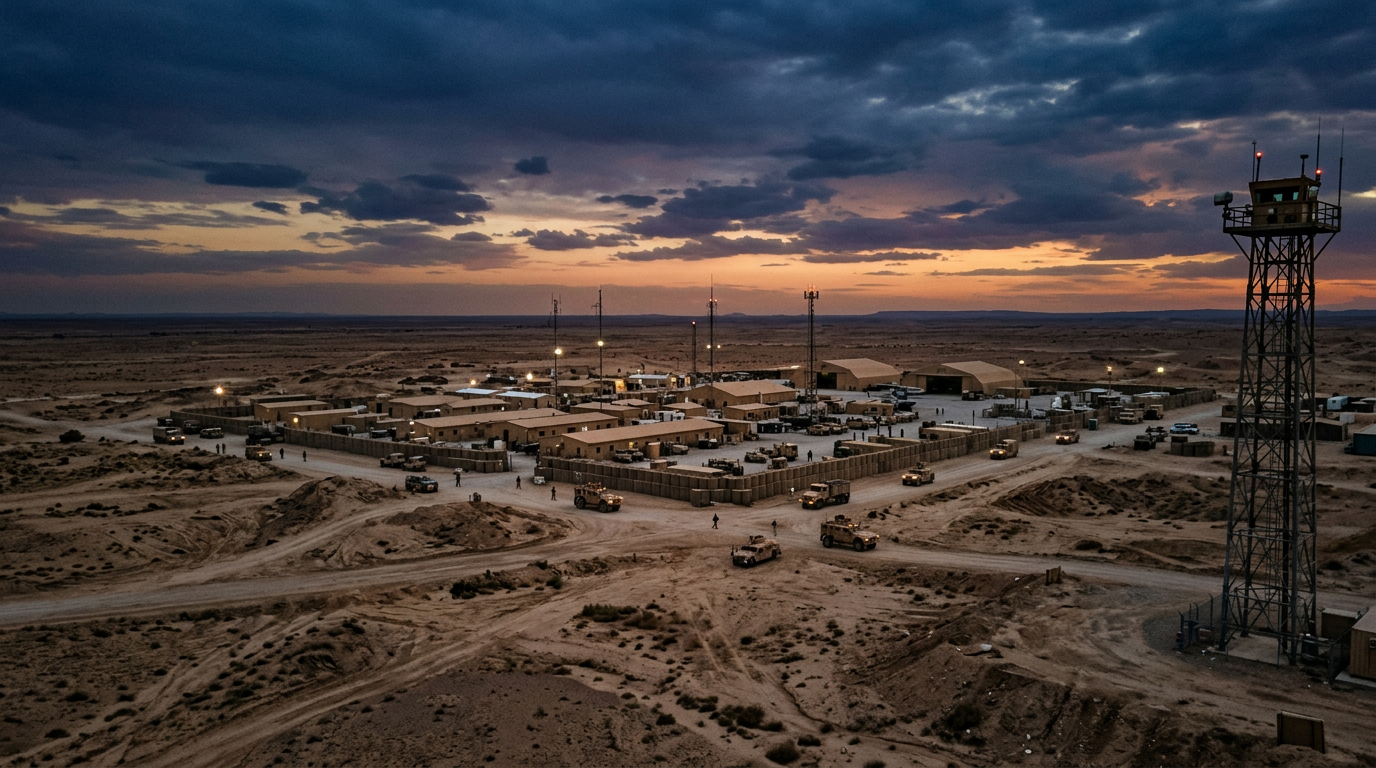
Key Takeaways
The LWIR vs MWIR decision shapes system architecture, total cost, and long-term program viability across defense and industrial applications.
- Target temperature and detection range are the first filters: MWIR excels at elevated-temperature targets over long distances; LWIR covers ambient-temperature objects efficiently with uncooled detectors
- Atmospheric conditions matter significantly: MWIR generally performs better in humid and maritime environments; LWIR holds advantages in smoke, dust, and particulate-heavy conditions
- System architecture diverges sharply: MWIR requires active cooling, adding SWaP burden and maintenance overhead; uncooled LWIR simplifies integration and lowers lifecycle costs
- A third path exists: broadband infrared (BBIR) systems spanning 2-14 µm offer application flexibility without cooled detector complexity, increasingly relevant for multi-role platforms
Technology selection drives everything downstream -- match your band to your operational profile before optimizing anything else.
The infrared imaging market is projected to grow from $8.61 billion in 2025 to $11.65 billion by 2030, according to recent MarketsandMarkets analysis. Defense modernization and industrial automation are the twin engines. For OEMs and system integrators, that growth creates real opportunity. But it also creates real pressure to make the right technology bets early.
The LWIR vs MWIR decision sits at the center of that challenge. Get it right and your platform is positioned to outperform on detection capability, integration timeline, and total cost of ownership. Get it wrong and you're redesigning components mid-program or underperforming against competitors who made the better call.
This guide cuts through the complexity for engineers, program managers, and product developers building next-generation thermal imaging systems. It covers where each band excels, where each falls short, how atmospheric conditions change the calculus, and how industry verticals typically deploy each technology. We also flag the increasingly relevant broadband option for platforms that need flexibility.
What Are the Core Differences Between LWIR vs MWIR?
Long-wave infrared (LWIR) and mid-wave infrared (MWIR) are two distinct portions of the electromagnetic spectrum. Both detect heat, but they operate on different physics, require different detector architectures, and perform differently across environments and target types. Understanding those differences is the foundation for every downstream design decision.
LWIR cameras operate in the 8-14 µm wavelength range. Objects at typical terrestrial temperatures, including people, vehicles, structures, and equipment under normal operating conditions, emit the bulk of their thermal energy in this band. That physical alignment makes LWIR the default choice for surveillance, perimeter monitoring, and most industrial inspection applications. Crucially, LWIR enables uncooled detector designs, eliminating the weight, power, and maintenance overhead of active cooling systems.
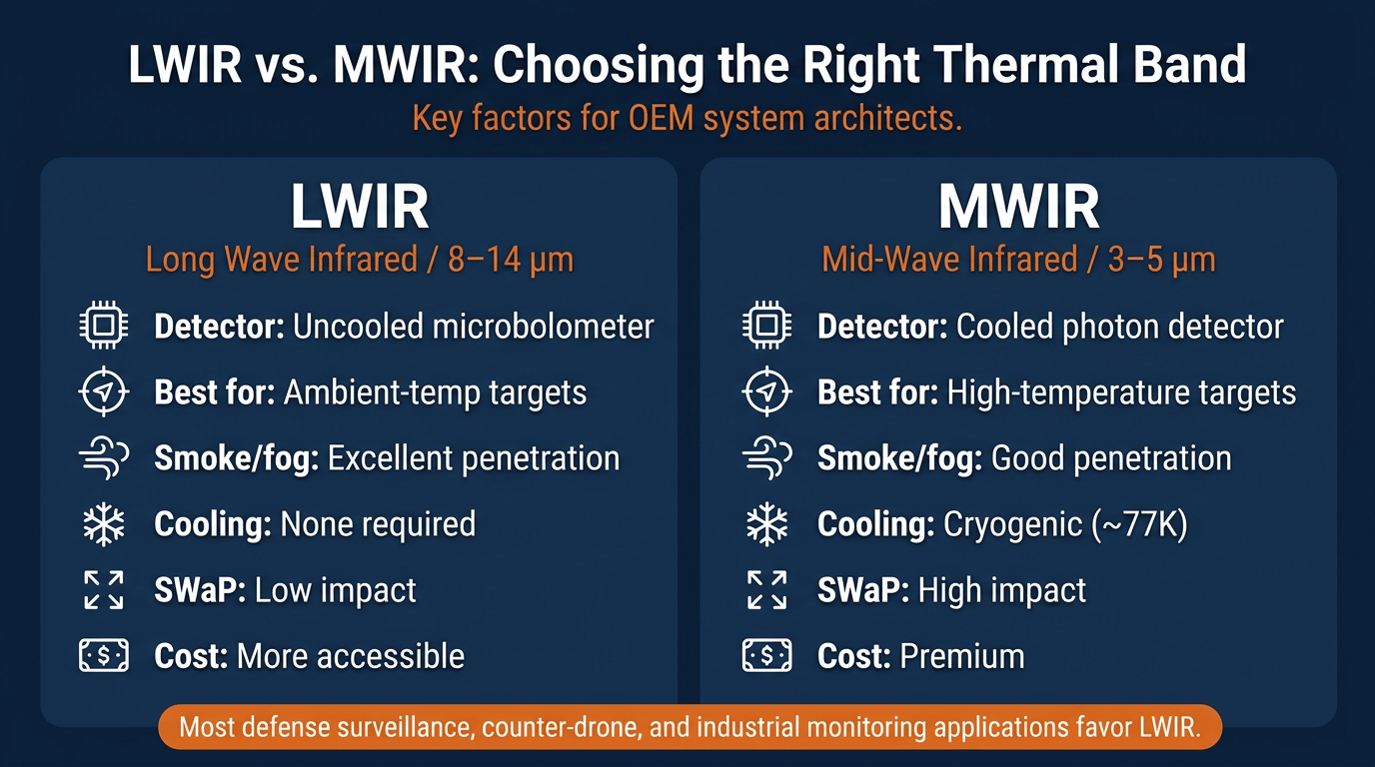
MWIR cameras operate in the 3-5 µm range. At these shorter wavelengths, the technology captures thermal emissions from objects significantly above ambient temperature, including engine exhaust, industrial furnaces, aircraft propulsion, and similar high-heat sources. MWIR's sensitivity to elevated temperatures at extended ranges makes it the band of choice for long-range defense targeting, maritime domain awareness, and high-temperature process monitoring. That performance typically requires cooled detector arrays, which add system complexity and cost, but deliver sensitivity that uncooled LWIR cameras cannot match at range.
LWIR vs MWIR: At-a-Glance Comparison
|
Characteristic |
LWIR (8-14 µm) |
MWIR (3-5 µm) |
|---|---|---|
|
Wavelength Range |
8-14 µm |
3-5 µm |
|
Best For |
Ambient-temperature targets: personnel, vehicles, equipment |
Elevated-temperature targets: engines, exhaust, furnaces |
|
Detector Type |
Uncooled (microbolometer) or cooled |
Typically cooled (InSb, MCT) |
|
Cooling Required |
No (for uncooled configurations) |
Yes (cryogenic cooling) |
|
Thermal Sensitivity |
30-60 mK (uncooled); 30-60 mK (cooled LWIR) |
High sensitivity to elevated-temp targets at range |
|
Atmospheric Performance |
Stronger in smoke, dust, particulates |
Stronger in humid, maritime conditions |
|
SWaP Profile |
Low (uncooled) |
Higher (cooling adds size/weight/power) |
|
Typical Use Cases |
Surveillance, perimeter security, predictive maintenance, counter-UAS |
Long-range targeting, maritime ISR, high-temp industrial processes |
How Do Atmospheric Conditions Affect LWIR vs MWIR Performance?
This is where the LWIR vs MWIR decision gets nuanced, and where generalizations can lead programs astray. The atmosphere does not treat these two bands equally, and the differences are operationally significant.
MWIR in Humid and Maritime Environments
MWIR generally performs better in humid conditions and environments with fine aerosols. The mid-wave band experiences less absorption from atmospheric water vapor across most operational ranges, which is why maritime domain awareness, coastal surveillance, and operations in tropical or humid climates tend to favor MWIR cameras. Salt spray, sea fog, and high ambient moisture content affect LWIR imaging more acutely, making MWIR the more reliable choice when platforms will regularly operate near or over water. Peer-reviewed modeling studies on infrared atmospheric transmission confirm that LWIR range performance is more sensitive to temperature and relative humidity variations than MWIR, with MWIR providing range advantages in higher-temperature, higher-humidity environments.
LWIR in Smoke, Dust, and Particulate Environments
LWIR holds an advantage in environments with suspended particulates, including smoke from fires, battlefield obscurants, and certain industrial environments. The longer wavelengths interact differently with particle scatter, maintaining image quality when MWIR performance degrades. This characteristic is well established in firefighting and certain military scenarios, though the degree of advantage depends heavily on particle size distribution and density. Neither band is immune to all atmospheric interference, and real-world conditions should drive selection rather than general rules.
Day/Night Thermal Contrast
Both technologies perform in complete darkness, which is a core advantage over visible-spectrum imaging. Where they differ is in daytime thermal contrast. LWIR systems can be more affected by background temperature rise during warm days, reducing contrast between targets and backgrounds. MWIR systems tend to maintain more consistent contrast across the day/night cycle. For LWIR, cold-climate or nighttime-heavy operational profiles typically yield the strongest performance, as higher thermal contrast between targets and background works in the system's favor.
Infrared Wavelength Comparison: Atmospheric Performance Summary
|
Condition |
LWIR |
MWIR |
Key Variable |
|---|---|---|---|
|
High Humidity / Maritime |
More affected |
Generally better |
Water vapor absorption |
|
Smoke / Particulates |
Often better |
More variable |
Particle size and density |
|
Clear Conditions |
Excellent |
Excellent |
Other factors dominate |
|
Fog / Haze |
Good (larger droplets) |
Variable |
Droplet size distribution |
|
Cold Climate / Night |
Higher thermal contrast |
Consistent performance |
Target-to-background delta |
|
Warm Climate / Day |
Reduced contrast possible |
Better target differentiation |
Background temperature rise |
Which Industries Favor LWIR or MWIR Cameras?
Application patterns in the field reflect the performance characteristics outlined above. Different operational environments create predictable preferences for one band over the other, though there is significant overlap and dual-band deployments are increasing. Here is how the major markets for infrared imaging technology typically align.
Aerospace and Defense
Defense applications split fairly predictably along range and target-temperature lines. Long-range surveillance and targeting, particularly in maritime and humid environments, favor MWIR cameras for their sensitivity advantages at extended distances. ISR platforms operating in these environments benefit from the band's ability to detect subtle heat differentials at standoff ranges where LWIR contrast may degrade.
Perimeter security and counter-UAS applications often favor LWIR, where ambient-temperature detection and the ability to deploy uncooled sensors reduces platform complexity and cost. Small UAS with limited engine signatures are frequently better detected via airframe thermal contrast rather than propulsion heat, which suits LWIR's strengths. Shipboard and maritime applications, consistent with the atmospheric data above, tend toward MWIR.
For a deeper look at how these considerations play out in defense program design, the LWIR technology guide for system integrators provides useful foundational context on detector architectures and integration trade-offs.
Industrial Monitoring and Predictive Maintenance
Industrial thermal imaging broadly favors LWIR. Most monitored assets, including electrical panels, motors, bearings, transformers, and building envelopes, operate at ambient or mildly elevated temperatures where LWIR detection is well-suited. The uncooled configuration makes continuous 24/7 monitoring practical: no cooling maintenance, lower power draw, and simpler integration into fixed installation architectures.
Where MWIR enters the industrial picture is in high-temperature process monitoring. Furnace inspection, combustion analysis, welding, and glass or steel production involve temperatures where MWIR's sensitivity to elevated heat provides meaningful advantages. Gas detection splits by molecule: hydrocarbon detection tends to favor MWIR due to absorption characteristics around 3.3 µm, while other gas types, including SF6 detection, fall into LWIR territory.
The industrial LWIR camera selection guide covers these integration considerations in more depth for OEMs building continuous monitoring platforms.
Counter-Drone and UAV Applications
Counter-UAS applications present an interesting split case. Larger drones with meaningful engine signatures are detectable via MWIR's sensitivity to exhaust heat. Smaller commercial-class or military-grade drones with minimal thermal signatures are often more reliably tracked via LWIR using airframe temperature contrast against the sky background. Many advanced CUAS platforms incorporate both technologies for this reason, optimizing across the full drone threat spectrum.
5 Questions to Ask Before Choosing LWIR or MWIR Cameras
Selecting between LWIR and MWIR cameras is not a single-variable decision. These five questions form a practical decision framework that applies across defense and industrial program types.
- What temperature range are your primary targets operating at?
Objects near ambient temperature favor LWIR. Objects significantly above ambient, like vehicle engines, industrial furnaces, or exhaust plumes, favor MWIR. This single question often determines the answer.
- What is your primary operating environment?
Maritime, coastal, and humid environments generally favor MWIR. Dusty, smoke-prone, or particulate-heavy environments often favor LWIR. A mixed-environment profile may warrant dual-band or broadband consideration.
- What are your SWaP constraints?
If your platform has tight size, weight, and power limits (common in airborne, UAS, and man-portable applications), uncooled LWIR is frequently the more viable path. MWIR's cooling requirements add meaningful overhead that smaller platforms cannot always absorb.
- What are your deployment and maintenance requirements?
Continuous monitoring and high-uptime applications benefit from uncooled LWIR, which requires minimal maintenance. Applications where performance justifies periodic cryocooler servicing, and where operational downtime is acceptable, can sustain cooled MWIR systems.
- Does your application require export compliance flexibility?
MWIR systems frequently require export licensing under ITAR and EAR regulations. For programs with international deployment requirements or complex supply chain structures, the compliance overhead of MWIR can affect delivery timelines and program planning.

Is There a Third Path? When to Consider Broadband Infrared
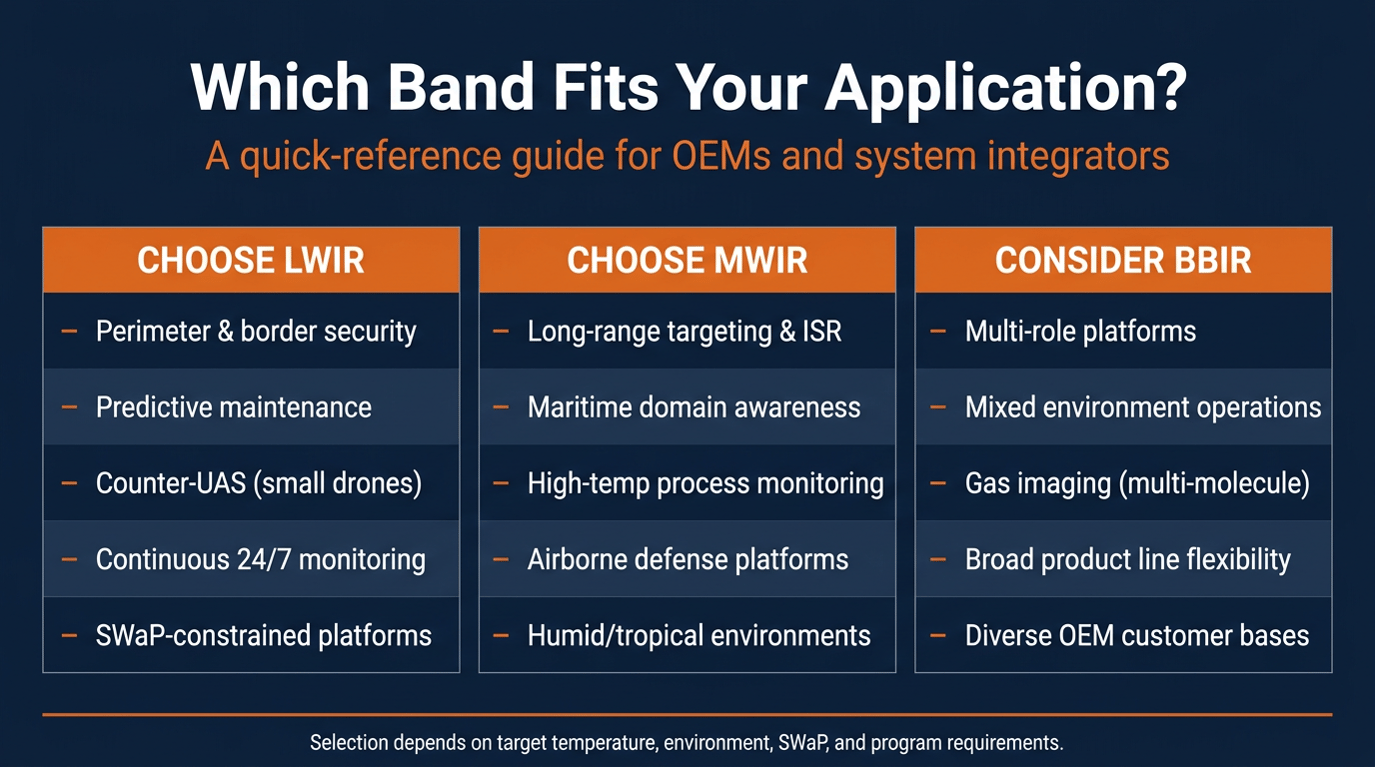
For OEMs building platforms that need to serve diverse applications, or whose detection requirements span both ambient and elevated temperatures, broadband infrared (BBIR) is worth considering. BBIR systems operating across the 2-14 µm range combine capabilities traditionally split between LWIR and MWIR, allowing detection across a wider thermal range without the cooling requirements of dedicated MWIR.
This extended spectral coverage has particular relevance for multi-role defense platforms and certain gas imaging applications where detection targets span multiple molecular absorption bands. The broadband infrared imaging approach also simplifies supply chain management for OEMs building product lines that need to serve both defense and industrial customers without maintaining separate component inventories.
Broadband is not a universal solution, and for applications where the performance ceiling of a single, optimized band is critical, LWIR or MWIR will still deliver better results. But for product roadmaps requiring flexibility, BBIR is a genuine and increasingly viable option that program managers should evaluate alongside the two primary bands.
How Do Material Choices and Supply Chain Affect the LWIR vs MWIR Decision?
Infrared optical components are not commodity items. The materials required to transmit effectively in each band have real supply chain implications that affect program risk, production costs, and long-term viability for OEMs building at volume.
LWIR optics have historically relied heavily on germanium, a material facing persistent supply challenges and cost volatility driven by geopolitical factors and production concentration. Chalcogenide glass materials offer a compelling alternative: they transmit well across the LWIR band, can be precision-molded into complex shapes, and draw from more stable, diversified sources. For any thermal imaging technology program with multi-year volume requirements, optical material supply stability belongs in the risk register alongside detector sourcing.
MWIR optics commonly use silicon for mid-wave applications, which is more widely available and cost-stable. However, the cooling hardware required for MWIR systems introduces separate supply chain considerations, as cryogenic cooling components have specialized suppliers and scheduled maintenance requirements that affect operational availability.
For program managers evaluating long-term supply stability, the infrared lens materials guide for OEMs provides a practical overview of material trade-offs across LWIR, MWIR, and broadband configurations.
Total Cost of Ownership: What LWIR vs MWIR Means for Your Program Budget
Acquisition cost is only part of the financial picture. Total cost of ownership across a program's lifecycle often tells a different story, and for OEMs, what matters is how these costs flow through to your product and your customers.
|
Cost Factor |
LWIR Systems |
MWIR Systems |
|---|---|---|
|
Component Acquisition |
Lower (especially uncooled) |
Higher (cooling hardware adds cost) |
|
Power Consumption |
Low to moderate (uncooled) |
High (cooling draws significant power) |
|
Maintenance |
Minimal (uncooled configurations) |
Regular cryocooler servicing required |
|
Integration Complexity |
Lower; simpler thermal management |
Higher; cooling system integration |
|
Operational Availability |
High; uncooled systems have minimal downtime |
Moderate; scheduled cooling maintenance |
|
Export Compliance Overhead |
Generally lower |
Often requires licensing (ITAR/EAR) |
MWIR's higher costs are frequently justified for applications where the performance advantage is operationally significant, such as long-range targeting or detection at extended standoff ranges. The risk is over-specifying: programs that could meet all mission requirements with LWIR but chose MWIR for theoretical performance gain often find the cost differential compounds throughout the program lifecycle.
For a broader look at how thermal imaging technology requirements are evolving across both platforms, the thermal imaging trend analysis for 2026 covers how detector advancements and SWaP optimization are affecting both bands.
Frequently Asked Questions: LWIR vs MWIR
What are the confirmed spectral ranges for LWIR and MWIR thermal imaging?
LWIR operates in the 8-14 µm wavelength range; MWIR operates in the 3-5 µm range. These represent the relevant atmospheric transmission windows for each band and are the standard references used in defense and industrial imaging specifications.
Do MWIR systems always require active cooling?
Most MWIR systems require cooled detector arrays, typically using cryogenic cooling to operate near 77 Kelvin. This is not an absolute technical requirement but reflects the practical reality that MWIR detector materials like InSb and MCT need cooling to achieve the sensitivity levels that make the band worthwhile for demanding applications. LWIR, by contrast, commonly uses uncooled microbolometer detectors that operate at room temperature, delivering thermal sensitivity in the 30-60 mK range that meets most surveillance and monitoring requirements.
How does thermal imaging technology compare when applied to counter-UAS applications?
Counter-drone applications benefit from both bands depending on the threat profile. MWIR provides better detection of drones with meaningful engine heat signatures and generally offers superior range in clear or humid conditions. LWIR is often more effective for small drones with minimal propulsion heat, detecting airframe thermal contrast against sky backgrounds. High-capability CUAS platforms increasingly integrate both bands to maximize threat coverage.
What is an infrared wavelength comparison's significance for gas detection?
Gas detection splits along molecular absorption lines. Hydrocarbon detection (methane, propane, other common industrial gases) occurs primarily in the MWIR band around the 3.3 µm absorption window. Other gases, including SF6 used in electrical equipment, are better detected in the LWIR band around 10.6 µm. Multi-gas monitoring applications may require dual-band capability or careful band selection based on the specific compounds being detected.
Is broadband infrared a viable alternative to choosing between LWIR and MWIR cameras?
Broadband infrared systems spanning 2-14 µm are viable for applications requiring spectral flexibility across ambient and elevated temperature ranges. They do not fully replicate the optimized performance of a dedicated MWIR cooled system at extreme ranges or in demanding thermal scenarios, but for multi-role platforms and product lines serving diverse customers, BBIR offers a practical middle path without cooling complexity.
Start with the Right Band. Build from There.
The LWIR vs MWIR decision is not about which technology is better in the abstract. It is about which one fits your mission profile, your operational environment, and your program economics. Most OEMs and system integrators find that a structured evaluation of target temperature, environmental conditions, SWaP constraints, and lifecycle cost consistently points toward the right answer faster than chasing specification sheets.
The infrared imaging market's continued expansion, driven by defense modernization and industrial automation demand, rewards platforms built on well-matched technology choices. Programs that get the band selection right early spend development time optimizing performance rather than redesigning around a mismatch.
LightPath Technologies delivers vertically integrated thermal imaging solutions across LWIR, MWIR, and broadband configurations, from proprietary Black Diamond chalcogenide glass through complete camera assemblies built for defense and industrial OEM programs.
Whether you are evaluating band selection for a new platform or optimizing an existing design, our engineering team works alongside yours from requirements through integration. Connect with our thermal imaging specialists to discuss what the right infrared architecture looks like for your specific application.