


Key Takeaways
An infrared lens transmits thermal radiation that standard glass cannot, making it essential for thermal imaging systems across defense, industrial, and aerospace applications.
- Different IR lens types serve distinct spectral bands: LWIR (8–14 µm), MWIR (3–5 µm), and broadband configurations (2–14 µm) each require specific material choices
- Germanium has long dominated LWIR lens materials, but supply chain concerns are driving demand for chalcogenide glass alternatives
- Choosing between standard and custom IR optics depends on integration requirements, volume, and whether your application demands specialized coatings or athermalized designs
For OEMs and system integrators building mission-critical platforms, partnering with a vertically integrated optics provider can streamline development and reduce supply chain risk.
Thermal imaging technology has moved well beyond its military origins to become a cornerstone of modern industrial and defense systems. From border surveillance platforms to predictive maintenance solutions, the demand for reliable infrared optics continues to accelerate. According to a 2024 report from Grand View Research, the global thermal imaging market is projected to grow at over 7% annually through 2030, driven by expanding applications in security, automotive, and industrial automation.
For OEMs and system integrators, understanding how an infrared lens works and which materials suit specific applications is fundamental to building systems that perform when it matters. This guide breaks down the essentials of IR lens types, spectral bands, and the practical considerations that inform material selection for professional thermal imaging applications.
What Is an Infrared Lens and How Does It Work?
An infrared lens focuses thermal radiation onto a detector, enabling systems to create images based on heat signatures rather than visible light. While visible-light optics rely on standard optical glass, infrared wavelengths require specialized materials that can transmit energy in the mid-wave and long-wave portions of the electromagnetic spectrum.
Standard optical glass absorbs infrared radiation rather than transmitting it. This is why thermal imaging systems require lenses made from materials like germanium, silicon, zinc selenide, or chalcogenide glass. Each material has distinct transmission characteristics, mechanical properties, and cost profiles that make it suitable for specific applications and spectral ranges.
The lens assembly in a thermal imaging system does more than focus energy. It also affects critical performance parameters like field of view, image resolution, and the system's ability to maintain focus across temperature extremes. For integrators building platforms that must operate reliably in harsh environments, these characteristics matter as much as raw transmission numbers.
What Are the Main IR Lens Types by Spectral Band?
Infrared imaging systems operate across different wavelength ranges, and each range has distinct advantages depending on the application. Understanding these spectral bands helps OEMs and program managers select optics that match their platform's mission requirements.
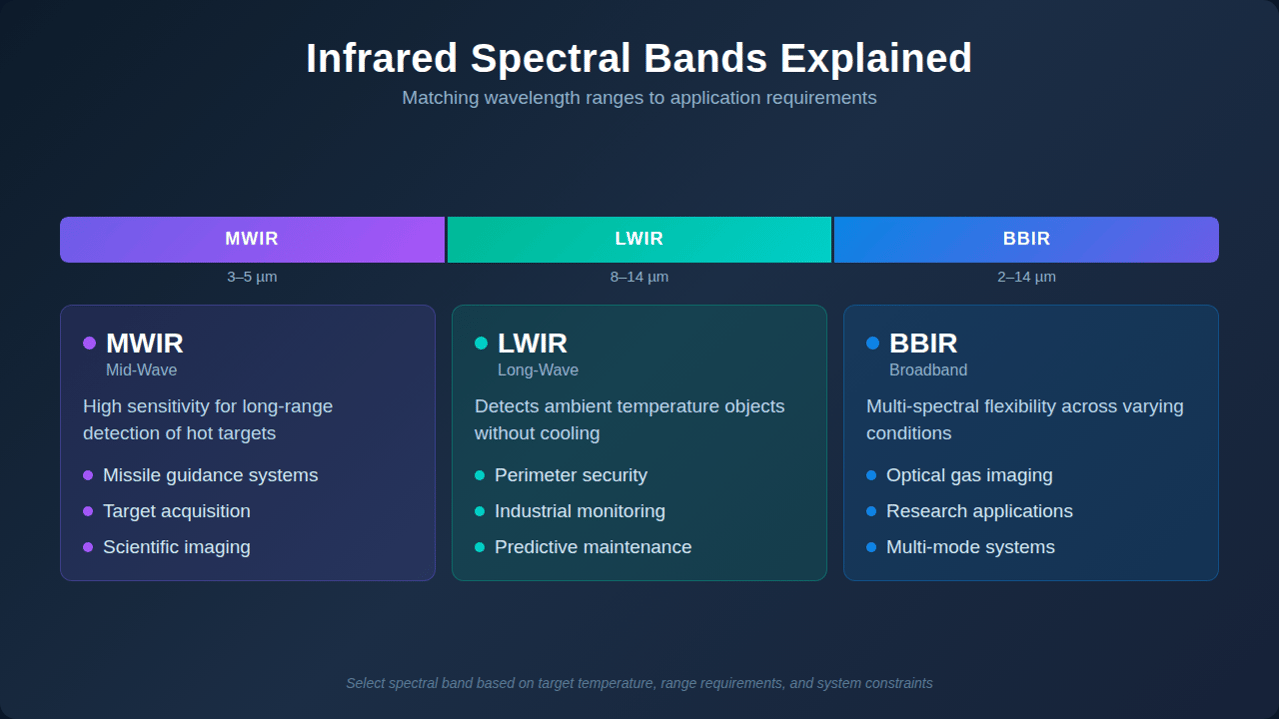
|
Spectral Band |
Wavelength Range |
Primary Applications |
Key Characteristics |
|
MWIR (Mid-Wave) |
3–5 µm |
Long-range targeting, missile seekers, scientific imaging |
High sensitivity, requires cooling, excellent for hot target detection |
|
LWIR (Long-Wave) |
8–14 µm |
Surveillance, perimeter security, industrial monitoring |
Detects ambient temperature objects, uncooled options available |
|
BBIR (Broadband) |
2-14 µm |
Research, multi-mode systems, optical gas imaging |
Flexibility across varying target types and conditions |
MWIR optics excel in applications requiring detection of high-temperature targets against cooler backgrounds. Defense platforms often use MWIR for targeting and tracking because these systems can detect subtle temperature differences at extended ranges. The trade-off is that MWIR detectors typically require cryogenic cooling, which adds complexity, weight, and power consumption.
LWIR lens materials serve the majority of commercial and security applications because they detect radiation emitted by objects at ambient temperatures. A person, vehicle, or piece of industrial equipment naturally emits energy in the LWIR band, making these systems ideal for surveillance, predictive maintenance, and process monitoring. Long-wave infrared solutions offer the advantage of uncooled detector compatibility, which significantly reduces system complexity and cost.
BBIR lens configurations provide flexibility for applications where targets may vary or where multi-spectral capability offers operational advantages. These broadband infrared systems are particularly valuable in research environments and specialized industrial applications like optical gas imaging, where different gases absorb at different wavelengths.

Which Materials Work Best for Each Infrared Band?
Material selection is one of the most consequential decisions in infrared optical system design. Each material offers a different balance of transmission efficiency, durability, thermal stability, and cost. For system integrators and procurement teams, understanding these trade-offs informs better sourcing decisions and helps manage program risk.
|
Material |
Best For |
Transmission Range |
Key Advantages |
Considerations |
|
Germanium |
LWIR |
2–14 µm |
High refractive index, excellent LWIR transmission |
Supply chain constraints, cost volatility, requires AR coating |
|
Silicon |
MWIR |
1.2–7 µm |
Low cost, good mechanical properties |
Limited LWIR transmission |
|
Zinc Selenide |
BBIR, MWIR, LWIR |
0.5–22 µm |
Very broad transmission |
Soft, requires careful handling |
|
Chalcogenide Glass |
LWIR, BBIR |
1–16 µm |
Moldable, germanium-free option |
Varies by formulation |
Germanium has been the workhorse material for LWIR lens materials for decades. Its high refractive index allows for compact optical designs, and it transmits efficiently across the 8–12 µm atmospheric window where most thermal imaging occurs. However, germanium faces significant supply chain challenges. Most germanium comes from a small number of sources, and geopolitical factors have created volatility in both availability and pricing. For defense programs and high-volume industrial applications, this uncertainty creates real program risk.
Silicon offers excellent MWIR transmission at a fraction of germanium's cost. It is mechanically robust and widely available, making it attractive for commercial applications. However, silicon's LWIR transmission is limited, so it is primarily used in mid-wave systems or as a window material where its mechanical properties are advantageous.
Zinc selenide provides remarkably broad transmission across visible through far-infrared wavelengths, making it valuable for multi-spectral applications and high-power laser systems. Its relative softness requires careful handling and protective coatings, but for applications demanding broadband performance, few materials can match its versatility.
Chalcogenide glass represents an increasingly important category of LWIR lens materials. These glasses, which contain elements like sulfur, selenium, or tellurium, can be precision-molded into complex shapes that would be cost-prohibitive to machine from crystalline materials. For high-volume applications, this moldability translates directly to lower per-unit costs. Chalcogenide formulations also offer a path to germanium-free optical systems, which is driving significant interest among defense contractors and OEMs managing supply chain risk.

How Do You Choose Between Standard and Custom IR Optics?
The decision between off-the-shelf and custom IR optics depends on several factors that vary by program phase, volume, and integration requirements. Neither approach is universally superior, and many successful programs use both.
Standard optical assemblies offer speed and predictability. When a catalog lens meets your focal length, f-number, and mounting requirements, it can dramatically accelerate development timelines. For prototype work and low-volume applications, this path often makes the most sense.
Custom IR optics become valuable when standard options create compromises. If your platform requires unusual focal lengths, specialized coatings, athermalized designs that maintain focus across wide temperature swings, or mechanical interfaces tailored to your housing, custom engineering is the answer. High-volume programs also benefit from custom optics because amortized engineering costs become negligible when spread across thousands of units.
Questions to guide the decision:
- Does your platform require form factors or mounting interfaces that standard products cannot accommodate?
- Will your system operate across temperature extremes that demand athermalized optical designs?
- Are there coating requirements, such as hydrophobic treatments or specialized anti-reflection stacks, that standard products do not offer?
- What is your anticipated production volume, and how does that affect the economics of tooling investment?
For OEMs integrating infrared optics into larger systems, working with a partner who offers both standard and custom capabilities provides flexibility as programs evolve from prototype through production.
5 Key Factors When Selecting an Infrared Lens
Beyond spectral band and material, several practical considerations influence which infrared lens will perform best in your application. Procurement teams and engineers should evaluate these factors early in the design process.
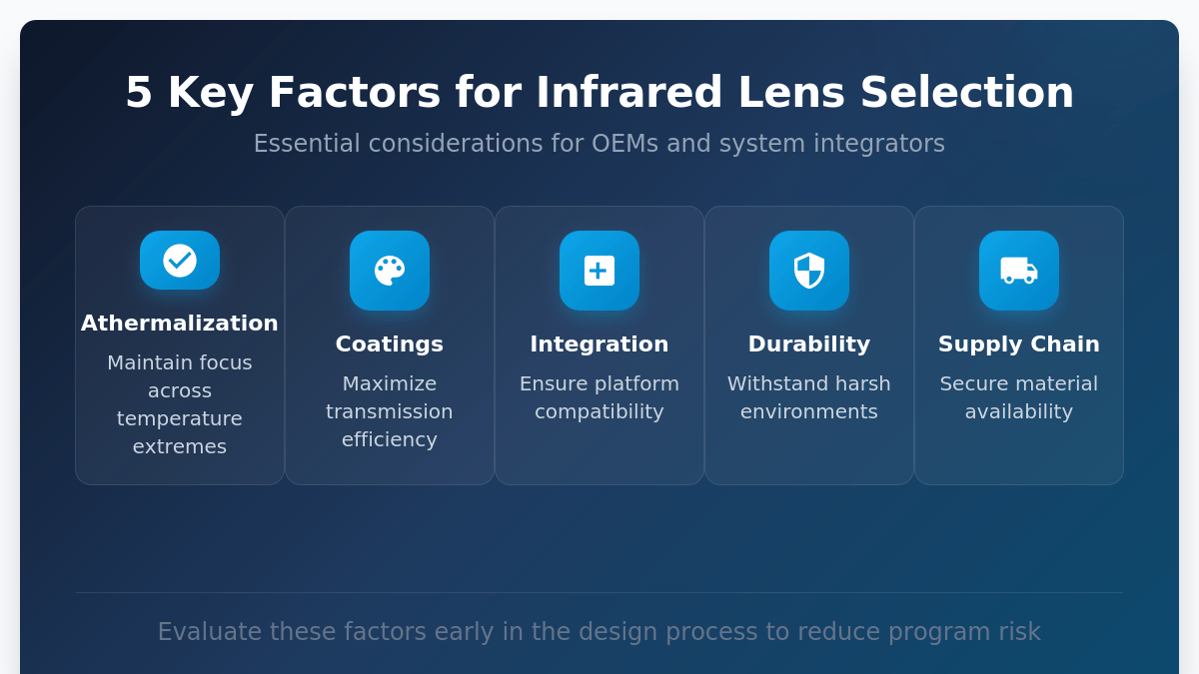
Athermalization requirements: Infrared materials change their optical properties with temperature. For systems that must maintain focus across wide temperature ranges, such as airborne platforms or outdoor installations, athermalized designs compensate for these changes. This typically involves careful material selection for both optical elements and mechanical housings, along with optical designs that balance positive and negative thermal effects.
Coating performance: Anti-reflection coatings are essential for germanium and other high-refractive-index materials. Without proper coatings, surface reflections substantially reduce transmission efficiency, compromising image quality and system sensitivity. Durable coatings that withstand cleaning and environmental exposure are particularly important for field-deployed systems.
Integration compatibility: The best optical design is worthless if it cannot be integrated into your platform. Consider mechanical mounting requirements, electrical interfaces for focus mechanisms, and compatibility with your selected detector format. Working with optics suppliers who understand system-level integration challenges can prevent costly redesigns.
Environmental durability: Thermal imaging solutions deployed in defense and industrial applications face harsh conditions including temperature extremes, humidity, salt spray, and mechanical shock. Ensure optical assemblies meet relevant environmental specifications for your application, whether that means MIL-STD compliance for defense programs or IP ratings for industrial systems.
Supply chain reliability: As noted earlier, material availability can affect program schedules and costs. Evaluating suppliers' material sourcing strategies and their ability to offer alternative materials like chalcogenide glass can reduce long-term risk.

Frequently Asked Questions
What is the difference between LWIR and MWIR lenses?
LWIR lenses transmit long-wave infrared radiation in the 8–12 µm range and are optimized for detecting ambient-temperature objects like people, vehicles, and equipment. MWIR lenses work in the 3–5 µm band and excel at detecting higher-temperature targets. LWIR systems can use uncooled detectors, while most MWIR systems require cooling for optimal sensitivity.
Why is germanium commonly used for infrared lenses?
Germanium offers excellent transmission in the LWIR band combined with a high refractive index that enables compact optical designs. However, germanium faces supply chain constraints, leading many OEMs to explore chalcogenide glass alternatives that offer similar LWIR performance with more stable sourcing.
When should I choose custom IR optics over standard products?
Custom IR optics make sense when your application requires non-standard focal lengths, specialized coatings, athermalized designs for extreme temperature operation, or mechanical interfaces tailored to your housing. High-volume production also favors custom designs because tooling costs are amortized across many units.
What materials are used for broadband infrared lenses?
Broadband infrared applications often use zinc selenide for its extremely wide transmission range, or specialized chalcogenide glass formulations designed for multi-spectral performance. Material selection depends on the specific wavelength ranges required and the application's mechanical and environmental demands.
Partner With Experts to Build Your Optical Advantage
Selecting the right infrared lens for your application involves balancing spectral requirements, material properties, integration constraints, and supply chain considerations. For OEMs and system integrators developing thermal imaging platforms, these decisions have lasting implications for system performance, production costs, and program risk.
LightPath Technologies brings four decades of infrared optics expertise to these challenges. With vertically integrated manufacturing that spans raw materials through complete optical assemblies, along with proprietary Black Diamond™ chalcogenide glass technology that offers a proven germanium alternative, LightPath helps partners move from concept to production with confidence. Connect with our engineering team to discuss how custom IR optics can strengthen your next platform.