
The hardest part of a UAV thermal imaging payload is fitting the sensor into a platform that already has tight budgets for weight, power, and space.
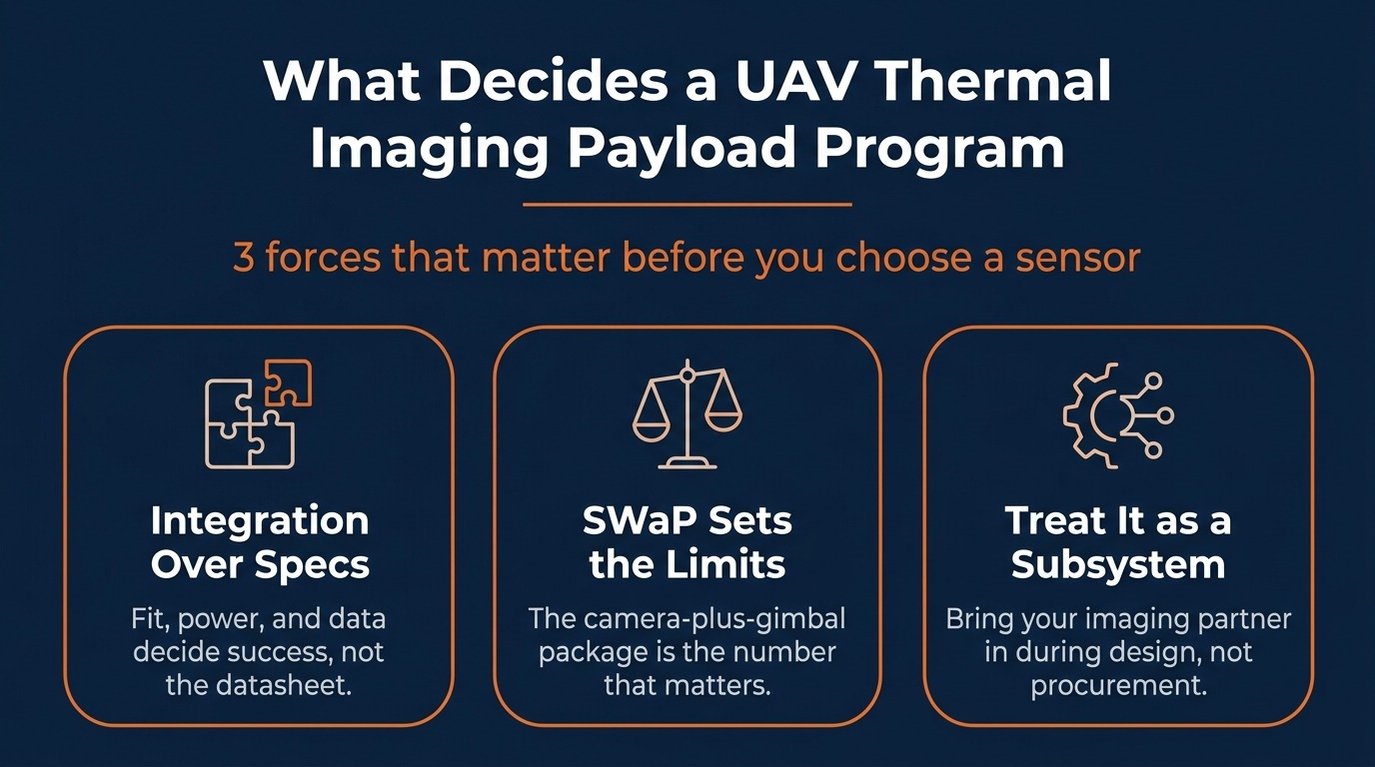
- Integration, not raw specs, is what makes or breaks a mid-size drone program once you move past the datasheet stage.
- SWaP (size, weight, and power) sets the real boundaries, and the camera-plus-gimbal package is the number that matters for your platform, not the sensor alone.
- Interfaces, vibration, thermal management, export control, and supply chain all need to be on the table early, not after the first flight.
- The teams that succeed treat the payload as a subsystem and bring their imaging partner in during design, not procurement.
If you're an OEM engineer scoping a new platform, decide your integration constraints before you shortlist a single camera.
Picking a thermal sensor is the easy part. The hard part is everything that comes after: making it fit, keeping it powered, holding it steady, getting clean data off it, and making sure you can ship the finished platform across borders. For drone OEM design engineers and UAV integrators, a UAV thermal imaging payload is a system-level commitment, and the decisions you make early ripple through your entire program.
MarketsandMarkets values the drone payload market at $4.15 billion in 2025, on track to reach $6.69 billion by 2030, with the OEM segment growing fastest. If you build aerial platforms, the integration choices you make now decide whether you capture that growth or fight to retrofit later. Companies that engineer advanced infrared optics and imaging for unmanned platforms see the same pattern repeat: programs that nail integration up front move faster and cost less.
This guide is written for the integration and design stage, not the shopping stage. If you're a UAV integrator or a defense UAV prime trying to turn a sensor choice into a flyable, shippable subsystem, this part of the process is where most of the real engineering happens.
What Makes a UAV Thermal Imaging Payload Different From a Ground Camera?
A UAV thermal imaging payload is a thermal sensor engineered specifically for airborne use, with the optics, packaging, and electronics designed around drone constraints rather than adapted from a fixed installation. A ground or vehicle-mounted thermal camera has the luxury of weight, spare power, and easy cooling. A drone has none of that, and a payload built without those limits in mind tends to underperform or simply won't fit.
Your Payload Is a Subsystem, Not a Standalone Camera
The moment a thermal core goes airborne, it stops being a camera and becomes a subsystem with mechanical, electrical, thermal, and software dependencies. Your flight controller cares about the data stream. Your gimbal cares about mass and balance. Your power system cares about continuous draw. Treating the payload as one box you bolt on at the end is the fastest route to a redesign. The strongest programs map these dependencies during early design so the payload and the platform evolve together.
SWaP Sets the Real Boundaries
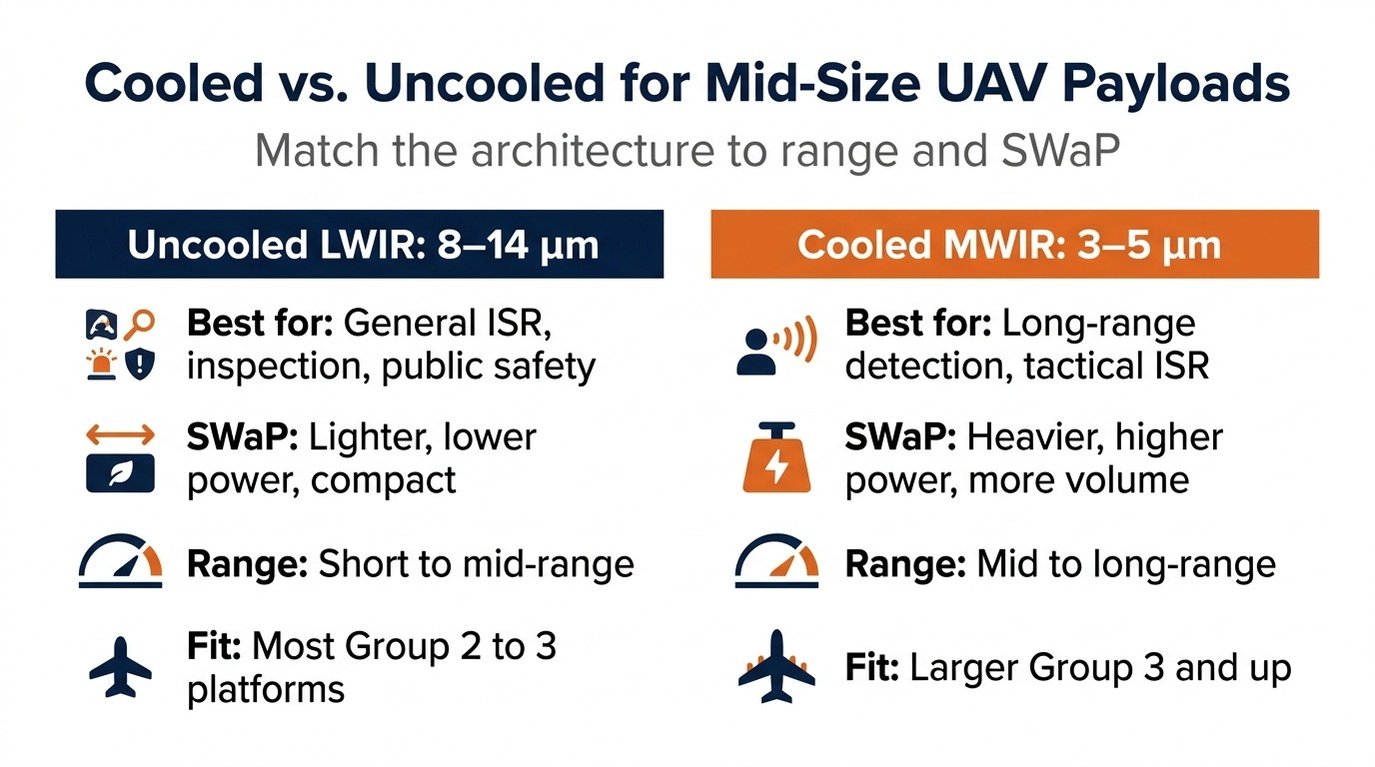
Size, weight, and power define what's possible before any spec sheet comes into play. Every gram of payload trims flight time, every watt shortens endurance, and every millimeter of envelope decides whether the camera fits the gimbal at all. For a mid-size drone thermal camera on a Group 2 or Group 3 platform, you're usually working with a modest payload budget, so the question is, "What's the best sensor that lives inside my constraints?" Uncooled LWIR cores (operating in the 8–14 µm band) tend to win on weight and power, while cooled MWIR systems (3–5 µm) deliver longer detection range at the cost of size, power, and complexity.
Why Does Integration Decide Mid-Size UAV Programs?
On larger platforms, you can sometimes brute-force a fit with extra lift and power. On a mid-size UAV, you can't. Integration discipline, more than the choice of mid-size drone thermal camera itself, separates programs that ship from those that stall. The combined camera and gimbal package becomes the relevant specification, and a lightweight camera paired with an oversized stabilization system can create worse weight and balance than a heavier, purpose-matched design.
Mission context shapes everything. Regulatory tailwinds are widening the addressable market. The FAA's proposed beyond-visual-line-of-sight rules, known as Part 108, point toward routine longer-range commercial operations, which raise the bar on payload endurance and image stability. Get the integration right, and your platform holds steady imagery at range while staying aloft longer. Get it wrong, and you're trading detection performance for flight time on every sortie.
5 Integration Considerations for Any UAV Thermal Imaging Payload
Before you commit to a sensor, walk through these five considerations for your drone thermal payload as a system. They're the issues that most often surface late and force expensive rework.
- Mechanical fit and the gimbal thermal camera envelope. Your camera has to mount securely inside the gimbal or fixed payload bay while meeting vibration and shock limits for your operational envelope. Lens diameter, length, and mass all have to live inside what the gimbal can carry and stabilize. Lock the envelope early because it constrains optical design more than almost anything else.
- Power budget and thermal management. Thermal cores continuously draw power throughout a flight, and that draw competes with endurance. The sensor also generates heat that has to go somewhere, which gets harder inside an enclosed bay on a warm day. Plan both steady-state and startup peaks against your available power.
- Data interfaces and onboard processing. The payload has to speak the same language as your flight controller, onboard compute, and datalink. Verify that the camera's video and data interfaces match your processing stack before you commit. If you're running AI inference at the edge, confirm the stream format your models expect.
- Vibration, environment, and validation. Drones subject optics to vibration, temperature swings, humidity, and dust that would wreck lab equipment. Build a validation plan early, and lean on recognized benchmarks where they exist. NIST publishes standard test methods for drone sensors that give you repeatable, quantitative criteria to hold a supplier and your own design to.
- Export control and supply chain. Export rules can classify thermal systems above certain frame-rate thresholds as controlled commodities, which affects where you can ship the finished platform. Supply chain is the quieter risk: USGS notes that China banned germanium exports to the U.S. in December 2024, and germanium is a workhorse material for infrared optics. Designing around domestically available materials and NDAA-compliant sourcing protects your program from disruptions you can't control.
Cooled vs. Uncooled at a Glance
The cooled-versus-uncooled call usually comes down to SWaP and range rather than pure image quality. The table below summarizes the tradeoffs for a mid-size drone thermal payload.
|
Consideration |
Uncooled LWIR (8–14 µm) |
Cooled MWIR (3–5 µm) |
|
Best for |
General ISR, inspection, public safety |
Long-range detection, tactical ISR |
|
SWaP impact |
Lighter, lower power, compact |
Heavier, higher power, more volume |
|
Detection range |
Short to mid-range |
Mid to long-range |
|
Complexity |
Lower, fewer moving parts |
Higher, includes cooler |
|
Typical fit |
Most Group 2–3 platforms |
Larger Group 3 and up |
A broadband (BBIR) option covering roughly 2–12 µm can give specialized mid-size programs flexibility across bands when a single mission profile won't capture every requirement.
How Do You Integrate a Thermal Camera Into a UAV, Step by Step?
Thermal camera UAV integration goes more smoothly when you treat it as a sequence rather than a scramble. Here's a workflow that keeps the platform and payload aligned from requirements through qualification.
- Define the mission and detection range. Start with what the platform has to see, how far, and in what conditions. Spell out target conditions like darkness, fog, and smoke, and keep performance claims qualified rather than promising every environment.
- Set your SWaP and gimbal thermal camera envelope budget. Translate flight time and platform limits into hard weight, power, and volume numbers for the payload. This budget becomes the filter for every sensor you'll consider.
- Select the band and sensor architecture. Choose uncooled LWIR or cooled MWIR based on range and SWaP, not on spec-sheet bravado. Match the optics to the envelope you locked in step two.
- Confirm interfaces and processing. Validate that the camera's data and video interfaces, power requirements, and stream formats fit your flight controller, compute, and datalink. Resolve mismatches before you build the first prototype.
- Validate environment and compliance. Run the payload through vibration, thermal, and environmental testing against your operational envelope, then confirm export classification and sourcing compliance before production. Our overview of thermal camera integration for OEMs walks through these checkpoints in more depth.
What Should Drone OEMs Look For in a UAV IR Payload Partner?
For any drone thermal payload program, the biggest predictor of a smooth program is early, sustained collaboration between the imaging supplier and the platform integrator. Successful thermal camera UAV integration rarely comes from a catalog vendor that hands you a fixed part and wishes you luck. A real partner engineers around your weight budget, gimbal envelope, power availability, and mission requirements, and stays involved from design through qualification.

Custom Engineering Beats Catalog Picking
When your envelope is tight or your field of view is unusual, an off-the-shelf lens often can't meet it. Suppliers who design and produce their own optics can shape a custom field of view or a specific IR band around your gimbal rather than forcing you to design around their part. That flexibility lets a mid-size platform hit performance targets that a catalog component would miss. For a structured way to evaluate options, our guide on what to look for in a drone thermal camera lays out the criteria that matter most.
Vertical Integration and Supply Chain Reliability
A supplier who controls materials, optics, detectors, and packaging can absorb the kind of shocks that strand single-source buyers, like the germanium restrictions above. Vertically integrated partners with domestic, NDAA-compliant manufacturing give you a more stable bill of materials for your UAV IR payload and faster turns when you need a change. If you're weighing suppliers, our take on evaluating drone thermal solutions and the deeper look at OEM drone imaging payloads are good places to pressure-test your shortlist.
Frequently Asked Questions
What is a UAV thermal imaging payload? It's a thermal imaging sensor engineered specifically for airborne integration, with optics, packaging, and electronics optimized for a drone's weight, power, vibration, and interface constraints. It differs from a ground or vehicle camera, which is built for installations with far more room and power to spare.
Should I choose cooled or uncooled for a mid-size drone thermal camera? For most Group 2 and Group 3 platforms, uncooled LWIR wins on weight and power and suits general ISR and inspection. Cooled MWIR makes sense when you need a longer detection range and can afford the extra size, power, and complexity it requires.
Why does the gimbal matter so much in thermal camera UAV integration? A gimbal thermal camera and its stabilization act as one system, so the combined package, not the sensor alone, is what your platform has to carry and balance. Pairing a light camera with an oversized gimbal can hurt weight and balance more than choosing a heavier, purpose-matched design.
How do export controls affect a UAV IR payload? Export rules can treat thermal systems above certain frame-rate thresholds as controlled commodities, which limits where you can ship the finished platform. Designing for NDAA-compliant, domestically sourced components early helps you avoid surprises during international deployment.
When should I bring in an imaging partner? During design, not procurement. Early collaboration lets the supplier engineer optics, detectors, and packaging around your platform constraints, which is far cheaper than retrofitting a fixed part after the airframe is locked.
Ready to Build a Payload That Fits Your Platform?
Mid-size UAV programs succeed when the imaging payload is treated as a subsystem and engineered alongside the airframe, not bolted on at the end. Set your SWaP and gimbal budget first, confirm interfaces and compliance early, and choose a partner who builds around your constraints instead of handing you a catalog part.
LightPath engineers thermal imaging payloads around your platform from optics through integration, with vertically integrated, domestically manufactured components built for unmanned missions. Request a UAV integration call, and we'll help you turn your constraints into a payload that flies.