

Key Takeaways
The thermal imaging market is projected to reach $6.70 billion by 2032, driven by AI integration, automation, and multi-band infrared systems that are redefining capabilities for OEMs and system integrators.
- AI-powered analytics are enabling thermal systems to detect anomalies faster while reducing false alarms through intelligent pattern recognition.
- Multi-sensor imaging platforms that combine MWIR, LWIR, and BBIR capabilities are becoming essential for organizations requiring operational flexibility across diverse environments.
- Automation in thermal monitoring is delivering 30-40% cost savings in industrial applications through predictive maintenance and continuous surveillance.
- System integrators who align their roadmaps with these thermal imaging trends will position themselves for sustained competitive advantage across defense, aerospace, and industrial markets.
The infrared imaging market continues evolving at a pace that demands attention from engineering teams, program managers, and procurement leaders alike. According to Data Bridge Market Research, the thermal imaging camera market reached $4.12 billion in 2024 and is expected to reach $6.70 billion by 2032, growing at a 6.4% CAGR. For OEMs and system integrators serving aerospace, defense, and industrial sectors, understanding which thermal imaging trends will reshape the competitive landscape has become essential to strategic planning.
The organizations capturing market share in 2026 and beyond are those investing in capabilities that go beyond basic thermal detection. They're building systems that leverage intelligent analytics, operate across multiple spectral bands, and integrate seamlessly into automated workflows. Here's what engineering and business development leaders need to know about the forces driving the next generation of thermal solutions.
What Thermal Imaging Trends Are Defining the Next Generation of IR Systems?
Several converging factors are accelerating innovation in infrared technology. Defense modernization programs worldwide continue prioritizing advanced surveillance and targeting capabilities. Industrial sectors are discovering that thermal monitoring delivers measurable returns through reduced downtime and improved safety compliance. Meanwhile, automotive applications are expanding as thermal sensing becomes integral to advanced driver assistance systems.
The infrared imaging trends gaining the most traction share a common thread: they help system integrators deliver more value to their end customers without proportionally increasing complexity or cost. This includes developments in sensor miniaturization, which has driven pixel sizes from 35μm down to 10μm or smaller, enabling more compact form factors without sacrificing resolution. It also encompasses advances in uncooled detector technology, which now represents the majority of new thermal deployments due to lower maintenance requirements and improved accessibility.
|
Trend Category |
Key Development |
Primary Benefit for OEMs |
|
AI Integration |
On-board neural networks for object classification |
Reduced operator workload, fewer false alarms |
|
Multi-Band Systems |
Combined MWIR/LWIR imaging in single platforms |
Operational flexibility across temperature ranges |
|
Sensor Miniaturization |
8μm pixel pitch detectors |
Compact integration, reduced SWaP |
|
Automation |
Continuous monitoring with predictive alerts |
30-40% maintenance cost reduction |
|
Material Innovation |
Germanium alternatives (chalcogenide glass) |
Supply chain stability, cost predictability |
These developments aren't occurring in isolation. The most capable thermal platforms emerging in 2026 combine multiple innovations into integrated solutions that address the full spectrum of operational requirements.
How Is AI in Thermal Cameras Transforming Detection and Analysis?
The integration of artificial intelligence into thermal imaging systems represents perhaps the most significant shift in how organizations deploy and operate infrared technology. Traditional thermal imaging required skilled operators to interpret temperature patterns and identify anomalies manually. AI in thermal cameras automates this process while improving accuracy and enabling real-time response.
Modern AI-powered thermal systems use deep learning algorithms trained on extensive datasets to recognize patterns that would be difficult or impossible for human operators to identify consistently. These systems can distinguish between genuine threats and common false alarm sources like wildlife movement, vegetation, or weather effects. Organizations implementing AI-enabled thermal monitoring report significant reductions in inspection time while catching anomalies that manual review consistently misses.
For defense applications, AI in thermal cameras enables capabilities like automatic target recognition and tracking. A thermal surveillance system can identify, classify, and maintain locks on multiple objects simultaneously without constant operator intervention. This reduces crew workload during extended missions while improving response times to emerging threats.
Industrial applications benefit equally from intelligent thermal analytics. Manufacturing facilities are integrating AI-enabled thermal monitoring into quality control processes where temperature variations indicate potential defects. The systems learn baseline thermal signatures for equipment and processes, then flag deviations that warrant investigation before they cause failures or safety incidents.
The convergence of edge computing and thermal imaging is accelerating these capabilities. Rather than streaming raw thermal data to remote servers for analysis, modern systems process information on-board using specialized processors optimized for neural network inference. This architecture supports real-time decision-making even in bandwidth-constrained environments.
Why Are Multi-Sensor Imaging Systems Gaining Momentum?
Organizations with diverse operational requirements are increasingly turning to multi-sensor imaging platforms that combine different spectral capabilities. Rather than deploying separate systems for different scenarios, multi-band solutions provide flexibility to address varying target temperatures, atmospheric conditions, and mission profiles with a single platform.

The physics driving this trend relates to how different infrared wavelengths interact with thermal targets and the environment. Long-wave infrared (LWIR) technology operates in the 8-14 μm range and excels at detecting objects at ambient temperatures, making it ideal for personnel detection, building monitoring, and general surveillance. Mid-wave infrared (MWIR) systems operate in the 3-5 μm band and provide superior sensitivity for high-temperature targets like vehicle engines, exhaust systems, and industrial processes.
Broadband infrared (BBIR) solutions take this approach further by capturing usable signals across multiple wavelength ranges simultaneously. This broad spectral coverage proves particularly valuable in applications where targets, backgrounds, and environmental conditions vary. A single BBIR platform can monitor everything from subtle temperature differentials in ambient-temperature equipment to extreme heat signatures in furnace inspection applications.
The growing adoption of multi-sensor imaging reflects a broader shift in how organizations approach thermal technology investment. Rather than optimizing for a single use case, engineering teams are designing platforms that can evolve with changing mission requirements. This approach reduces total cost of ownership while extending the useful life of thermal imaging investments.
5 Thermal Imaging Trends OEMs Should Prioritize in 2026
Engineering leaders planning product roadmaps for the coming years should pay particular attention to these developments:
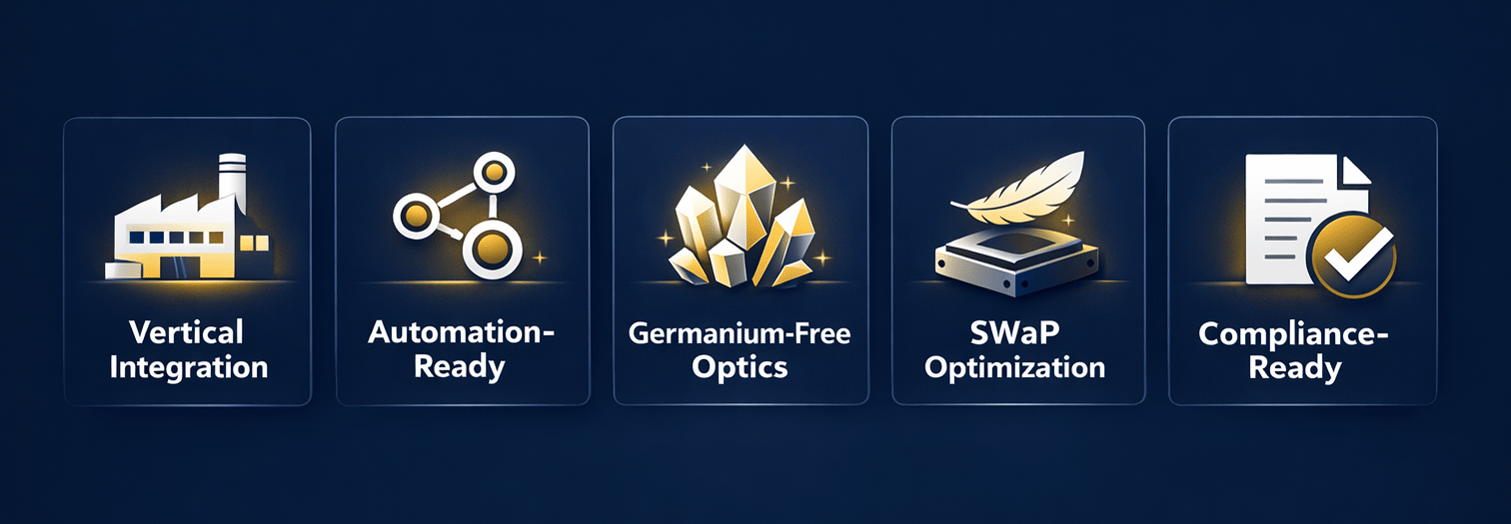
1. Vertical Integration for Supply Chain Resilience Recent disruptions have highlighted the risks of depending on fragmented supply chains for critical components. OEMs are prioritizing partnerships with manufacturers who control materials, optics, and camera assemblies under one roof.
2. Automation-Ready Interfaces Systems designed for integration with automated monitoring platforms command premium positioning. This includes standardized data interfaces, embedded analytics capabilities, and compatibility with industrial control systems.
3. Germanium-Free Optical Solutions Germanium supply constraints continue creating uncertainty for thermal imaging programs. Alternative materials like chalcogenide glass provide comparable optical performance without exposure to material availability risks.
4. SWaP Optimization Size, weight, and power constraints remain critical for drone, vehicle-mounted, and man-portable applications. Uncooled detector technology and compact optical designs enable deployment in previously inaccessible platforms.
5. Compliance-Ready Documentation Defense programs increasingly require comprehensive documentation covering materials sourcing, manufacturing processes, and testing protocols. Manufacturers with established compliance frameworks accelerate program timelines.
What Role Does Automation Play in Modern Thermal Solutions?
The push toward automation extends beyond AI-powered analytics to encompass the entire lifecycle of thermal monitoring operations. Organizations are implementing thermal imaging as a core component of automated predictive maintenance programs, continuous security surveillance, and industrial process control systems.
According to the U.S. Department of Energy Better Buildings program, building envelopes account for approximately 30% of energy consumed in commercial buildings, making thermal monitoring essential for identifying insulation gaps and air leakage that drive inefficiency. Research from the Federal Energy Management Program further demonstrates that properly implemented predictive maintenance programs deliver 30-40% savings compared to reactive maintenance approaches.
The automation trend also reflects workforce considerations. Skilled thermal imaging technicians remain in short supply, and organizations cannot always maintain 24/7 coverage with manual monitoring. Automated thermal surveillance fills these gaps while maintaining consistent performance regardless of staffing constraints or operator fatigue.
|
Application |
Automation Benefit |
Implementation Consideration |
|
Perimeter Security |
Continuous monitoring without operator fatigue |
Integration with existing VMS platforms |
|
Predictive Maintenance |
Early fault detection before failures |
Baseline thermal signature development |
|
Process Monitoring |
Real-time quality control |
Temperature threshold configuration |
|
Gas Detection |
Immediate leak identification |
Spectral filtering requirements |
For system integrators, the automation imperative creates opportunities to deliver complete solutions rather than component-level products. Customers increasingly want turnkey implementations that include cameras, analytics software, integration services, and ongoing support.
Frequently Asked Questions
What is driving the growth in thermal imaging technology adoption?
Defense modernization, industrial automation requirements, and expanding automotive applications are the primary growth drivers. Organizations across sectors are recognizing thermal imaging as essential infrastructure rather than specialized equipment.
How does AI improve thermal camera performance?
AI enables automated pattern recognition, anomaly detection, and object classification that would require constant human attention with traditional systems. This reduces false alarms, speeds inspection processes, and enables 24/7 monitoring without proportional staffing increases.
What are the advantages of multi-band infrared systems?
Multi-band platforms provide operational flexibility to address different target temperatures and environmental conditions with a single system. This reduces the need for multiple specialized cameras while ensuring reliable performance across diverse scenarios.
Why are alternatives to germanium becoming important for thermal optics?
Germanium supply constraints and pricing volatility create program risk for thermal imaging deployments. Materials like chalcogenide glass provide comparable optical performance with more predictable sourcing and cost structures.
Building Your Thermal Imaging Strategy for Tomorrow
The thermal imaging trends reshaping the market reward organizations that plan strategically rather than react to each new development. Engineering teams building platforms today should design for modularity, ensuring their systems can incorporate advancing AI capabilities, support multiple spectral bands, and integrate with evolving automation frameworks.
Procurement leaders benefit from establishing relationships with vertically integrated manufacturers who can provide materials, optics, assemblies, and complete cameras from a single source. This approach simplifies supply chain management while ensuring system components work together as intended.
The organizations achieving sustained success in thermal imaging markets share common characteristics: they prioritize solution quality over component cost, they invest in partnerships that accelerate development timelines, and they build systems designed to evolve with changing requirements.
LightPath Technologies brings four decades of thermal imaging expertise to help aerospace, defense, and industrial leaders navigate these decisions. Connect with our engineering team to discuss how these trends apply to your specific program requirements.