

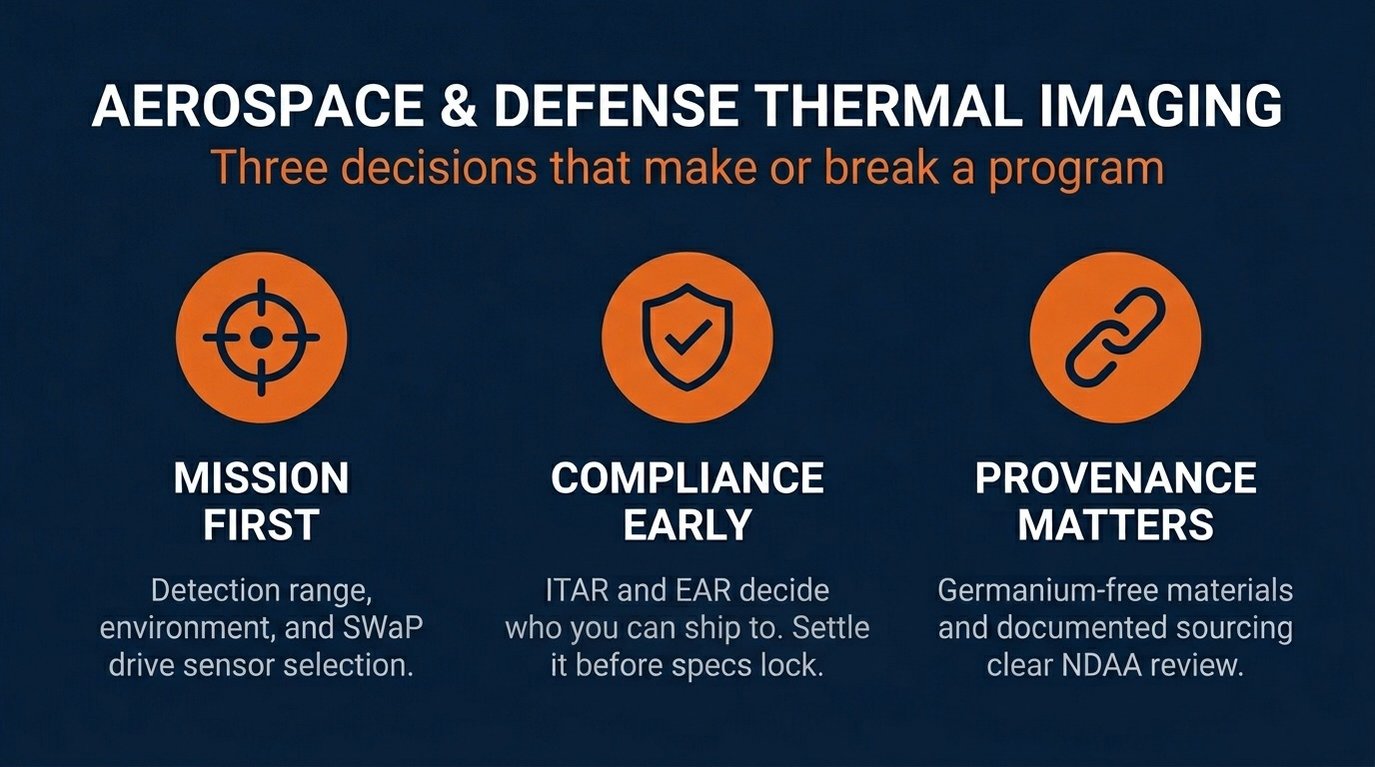
In aerospace and defense thermal imaging, the toughest calls are about matching the sensor to the mission and clearing ITAR and export controls before a program ever locks its specs.
- Mission requirements (detection range, operating environment, platform size, weight, and power) should drive sensor selection, so define them before you compare datasheets.
- ITAR and EAR split jurisdiction between the State Department and the Commerce Department, and most defense-grade infrared systems touch one or both.
- Performance thresholds like frame rates above 9 Hz can push a camera into controlled territory, which affects who you can sell to and how fast you can ship.
- Supply chain provenance and germanium-free materials decide whether a component clears NDAA and procurement review.
Treat compliance and mission fit as design inputs from day one, and pick a supplier who can engineer to spec while documenting provenance, instead of retrofitting compliance at delivery.
Global defense budgets are climbing. World military spending reached a record $2.7 trillion in 2024, a 9.4% jump that was the steepest year-over-year rise since the late 1980s. That money flows into platforms, and a growing share needs to see in the dark. For the OEMs and primes building them, infrared has become a core capability.
When developing defense and aerospace imaging platforms, the optics are rarely the hard part. The hard part is the ITAR and export-control exposure baked into aerospace and defense thermal imaging, the rules that decide who you can ship to, and the sensor choices you commit to long before a system reaches the field. Get those wrong, and a technically excellent design can stall at delivery or lose a market you assumed you had.
This guide is written for A&D OEM procurement teams, defense primes, and compliance officers who specify infrared systems. We'll walk through how mission requirements should drive sensor selection, where ITAR and export controls fit, and what to look for in a compliant component partner.
What Does Aerospace and Defense Thermal Imaging Mean for an OEM?
Aerospace and defense thermal imaging refers to the infrared sensors, optics, and camera assemblies that let military and aerospace platforms detect, recognize, and track heat signatures across surveillance, targeting, navigation, and force-protection missions. For an OEM, A&D thermal imaging is less about a single camera and more about a stack: the detector, the optics in front of it, the assembly that holds everything in alignment, and the processing that turns raw photons into a usable picture. Each layer carries performance and compliance implications, and the choices interact. A decision about the detector can change your export posture. A decision about the optics can change your supply chain risk. Understanding the building blocks helps you specify with intent.
MWIR or LWIR: Which Band Fits the Job?
Most defense infrared work happens in two bands. Mid-wave infrared (MWIR) covers roughly 3–5 µm and is typically paired with cooled detectors for long-range sensitivity and clarity. Long-wave infrared (LWIR) covers roughly 8–14 µm and is usually uncooled, which makes it lighter, lower-power, and well suited to drones, vehicles, and man-portable gear. Neither band is universally better. The right one depends on range, target, and the conditions you expect to operate in.
Cooled or Uncooled: Where the Tradeoffs Live
Cooled MWIR systems deliver outstanding range and sensitivity, but they carry more size, weight, and power, plus a cooler that needs thermal management. Uncooled LWIR systems trade some of that performance for a compact, efficient package that fits tight payload budgets. For a lot of programs, an uncooled system handles surveillance, perimeter security, and detection missions perfectly well, while cooled systems earn their place in long-range targeting and reconnaissance. Knowing which side of that line your mission sits on is the first real fork in sensor capability for defense applications.
Why Do Mission Requirements Drive Sensor Selection (Not the Other Way Around)?
It's tempting to start with a sensor you like and work backward. That's how programs end up with capable hardware that misses the mission or, worse, can't ship to the customer that funded it. Defense mission thermal requirements should set the terms, and the sensor should follow. Three requirements tend to dominate the decision.
How Far Do You Really Need to See?
Detection, recognition, and identification each happen at different ranges, and the gap between them is large. A sensor that detects a vehicle at several kilometers may not let an operator identify it until it's much closer. Defining the range you actually need keeps you from over-specifying into a cooled, export-restricted, expensive system when an uncooled one would do, or from under-specifying and missing the mission entirely.
What Environment Will the System Live In?
Thermal imaging earns its keep in low-visibility conditions: darkness, fog, smoke, and dust. It's not a cure-all. Heavy rain and high-radiance sources like direct sunlight can degrade performance, so a credible spec sheet describes the conditions a system supports rather than claiming it works in every situation. Define the environmental envelope your platform must handle, then make sure the sensor and optics are validated across that envelope rather than at a nominal lab benchmark alone.
Can the Platform Carry It?
A drone has a very different payload budget than a vehicle turret or a fixed surveillance tower. Size, weight, and power constraints frequently decide the sensor before performance does, especially for airborne and man-portable systems. Mapping the platform's limits early is the difference between a clean aerospace thermal sensor selection and a redesign six months in.
|
Mission profile |
Primary driver |
Sensor consideration |
|
Long-range ISR and targeting |
Detection and ID range |
Often cooled MWIR (3–5 µm) for range and sensitivity; larger SWaP |
|
Drone or man-portable surveillance |
SWaP and endurance |
Uncooled LWIR (8–14 µm); lighter, lower power |
|
Border, perimeter, and fixed sites |
Wide-area, continuous coverage |
Uncooled LWIR in ruggedized housings |
|
Multi-jurisdiction or export programs |
Market access |
Configurations that respect frame rate and resolution thresholds |
How Do ITAR and Export Controls Shape an Aerospace and Defense Thermal Imaging Program?
Defense thermal imaging export controls are a design input, and they shape a program from the first specification. Two U.S. frameworks do most of the work, and they're administered by different agencies with different philosophies.
ITAR or EAR: Who Has Jurisdiction?
The International Traffic in Arms Regulations (ITAR) govern defense articles, defense services, and related technical data. They're administered by the State Department's Directorate of Defense Trade Controls through the U.S. Munitions List. Many military-grade infrared systems, especially those built for targeting or airborne surveillance, fall under ITAR, and ITAR controls reach even domestic transfers to foreign persons.
Items that aren't ITAR-controlled usually fall under the Export Administration Regulations (EAR), administered by the Commerce Department's Bureau of Industry and Security. EAR classification tends to be more deterministic. You can often map an item to a specific control number and read the rules.
A third layer sits above both, the multilateral Wassenaar Arrangement, which harmonizes control lists across member states and shapes how allied nations treat dual-use imaging technology.
|
Framework |
Administering agency |
Typically covers |
What it means for your program |
|
ITAR (U.S. Munitions List) |
State Department (DDTC) |
Defense articles, services, and technical data; many military-grade IR systems |
Tightest controls; licensing required even for foreign persons inside the U.S. |
|
EAR (Commerce Control List) |
Commerce Department (BIS) |
Dual-use items; many commercial and higher-performance IR cameras |
More deterministic classification; license depends on item, destination, and end use |
|
Wassenaar Arrangement |
42-state multilateral body |
Harmonized dual-use and munitions control lists |
Shapes allied export norms and informs national rules |
Which Performance Thresholds Flip a Camera Into Controlled Territory?
Certain capabilities push an infrared system into tighter control, and the specifications that do it are well known. A frequently cited line is the frame rate: systems capable of frame rates above 9 Hz are treated as controlled for export to certain destinations, a rule reflected in U.S. export regulations. Resolution above common commercial levels and very high sensitivity can have similar effects, often in combination rather than in isolation. The performance you specify directly shapes your addressable market, so a small change in a spec can open or close an entire export channel.
Why Is Compliance a Procurement Filter, Not an Afterthought?
Programs that discover export constraints at the delivery stage face licensing delays that compress field schedules and can derail a launch. ITAR violations also carry steep civil and criminal penalties, and enforcement is active. The teams that handle this well treat ITAR and export classification as something to settle during requirements definition, working with suppliers who can advise on ITAR-compliant camera configurations before the design is frozen. That early conversation is far cheaper than a redesign.
What Should OEMs Look for When Selecting an ITAR-Compliant Thermal Camera or Component?
Once mission requirements and export posture are clear, supplier selection becomes the lever that determines whether your program ships on time and stays compliant. An ITAR-compliant thermal camera or component is only as dependable as the partner behind it.

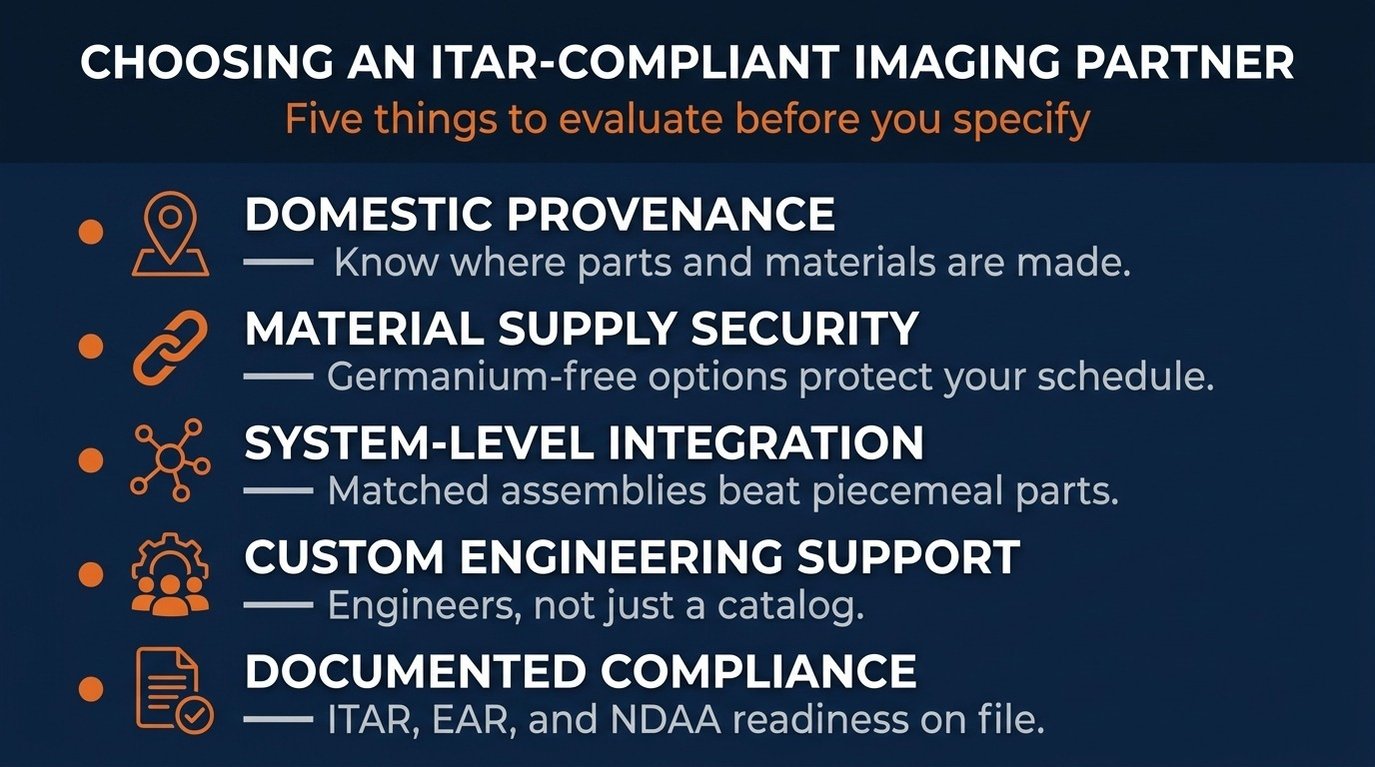
Here are five things worth evaluating before you commit to a specification.
- Domestic provenance and manufacturing location. For defense and homeland security work, where a component is made and where its materials come from is increasingly a gate, not a preference. A supplier with transparent, documented provenance gives you defensible answers when a prime or a government customer asks. North American manufacturing also shortens the distance between a design change and a delivered part.
- Material supply security. Germanium has been the workhorse of infrared optics for decades, but export restrictions and price volatility make germanium-dependent supply chains risky for multi-year programs. Suppliers offering germanium-free optical materials protect your schedule against shortages you can't control.
- System-level integration. Detectors, optics, coatings, and assemblies perform best when they're designed to work together rather than sourced piecemeal. A vertically integrated supplier that controls its materials and builds matched assemblies can tune the whole signal chain, which usually beats stitching together parts from several vendors.
- Custom engineering support. Documentation is not engineering support. Programs with non-standard requirements or aggressive timelines need a partner whose engineers engage from requirements through environmental validation, not a catalog you pick from and hope it fits your platform.
- Documented compliance posture. Look for a supplier who can speak fluently to ITAR and EAR classification and who can show how their components align with what the FY26 NDAA requires. Compliance-ready documentation accelerates your program reviews instead of stalling them.
How Do Supply Chain and Materials Tie Back to Compliance?
Materials and compliance are more connected than they look. The same proprietary chalcogenide glass that reduces germanium dependence also strengthens the supply-chain story you tell a defense customer. Domestic, controllable material sourcing is exactly what NDAA-driven procurement is pushing toward. When you choose a supplier whose materials, optics, and assemblies all trace to a secure, documented source, you're solving an availability and compliance problem at the same time. That alignment is why so many aerospace and defense imaging programs now weigh material provenance as heavily as raw optical performance.
Frequently Asked Questions
Are all thermal imaging cameras ITAR-controlled?
No. Many commercial and industrial infrared cameras fall under the EAR rather than ITAR, and some lower-performance systems face minimal controls. Whether a specific system is ITAR-controlled depends on its capabilities and intended use, which is why classification should be verified early with qualified guidance rather than assumed.
What's the difference between ITAR and EAR for thermal systems?
ITAR, administered by the State Department, governs defense articles and many military-grade infrared systems, with tight controls that apply even to foreign persons inside the U.S. EAR, administered by the Commerce Department, governs dual-use items and tends to allow more deterministic classification. Many infrared systems sit under one or the other, depending on their performance and design.
Does the 9 Hz frame rate threshold still matter?
Yes. A frame rate above 9 Hz remains a commonly cited line that can place an infrared system under tighter export control for certain destinations. It's one of several thresholds, alongside resolution and sensitivity, that can affect classification, so it's worth confirming against current regulations before you settle on an ITAR-compliant thermal camera for an exportable program.
How early should defense thermal imaging export controls factor into sensor selection?
As early as possible, ideally during requirements definition. Export posture affects which sensors you can ship to which customers, and discovering a constraint at delivery can trigger licensing delays that compress your schedule. Treating it as a design input keeps your addressable market intact.
How do NDAA requirements relate to ITAR for defense imaging?
They're separate but complementary. ITAR governs the export of defense-related technology, while NDAA provisions push for secure supply chains and reduced reliance on materials from specified foreign sources. For many defense programs, both shape procurement, so components need to satisfy export rules and supply-chain provenance requirements together.
Specify Your Next A&D Imaging Program With Compliance Built In
Successful A&D programs define the mission, choose the sensor to fit it, settle export posture up front, and pick a partner who can document every link in the chain. In turn, compliance stops being a risk and starts being a head start.
With four decades in infrared, proprietary germanium-free materials, vertically integrated North American manufacturing, and engineers who design to your spec, LightPath can help you engineer a compliant, mission-matched imaging solution from the first requirement to field validation. Request an A&D compliance consultation and put export classification, sensor fit, and supply-chain provenance on the table before you freeze a single spec.