
Key Takeaways
Industrial thermal imaging systems are delivering measurable returns for OEMs, system integrators, and the manufacturing operations they serve.
- Predictive maintenance programs powered by thermal imaging can reduce maintenance costs significantly, with leading programs achieving ROI within 12–18 months.
- Deloitte research shows predictive maintenance reduces planning time by 20–50% and increases equipment availability by 10–20%.
- An industrial IR camera enables non-contact, real-time monitoring across electrical, mechanical, and process applications.
- OEMs that integrate purpose-built thermal monitoring platforms into their products gain competitive advantages through improved reliability and faster time to market.
If your organization builds, integrates, or specifies monitoring equipment for industrial environments, thermal imaging deserves a place in your next platform discussion.
The global thermal imaging market is on track to reach approximately $7.8 billion by 2032, with industrial applications driving a significant share of that growth. For OEMs and system integrators designing monitoring platforms for manufacturing, energy, and process industries, this expansion reflects a fundamental shift in how facilities approach equipment health and operational performance.
Industrial thermal imaging systems have moved well beyond the handheld inspection tools most people picture when they hear “thermal camera.” Today’s advanced thermal imaging solutions are fixed, integrated, and purpose-built for continuous operation in demanding environments. They feed data into maintenance management systems, trigger automated alerts, and enable the kind of predictive maintenance infrared programs that turn reactive repair cycles into planned, cost-effective interventions.
This article explores how industrial thermal imaging systems create measurable value for the organizations that build and deploy them, with a focus on predictive maintenance, operational ROI, and the selection criteria that matter most when choosing a thermal imaging partner.
Why Are Industrial Thermal Imaging Systems Gaining Traction?
Several converging factors are pushing these systems from “nice to have” into “essential infrastructure” territory. Aging equipment across manufacturing and energy sectors is creating more points of failure. Skilled maintenance technicians are retiring faster than companies can replace them. And the cost of unplanned downtime continues to climb, with some estimates placing losses in the hundreds of thousands of dollars per hour for large industrial operations.
At the same time, the technology itself has become more capable and more accessible. Modern industrial IR camera systems offer higher resolution, better sensitivity, and more robust connectivity than even a few years ago. Fixed-mount configurations now support 24/7 monitoring with automated analysis, removing the need for a trained thermographer to be physically present at every inspection point.
For OEMs and integrators, this means the market for embedded thermal monitoring solutions is expanding across sectors like power generation, oil and gas, chemical processing, food production, and heavy manufacturing.
What Does Predictive Maintenance Infrared Monitoring Look Like in Practice?
Predictive maintenance infrared programs work by establishing thermal baselines for critical equipment and then continuously monitoring for deviations. When a motor bearing begins to degrade, friction generates excess heat. When an electrical connection loosens, resistance increases and temperature rises. These changes are often invisible to the eye and undetectable by traditional inspection methods until failure is imminent. Thermal monitoring catches them early, sometimes weeks or months before a breakdown would occur.
A Practical Scenario
Consider a manufacturing facility running a continuous production line with dozens of high-value motors, compressors, and electrical distribution panels. Under a traditional time-based maintenance schedule, technicians inspect equipment at fixed intervals, regardless of condition. Components get replaced on a calendar, whether they need it or not.
With an industrial IR camera system integrated into the facility’s monitoring infrastructure, thermal data streams continuously from each critical asset. The system flags a bearing housing that’s trending 12°C above its established baseline. Maintenance schedules a planned repair during the next production window. Total cost: a few thousand dollars and minimal disruption. Without that early detection, the same bearing failure during peak production could result in an emergency shutdown costing tens or hundreds of thousands in lost output, overtime labor, and expedited parts.
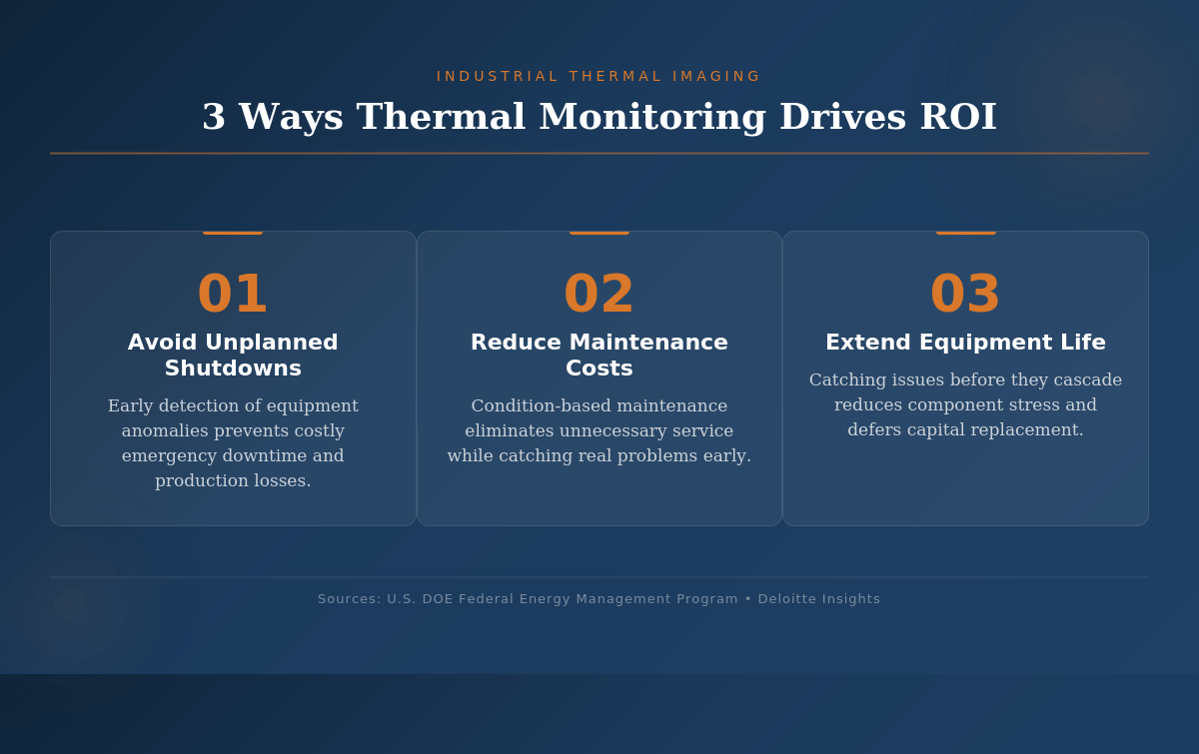
According to Deloitte’s research on predictive technologies, predictive maintenance can reduce planning time by 20–50%, increase equipment availability by 10–20%, and lower overall maintenance costs by 5–10%. For facilities with high-value assets and tight production schedules, these improvements translate directly into competitive advantage.
How Do Industrial Thermal Imaging Systems Deliver ROI?
The return on investment from thermal monitoring programs comes from multiple channels, and it tends to compound over time as monitoring data accumulates and maintenance programs mature.
|
ROI Driver |
How It Creates Value |
|
Avoided Downtime |
Early detection prevents unplanned shutdowns that can cost hundreds of thousands of dollars per hour in large industrial operations. |
|
Maintenance Cost Reduction |
Shifting from reactive to condition-based maintenance reduces labor, parts, and emergency repair premiums significantly over time. |
|
Extended Equipment Life |
Catching issues early reduces stress on components, helping extend useful asset life and defer capital replacement costs. |
|
Energy Savings |
Thermal monitoring identifies insulation failures, steam trap malfunctions, and inefficient heat exchange that waste energy. |
|
Safety Improvement |
Non-contact monitoring keeps personnel away from high-voltage, high-temperature, and hazardous equipment during inspections. |
Most facilities implementing comprehensive predictive maintenance infrared programs report positive ROI within 12–18 months. Research from the U.S. Department of Energy’s Federal Energy Management Program estimates that a properly functioning predictive maintenance program can deliver savings exceeding 30–40% compared to purely reactive approaches. Facilities with high-criticality assets and expensive downtime often see returns even faster.
Which Industries Benefit Most from Industrial Thermal Imaging Systems?
While thermal monitoring applies across virtually any sector with critical equipment, certain industries see outsized returns from these systems. Here are five sectors where the technology delivers the greatest impact for OEMs and the end users they serve.
1. Manufacturing and Process Industries
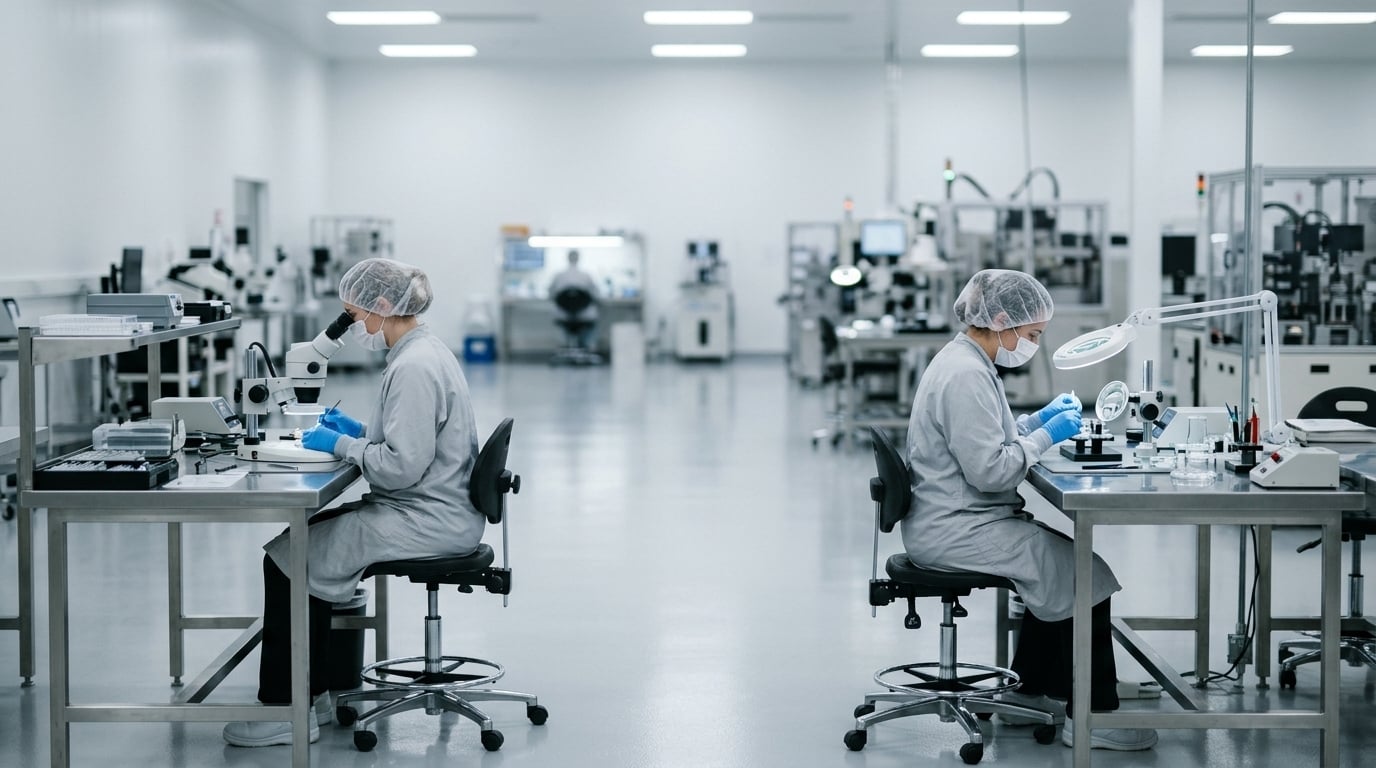
Continuous production environments depend on equipment running within tight operating parameters. Thermal monitoring solutions track motors, conveyors, presses, and heating/cooling systems to catch deviations before they cause line stoppages. Thermal cameras designed for industrial use also support quality control by detecting temperature inconsistencies in materials and finished products.
2. Energy and Utilities
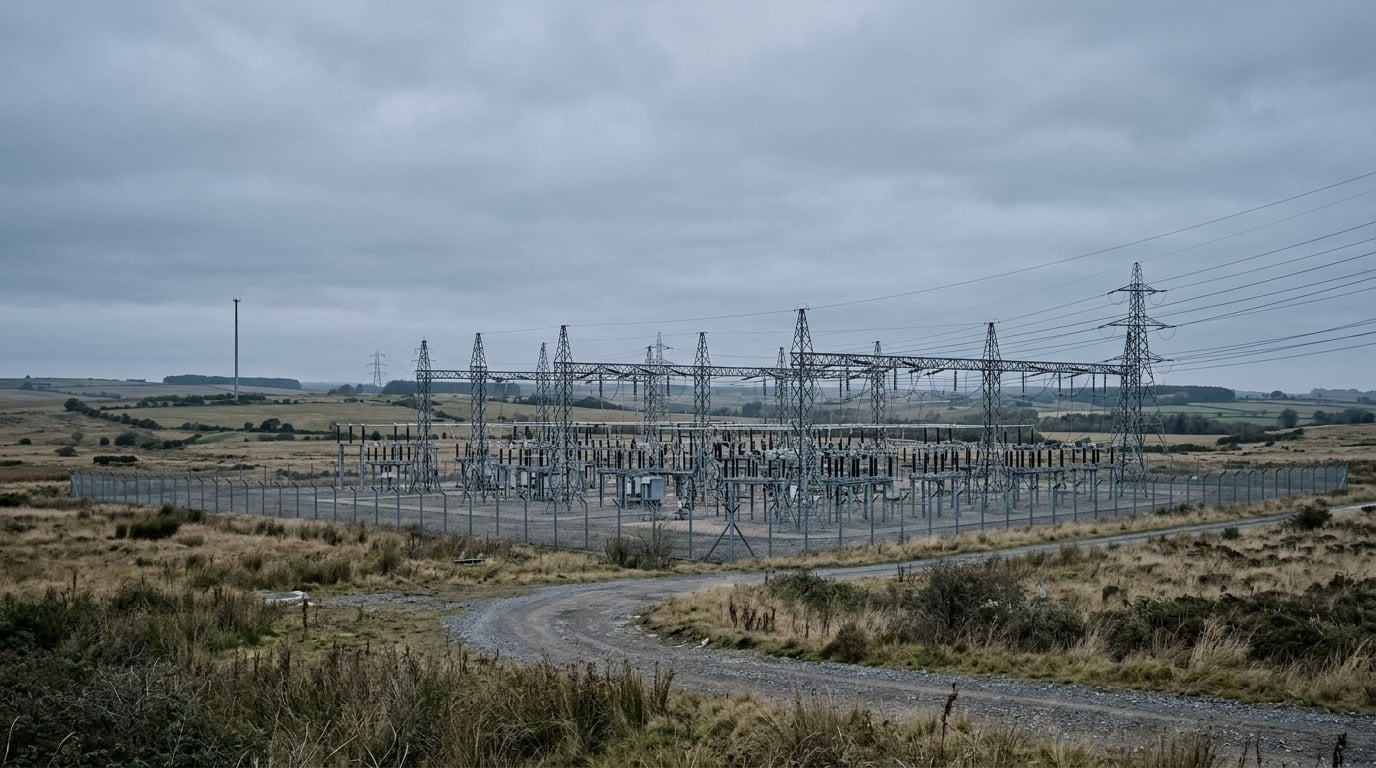
Power generation and distribution facilities use thermal monitoring systems to track transformers, switchgear, turbines, and transmission infrastructure. Thermal anomalies in these systems can indicate impending failures that carry serious safety and financial consequences. Predictive maintenance with thermal imaging has become a standard practice across the energy sector.
3. Oil, Gas, and Chemical Processing
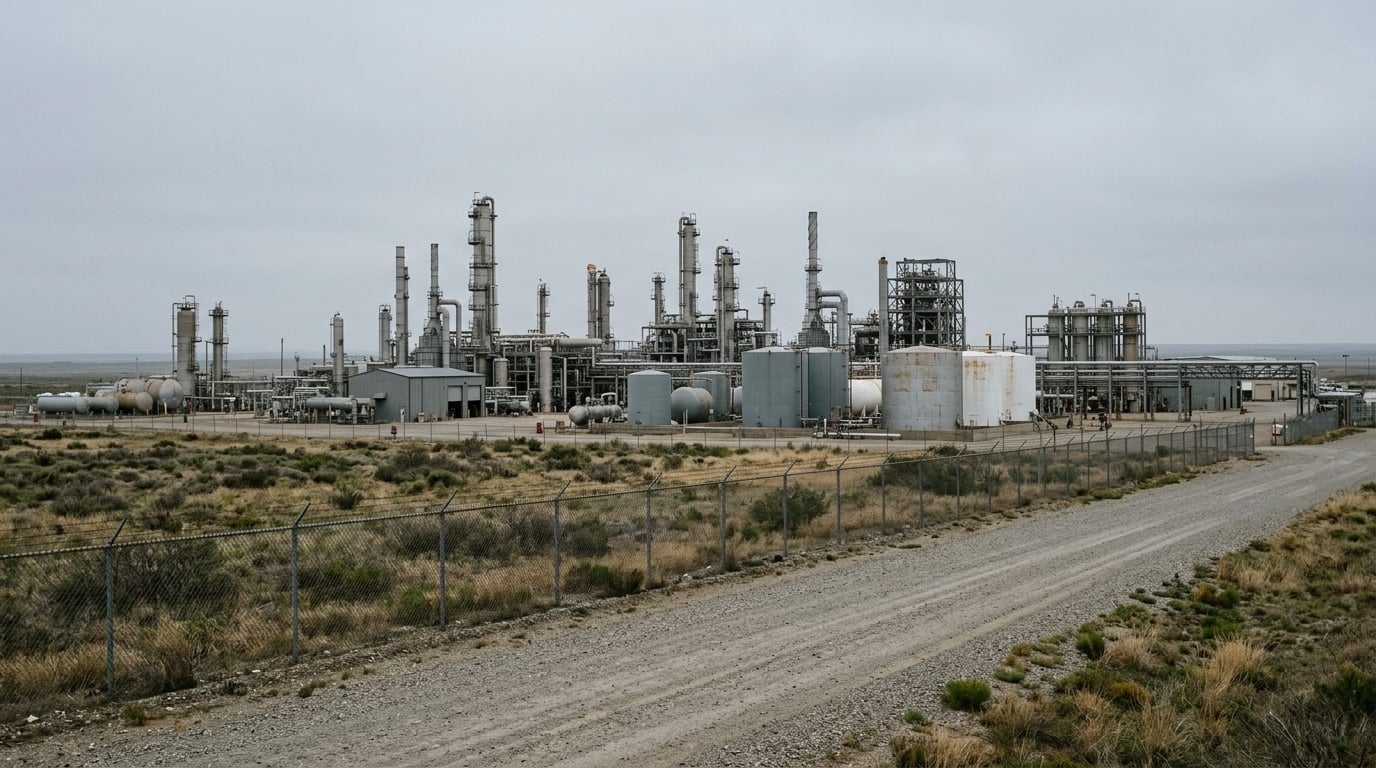
Beyond equipment monitoring, the oil and gas sector relies on specialized optical gas imaging systems that use thermal technology to visualize fugitive emissions invisible to the naked eye. These systems support regulatory compliance, safety programs, and environmental monitoring across refineries, pipelines, and processing facilities.
4. Steel, Glass, and Ceramics
High-temperature manufacturing environments push conventional monitoring equipment past its limits. Thermal cameras engineered for extreme heat applications monitor furnaces, kilns, and molten material processes where temperatures can exceed 1,500°C. For OEMs building monitoring solutions in these sectors, the camera’s durability and measurement range are critical differentiators.
5. Food and Pharmaceutical Production
Temperature control is both a quality and a compliance requirement in these regulated industries. Thermal monitoring platforms verify process temperatures, detect equipment hotspots, and support hygiene monitoring by identifying areas where temperature deviations could indicate contamination risks.
What Should OEMs Look for in an Industrial Thermal Imaging Partner?
For OEMs and system integrators, the decision to incorporate thermal imaging into a product platform involves more than selecting a camera module from a catalog. The partner behind the technology matters as much as the specs on the data sheet. Here are the criteria that consistently separate strong partnerships from frustrating ones.
|
Selection Criteria |
Why It Matters |
|
Vertical Integration |
Partners who control materials, optics, coatings, and assembly in-house deliver more consistent quality and faster iteration cycles. |
|
Custom Engineering |
Industrial applications rarely fit a one-size-fits-all solution. Engineering collaboration from requirements through validation ensures the final system meets your exact specifications. |
|
Supply Chain Stability |
Germanium shortages and export restrictions make material sourcing a strategic concern. Partners with proprietary alternatives reduce your exposure to supply disruptions. |
|
Environmental Ruggedization |
Industrial environments involve heat, vibration, dust, moisture, and corrosive atmospheres. Systems must be purpose-built for these conditions from initial design. |
|
Integration Support |
Communication protocols, mounting solutions, software interfaces, and data integration all need to work within your existing platform architecture. |
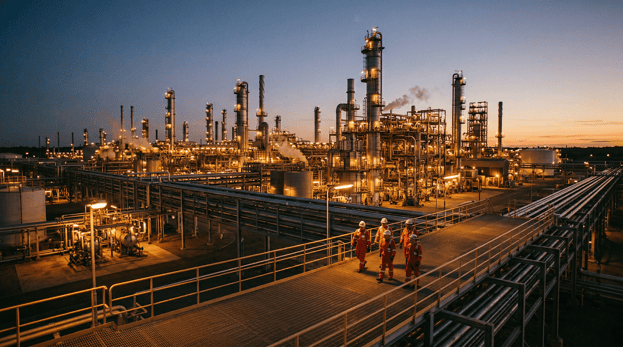
The integration process for industrial thermal cameras involves evaluating compatibility across communication protocols, mounting configurations, and software ecosystems. OEMs who invest time in this evaluation upfront avoid costly redesigns and performance issues after deployment.
How Is the Industrial Thermal Imaging Market Evolving?
Several trends are shaping the next generation of industrial thermal imaging systems, and OEMs who understand them will be better positioned to deliver solutions that stay relevant as the market matures.
Edge computing and onboard analytics. Rather than streaming raw thermal data to central servers, newer industrial IR camera systems process data at the camera level. This reduces bandwidth requirements, improves response times for critical alerts, and simplifies network architecture for facility managers.
AI-assisted anomaly detection. Machine learning algorithms trained on thermal data can identify patterns that human operators might miss, flagging subtle temperature trends that indicate developing problems weeks before they become visible through manual inspection.
Multi-sensor fusion. Combining thermal data with vibration analysis, acoustic monitoring, and electrical signature analysis creates a more complete picture of equipment health. Thermal cameras increasingly serve as one layer in a broader condition-monitoring ecosystem.
Germanium-free optics. With global germanium supplies under pressure from export restrictions and competing demand, alternative infrared optical materials like chalcogenide glass are becoming strategically important for OEMs concerned about long-term supply chain stability.
Frequently Asked Questions
What types of equipment are best suited for predictive maintenance infrared monitoring?
Electrical distribution panels, motors, bearings, compressors, heat exchangers, steam systems, and any rotating or high-voltage equipment benefit most from continuous thermal monitoring. These assets generate characteristic heat signatures when components begin to degrade, making them strong candidates for predictive maintenance infrared programs.
How quickly do these thermal monitoring systems pay for themselves?
Most organizations report positive ROI within 12–18 months. Facilities with high downtime costs or critical assets often recoup their investment faster. A single prevented failure on a high-value production line can offset the entire cost of a thermal monitoring system.
Can these systems integrate with existing maintenance management software?
Yes. Modern systems support standard industrial communication protocols and can feed data directly into CMMS and enterprise asset management platforms. This integration capability is a key evaluation criterion when selecting a thermal imaging partner for OEM platform development.
Put Your Next Platform on a Stronger Foundation
For OEMs and system integrators building industrial monitoring solutions, the right thermal imaging partner can be the difference between a product that simply works and one that delivers lasting competitive advantage. LightPath Technologies brings four decades of optical and infrared imaging expertise, vertically integrated manufacturing, and a collaborative engineering approach that ensures your industrial thermal imaging systems perform exactly as your customers need them to. Connect with the LightPath team to explore how the right partnership can strengthen your next platform.