
Key Takeaways
Selecting the right drone thermal imaging solutions requires evaluating far more than resolution specs or price points.
- The thermal drone market is projected to grow from $7.9 billion in 2025 to $23.5 billion by 2035, making platform-level imaging decisions increasingly consequential for competitive positioning.
- SWaP (size, weight, and power) tradeoffs shape every aspect of thermal payload selection, from flight endurance to mission capability and total system cost.
- Supply chain reliability and material sourcing have become as critical as optical performance, with germanium shortages forcing OEMs to rethink legacy approaches.
- Vertically integrated manufacturing partners who control the full value chain deliver faster timelines, better customization, and fewer integration surprises.
If your team is building or upgrading a drone platform with thermal capability, the supplier you choose will define your competitive position for years.
The demand for drone thermal imaging solutions is accelerating across defense, aerospace, and industrial markets. According to Market Research Future, the thermal drone market reached $7.9 billion in 2025 and is on pace to hit $23.5 billion by 2035. That growth is being driven by defense surveillance requirements, expanding industrial inspection use cases, and a broader push toward unmanned systems across nearly every sector.
For OEMs and system integrators building the next generation of aerial platforms, the thermal payload decision sits at the center of program success. Get it right, and your platform outperforms competitors in detection range, endurance, and reliability. Get it wrong, and your development timeline slips, integration costs balloon, and end customers lose confidence in the system. This guide walks through the evaluation criteria that matter most when selecting drone thermal imaging solutions, written for program managers, engineering leads, and business development teams navigating this decision.
Why Are Drone Thermal Imaging Solutions a Strategic Priority?
Thermal imaging has moved from a “nice to have” payload to a defining feature of competitive drone platforms. Defense agencies now require thermal capability as baseline for surveillance and reconnaissance programs. Industrial buyers expect it for infrastructure inspection, gas leak detection, and predictive maintenance applications. The thermal payload is no longer a secondary accessory. It is the primary value driver for many aerial platforms.
Several converging forces are pushing OEMs to prioritize their thermal imaging strategy. Recent U.S. policy directives are expanding the addressable market for both commercial and defense UAV programs, with new frameworks for beyond-visual-line-of-sight operations and domestic manufacturing mandates. At the same time, sensor miniaturization has made it possible to integrate high-performance thermal systems into smaller, lighter platforms that would have been impractical even three years ago.
For teams developing UAV infrared payload configurations, the market window is narrowing. Competitors are investing heavily in platform differentiation through imaging performance, and the OEMs that secure reliable, high-quality thermal partnerships now will be positioned to capture contracts as the market scales.
What SWaP Factors Should Drive Your UAV Infrared Payload Decision?
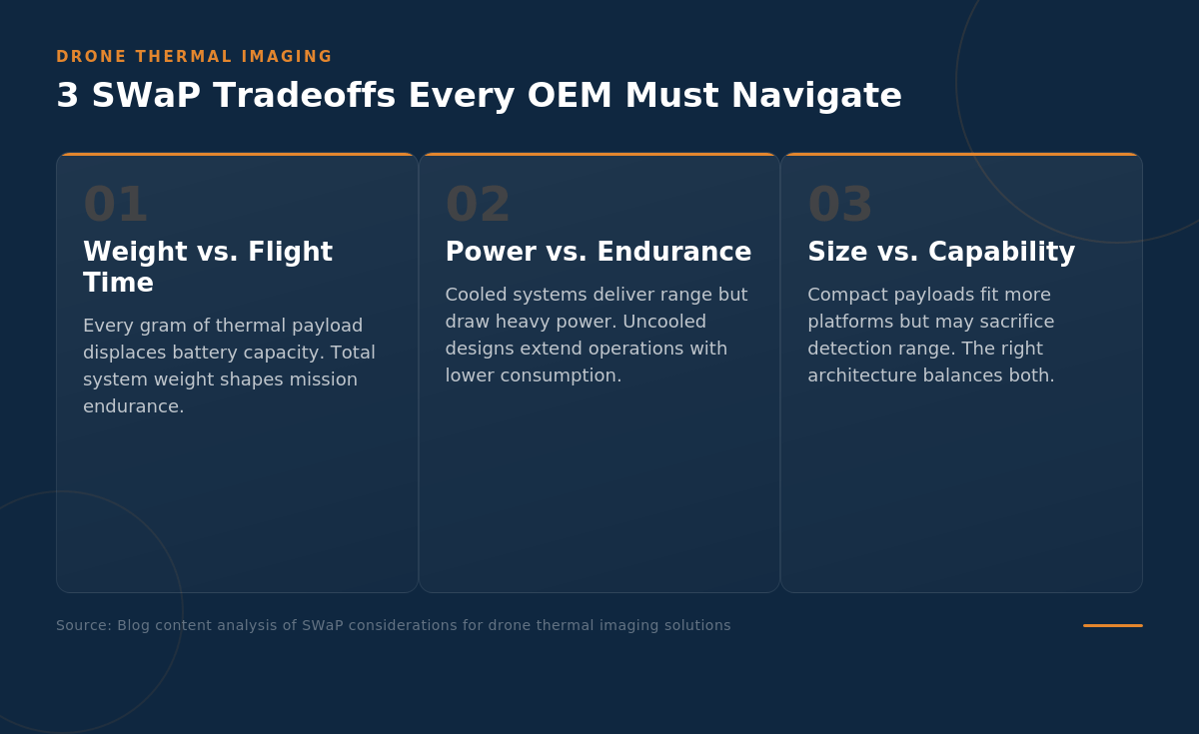
Size, weight, and power (SWaP) considerations define the practical boundaries of any thermal payload decision. Every engineering team knows this in theory, but the real-world tradeoffs are more nuanced than spec sheet comparisons suggest. SWaP decisions ripple through your entire platform design, affecting flight endurance, mechanical integration, aerodynamic performance, and total system cost.
Weight and Flight Endurance
Every gram of aerial thermal camera payload displaces either battery capacity or structural margin. For small and medium drone platforms, a difference of 100 to 200 grams in camera weight can translate to meaningful changes in mission duration. Teams evaluating thermal payloads should assess total system weight, including the camera, optics, gimbal, cabling, and any onboard processing hardware, rather than focusing only on the imaging core. Lightweight solutions that maintain performance allow platform designers to allocate weight budget toward additional sensors, extended batteries, or ruggedized structures.
Power Consumption and Mission Duration
Thermal cameras draw continuous power throughout flight operations, and power budget analysis should account for both steady-state consumption and peak demands during startup or intensive processing. Uncooled systems offer significant power advantages over cooled alternatives, making them the default choice for platforms where endurance matters more than maximum detection range. For programs requiring extended surveillance missions, power-efficient designs directly translate to operational capability that wins contracts.
Cooled vs. Uncooled: Choosing the Right Architecture
The cooled versus uncooled decision shapes nearly every downstream aspect of your platform. Here is a practical comparison for OEM decision-makers:
|
Factor |
Cooled Systems |
Uncooled Systems |
|
Best suited for |
Long-range targeting, ISR missions |
Surveillance, inspection, patrol |
|
SWaP impact |
Higher weight and power draw |
Lighter, lower power consumption |
|
Detection range |
Superior at extended distances |
Effective at moderate distances |
|
Maintenance |
Cooler requires periodic service |
Minimal ongoing maintenance |
|
Cost profile |
Higher upfront and lifecycle cost |
Lower total cost of ownership |
|
Ideal platform size |
Medium to large UAVs |
Small to medium UAVs |
Many OEMs find that a mixed approach works best, offering cooled configurations for defense programs demanding maximum range and uncooled options for platforms where flight endurance and cost efficiency take priority. Working with a partner that builds both cooled and uncooled solutions simplifies procurement and ensures optical consistency across your product line.
How Does Supply Chain Reliability Affect Program Timelines?
Supply chain disruption has become one of the top risks for drone programs over the past several years. Material shortages, export restrictions, and single-source dependencies have delayed or derailed programs that were otherwise on track technically. For teams sourcing thermal imaging payloads, supply chain evaluation deserves equal weight alongside performance specifications.
Germanium, the traditional material for infrared optics, presents a growing challenge. Global production is concentrated in a handful of countries, and price volatility has made long-term cost forecasting difficult for multi-year defense contracts. OEMs building aerial thermal camera assemblies around germanium-dependent optics face increasing risk that material availability will compromise delivery schedules or force expensive redesigns mid-program.
Alternative infrared materials, particularly chalcogenide glass formulations, offer comparable optical performance without germanium dependence. Manufacturers who have invested in proprietary alternative materials give OEMs a path to stable pricing and reliable supply over multi-year program timelines. This matters especially now, as federal policy is accelerating demand. The June 2025 executive orders on restoring American airspace sovereignty prioritize domestically manufactured drone systems and counter-UAS technologies, creating a procurement environment that rewards suppliers with secure, U.S.-based material and manufacturing capabilities.
What Defense Surveillance Applications Are Driving Demand for Aerial Thermal Cameras?
Defense and homeland security represent the largest investment category for drone thermal imaging solutions today. The applications span a wide range of operational requirements, each placing different demands on the imaging system and its integration with the broader platform.
ISR and Border Surveillance
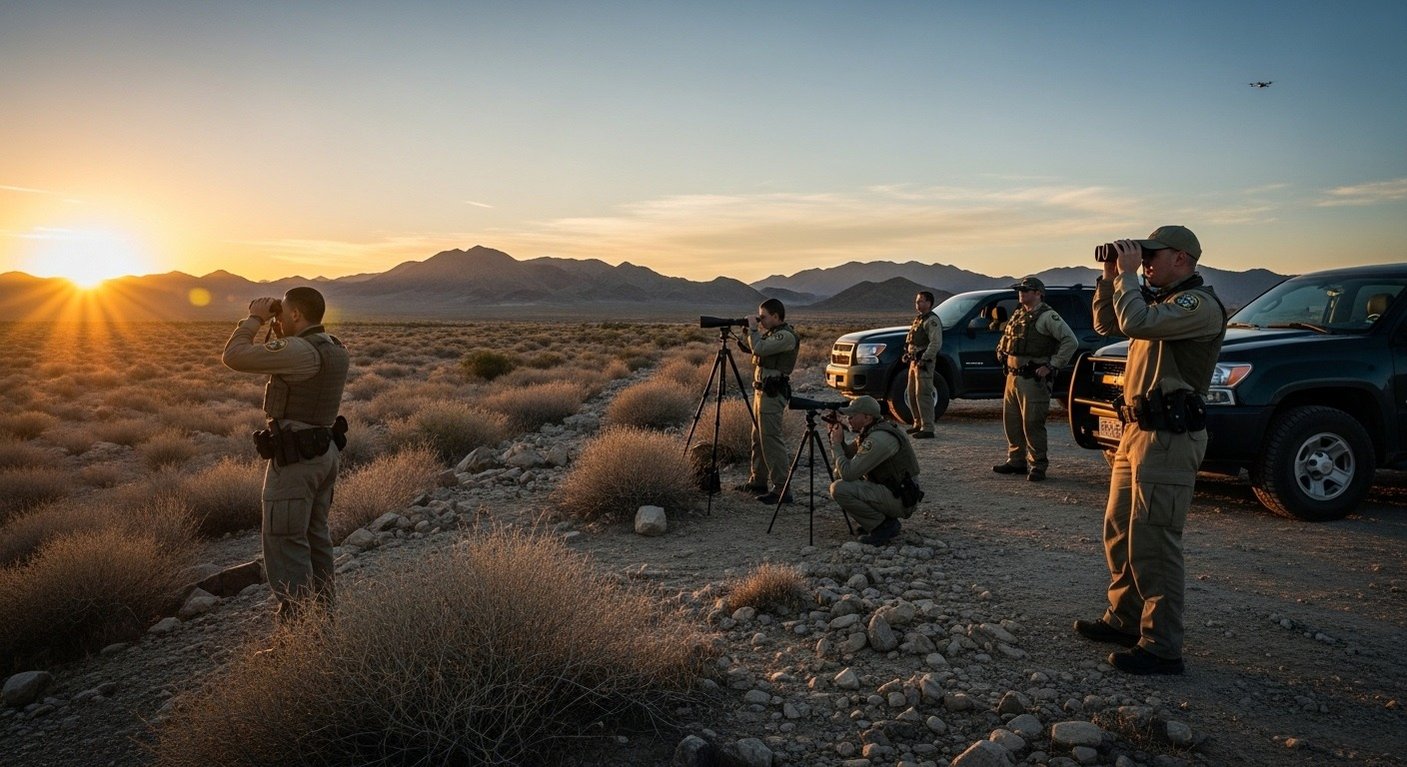
Intelligence, surveillance, and reconnaissance missions require sustained thermal coverage over extended periods. Border security operations benefit from aerial thermal camera systems that detect human heat signatures through darkness, light vegetation, and adverse weather. These applications demand consistent image quality over long flight durations, making power-efficient uncooled systems a natural fit for patrol and monitoring missions. Federal border and critical infrastructure surveillance programs continue expanding the installed base of thermally equipped drone platforms, creating steady demand for reliable imaging payloads that perform around the clock.
Counter-UAS Operations
CUAS (Counter-Unmanned Aircraft System) applications represent one of the fastest-growing segments for thermal imaging on drone platforms. Detecting small, low-observable targets at distances that provide sufficient response time demands high-sensitivity sensors with rapid target acquisition capabilities. Thermal cameras designed for CUAS must distinguish small drones from birds and other environmental clutter, which requires optimized optics and advanced image processing, capabilities that separate purpose-built systems from repurposed commercial cameras.
Shipboard and Maritime Surveillance
Naval programs increasingly integrate drone-mounted thermal systems for shipboard surveillance and force protection. Maritime environments introduce additional challenges: salt spray corrosion, electromagnetic interference, and wide temperature swings. Infrared imaging systems for maritime use require environmental hardening beyond what standard commercial-grade cameras provide.
5 Evaluation Criteria for Selecting a Drone Thermal Imaging Partner
Beyond specifications and pricing, the supplier relationship itself can make or break a drone program. Here are five criteria that experienced program managers consistently flag as the real differentiators between reliable thermal imaging partners and those who create headaches downstream.
1. Vertical integration depth. Manufacturers that control their own material production, lens fabrication, coating processes, and camera assembly can optimize each layer for your application. Component assemblers who source from multiple vendors introduce compatibility risks and reduce their ability to customize.
2. Customization capability and speed. Standard catalog cameras rarely match the exact requirements of a new drone platform. Partners that offer engineering collaboration from design through environmental testing help you reach production faster and with fewer surprises.
3. Material innovation and supply stability. Ask prospective suppliers about their material sourcing strategy. Dependence on single-source or geopolitically constrained materials introduces risk that escalates over multi-year programs.
4. Manufacturing location and compliance. NDAA compliance, ITAR considerations, and domestic manufacturing requirements increasingly factor into procurement decisions. Suppliers with North American and European production facilities simplify compliance documentation and reduce regulatory risk.
5. Proven track record in your application domain. Experience in aerospace and defense applications is fundamentally different from commercial or consumer drone markets. Partners who understand military specification requirements, program timelines, and environmental qualification testing bring institutional knowledge that accelerates your development cycle.

How Do Application Requirements Shape Your Thermal Payload Selection?
Different mission profiles place fundamentally different demands on thermal imaging payloads. Understanding where your platform will operate helps narrow the field of viable options and ensures the system you select is optimized for real-world conditions rather than laboratory benchmarks.
|
Application |
Key Performance Priority |
Typical Architecture |
Critical SWaP Consideration |
|
ISR / Surveillance |
Extended detection range, consistent image quality |
Cooled MWIR (3–5 µm) or uncooled LWIR (8–14 µm) |
Power budget for long endurance |
|
CUAS Detection |
Fast target acquisition, clutter rejection |
Cooled or high-res uncooled |
Rapid deployment weight limits |
|
Industrial Inspection |
Radiometric accuracy, temperature measurement |
Uncooled LWIR |
Compact form for tight spaces |
|
Search and Rescue |
Wide FOV, human detection through obscurants |
Uncooled LWIR or BBIR (2–12 µm) |
Flight endurance priority |
|
Maritime Operations |
Corrosion resistance, EMI hardening |
Cooled MWIR for range |
Environmental ruggedization |
The most effective approach for OEMs serving multiple markets is to work with a thermal imaging partner capable of delivering both cooled and uncooled configurations from a unified engineering platform. This provides consistency in quality and integration approach across your product line while allowing each variant to be optimized for its intended application.
What Role Does AI Integration Play in Next-Generation Drone Thermal Imaging Solutions?
Artificial intelligence is rapidly becoming a differentiator in how aerial thermal camera data is processed and acted upon. Onboard AI capabilities enable real-time target detection, automated anomaly identification, and intelligent scene analysis that reduce operator workload and improve mission effectiveness. According to Grand View Research, enhanced imaging sensors and AI integration are among the primary growth drivers for the broader drone market, which reached $83.8 billion in 2025.
For OEMs, the AI conversation has practical implications for thermal payload selection. Camera systems with standardized data interfaces, sufficient onboard processing headroom, and support for common AI frameworks simplify the integration of intelligent analytics into your platform. Partners who understand the full imaging pipeline, from lens design through data output, can help ensure that raw thermal data arrives in formats optimized for downstream AI processing.
Frequently Asked Questions
What is the difference between LWIR and MWIR for drone thermal imaging solutions?
LWIR (long-wave infrared, 8–14 µm) and MWIR (mid-wave infrared, 3–5 µm) operate in different portions of the infrared spectrum. LWIR is commonly used in uncooled systems and excels at ambient temperature detection, making it well-suited for surveillance and industrial inspection. MWIR, typically requiring cooled detectors, provides superior sensitivity and long-range detection capability, making it the preferred choice for defense targeting and ISR applications. The right selection depends on your platform’s mission profile and SWaP constraints.
How do SWaP constraints affect UAV infrared payload design?
Size, weight, and power directly determine which thermal architectures are viable for a given drone platform. Heavier cooled systems deliver better long-range performance but reduce flight endurance and limit integration on smaller UAVs. Lightweight uncooled solutions preserve battery life and enable integration on compact platforms but may not meet detection range requirements for all applications. Evaluating SWaP as a system-level tradeoff, rather than a single-component metric, leads to better overall platform performance.
Why does vertical integration matter when choosing a thermal imaging partner?
Vertically integrated manufacturers control the entire production process, from raw infrared materials through finished camera systems. This approach enables tighter quality control, faster customization, and reduced supply chain risk compared to assemblers who source components from multiple vendors. For drone programs with strict timeline and compliance requirements, working with a vertically integrated partner simplifies procurement and reduces the risk of component-level incompatibilities.
Build Your Next Drone Platform on a Proven Thermal Imaging Foundation
Evaluating drone thermal imaging solutions is a decision that touches every aspect of your platform’s competitive position: detection performance, flight endurance, development timeline, supply chain stability, and long-term program viability. The partners you choose now will define your capabilities for years to come.
The OEMs winning contracts today are the ones working with manufacturing partners who offer complete vertical integration, proprietary material innovation, and collaborative engineering from concept through production. LightPath Technologies delivers exactly that, with over 40 years of experience engineering premium optical and thermal imaging solutions for the world’s most demanding aerospace, defense, and industrial programs. Connect with our engineering team to discuss how we can help you build drone thermal imaging solutions that give your platform a measurable competitive edge.