

From AI Analytics to Supply Chain Shifts: Here's What Program Managers and Engineering Teams Need to Know.
Key Takeaways
The future of infrared imaging is being shaped by market forces that will fundamentally change how OEMs and system integrators source, design, and deploy thermal solutions over the next decade.
- The global infrared imaging market is projected to grow from $8.61 billion in 2025 to $11.65 billion by 2030, with defense and industrial applications driving the majority of that expansion.
- AI-powered analytics, supply chain diversification, uncooled technology gains, and miniaturization are converging to create new competitive dynamics for program managers and engineering teams.
- Vertical integration and material innovation are becoming decisive differentiators as OEMs seek partners who can deliver complete thermal systems rather than individual components.
- Organizations that align their sourcing strategies with these shifts now will be better positioned to win programs, reduce risk, and accelerate time to market over the next decade.
Thermal imaging has moved from specialized military equipment to a foundational technology layer across defense, aerospace, and industrial operations. And the pace of that shift is accelerating. According to MarketsandMarkets research, the infrared imaging market is on track to reach $11.65 billion by 2030, expanding at a 6.2% CAGR driven by defense modernization, industrial automation, and surveillance applications. For OEMs and system integrators building the next generation of optical and thermal imaging platforms, the future of infrared imaging represents both a massive opportunity and a strategic inflection point.
Here are the five trends most likely to reshape how thermal systems get designed, built, and deployed, and what they mean for engineering and business leaders making those decisions.
Why Is the Future of Infrared Imaging Generating So Much Attention?
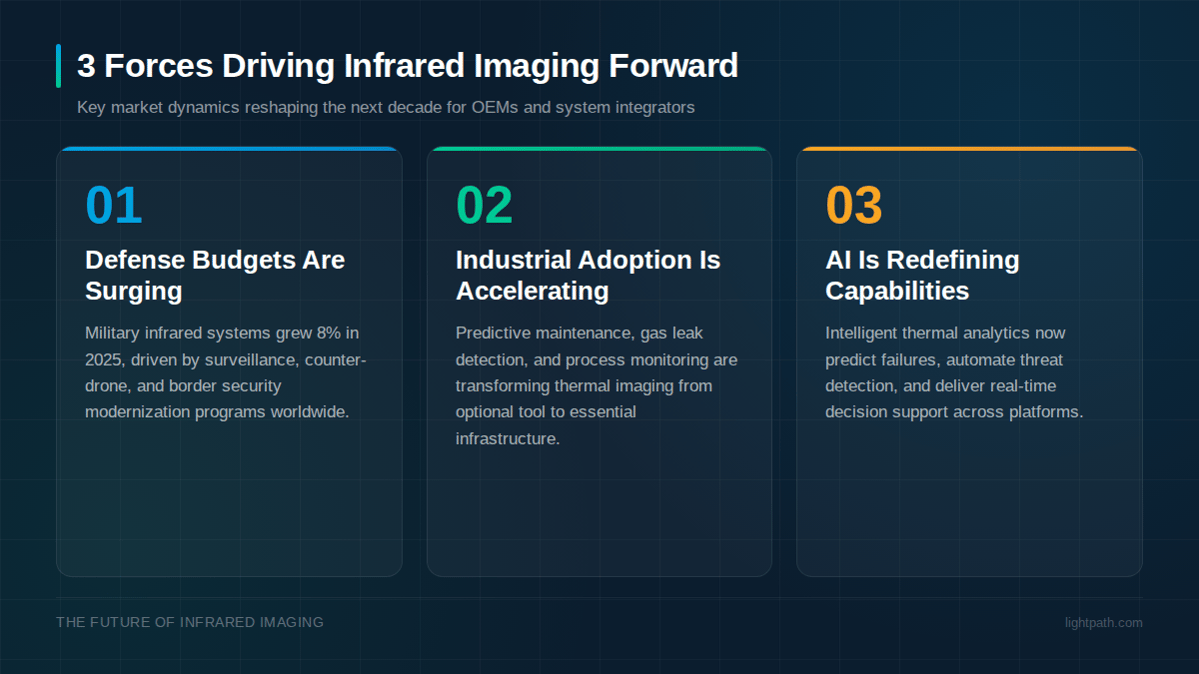
The short answer: money, geopolitics, and technology are all pointing in the same direction. Defense budgets across North America and Europe are expanding, with governments prioritizing surveillance, counter-drone capabilities, and border security programs that rely heavily on infrared technology. The global military infrared imaging systems market grew 8% in 2025 and is expected to exceed $18 billion by 2030.
On the industrial side, facilities are adopting thermal monitoring at unprecedented rates for predictive maintenance, gas leak detection, and process optimization. The U.S. Department of Energy's Federal Energy Management Program has long advocated predictive maintenance approaches, including thermal imaging, as one of the most cost-effective methods for ensuring reliability, safety, and energy efficiency in complex facilities. What was once a "nice to have" inspection tool has become essential infrastructure for plants and utilities looking to reduce downtime and meet strict safety requirements. The convergence of these demand drivers with significant technology advances means the future of infrared imaging looks very different from even five years ago.
What Thermal Imaging Trends Should OEMs Watch Over the Next Decade?
Five developments stand out as the most consequential for organizations that design, integrate, or procure thermal imaging solutions for defense, aerospace, and industrial platforms. Each one carries implications for how programs get structured, how suppliers get selected, and how systems ultimately perform in the field.
1. AI-Powered Thermal Analytics Are Becoming Table Stakes
Artificial intelligence integration represents the most significant shift shaping the infrared technology future. Thermal cameras are evolving from passive detection instruments into intelligent systems that analyze, predict, and automate decisions in real time.
For industrial applications, AI-powered thermal systems can now predict equipment failures weeks before traditional temperature thresholds trigger alarms. In defense environments, machine learning algorithms enhance threat detection, reduce false alarms, and enable automated target classification. The practical impact for OEMs is that procurement specifications increasingly require AI compatibility, structured data outputs, and integration with broader analytics platforms.
2. Uncooled Systems Are Closing the Performance Gap
Uncooled infrared technology continues expanding its market share, with industry analysts estimating it now accounts for the majority of the thermal imaging market. That dominance reflects a genuine shift in what uncooled systems can deliver. Modern microbolometer detectors paired with advanced signal processing algorithms are narrowing the performance gap with cooled alternatives for many applications.
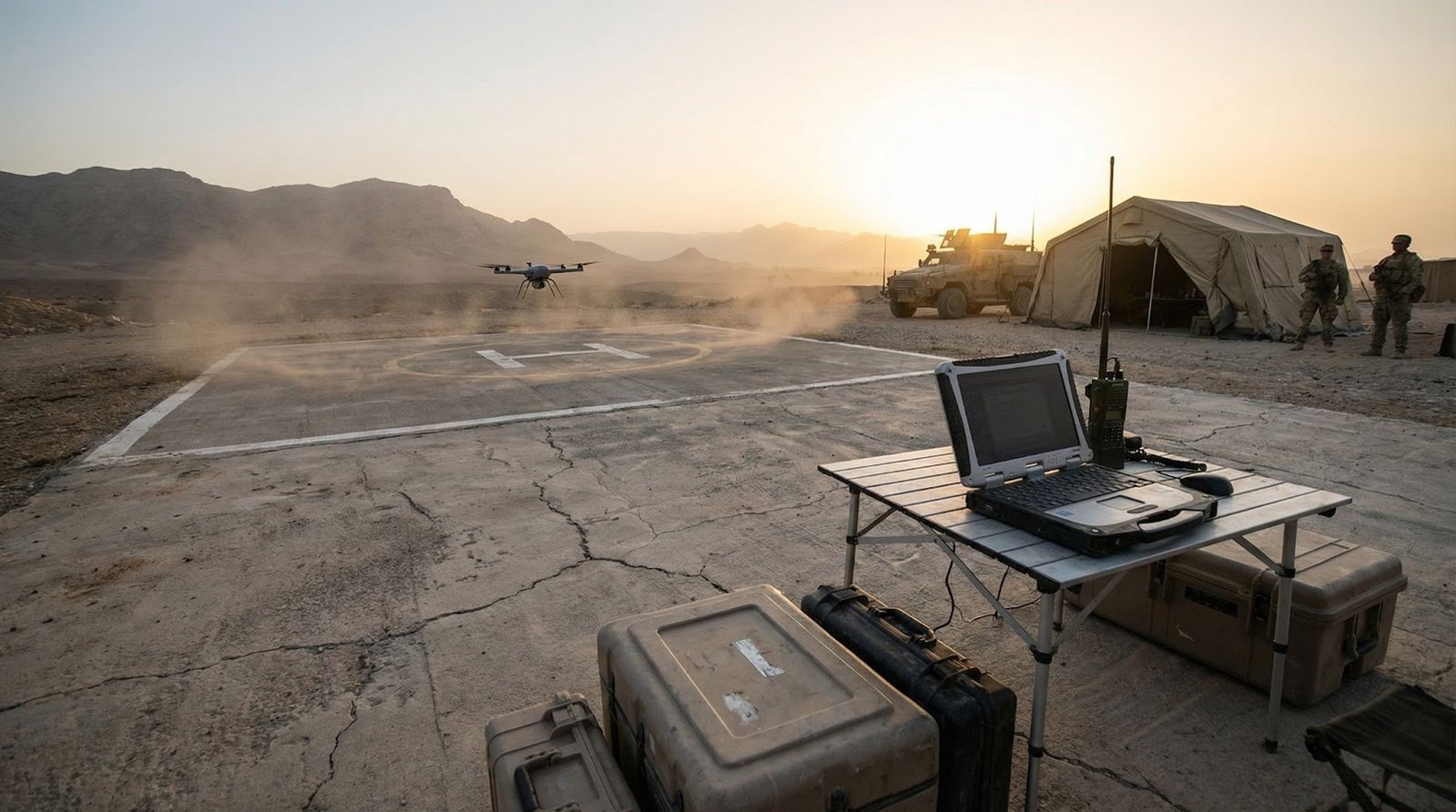
The implications are significant for system integrators. Uncooled platforms offer dramatic advantages in power consumption, maintenance burden, total cost of ownership, and size, weight, and power (SWaP) optimization. For drone payloads, vehicle-mounted systems, and continuous industrial monitoring, uncooled solutions now provide more than sufficient thermal sensitivity while eliminating the complexity of cryogenic cooling.
Cooled systems remain essential for long-range targeting, missile seekers, and applications demanding maximum sensitivity. As Yole Group's infrared imaging analysts have noted, geopolitical instability has strongly boosted MWIR and LWIR sensor markets, while a new generation of software-defined defense companies is accelerating innovation in counter-UAS and drone technology. The real thermal imaging trends story here is about OEMs having better options across a wider performance spectrum, not about one technology replacing the other. Understanding the practical differences between LWIR and MWIR approaches helps teams make smarter design decisions based on mission requirements rather than assumptions.
3. Supply Chain Diversification Is No Longer Optional
The traditional reliance on germanium-based optics has created vulnerability that smart organizations are actively addressing. Germanium supply constraints, driven by export restrictions and limited global production, have made material sourcing a strategic risk rather than a procurement detail.
Alternative materials, particularly chalcogenide glass technology, have emerged as viable options that deliver comparable thermal performance with more predictable supply chains and cost structures. For system integrators managing multi-year defense programs or large-scale industrial deployments, supply chain stability frequently outweighs marginal performance differences in material selection decisions.
|
Supply Chain Factor |
Traditional Germanium Optics |
Alternative Material Approaches |
|
Supply predictability |
Subject to export restrictions and geopolitical risk |
More diversified sourcing with stable availability |
|
Cost trajectory |
Rising due to scarcity and demand competition |
More predictable pricing over program lifecycles |
|
Performance |
Excellent infrared transmission |
Comparable transmission with broader spectral options |
|
Lead time risk |
Vulnerable to disruption |
Reduced single-source dependency |
|
Program suitability |
Established but increasingly constrained |
Growing adoption across defense and industrial programs |
This shift in the infrared technology future affects how OEMs evaluate potential partners. Manufacturers who develop and produce their own alternative optical materials offer a fundamentally different risk profile than those dependent on the same constrained germanium sources as everyone else. Owning the raw material supply chain means faster lead times, more predictable costs, and the ability to engineer materials specifically for a program's performance requirements.
4. Miniaturization Is Expanding the Application Envelope
Smaller pixels, more compact sensor packages, and lighter overall system architectures are opening thermal imaging to platforms and use cases that were impractical even a few years ago. This trend is especially pronounced in drone-mounted imaging payloads, small unmanned ground vehicles, and man-portable defense equipment.
The push toward SWaP-optimized systems is being driven from both sides: defense, where every gram matters on a tactical drone, and industrial, where compact thermal sensors integrate into robotic inspection platforms and tight factory floor spaces. For OEMs, this means the design constraints of five years ago may no longer apply. Programs that previously ruled out thermal imaging due to size or weight limitations should reassess what current technology can deliver.
5. Vertical Integration Is Becoming a Competitive Requirement
The future of infrared imaging increasingly favors manufacturers who control the entire value chain, from raw materials and lens fabrication to coatings, assemblies, and finished camera systems. This represents a structural shift in how OEMs should evaluate partnerships.
When a single partner owns the materials science, optical design, coating processes, and system integration, the result is tighter performance optimization, faster customization, and reduced coordination complexity. OEMs working with vertically integrated suppliers report shorter development timelines, fewer integration surprises, and more predictable program execution.
How Will the Infrared Technology Future Affect Sourcing Decisions?
Beyond the technology trends themselves, the future of infrared imaging is reshaping the criteria that engineering and procurement teams use to select thermal imaging partners. Historically, decisions centered on specifications like resolution, sensitivity, and operating temperature range. Those parameters still matter, but they are increasingly necessary rather than sufficient.
|
Evaluation Criteria |
Previous Priority |
Emerging Priority |
|
Core specifications |
Resolution, NETD, frame rate |
System-level performance including AI compatibility |
|
Supply chain |
Price per unit, lead time |
Material sourcing stability and geopolitical risk mitigation |
|
Manufacturing |
Component quality |
Vertical integration depth and in-house capability |
|
Partnership model |
Transactional procurement |
Collaborative engineering from design through production |
|
Geographic considerations |
Global lowest cost |
Regional manufacturing for compliance and speed |
Program managers navigating these shifts are finding that the strongest partnerships combine deep thermal imaging expertise with manufacturing breadth and material innovation. The days of treating thermal camera procurement as a commodity purchase are fading fast, particularly for mission-critical applications in defense and aerospace.
How Should System Integrators Prepare for These Shifts?
Practical preparation comes down to three priorities. First, evaluate your current thermal imaging supply chain for single-source risks, especially around germanium-dependent optics. Second, assess whether your existing thermal imaging partners can support the system-level integration demands that AI analytics and sensor fusion are creating. Third, look for manufacturers who can scale with your program from prototype through production.
The organizations that adapt their procurement and partnership strategies for industrial thermal applications around these thermal imaging trends will find themselves with shorter development cycles, more resilient supply chains, and ultimately better-performing end products. The infrared technology future belongs to teams that act on these insights now rather than reacting later.
Frequently Asked Questions
What is driving growth in the future of infrared imaging market?
The primary growth drivers are defense modernization programs, expanding industrial adoption for predictive maintenance and safety monitoring, and technological advances in AI-powered analytics and uncooled detector performance. The market is projected to grow from $8.61 billion in 2025 to $11.65 billion by 2030, with North America and Asia-Pacific leading regional demand.
How are thermal imaging trends affecting OEM procurement decisions?
OEMs are increasingly prioritizing supply chain resilience, vertical integration depth, and system-level engineering capability over pure specification comparisons. The shift toward AI-compatible systems and alternative optical materials like chalcogenide glass is changing what "best value" means in thermal imaging procurement.
Should OEMs choose cooled or uncooled infrared systems for new programs?
The answer depends entirely on mission requirements. Uncooled systems now serve the majority of surveillance, industrial monitoring, and drone applications with excellent performance at lower cost and complexity. Cooled systems remain essential for long-range targeting and applications requiring maximum thermal sensitivity. Many programs benefit from working with partners who offer both technologies and can recommend the optimal approach for specific operational needs.
Build Your Next Thermal System With a Partner Who Sees What's Coming
The future of infrared imaging rewards organizations that choose their technology partners strategically. As AI integration, supply chain dynamics, and platform requirements continue evolving, the value of working with a vertically integrated manufacturer becomes increasingly clear. LightPath Technologies brings four decades of innovation, proprietary Black Diamond™ chalcogenide glass, and a full spectrum of cooled and uncooled thermal solutions to help OEMs and system integrators build lasting competitive advantages. Start a conversation with our engineering team to explore how we can support your next program.