
Fixed optical gas imaging has shifted from a survey tool to permanent facility infrastructure, and that shift is changing what OEMs need to build.
- Regulatory pressure is pulling monitoring from periodic to persistent. Federal alternative-technology pathways, European reporting rules, and international measurement frameworks all reward continuous coverage over scheduled walkarounds.
- A continuous methane monitoring camera is a system, not a sensor. Detection quality depends on coverage geometry, analytics, alerting logic, and integration just as much as on the imaging core.
- "Continuous" is a claim that deserves scrutiny. Pan-and-tilt cycling, lock-out states, and weather all interrupt coverage, and buyers are learning to ask about it.
- Fenceline deployment favors different engineering choices than handheld work. Environmental hardening, power budget, and long-duty-cycle reliability move to the top of the list.
If you're building systems for the emissions market, the differentiator isn't the camera anymore. It's whether the whole detection chain holds up unattended in the field for years.
Methane is the emissions problem the energy sector cannot inventory its way out of. The International Energy Agency estimates that fossil fuel operations release roughly 124 million tonnes of methane annually, with oil the largest single contributor, and finds no sign that those emissions are falling despite proven mitigation options. The gap between what's known and what's actually caught in the field is where fixed monitoring hardware earns its place, and it's why demand for advanced infrared imaging systems keeps expanding across upstream, midstream, and downstream sites.
The response has been a steady move toward the continuous methane monitoring camera: an unattended, permanently mounted imaging system that watches a defined area around the clock instead of waiting for a scheduled inspection. For OEMs and integrators serving oil and gas, utilities, and chemical processing, that's a genuine architectural shift. The camera is no longer an instrument someone carries to a suspected leak. It's site infrastructure, and it has to behave like it.
What Is a Continuous Methane Monitoring Camera?
A continuous methane monitoring camera is a fixed-mount infrared imaging system that detects hydrocarbon releases by making the plume visible against its background, then automatically reports that detection with no operator present. The physics matches any optical gas imaging system: target gases absorb infrared energy at characteristic wavelengths, and spectral filtering turns that absorption into visible image contrast. What changes in a fixed deployment is everything wrapped around that core.
The distinction matters commercially because a continuous methane monitoring camera and a handheld unit sell to different buyers with different requirements. Understanding where each fits keeps specification conversations honest.
How Fixed OGI Differs From Handheld Survey Work
A handheld optical gas imaging system is human-supervised. An inspector points the camera, interprets what they see, and documents the finding. Coverage is deliberate but intermittent, and result quality tracks closely with operator skill and inspection frequency. It remains the right tool for confirming an alarm, working inside congested pipe racks, and building documented evidence.
A fixed OGI camera sits on a pole or platform and observes an assigned field of view indefinitely. There's no operator to interpret the image, so analytics have to do the interpreting, and no one to reposition the unit, so coverage geometry has to be right at commissioning. Because the system runs for years rather than hours, environmental sealing, thermal management, and power draw become design constraints rather than conveniences.
Where These Systems Get Mounted
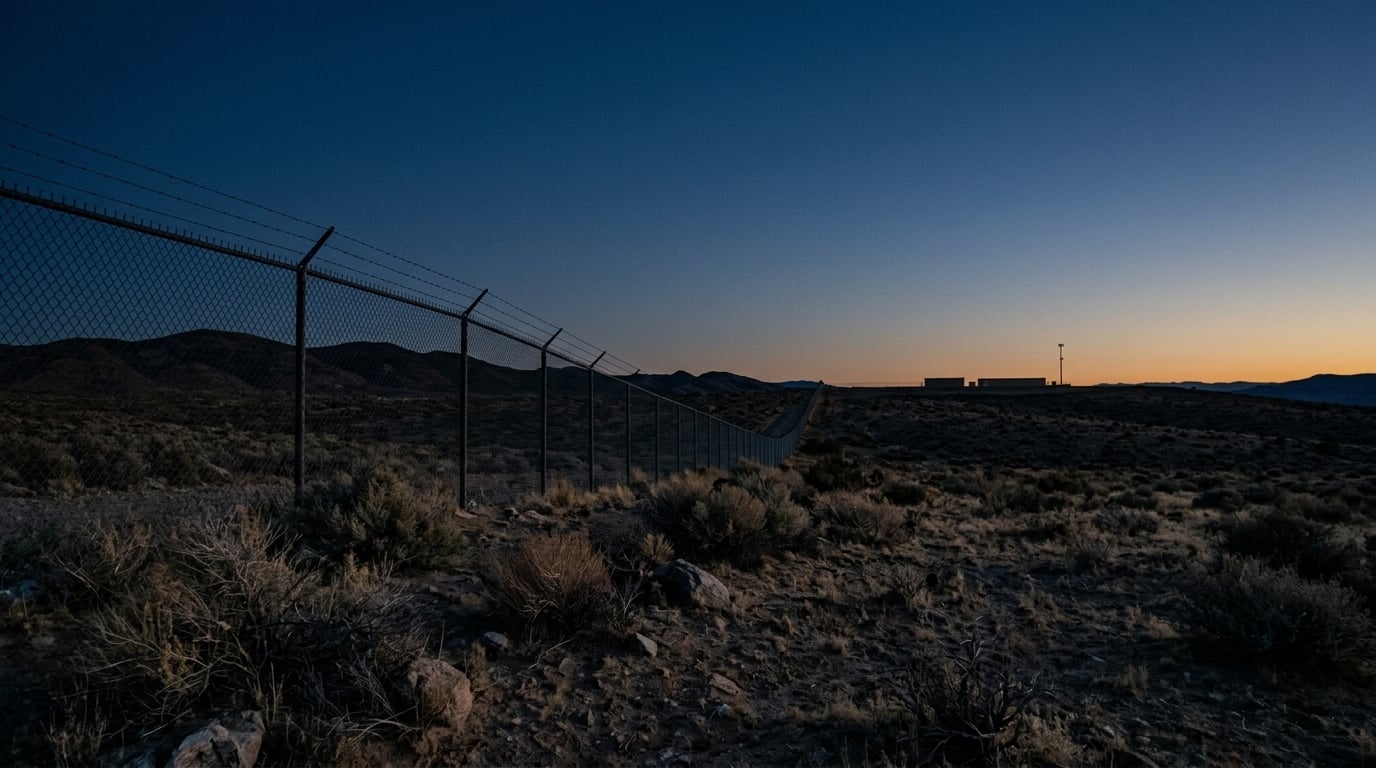
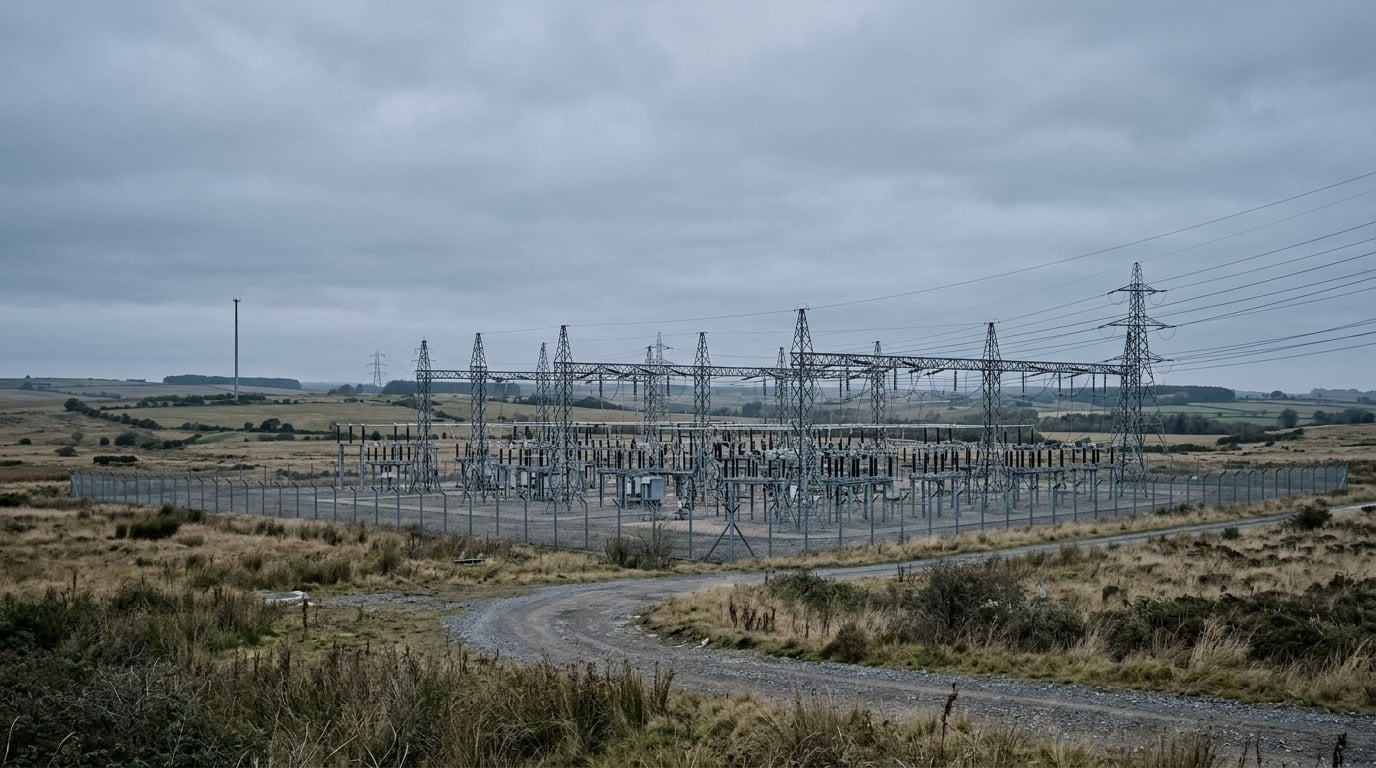
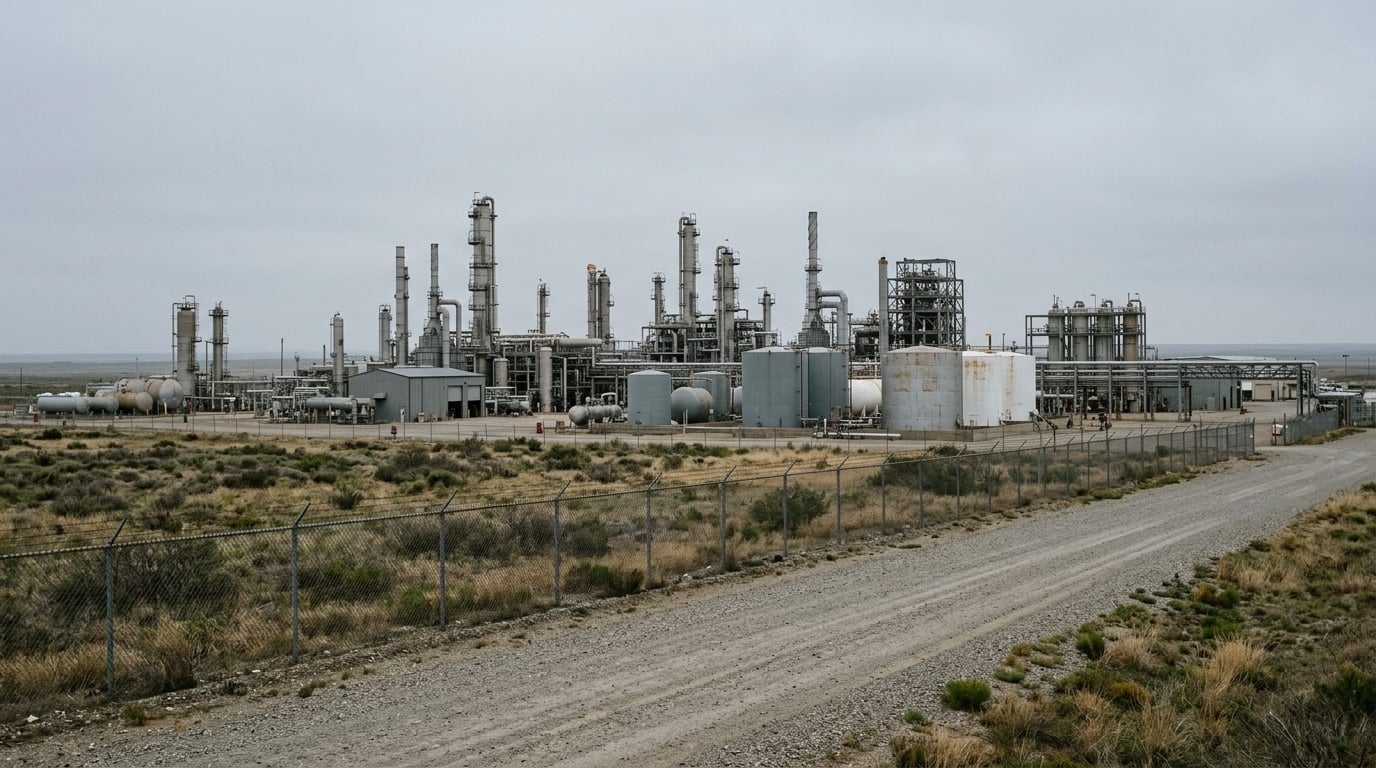
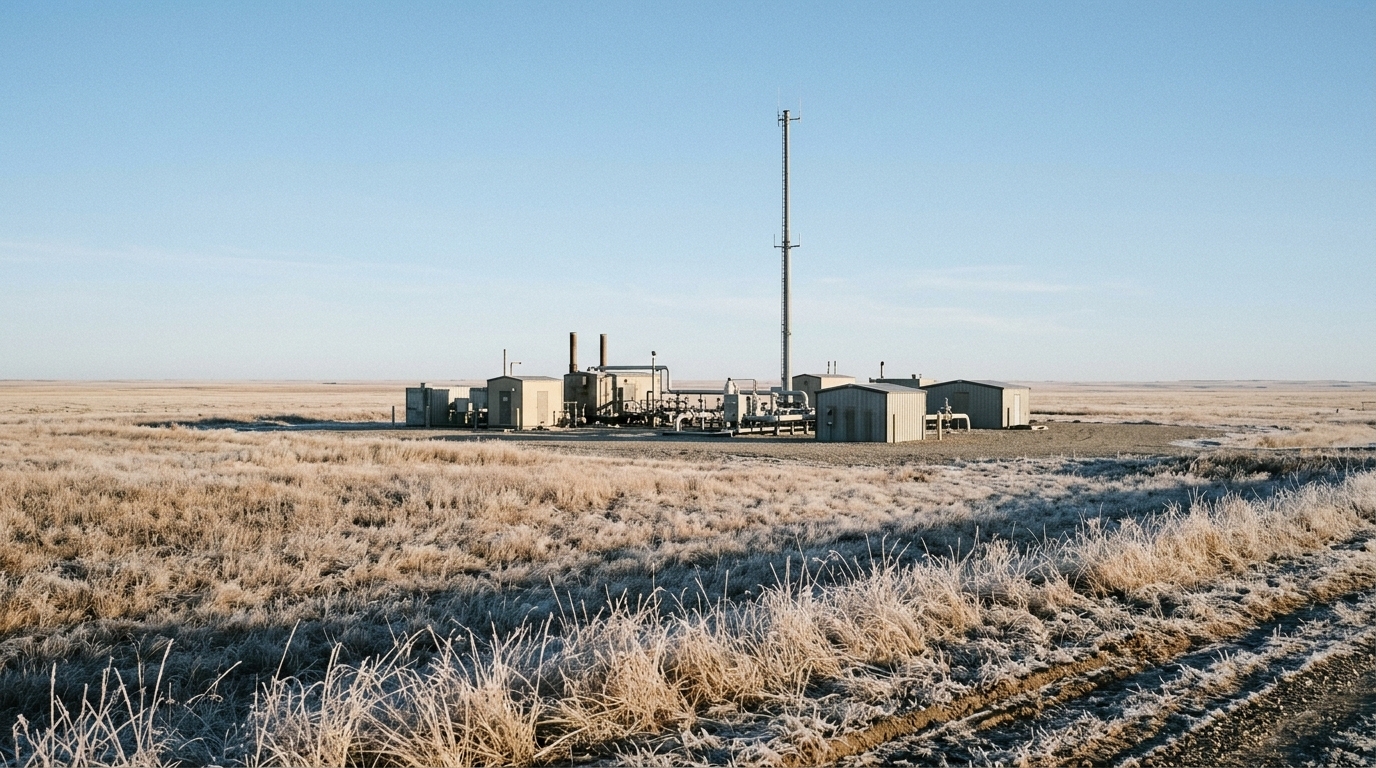
Fenceline methane detection is the most visible application, with cameras positioned along a perimeter to characterize what leaves the property line. Inside the fence, coverage concentrates on equipment that's both likely and expensive to leak. Larger sites run both approaches together, using perimeter units for site-level accounting and interior units for source localization.
The deployment zones that come up most often in specification conversations:
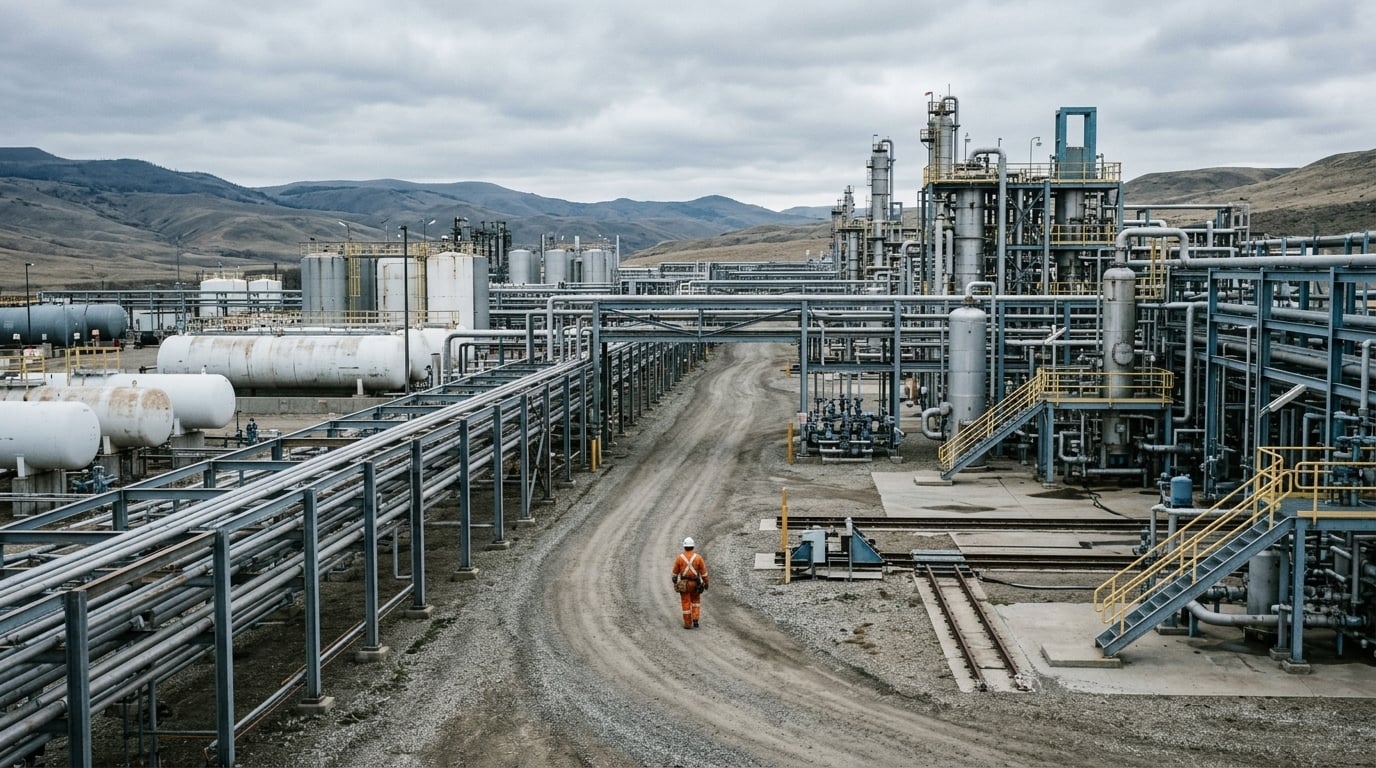
- Storage and transfer: tank farms, loading racks, and terminal transfer points, where releases tend to be large and intermittent
- Rotating and pressurized equipment: compressor packages, separators, and meter stations, where component-level leaks subtly accumulate
- Combustion assets: flare and enclosed combustor stacks, where operators need confirmation that destruction is working as designed
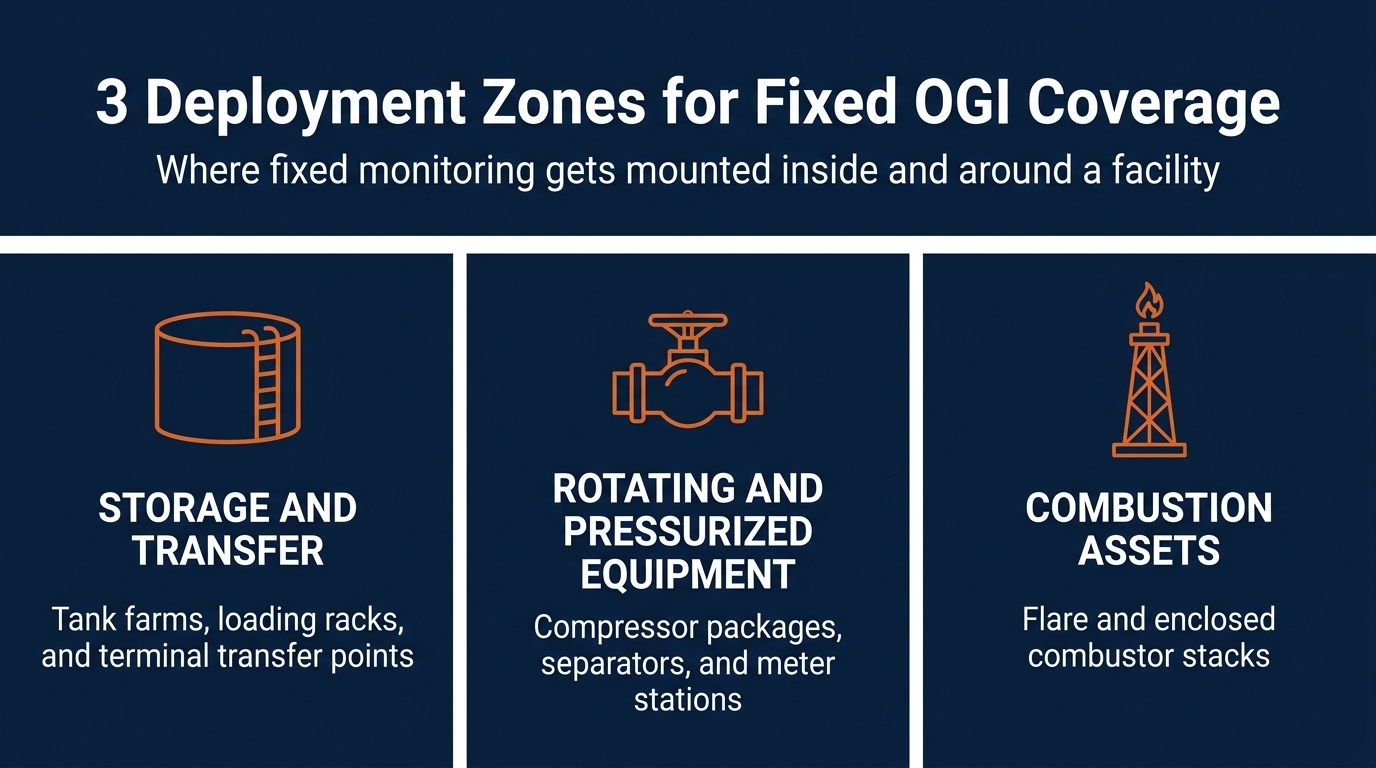
Each of those zones implies different standoff distances and viewing angles, which is why coverage planning tends to drive hardware selection rather than the other way around.
Why Are Facilities Moving From Periodic Surveys to Continuous Coverage?
The operational argument was always there. On a quarterly survey cadence, a leak that starts the day after an inspection can run until the next one, and every hour of that is lost product plus accumulating risk. What changed is that the regulatory environment started rewarding faster detection rather than merely documented detection.
The U.S. Environmental Protection Agency maintains a formal review process for advanced detection technologies, with published criteria covering periodic screening and continuous monitoring applications, plus a public register of approved methods and their leak resolution thresholds. That gives operators a defensible route to supplement conventional survey programs with automated systems. In Europe, methane regulation obligations phase in through 2030, and legal analysis of the framework notes that operators face leak detection and repair programme submissions, annual source-level reporting, and restrictions on routine venting and flaring, backed by administrative penalties.
Voluntary frameworks pull in the same direction. The UN Environment Programme's methane partnership describes itself as the sector's only comprehensive measurement-based international reporting framework, and its highest data tier requires reconciling source-level emissions against site-level measurement. That reconciliation is difficult with snapshot surveys and much easier with persistent measurement running.
|
Driver |
What it asks of operators |
Where continuous monitoring fits |
|
U.S. federal alternative technology pathway |
Demonstrated detection performance for approved screening or monitoring methods |
Provides a route to automate or supplement scheduled survey programs |
|
European methane regulation |
Documented LDAR programs, source-level reporting, venting and flaring limits |
Supplies persistent evidence and faster event notification |
|
International measurement-based reporting |
Source-level data reconciled against site-level measurement |
Generates the ongoing dataset reconciliation depends on |
|
Product loss and safety exposure |
Faster time to detection on unplanned releases |
Cuts the interval between release start and operator awareness |
How Does a Continuous Methane Monitoring Camera Work in a Fenceline Deployment?
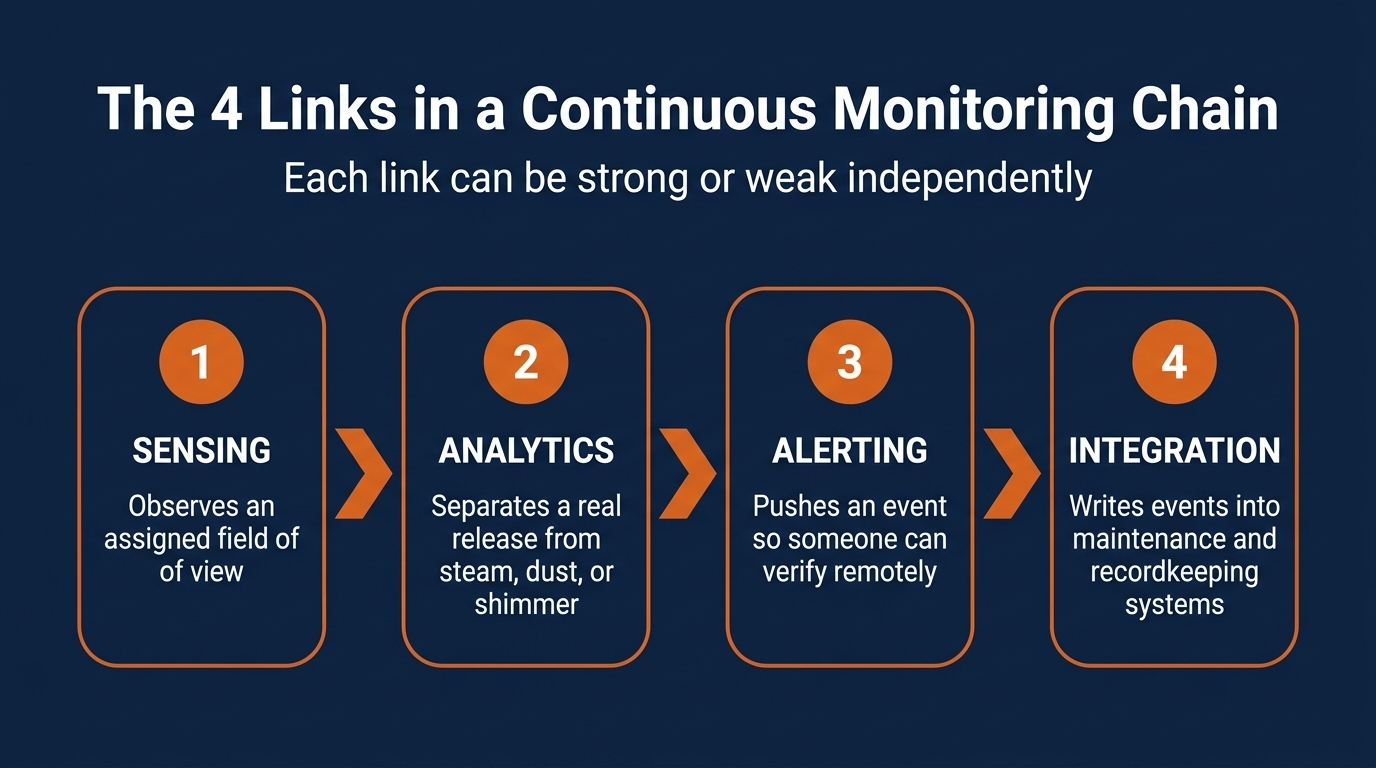
Think of the deployment as a chain rather than a device. Each link can be strong or weak independently, and the system performs at the level of its weakest link. Vendors compete hard on the imaging core, but field failures rarely originate there.
The Detection and Alerting Chain
Sensing comes first, with the imaging assembly observing its field of view, often cycling through preset pan-and-tilt positions to extend coverage from a single mount. Analytics come second, separating an actual release from steam, heat shimmer, blowing dust, or a passing vehicle. Alerting comes third, pushing an event with supporting imagery to a control room so someone can verify remotely instead of dispatching a technician. Integration comes last, writing events into the systems the facility already uses for maintenance and recordkeeping.
That last link is underrated. A continuous emissions monitoring camera that generates alerts nobody can route into a work order is an expensive notification service. Detection creates value only when it connects to repair and reporting workflows.
What "Continuous" Actually Means
Here's the nuance separating informed buyers from optimistic ones. Colorado State University's methane testing center, which runs standardized single-blind evaluations of detection technologies, is explicit that systems colloquially called continuous monitors do not operate at all times, citing lock-out conditions, cycling, and panning between fields of view as ordinary interruptions.
That's not a criticism of the technology. It's a reminder to specify honestly. Coverage is a duty-cycle and geometry question, and performance varies with wind, background thermal contrast, and weather. A continuous emissions monitoring camera performs well in fog, darkness, and many low-visibility conditions where visible-light systems struggle, while heavy rain, dense spray, and strong background radiance sources degrade results. Buyers increasingly ask about detection thresholds, revisit intervals, and false-positive rates, and suppliers who answer plainly tend to win the technical evaluation.
Five Design Decisions That Shape Fenceline Methane Detection Performance
If you're building these platforms, a handful of choices made early will determine how the finished system performs three years into deployment. None of them is reversible once units are in the field.
- Coverage geometry. Mounting height, standoff distance, and field of view define what the system can physically see. Blind spots created at commissioning tend to stay blind, so coverage modeling belongs in design rather than installation.
- Detection threshold and confidence. Sensitivity, probability of detection, and time to detection are what regulators and operators evaluate. Pushing sensitivity without controlling false positives produces a system that operators learn to ignore.
- Environmental hardening. Fixed units live outdoors through temperature swings, vibration, humidity, and dust. Sealing, window durability, and thermal stability determine whether calibrated performance holds across seasons.
- Power and connectivity budget. Many monitoring locations are remote or unmanned, so power draw, cooling, and imagery bandwidth constrain where a system can realistically go and what installation costs.
- Supply chain durability. Infrared optics depend on specialized materials, and a decade-long program needs components still available and consistently specified in year eight. Sourcing strategy becomes a product decision.

Fixed or Handheld: Which Deployment Fits Which Job?
Most mature facilities run both, and the strongest OEM positioning acknowledges that rather than arguing one obsoletes the other.
|
Consideration |
Fixed OGI camera |
Handheld survey camera |
|
Coverage pattern |
Persistent, defined field of view |
Deliberate, operator-directed, intermittent |
|
Best-fit role |
High-risk zones, perimeter accounting, unmanned sites |
Alarm verification, congested areas, documented inspections |
|
Operator requirement |
Unattended with remote verification |
Trained inspector on site |
|
Detection latency |
Minutes to hours, depending on cycle |
Interval between scheduled surveys |
|
Primary design constraints |
Environmental sealing, power, duty cycle |
Ergonomics, battery life, portability |
|
Typical integration |
Control room, alarm and maintenance systems |
Inspection records and reporting workflows |
Fixed systems shorten the clock on releases at the equipment most likely to fail. Handheld work confirms those flags and reaches places fixed units can't see. If your customers treat the two as complements rather than alternatives, they'll build stronger programs, and that's usually the more productive positioning conversation to have.
What Should OEMs Weigh When Building a Continuous Emissions Monitoring Camera?
Building a continuous methane monitoring camera means designing for duty cycle first. A thermal imaging platform intended for occasional inspection tolerates compromises that a system running unattended for years cannot. Optical stability across thermal cycling, window materials that survive weather and cleaning, and assemblies matched to the sensor rather than adapted to it all become gating requirements.
Material sourcing deserves attention too. Infrared optics have historically leaned on materials with concentrated and occasionally disrupted supply, and program managers building gas detection and monitoring platforms increasingly ask about alternatives before committing to a design. Chalcogenide glass formulations have matured into practical substitutes for several applications, and domestic manufacturing capacity shortens lead times.
The other consideration is engineering depth. Fenceline methane detection geometry differs from tank farm geometry, which differs again from flare monitoring. Suppliers who can adjust an optical design to a specific standoff, field of view, and environmental envelope let OEMs field a purpose-built system instead of adapting a catalog part and absorbing the performance penalty.
Frequently Asked Questions
How is a fixed OGI camera different from a point gas detector? A point detector measures concentration where the sensor sits, so gas has to reach it. An imaging system observes an area remotely and shows the plume in context, which helps localize the source instead of confirming gas is present somewhere nearby.
Can a continuous methane monitoring camera quantify how much gas is escaping? Some systems pair imaging with quantification analytics to estimate release rate. Accuracy varies with release size, distance, and conditions, and independent controlled-release testing shows wide uncertainty at low flow rates. Treat quantification claims as something to verify.
Does fixed monitoring eliminate scheduled inspections? Rarely, and never automatically. Regulatory programs specify which approaches are acceptable, and approval pathways exist precisely because substitution requires demonstrated performance. Most facilities keep survey capability for verification and coverage gaps.
What gases besides methane can these systems detect? Spectral filtering determines the target. Systems configured for hydrocarbon bands visualize a broad range of volatile organic compounds alongside methane, while other gases require different filter and detector combinations.
How long does a fixed deployment typically last? These are multi-year infrastructure installations, which is why component availability, calibration stability, and supplier continuity carry more weight than they would for portable equipment.
Put the Right Optical Foundation Under Your Monitoring Platform
Continuous emissions monitoring is becoming permanent facility infrastructure, and the systems that win will be the ones that stay accurate, available, and supportable long after installation. That reliability starts at the optical layer, with components engineered for the geometry and environment each deployment demands.
LightPath Technologies builds vertically integrated infrared solutions for exactly this work, from proprietary Black Diamond chalcogenide glass through lens assemblies and complete camera systems, manufactured in North America with the engineering support OEMs need to move from concept to deployed platform. Talk with our engineering team about what your monitoring program needs.