
LWIR thermal cameras give ADAS and autonomous platforms a way to see pedestrians and hazards in the dark, exactly where the rest of the sensor suite struggles most.
- Most pedestrian fatalities happen after dark, where visible cameras, headlights, and near-infrared systems lose reliability.
- LWIR imaging (8 to 14 µm) detects emitted body heat, so it works in total darkness and holds up against headlight glare, sun glare, fog, and smoke that wash out reflected-light sensors.
- Thermal is not a replacement for radar, lidar, or visible cameras. It is the redundant layer that closes the nighttime detection gap inside a fused sensor stack.
- OEM integration comes down to a short list: real-world detection performance, size and weight and power, fusion compatibility, and a supply chain that won't stall your program.
When specifying an ADAS or autonomous platform for the next model cycle, evaluating a thermal sensing system now is a competitive decision, not a future one.
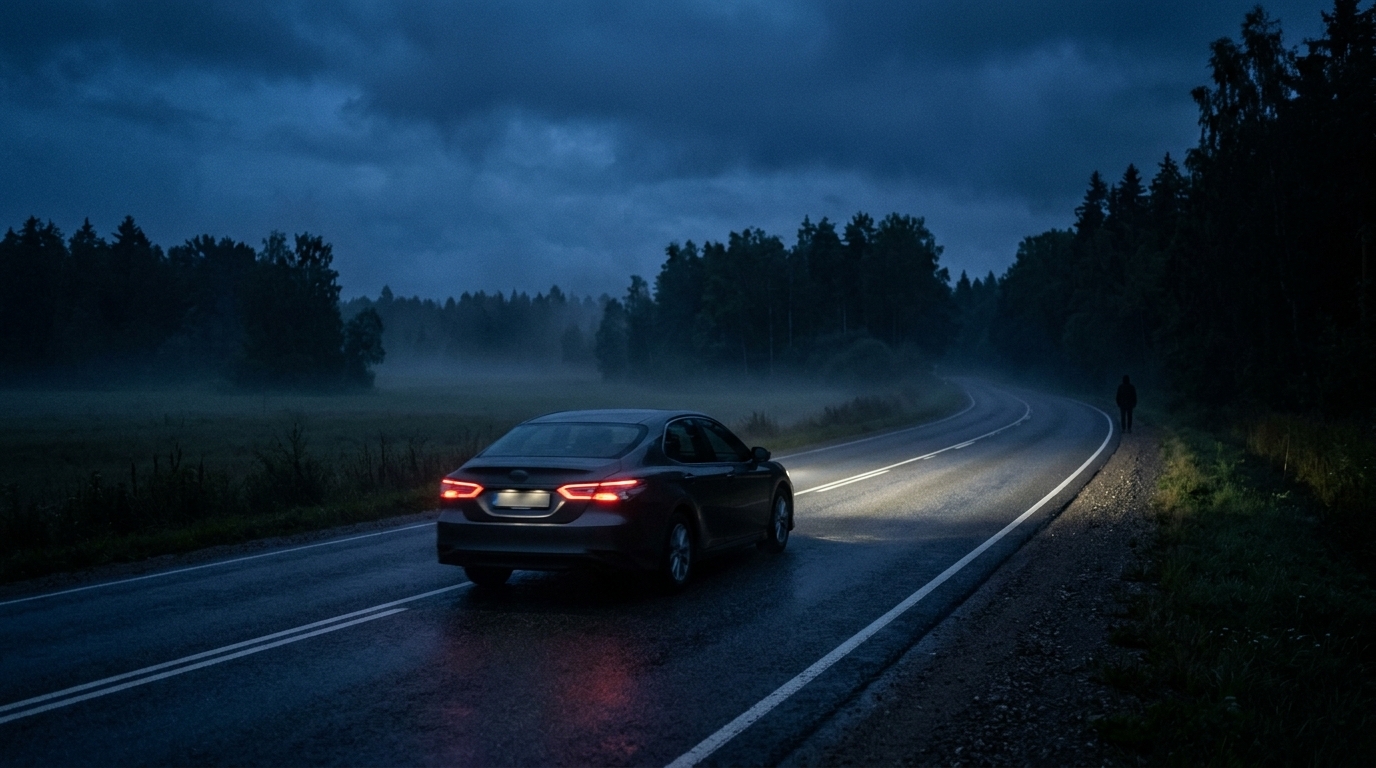
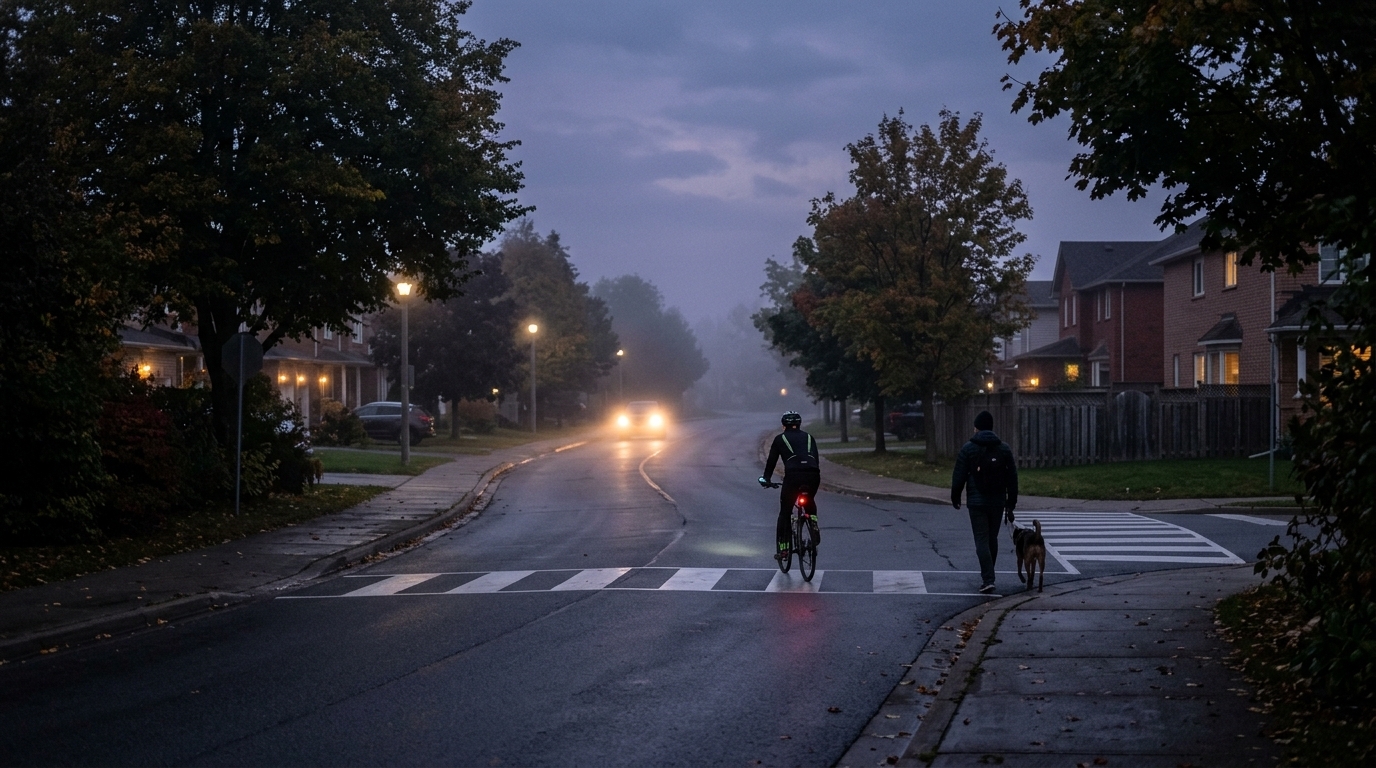
Roughly three out of four people killed while walking on U.S. roads are struck after dark. That single statistic reframes the whole conversation around automotive thermal imaging because darkness is where the standard sensor suite is weakest and where the stakes are highest. If you build advanced driver assistance systems or autonomous platforms, the hardest perception problem is the unlit two-lane road at 11 p.m. with a pedestrian in dark clothing stepping off the shoulder.
That's the gap long-wave infrared was made for. As a category of vertically integrated infrared imaging, thermal sensing gives a vehicle a way to detect a warm body against a cool background without any visible light at all. This piece walks through why thermal imaging automotive programs are moving from novelty to near-requirement, how LWIR differs from the cameras already on the car, where it fits in the sensor stack, and what to weigh before you integrate one.
Why Is Thermal Imaging Automotive Technology Becoming Essential for Nighttime Safety?
The existing sensor suite has a night-shaped hole in it, and regulators and safety bodies have noticed. Visible cameras depend on reflected light, so their performance drops off once you leave streetlights behind. Radar is excellent at range and closing speed but weak at telling a person from a signpost. Lidar builds a precise 3D map yet still struggles to classify what it's mapping in poor conditions. Each is strong somewhere and blind somewhere else.
The Nighttime Detection Gap
Nighttime is not a minor edge case. Pedestrians make up about 18% of all U.S. traffic deaths, a share that's climbed sharply over the past decade, and the danger concentrates heavily after dark. A visible camera dazzled by oncoming headlights can lose a pedestrian entirely in the glare, and a person in non-reflective clothing doesn't return enough light to register in time. Pedestrian detection thermal imaging changes the math because a human body radiates heat, whether or not any light is falling on it. That capability is the clearest argument for automotive thermal imaging on a modern vehicle.
The Regulatory Push Toward Better Detection
Safety regulators have made nighttime pedestrian detection a formal target. A federal rule finalized in 2024 requires automatic emergency braking, including pedestrian automatic emergency braking that works in both daylight and darkness, with an estimated benefit of at least 360 lives saved each year. The rule now faces legal challenges, and its final timeline is uncertain, but the direction of travel is clear. Independent testing has repeatedly shown that hitting demanding nighttime detection targets is hard with the conventional sensor suite alone, which is why an ADAS thermal sensor is increasingly part of the conversation.
How Does LWIR Differ From Visible and Near-Infrared Cameras?
Visible and near-infrared cameras are reflected-light devices. They need photons bouncing off a scene, whether from the sun, headlights, or a near-infrared illuminator. Long-wave infrared works differently. It reads the heat that objects emit on their own. Every person, animal, and running engine radiates most of its thermal energy in the 8 to 14 µm band, the range an LWIR ADAS camera is tuned to see. If you want the physics without the jargon, our primer on how LWIR imaging works breaks it down.
Because it's passive and heat-based, an automotive night vision camera built on LWIR doesn't care whether the sun is up. A moonless night reads much the same as an overcast afternoon, since the sensor is detecting emitted warmth rather than reflected brightness. That reliability is why purpose-built long-wave infrared camera systems keep winning a seat in the automotive perception stack. It's worth knowing the bands you'll see referenced when compared with mid-wave infrared:
|
Band |
Typical range |
What it sees best |
Automotive fit |
|
Near-infrared (NIR) |
~0.75 to 1.4 µm |
Reflected light, needs illumination |
Driver monitoring, active night vision |
|
Mid-wave infrared (MWIR) |
3 to 5 µm |
Hot objects: exhaust, engines |
Rare in production cars, higher cost |
|
Long-wave infrared (LWIR) |
8 to 14 µm |
Body heat at ambient temperatures |
Pedestrian and hazard detection |
Seeing Through Glare, Fog, and Darkness
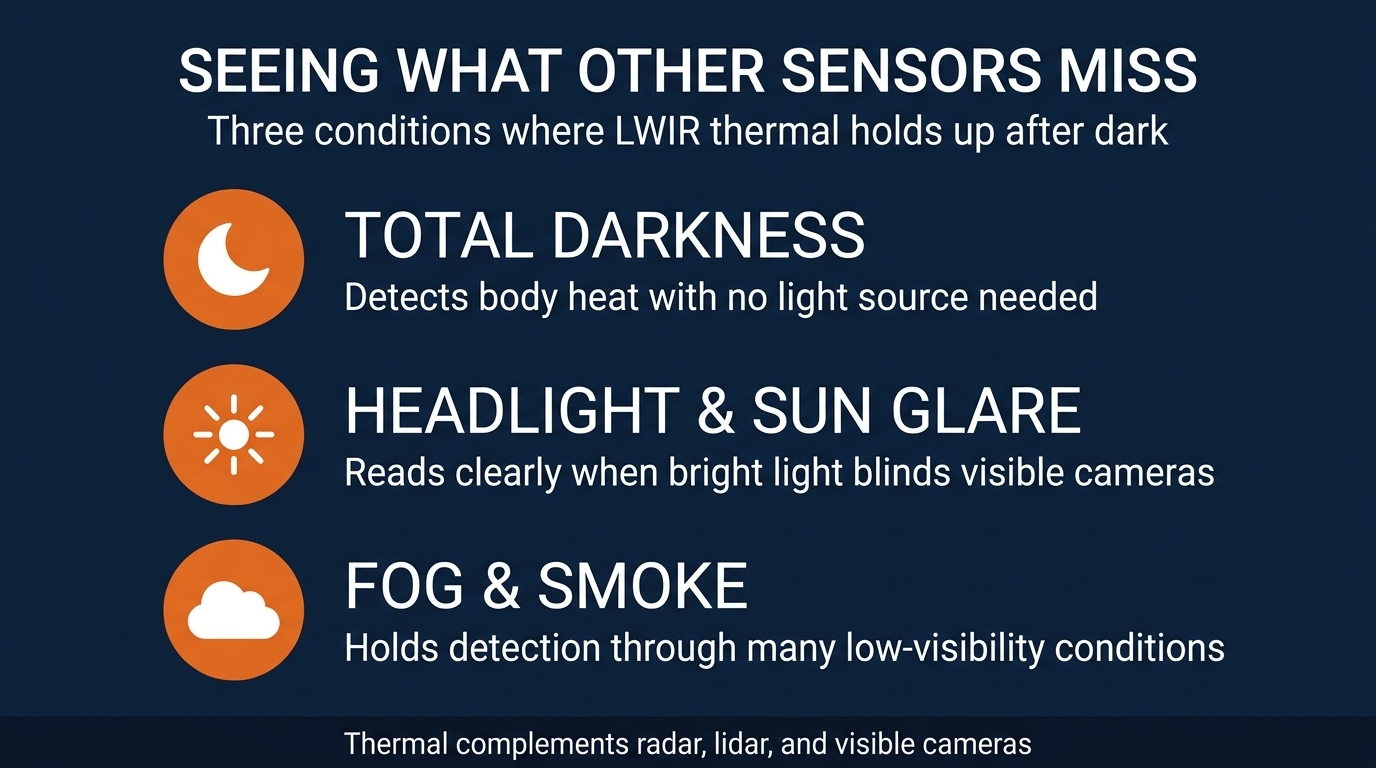
LWIR shines in the conditions that trip up reflected-light sensors. It reads clearly in complete darkness, holds detection through many fog and smoke situations, and isn't blinded by headlight or sun glare the way a visible camera can be. Thermal has limits. Heavy rain, dense spray, and very high-radiance sources can degrade a thermal image, so the honest framing is strong low-visibility performance rather than performance in any condition. Even with those caveats, pedestrian detection thermal imaging holds a decisive edge over reflected-light sensors after dark, which is what makes an automotive night vision camera worth the integration effort. That candor matters when you're specifying a system you'll have to defend in testing.
Where Does Thermal Fit in the ADAS and AV Sensor Stack?
In a well-built stack, automotive thermal imaging is a complementary layer, not a rip-and-replace. The most robust perception architectures fuse several modalities so that each sensor covers for the others' weak spots. Radar handles range and velocity, lidar handles precise geometry, the visible camera handles color and signage, and thermal handles warm objects in the dark. Fuse them, and you get redundancy exactly when a single sensor would fail.
That redundancy is the whole point of an autonomous vehicle thermal camera. If a visible camera is washed out by glare at the worst possible moment, the thermal channel still sees the pedestrian. Here's how the common modalities stack up on the conditions that matter most at night:
|
Condition |
Visible camera |
Radar |
Lidar |
LWIR thermal |
|
Total darkness |
Weak |
Strong |
Moderate |
Strong |
|
Fog and smoke |
Weak |
Strong |
Weak |
Moderate to strong |
|
Headlight glare |
Weak |
Strong |
Strong |
Strong |
|
Classify a person's shape |
Strong |
Weak |
Moderate |
Strong |
|
Detect a warm animal on the road |
Moderate |
Weak |
Moderate |
Strong |
No single row wins everywhere, which is the case for stacking, and thermal is the one channel that stays strong across the darkness-and-glare rows.
What Should Auto OEMs Evaluate in a Thermal Sensing System?
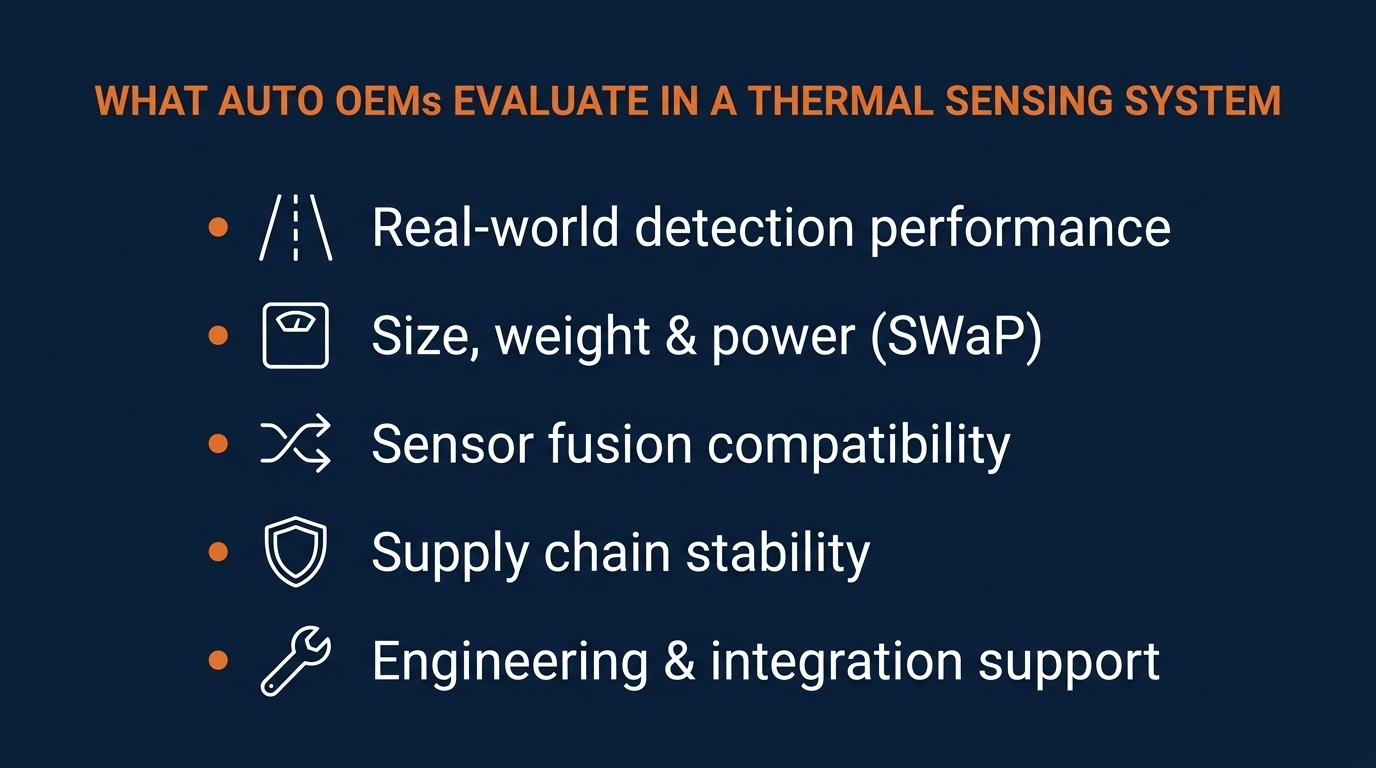
When teams move from "thermal looks interesting" to "let's integrate one," the same short list of questions decides whether an ADAS thermal sensor earns its place. If you're scoping automotive thermal imaging for a build, these five criteria are where the real decisions live.
- Real-world detection performance. Lab numbers are a starting point, not the finish line. Ask how the ADAS thermal sensor performs on the messy corner cases: a partially occluded pedestrian, an animal at the road edge, mixed thermal clutter on a warm night. Detection range and classification reliability in those scenarios matter far more than a headline spec.
- Size, weight, and power (SWaP). A production vehicle has no tolerance for a bulky, power-hungry add-on. Passive LWIR helps here since it draws little power and needs no illuminator, but packaging still has to disappear into the vehicle's design and thermal budget.
- Sensor fusion compatibility. Whether it's a driver-assist feature or a full autonomous vehicle thermal camera, the channel has to speak the same language as the rest of the stack. Clean data output, predictable timing, and straightforward integration with your perception software decide whether fusing an LWIR ADAS camera is a week of work or a quarter of it.
- Supply chain stability. Many infrared optics have historically depended on germanium, a material with real availability and pricing volatility. Evaluating a germanium-free optical path protects a program that has to ship in volume for years. Supply certainty is a design requirement, not a purchasing afterthought.
- Engineering and integration support. Off-the-shelf rarely survives contact with a real platform. A partner who will tune optics, packaging, and output to your specific vehicle saves cycles you can't get back late in a program.
Nail those five aspects, and integration stops being a science project. Otherwise, you'll feel it in schedule and cost.
Frequently Asked Questions
Does a thermal camera replace the other sensors in an ADAS?
No. Thermal is designed to work alongside radar, lidar, and visible cameras, not replace them. Its job is to close the nighttime and low-visibility detection gap so the fused system stays reliable when a single sensor would fail. It adds redundancy for the hardest conditions.
Why use LWIR instead of a near-infrared night vision camera?
A near-infrared automotive night vision camera still relies on reflected light and usually needs an illuminator, which can be defeated by glare and limited range. An LWIR ADAS camera detects emitted body heat directly, so it works in total darkness without any illumination and handles headlight glare far better.
Can thermal imaging see pedestrians in fog and smoke?
In many fog and smoke conditions, yes. LWIR penetrates a range of obscurants that scatter visible light. Performance still degrades in heavy rain, dense spray, or against very high-radiance sources, so it's best described as strong low-visibility detection rather than all-condition performance.
Is thermal imaging only relevant for autonomous vehicles?
Not at all. The same thermal pedestrian detection that justifies an autonomous vehicle thermal camera also strengthens driver assistance features like pedestrian automatic emergency braking on human-driven vehicles, which is where near-term regulatory pressure is focused.
Ready to Bring Thermal Into Your Next Platform?
Nighttime is where automotive safety is won or lost, and automotive thermal imaging is the one capability built to see there. The OEMs moving early are treating a thermal channel as core architecture rather than a bolt-on, and they're making the material and integration decisions now, while there's still runway before the next model cycle locks.
If you're weighing how a long-wave infrared camera system fits your ADAS or autonomous roadmap, that's a conversation worth having early. LightPath Technologies engineers thermal imaging systems from the raw material up, including a germanium-free optical path and full custom integration support built for programs that have to ship at scale. Talk through your program with our team, and we'll help you scope the right approach.