
Airborne thermal imaging has become a baseline expectation on surveillance and targeting platforms, and the sourcing decision now shapes program outcomes more than the sensor spec does.
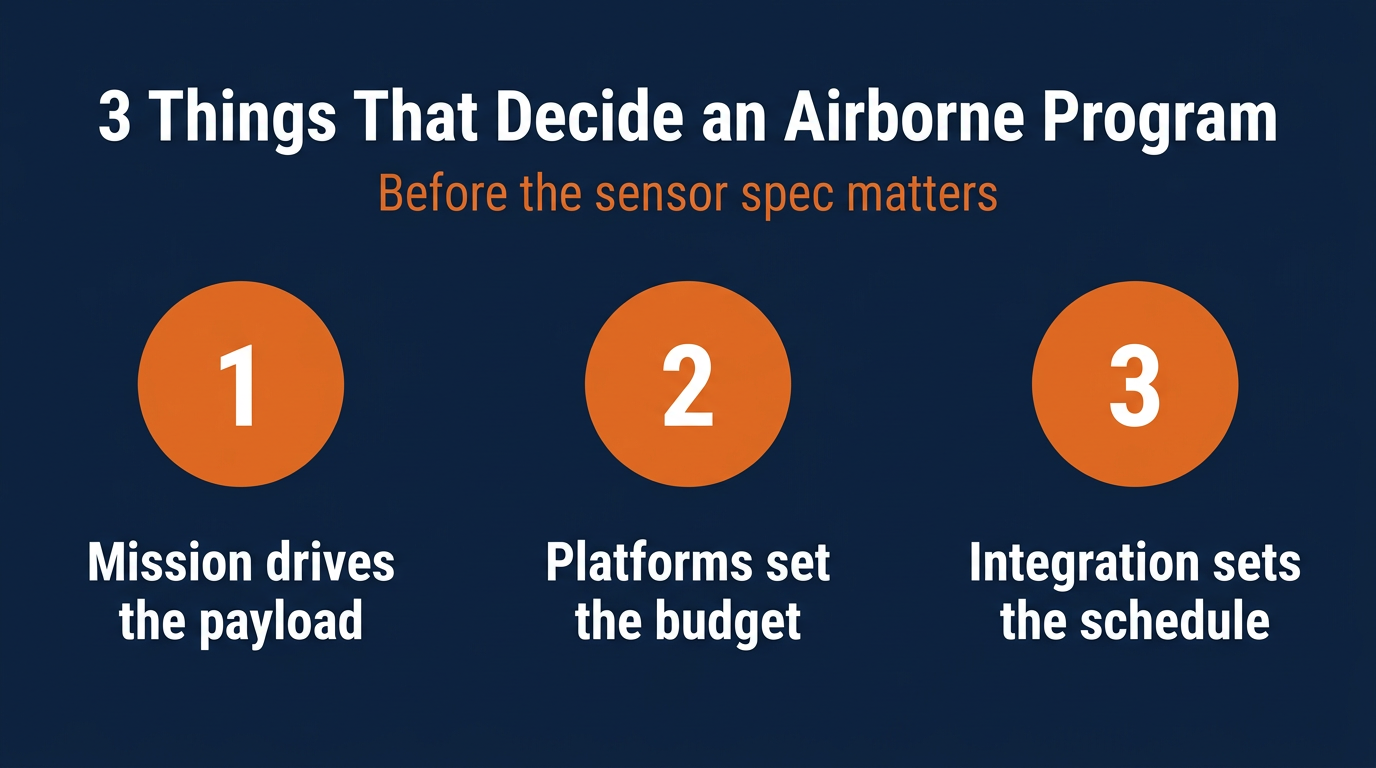
- Mission profile drives the payload. Persistent overwatch, wide-area search, and target acquisition each pull the design in a different direction.
- Crewed and uncrewed platforms impose different budgets. Weight, power, and thermal headroom vary enough that one imaging approach rarely transfers cleanly between them.
- Integration risk is where programs lose schedule. Sensor, optics, and packaging engineered separately tend to surface problems late.
- Supplier structure matters as much as capability. Who controls the materials, optics, and assembly determines how fast you can absorb a requirements change.
If your program is still treating the imaging payload as a component purchase rather than a system decision, that is the assumption worth revisiting first.
Program teams building fixed-wing special-mission aircraft, rotary-wing platforms, and unmanned systems are all working through a version of the same problem. How do you get dependable infrared performance out of a sensor that is moving fast, vibrating constantly, and operating inside a strict weight and power budget? That question sits at the center of most optical and thermal imaging procurement conversations in aerospace and defense right now.
The pressure is coming from both directions. Small unmanned aircraft now support surveillance, reconnaissance, and target acquisition across U.S. Army tactical formations, pushing imaging requirements onto platforms never designed to carry much. Larger crewed aircraft, meanwhile, are being asked to do more with existing airframes. The global airborne ISR market is projected to grow from roughly $10.65 billion in 2026 to $14.51 billion by 2034, with manned special-mission aircraft leading platform share. Both ends of the fleet are competing for the same engineering attention.
This is written for the people making those calls: program managers, design engineers, and procurement leads specifying complete systems, not the operators flying them.
What Makes Airborne Thermal Imaging Different From Ground-Based Systems?
A thermal camera mounted on a tower has advantages an aircraft installation never gets. It sits still, draws mains power, and sheds heat into open air without much thought. Move that imaging chain onto an airframe and every one of those assumptions disappears. Understanding what changes is the starting point for any serious conversation about aircraft thermal imaging.
Motion Is a Design Constraint, Not a Nuisance
Airframes vibrate across a frequency range that varies by platform type. Rotary-wing aircraft introduce rotor harmonics, fixed-wing platforms deal with airflow buffeting, and small unmanned systems have their own signature driven by motor speed and structural resonance. Optical assemblies that hold alignment on a bench can drift under sustained vibration, and drift shows up as image degradation long before anything fails outright. In aircraft thermal imaging, stabilization and optomechanical design get decided together and early.
Altitude Changes What the Sensor Sees
Looking down through several thousand feet of atmosphere is a different problem than looking across a parking lot. Humidity, particulates, and temperature gradients attenuate infrared energy along the path, and the effect grows with slant range.
An airborne infrared system that performs well at low altitude on a clear night will behave differently at higher altitude in humid conditions. Thermal imaging holds up strongly in darkness, smoke, and light fog, though heavy precipitation and high-radiance backgrounds still impose real limits worth naming at the requirements stage.
Which Missions Drive Demand for Airborne Infrared Systems?
Mission profile is the most useful filter available, and the one most often skipped. Two programs can specify nearly identical aircraft thermal imaging hardware and get very different outcomes because one was built around persistent coverage and the other around positive identification at range. Across defense and homeland security fleets, a handful of profiles account for most airborne thermal imaging demand:
|
Mission Profile |
Primary Imaging Priority |
Typical Platform Mix |
Main Payload Constraint |
|---|---|---|---|
|
Persistent overwatch |
Endurance and consistent image quality over long dwell |
Medium and large unmanned systems, aerostats |
Power draw across extended missions |
|
Wide-area search |
Field of view and sweep efficiency |
Crewed special-mission aircraft, larger UAS |
Data volume and operator workload |
|
Target acquisition |
Range and identification confidence |
Crewed platforms, larger unmanned systems |
Optical aperture and stabilization |
|
Maritime patrol |
Detection against cluttered sea background |
Fixed-wing patrol aircraft |
Environmental sealing and corrosion resistance |
|
Border and infrastructure monitoring |
Reliability and low sustainment burden |
Mixed crewed and unmanned fleets |
Total cost of ownership over long service life |
Notice how little of this is about the sensor itself. The constraints that shape a program sit around the sensor: packaging, stabilization, power draw, and environmental survivability. An aerospace and defense imaging platform has to treat all of it as one design problem.
How Do Manned and Unmanned Platforms Differ in Payload Requirements?
The instinct to treat crewed and uncrewed platforms as variations on a theme causes real problems. They differ in ways that reach back into the optical design, and a payload optimized for one is rarely a clean fit for the other.
Crewed Aircraft Buy Margin
A special-mission aircraft brings structural capacity, generator power, and environmental control that a small airframe cannot match. That margin opens up larger apertures and heavier stabilized mounts. It also puts operators in the loop, which changes how much the imaging chain has to resolve on its own.
Unmanned Platforms Buy Efficiency
A UAV ISR payload competes for every gram and every watt, and weight displaces either endurance or structural margin. That math usually settles sensor class before anything else does. Cooled mid-wave sensors, roughly 3 to 5 µm, deliver the longest detection range and finest sensitivity, but carry cryocooler power and cooldown time that smaller airframes struggle to absorb. Uncooled long-wave systems in the 8 to 14 µm range are lighter and simpler, trading away some range. Teams scoping a UAV ISR payload usually find that SWaP is a system-level tradeoff rather than a line item, and that the cooled and uncooled decision follows from it.
|
Consideration |
Crewed Special-Mission Aircraft |
Unmanned Platforms |
|---|---|---|
|
Weight budget |
Generous relative to payload mass |
Tightly constrained, drives most decisions |
|
Available power |
Aircraft generator, ample headroom |
Limited, often battery-dependent |
|
Thermal management |
Existing environmental control |
Payload must manage its own heat |
|
Sensor class flexibility |
Cooled and uncooled both practical |
Uncooled favored on smaller airframes |
|
Onboard interpretation |
Operators available in the loop |
Depends on edge processing and downlink |
|
Typical integration timeline |
Longer, tied to airframe modification |
Shorter, but less room for error |
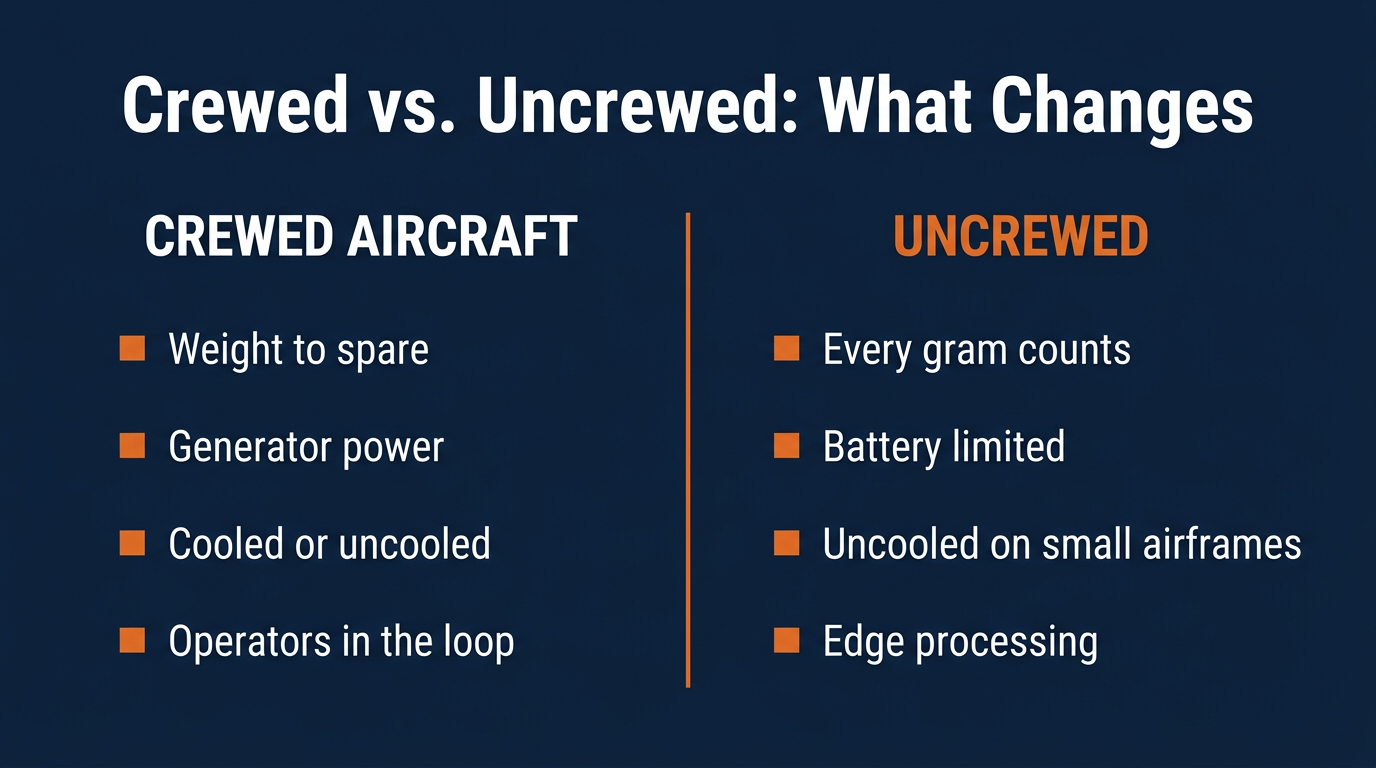
Neither column is easier. Specifying an ISR thermal camera for one platform class and assuming it carries to the other is where schedules start slipping. If a mixed fleet is in scope, decide early whether one ISR thermal camera family can scale across it or whether two lines are the honest answer.
What Should Program Teams Evaluate in a Thermal Imaging Supplier?
Once mission and platform are settled, the sourcing decision carries more weight than most program plans assume. Five questions worth asking before a supplier reaches your shortlist:
- Who controls the optical materials? Infrared optics depend on specialty materials with concentrated supply chains, and germanium availability has become a recurring procurement conversation. Suppliers working with alternative formulations, including proprietary chalcogenide glass, carry less exposure and tend to quote more predictable lead times.
- How far up the stack does the supplier go? There is a meaningful difference between a components vendor, an assembly house, and a manufacturer that designs materials through finished camera systems. Vertically integrated suppliers absorb interface problems internally instead of routing them back to your team.
- When do their engineers engage? Suppliers who join at requirements definition catch integration conflicts while they are still cheap to fix. Suppliers who quote against a finished specification will deliver exactly what was asked for, including the parts that were wrong.
- Where is manufacturing located? Domestic production simplifies compliance for programs with NDAA or traceability requirements, and it shortens the feedback loop on a mid-program design change.
- Who owns testing and qualification? Airborne programs face vibration, temperature, and airworthiness requirements that bench performance says nothing about. Suppliers who test and qualify in house, and who hold quality control from first unit through production ramp, remove a category of risk that otherwise lands on your schedule.
Where Does Targeting Diverge From Surveillance?
Surveillance payloads and targeting thermal camera requirements get bundled together in program documents more often than they should. Both rely on infrared detection and the same underlying optical quality. What separates them is the confidence threshold.
Surveillance asks whether something is present and roughly what it is doing. A targeting thermal camera has to support positive identification, a substantially higher bar. That pushes requirements toward longer effective focal lengths, tighter stabilization, and cooled sensor classes. It also raises the stakes on stray light control, since artifacts that are tolerable in a surveillance feed can compromise an identification decision.
Multi-sensor architectures complicate this. Modern platforms fuse infrared imagery with visible-band cameras and radar returns, and real-time fusion at the tactical edge is now a standard design assumption. When infrared data is one input among several, its registration accuracy and timing behavior matter to the whole system. Teams working on multi-sensor detection architectures tend to learn this late if the imaging chain was sourced in isolation.
Scope a targeting thermal camera and a surveillance payload as separate requirements even when they share hardware. One specification covering both usually underdelivers on the harder mission.
Frequently Asked Questions
What is airborne thermal imaging used for in defense programs?
An ISR thermal camera supports surveillance and reconnaissance, target acquisition, search and rescue, maritime patrol, and border monitoring. The common thread is detecting heat signatures from an aircraft in darkness or degraded visibility, where visible-band cameras have limited value.
Is cooled or uncooled better for an airborne infrared system?
Start from the mission, not the spec sheet. If positive identification at long range drives the requirement and the platform has power and weight to spare, cooled is usually the answer. If endurance, payload budget, or sustainment simplicity dominate, uncooled generally wins.
How much does payload weight affect a UAV ISR payload decision?
Substantially. On smaller unmanned airframes, weight is usually the first filter applied, and it eliminates most sensor options before performance is compared.
Does airborne thermal imaging work in bad weather?
It performs well in darkness, smoke, haze, and light fog, which covers most operational conditions of interest. Heavy rain, dense spray, and very high-radiance backgrounds all degrade performance, so those limits belong in the requirements conversation early.
Can the same imaging system serve both crewed and uncrewed aircraft?
Sometimes, though it requires deliberate design for scalability. Shared optical and material foundations can carry across a fleet even when packaging, power architecture, and stabilization differ by platform.
Build the Imaging Chain Around the Mission
The detector is rarely what decides an airborne thermal imaging program. What decides it is whether the optics, packaging, stabilization, and qualification were designed as one thing or assembled from four separate decisions made months apart.
LightPath Technologies designs and manufactures complete infrared and thermal imaging systems for aerospace and defense OEMs, from proprietary Black Diamond chalcogenide glass and precision optics through finished cooled and uncooled camera assemblies. Most of our work sits in aerospace and defense, and four decades of vertically integrated North American manufacturing means fewer handoffs, more predictable supply, and engineers who engage while the specification is still open. If your airborne program has detection requirements, platform constraints, or compliance considerations to work through, connect with our engineering team.