

The best industrial thermal imaging solutions come from engineering partners, not parts catalogs, and that distinction shows up long after the purchase order clears.
- The market is splitting into component vendors on one side and full-solution partners on the other. OEMs specifying complete camera systems need the latter.
- Vertical integration, from raw materials through the finished camera, is the strongest predictor of customization speed and supply reliability.
- Regulatory tailwinds like the 2023 NFPA 70B thermography mandate are pulling continuous thermal monitoring deeper into industrial platforms.
- Supply chain security, especially a credible germanium alternative, now sits right alongside performance as a first-order selection criterion.
Shortlist providers on partnership depth and supply resilience first, then pressure-test each candidate against the same criteria before you commit.
If you're building an industrial platform that depends on infrared imaging, the hard part isn't finding a camera. It's finding a partner who can engineer the whole solution to fit your application, hit your production volume, and hold up over a multi-year program. That gap between a parts catalog and a real solution provider is why the search for the right industrial thermal imaging solution providers has become a program-level decision instead of a purchasing errand.
Demand keeps climbing, which means more choice and more noise. The global thermal imaging market was valued at $7.9 billion in 2025 and is on track to reach $16.6 billion by 2033, with the industrial segment growing at a steady pace as manufacturers lean harder on non-contact inspection and monitoring. In that kind of market, premium optical and infrared imaging systems can look identical, right up until integration starts and the differences get expensive.
This guide breaks the landscape down into something usable: the types of providers you'll encounter, the criteria that predict a good partnership, and the industrial applications where the right partner earns their keep. Treat it as a shortlist framework for your next vendor evaluation.
What Sets Industrial Thermal Imaging Solution Providers Apart From Parts Vendors?
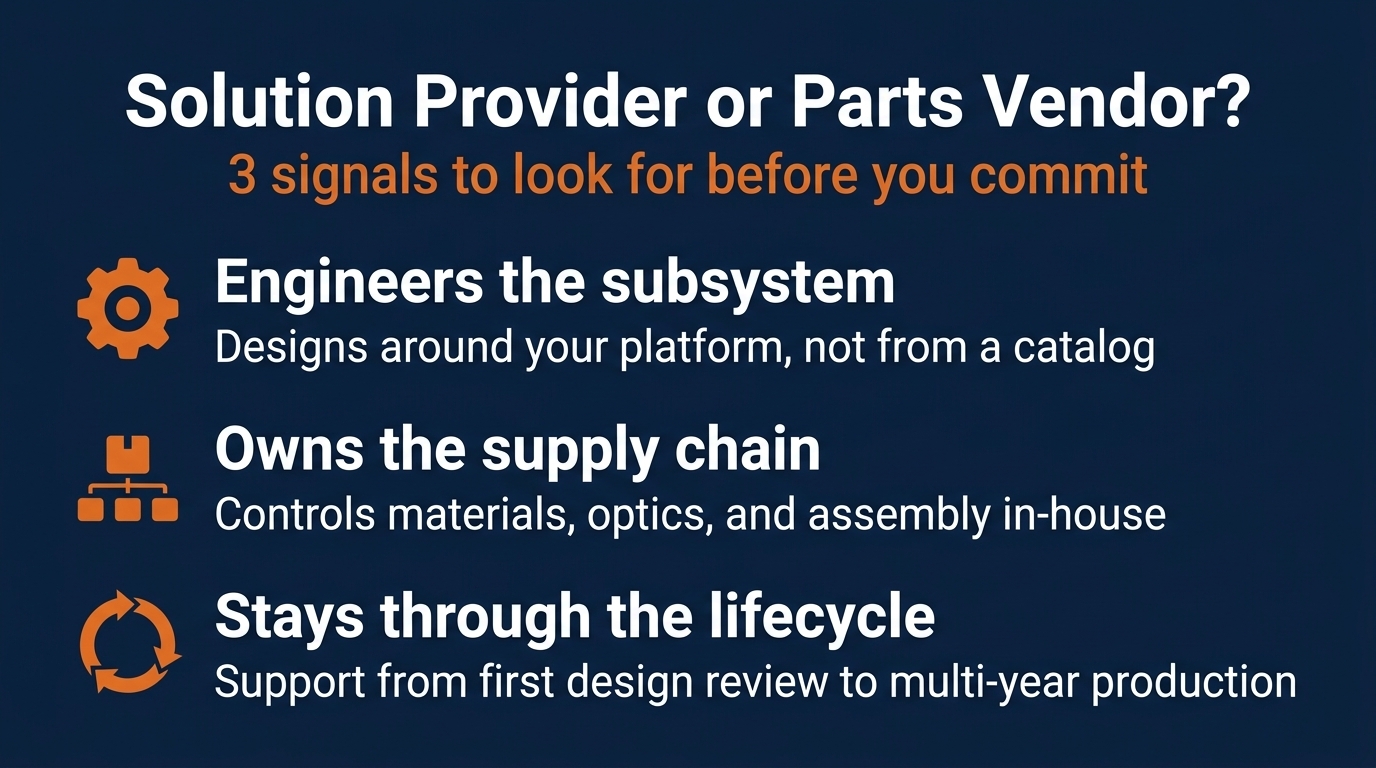
The label "provider" gets used loosely, so it's worth drawing a clean line. A parts vendor sells you a camera or a lens from a catalog and wishes you luck with the rest. A solution provider engineers the imaging subsystem around your platform, from optical design and materials through assembly, integration support, and lifecycle continuity. For an OEM, that difference is the whole ballgame because the imaging module has to live inside your power budget, mechanical envelope, data pipeline, and qualification timeline.
Two forces are pushing more industrial programs toward genuine solution providers rather than commodity suppliers. The first is regulatory. The 2023 edition of NFPA 70B made infrared thermography inspections a requirement rather than a recommendation for electrical equipment, which is nudging thermal monitoring into a designed-in feature across facilities. The second is economics. The U.S. Department of Energy's Federal Energy Management Program estimates predictive maintenance saves 8% to 12% over preventive programs and considerably more against purely reactive maintenance, which is why plant operators want continuous imaging built into the platforms they buy and why they increasingly judge industrial thermal monitoring providers on designed-in capability.
The imaging component you choose at the start sets the ceiling on what the platform can do later. That's the case for treating industrial thermal imaging solutions as a strategic sourcing decision, not a line item.
How Do the Main Types of Industrial Thermal Imaging Companies Compare?
The industrial market includes several distinct categories of suppliers, and each brings a different center of gravity to an OEM relationship. Knowing which archetype you're talking to saves you from mismatched expectations six months into a program. Here's how the main types of industrial thermal imaging companies stack up.
Large Defense and Electro-Optical Primes
These organizations fold thermal imaging into broad electro-optical and infrared portfolios built around government programs. They excel at complex, large-scale defense integrations and heavy compliance requirements. The trade-off is flexibility. Their scale and program cadence can make them a tough fit for a mid-volume industrial platform that needs quick custom engineering and responsive support.
Diversified Technology Conglomerates
Conglomerates that span everything from consumer products to industrial instrumentation offer real breadth and production capacity. If you need high volumes of a standard configuration, that scale is an advantage. The catch is that thermal imaging is one line among hundreds, so deep application collaboration and rapid customization are not always where their attention sits.
Catalog and Component Camera Makers
Plenty of industrial thermal camera manufacturers sell capable cameras and modules from a fixed catalog. For occasional inspection or a well-understood, off-the-shelf need, this path is efficient and affordable. The limitation appears when your application drifts outside the catalog. Custom optics, unusual environmental ratings, or tight integration windows are hard to get from a supplier whose model is built on standard parts.
Vertically Integrated Solution Partners
A smaller group of thermal imaging solution providers controls the full stack: optical materials, lens fabrication, coatings, assembly, and finished camera engineering. Because they own each layer, they can tune the whole system for your application, respond faster to custom requirements, and give you a single accountable point of contact when specifications change. For OEMs that need real customization plus supply-chain stability, this category is usually the closest fit.
|
Provider type |
Customization depth |
Supply chain control |
OEM integration support |
Best fit for |
|
Defense / EO primes |
Moderate |
High |
Program-driven |
Large defense integrations |
|
Diversified conglomerates |
Low to moderate |
Moderate |
Variable |
High-volume standard configs |
|
Catalog / component makers |
Low |
Low to moderate |
Limited |
Off-the-shelf, spot needs |
|
Vertically integrated partners |
High |
High |
Collaborative |
Custom industrial platforms |
None of these archetypes of industrial thermal imaging companies is wrong. A general-purpose catalog camera is fine for a spot check, and a prime is the right call for a major defense program. The point is to match the type to your program, and for most OEMs building differentiated industrial platforms, the vertically integrated solution partner removes the most risk.
5 Criteria for Choosing an OEM Thermal Imaging Partner
Once you know the archetypes, you still need a way to compare specific candidates. Experienced program managers tend to weigh the same short list of factors, and most of them have little to do with the numbers on a data sheet. Use these five criteria to score any OEM thermal imaging partner you're considering.
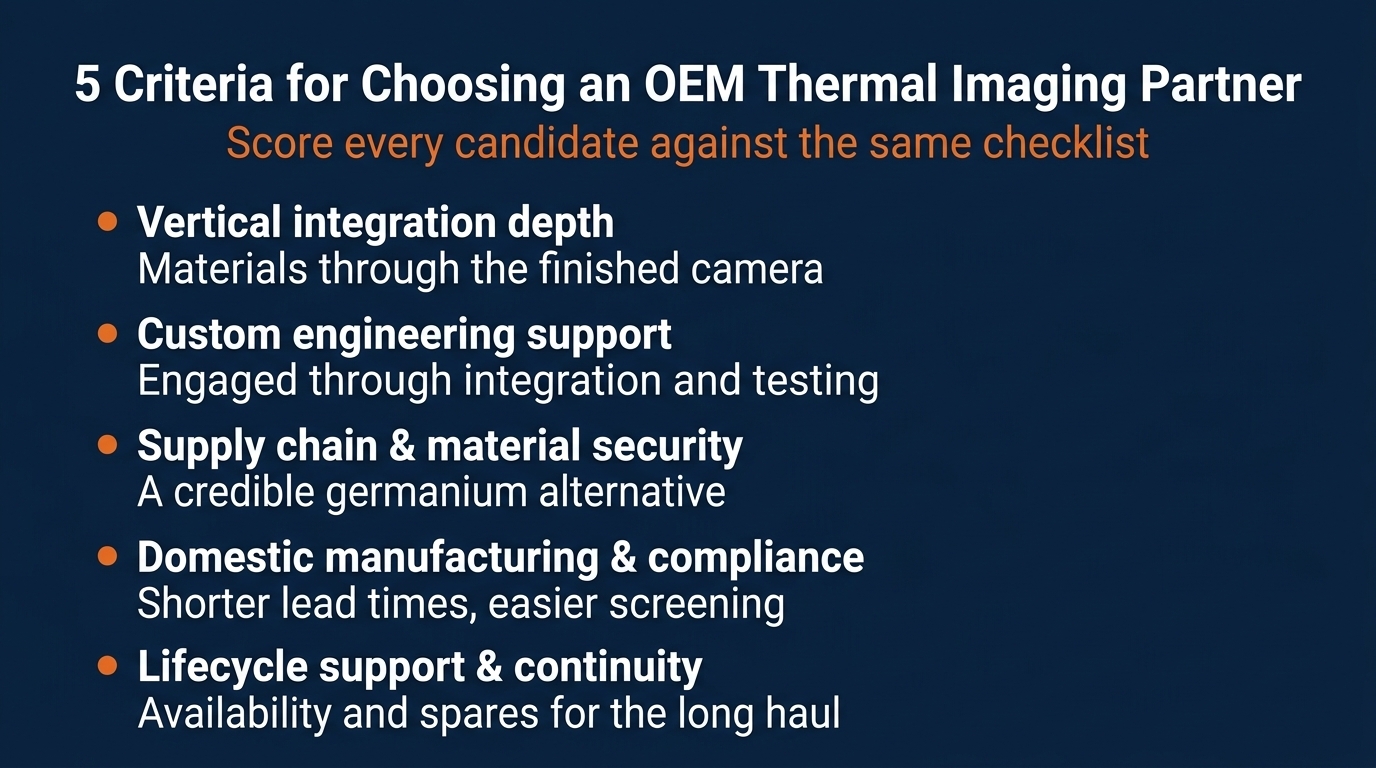
- Vertical integration depth. Ask whether the supplier controls its own materials, optics, coatings, and camera assembly, or whether it sources those layers from third parties. A partner who owns the full chain can customize without waiting on outside vendors and can keep quality consistent from glass to finished system.
- Custom engineering and integration support. Hardware delivery is table stakes. What separates a strong partner is whether their engineers stay engaged during integration and testing, not just before the order. Look for collaboration from requirements definition through validation, since the gap between a functional install and a high-performing one usually closes during integration.
- Supply chain and material security. Germanium has long been the default material for long-wave infrared optics, and its supply is concentrated: China supplied more than half of U.S. germanium imports before tightening export controls that began in 2023. Partners who offer germanium-free optical materials reduce a real program risk rather than passing it on to you.
- Domestic manufacturing and compliance. North American manufacturing shortens lead times, simplifies communication, and helps with export and documentation requirements that industrial and government-adjacent programs increasingly screen for. It also makes supply continuity easier to verify than an opaque overseas chain.
- Lifecycle support and supply continuity. Industrial platforms run for years, sometimes decades. A component change or discontinued line mid-program can stall your whole system, so confirm the supplier's commitment to long-term availability, spares, and engineering support before you design them in.
Score each candidate against all five criteria, weighted for your program, and the right OEM thermal imaging partner usually separates from the pack. For a deeper cut on the hardware side, our specification checklist for buyers pairs well with this framework.
Which Industrial Applications Depend Most on Thermal Imaging Solution Providers?
The right partner also depends on what you're building because industrial thermal monitoring providers serve very different use cases with very different priorities. Thermal imaging performs best in low-visibility conditions, such as smoke, dust, and darkness, and it gives quality teams a non-contact window into processes that visible-light systems miss. It does have limits worth designing around: heavy rain, dense spray, and high-radiance sources like direct sunlight can all degrade a reading, so match the system to the environment rather than assuming universal performance.

A few of the most common industrial applications include electrical and mechanical predictive maintenance, optical gas imaging for methane and other emissions, furnace and high-temperature process monitoring, and continuous quality inspection on the line. Each leans on the imaging subsystem differently, which is why platform builders benefit from purpose-built industrial thermal imaging solutions rather than a one-size camera.
|
Industrial application |
What to prioritize |
Typical spectral band |
|
Electrical & mechanical predictive maintenance |
Sensitivity, uptime, integration |
LWIR (8 to 14 µm), uncooled |
|
Optical gas imaging |
Detection selectivity, low false alarms |
Often MWIR (3 to 5 µm) |
|
Furnace & high-temperature monitoring |
High-temp range, ruggedization |
MWIR (3 to 5 µm) |
|
Process & quality inspection |
Resolution, continuous operation |
LWIR (8 to 14 µm), uncooled |
For most continuous monitoring, uncooled long-wave systems cover the widest range of needs at a sensible footprint. Applications that demand finer temperature discrimination or long-range detection are where cooled systems and a more involved engineering conversation come in. Either way, the best industrial thermal monitoring providers earn their fee by matching the architecture to the job, and our predictive maintenance imaging guide ties those choices back to program outcomes. When you're weighing the full range of complete thermal imaging solutions, keep the application at the center of the decision.
Frequently Asked Questions
What are industrial thermal imaging solution providers?
They are suppliers that engineer complete thermal imaging subsystems for integration into larger industrial platforms, covering optical design, materials, assembly, and integration support. Unlike catalog vendors that sell finished handheld cameras to end users, solution providers work with OEMs and system integrators to build imaging into monitoring networks, gas detection systems, and inspection platforms.
How is a solution provider different from an industrial thermal camera manufacturer?
Every solution provider is a manufacturer, but not every manufacturer is a solution provider. Many industrial thermal camera manufacturers offer standard cameras from a catalog. A solution provider adds custom engineering, application collaboration, and lifecycle support, which matters when your platform needs something the catalog doesn't cover.
What should OEMs look for first when comparing providers?
Start with vertical integration and supply chain security, since those two factors drive customization speed, quality consistency, and long-term availability. Then evaluate custom engineering support, domestic manufacturing and compliance, and lifecycle commitment. Performance specifications matter, but they rarely separate a good partner from a fragile one.
Why does germanium supply come up in supplier selection?
Germanium is a common long-wave infrared optical material, and its global supply is concentrated in a small number of sources subject to export controls. That concentration introduces pricing and availability risk for multi-year programs, so many OEMs now favor partners offering proven germanium alternatives to protect their supply and margins.
Do these solution providers sell directly to end users?
Generally no. These providers sell components and integrated systems to OEMs and integrators who build the finished product. A plant looking for a handheld inspection device buys from a different channel, while a company designing a monitoring platform works with a solution provider to specify the imaging subsystem.
Ready to Specify Your Next Industrial Thermal Platform?
Choosing among industrial thermal imaging solution providers comes down to one question: Do you want a vendor who ships a box or a partner who helps you win the program? Unlike catalog-only industrial thermal camera manufacturers, the providers worth shortlisting control their own materials and optics, engineer to your application, manufacture close to home, and stay with you through the full lifecycle. LightPath Technologies brings four decades of optical and infrared expertise, vertically integrated domestic manufacturing, and proprietary germanium-free Black Diamond glass to industrial OEM partnerships. If you're specifying a full thermal imaging system for your next platform, talk with our engineering team and let's build it right from the first design review.