
Key Takeaways
Sourcing IR imaging components for industrial platforms is a program-level decision, not just a procurement task.
- Industrial OEMs who treat IR imaging component sourcing as a strategic decision (not a commodity purchase) reduce integration risk, shorten development cycles, and protect long-term supply chain continuity.
- The right supplier for IR imaging components industrial builds depend on should cover the full stack: raw optical materials, lenses and assemblies, and cooled or uncooled camera systems.
- Material supply risk (particularly around germanium) is a real procurement consideration that every OEM sourcing IR components today needs to evaluate, regardless of program timeline.
- Vertically integrated IR imaging component suppliers offer measurable advantages over multi-vendor approaches for custom, application-specific industrial builds.
If you're specifying IR imaging components for an industrial monitoring platform, this guide will help you ask the right questions before you issue your first RFQ.
If you're developing an industrial monitoring system that incorporates thermal detection, the component sourcing decisions you make early in the design process will shape your program for years. Which supplier can deliver consistent optical performance across a multi-year production run? Who owns their manufacturing process end-to-end? What happens to your timeline if a key optical material becomes supply-constrained mid-program?
These are the questions that matter to program managers, design engineers, and procurement leads at industrial OEM companies. IR imaging components for industrial monitoring platforms are not off-the-shelf commodities. They're engineered subsystems, and the supplier relationships behind them carry real programmatic weight.
According to Mordor Intelligence, the global IR and thermal imaging systems market is projected to reach $10.63 billion by 2030, with industrial applications representing one of the fastest-growing segments. That growth is creating both opportunity and sourcing complexity for OEMs who need to build thermally capable platforms at scale.
This guide is written for the engineering and procurement teams doing that work.
What Does the IR Imaging Component Stack Actually Include?
Before getting into sourcing criteria, it helps to be precise about what "IR imaging components" actually means at the OEM level. This is not about handheld inspection tools or end-user devices. The components OEMs source go into fixed monitoring systems, process control platforms, safety and gas leak detection systems, and continuous industrial surveillance infrastructure.
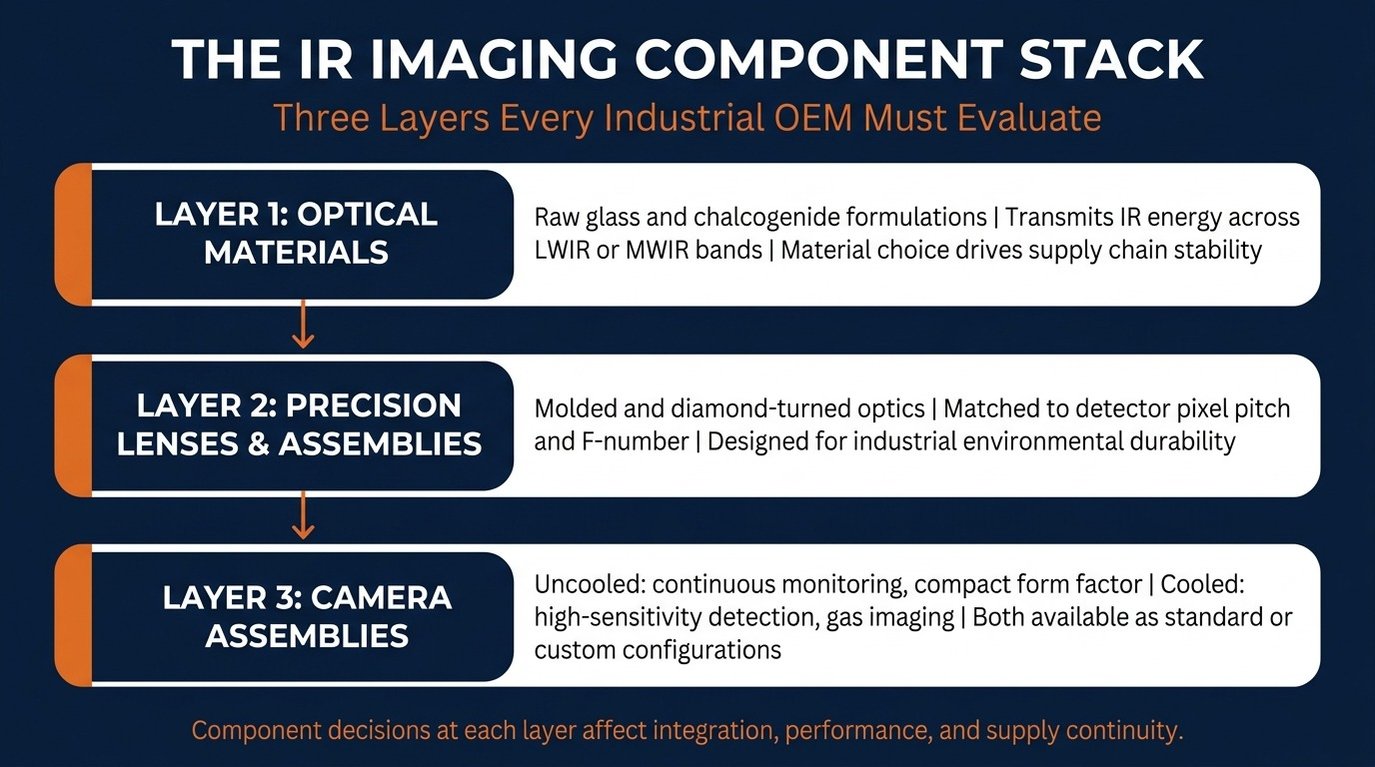
The core IR imaging component stack for industrial OEM builds includes several distinct layers, each with its own sourcing and performance considerations.
Optical Materials and Raw Glass
The foundation of any IR imaging system is the optical material used to transmit infrared energy to the detector. For industrial wavelength ranges, particularly LWIR (8-14 µm) and MWIR (3-5 µm), optical materials must transmit efficiently across the relevant spectral band. The material choice affects not just optical performance but supply chain stability, and it's one of the first decisions that deserves scrutiny at the sourcing stage.
Precision Lenses and Optical Assemblies
Sourcing IR imaging components for industrial lens assemblies involves more than matching a focal length to a detector. Industrial applications often require tight field-of-view tolerances, specific F-number optimization for uncooled detectors, compatibility with particular pixel pitches, and environmental durability for continuous operation in high-temperature or chemically active environments. Lens assemblies must be designed with the sensor in mind from the start. Mismatched optical and detector specifications are one of the most common sources of image quality problems in OEM builds, and they're far more expensive to correct after integration than before.
Uncooled and Cooled Camera Assemblies
The camera system level is where component decisions become most visible in system performance. Uncooled systems, which use microbolometer detectors operating at ambient temperature, are widely deployed for continuous industrial monitoring applications like predictive maintenance, process temperature monitoring, and safety surveillance. They offer lower operating cost, reduced maintenance requirements, and compact form factors suited for fixed-mount industrial installations and weight-constrained UAV payloads.
Cooled systems, which use detector arrays that operate at cryogenic temperatures, deliver higher sensitivity and better performance in applications where subtle thermal signatures matter, such as optical gas imaging for leak detection and high-precision furnace or kiln monitoring. The cooling mechanism adds cost and maintenance overhead, but for applications where detection accuracy is the primary requirement, the performance advantage is substantial.
Why the Best Place to Source IR Imaging Components Is Not Always the Lowest Bidder
This is worth saying plainly: for industrial OEM programs with multi-year production horizons, the best place to buy IR imaging components for industrial builds is not determined primarily by unit price. The real cost of component sourcing decisions shows up in integration labor, redesign cycles, delivery variability, and supply chain disruptions — not on the initial purchase order.
When evaluating IR imaging component suppliers for an industrial OEM program, there are several criteria that consistently separate capable long-term partners from transactional vendors.
Vertical Integration Depth. Suppliers who control their manufacturing stack from optical materials through finished assemblies reduce the number of handoff points in your supply chain. Every handoff between a materials supplier, a lens fabricator, and a camera assembler is a potential source of lead time variability, quality inconsistency, and communication gaps. Vertically integrated industrial IR camera components manufacturing reduces those risks materially.
Custom Engineering Capability. Most industrial monitoring applications are not well-served by off-the-shelf catalog configurations. Process environments vary. Integration constraints vary. Wavelength requirements vary based on target gas species or equipment temperature profiles. Suppliers who can engage your engineering team early in the design cycle, and who have the in-house capability to configure components to your spec rather than asking you to adapt your design to their catalog, are simply more valuable program partners.
Material Supply Strategy. Germanium has historically been the dominant optical material for IR systems, but it carries real supply chain risk. China is the world's leading producer and exporter of germanium metal, and export restrictions implemented in 2023 and expanded in 2024 created genuine cost and availability uncertainty for programs with multi-year production horizons. Chalcogenide glass formulations offer comparable IR transmission performance in LWIR applications, and suppliers who manufacture these materials in-house provide meaningfully better supply predictability. Domestic or allied-nation manufacturing adds another layer of insulation for programs where supply continuity is a program-level requirement.
Quality Consistency at Production Volume. Prototype performance doesn't always translate to production consistency, particularly for precision optical components. The right question to ask any supplier is not just "can you build this?" but "can you build this consistently at volume, and what quality systems back that up?"
How to Match IR Imaging Components to Industrial Application Requirements
Not every industrial thermal imaging application needs the same component configuration. Matching the component specification to the application requirements is one of the most important sourcing decisions an OEM engineering team makes. Here is a practical framework.
|
Application Type |
Spectral Band |
Cooled vs. Uncooled |
Key Component Considerations |
|
Predictive maintenance (electrical, mechanical) |
LWIR 8-14 µm |
Uncooled |
Sensitivity 30-60 mK, compact form factor, continuous operation |
|
Optical gas imaging (hydrocarbon leak detection) |
MWIR 3-5 µm |
Cooled |
High sensitivity, specific transmission band, ruggedized for field deployment |
|
Furnace and kiln monitoring |
LWIR 8-14 µm |
Uncooled |
High-temperature operating range, coatings for thermal durability |
|
Process temperature monitoring |
LWIR or MWIR |
Uncooled |
Temperature measurement accuracy, integration with control systems |
|
Safety surveillance and fire detection |
LWIR 8-14 µm |
Uncooled |
Wide field of view, 24/7 operation, environmental IP rating |
The table above represents typical configurations, not universal requirements. Application-specific variables, including target temperature range, detection distance, environmental conditions, and integration interface requirements, will drive component selection decisions in ways that generic specifications don't capture. This is precisely why early engineering collaboration with your component supplier matters as much as the spec sheet does.

Thermal Camera Component Sourcing: What OEMs Get Wrong
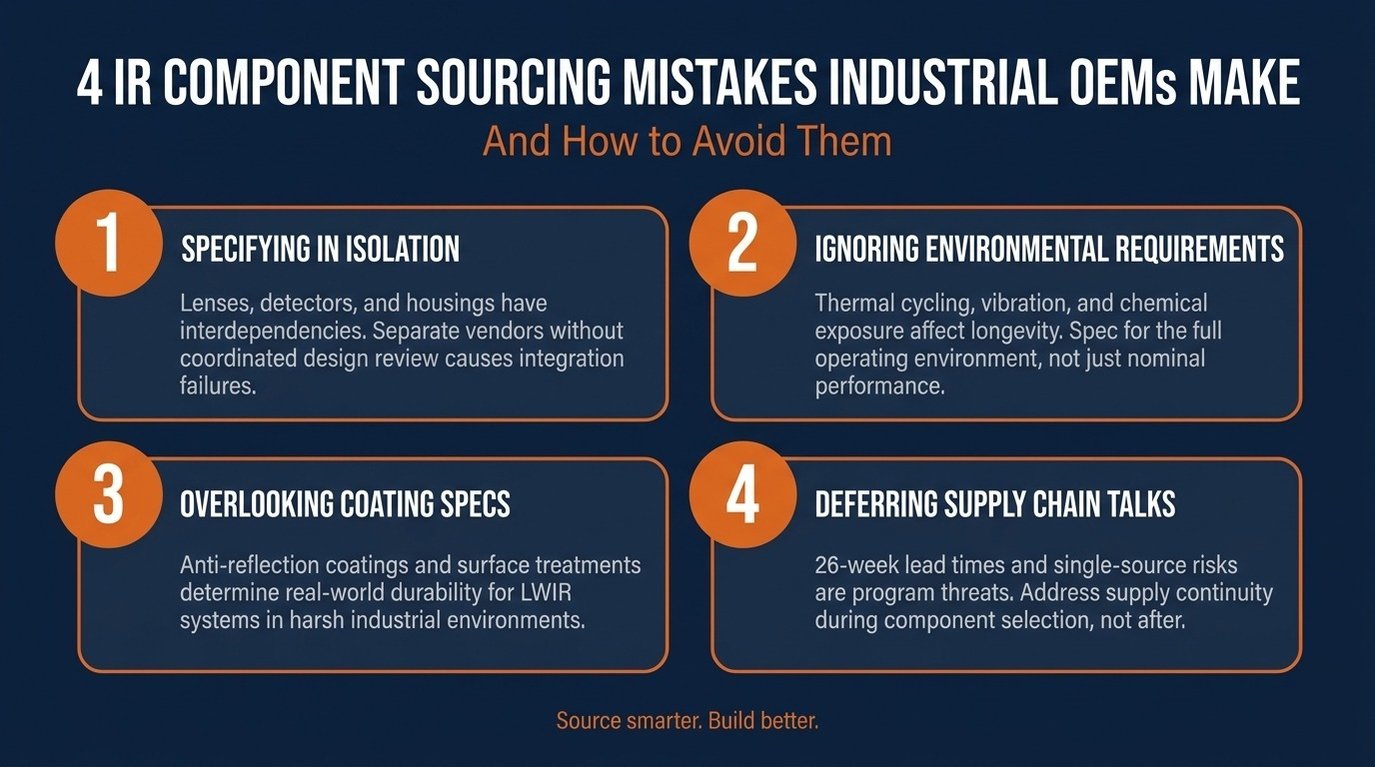
Specifying IR imaging components for industrial platforms surfaces a predictable set of mistakes — most of them made during the design phase, not the procurement phase. Here are the ones that show up most often.
Specifying components in isolation. Lenses, detectors, and mechanical housings all have interdependencies that affect system performance. A lens optimized for one detector pixel pitch will not deliver the same image quality with a different sensor. Sourcing these elements from separate vendors without coordinated design review is a frequent cause of integration problems.
Under-specifying environmental requirements. Industrial environments are harsh. Thermal cycling, vibration, chemical exposure, and particulate contamination all affect component performance and longevity. Thermal camera component sourcing decisions should account for the full operating environment, not just the nominal performance specs.
Ignoring coating specifications. Optical coatings profoundly affect transmission efficiency, image contrast, and environmental durability. For LWIR systems operating in chemically active environments, anti-reflection coatings and protective surface treatments are not optional details. They're part of what determines whether the component performs as specified in the field after a year of continuous operation.
Deferring the supply chain conversation. Lead time and supply stability discussions are often treated as procurement-phase concerns when they should happen during component selection. If your design specifies a component that has a 26-week lead time or a single-source supply chain, that's a program risk that needs to be understood before you're in production, not after.
A Practical Comparison: Single-Source vs. Multi-Vendor Component Sourcing
One of the more consequential decisions in structuring an IR imaging component program is whether to consolidate sourcing with a single vertically integrated supplier or to manage separate vendor relationships for optical materials, lenses, and camera assemblies.
|
Factor |
Single Vertically Integrated Supplier |
Multi-Vendor Approach |
|
Integration complexity |
Lower: components are designed to work together |
Higher: interface compatibility requires active management |
|
Design cycle |
Shorter: unified engineering engagement |
Longer: coordination across multiple design teams |
|
Quality accountability |
Clear: single source for performance issues |
Diffuse: multiple parties involved in root cause |
|
Supply chain risk |
Lower if supplier is well-diversified |
Potentially higher: multiple points of exposure |
|
Customization capability |
Higher: full stack available for configuration |
Variable: depends on each vendor's capability |
|
Cost structure |
Potentially lower total cost of ownership |
Lower initial unit price possible but higher overhead |
Multi-vendor approaches can work for programs where standardized commercial components are a good fit. For industrial OEM programs that require custom configurations, tight integration tolerances, or long production lifespans, the consolidated approach typically delivers better outcomes over the program lifecycle.
Frequently Asked Questions: IR Imaging Components for Industrial OEMs
What spectral band should industrial OEMs specify for predictive maintenance applications?
For most predictive maintenance applications involving electrical systems and rotating mechanical equipment, LWIR (8-14 µm) is the standard choice. Equipment operating near ambient temperature emits most of its thermal radiation in this band, and uncooled LWIR systems offer favorable performance, cost, and form factor characteristics for continuous industrial monitoring. MWIR (3-5 µm) becomes relevant for high-temperature process monitoring and optical gas imaging applications, where the target emission or absorption characteristics fall in that spectral range.
How significant is the germanium supply issue for OEMs sourcing IR imaging components today?
It's a real program risk, particularly for OEMs committing to multi-year production volumes. China's export restrictions on germanium, implemented in 2023 and 2024, created genuine supply and cost uncertainty for programs dependent on germanium-based optics. OEMs should either confirm that their component supplier has a diversified, non-germanium-dependent material strategy, or explicitly address supply continuity in their procurement agreements. Suppliers with proprietary chalcogenide glass formulations offer one practical path to reducing this exposure.
What is the difference between sourcing an IR lens assembly versus a complete IR camera module for an OEM integration?
Sourcing a lens assembly gives your team more control over the detector and electronics architecture, but requires your engineering team to manage the optical-to-detector interface and the full integration process. A complete camera module simplifies integration by delivering a validated sensor-optics system, but limits your configurability and typically increases per-unit cost. The right choice depends on your team's integration capability, your application's customization requirements, and your production volume. Many industrial OEM programs benefit from a supplier who can offer both options and help you decide which approach fits your specific program.
When should an industrial OEM engage an IR imaging component supplier versus a complete system integrator?
If you're building a proprietary industrial monitoring platform and need to embed imaging capability within your own system architecture, component-level or module-level sourcing with an IR imaging specialist is typically the right approach. System integrators make more sense when you need a complete, deployed solution rather than a component to incorporate into your own product. Most industrial OEM engineering teams that are building differentiated monitoring platforms benefit from engaging directly with an IR imaging component manufacturer who brings custom engineering capability alongside their product portfolio.
Build the Right Foundation for Industrial Thermal Monitoring
IR imaging components are a long-term commitment for any industrial OEM. The components you specify today will define your product's performance, your supply chain's resilience, and your customers' satisfaction for the duration of the program. Getting the sourcing strategy right from the start is worth the early investment in supplier evaluation and engineering engagement.
Research from Deloitte's predictive maintenance practice has found that predictive maintenance programs reduce maintenance costs by up to 25% on average while increasing overall productivity. For facilities moving from purely reactive maintenance to a predictive approach, the U.S. Department of Energy's Federal Energy Management Program has documented savings potential of 30-40% over reactive baselines. The industrial OEMs whose platforms enable those outcomes for their customers are the ones who invested the time to source the right imaging components from the right partners. That's not a small distinction. It's the difference between a product that performs as specified in the field and one that creates field service headaches for the life of the program.
Ready to Source IR Imaging Components for Your Next Industrial Program?
For OEM product managers and procurement leads evaluating thermal imaging solutions for industrial applications, the sourcing framework in this guide gives you the right set of questions to ask before you commit to a component architecture. Start with the application requirements, work back through the component stack, and engage potential suppliers early enough that custom engineering is still a practical option rather than a program change request. Those building predictive maintenance platforms will also find the OEM integration guide for predictive maintenance thermal cameras a useful companion for thinking through system-level requirements alongside component sourcing decisions.
LightPath Technologies has spent four decades engineering precision optical and thermal imaging solutions for industrial OEMs and system integrators who need more than a catalog pick. From proprietary Black Diamond chalcogenide glass through precision lens assemblies and cooled or uncooled camera systems, the team works with OEM engineering and procurement leads from initial specification through production validation. If you're evaluating IR imaging component suppliers for an industrial program, connect with the LightPath team to discuss your requirements.