

The uncooled vs cooled LWIR decision comes down to matching detector technology to your mission, not chasing the highest number on the spec sheet.
- Uncooled LWIR cameras win on cost, size, weight, power, and simplicity, and they cover the majority of defense surveillance and industrial monitoring needs.
- Cooled LWIR sensors earn their place when you need maximum sensitivity, long-range detection, or specialized imaging, and you can absorb the size, power, and budget that cooling adds.
- Both approaches operate in the same 8–14 µm long-wave infrared band, so the detector and cooling choice (not the wavelength) drives everything downstream.
- Over-specifying a cooled system can pile on cost, weight, and export-control complexity you may not actually need.
Start from your detection range, target temperatures, and platform constraints, then pick the simplest LWIR architecture that meets them.
You're specifying a thermal payload, and the spec sheet hands you a fork in the road: uncooled vs cooled LWIR. Both designs see heat in total darkness, both operate in the same 8–14 µm long-wave infrared band, and both can anchor a serious defense or industrial platform. The real difference lives inside the camera, and it ripples straight through your cost, your size and weight budget, and which countries you're allowed to ship to.
With global military spending hitting a record $2.7 trillion in 2024, OEMs are building more thermal-equipped platforms than ever, and the pool of vertically integrated infrared solutions that can take you from raw material to finished camera is narrower than most buyers expect. Picking the wrong detector class can lock in cost and integration headaches you'll carry for the life of the program.
This guide is written for defense and industrial OEM design engineers, plus the buyers weighing cost against performance. We'll keep it practical and decision-focused, so by the end, you'll know which side of that line your platform belongs on and why.
What Does Uncooled vs Cooled LWIR Actually Mean?
Long-wave infrared imaging detects the heat that objects emit, in the 8–14 µm band, rather than the light they reflect. That's why an LWIR system works in darkness, fog, smoke, and dust. The distinction is about how the detector turns that heat into an image and whether it needs to be chilled to do its job well.
How Does an Uncooled LWIR Camera Work?
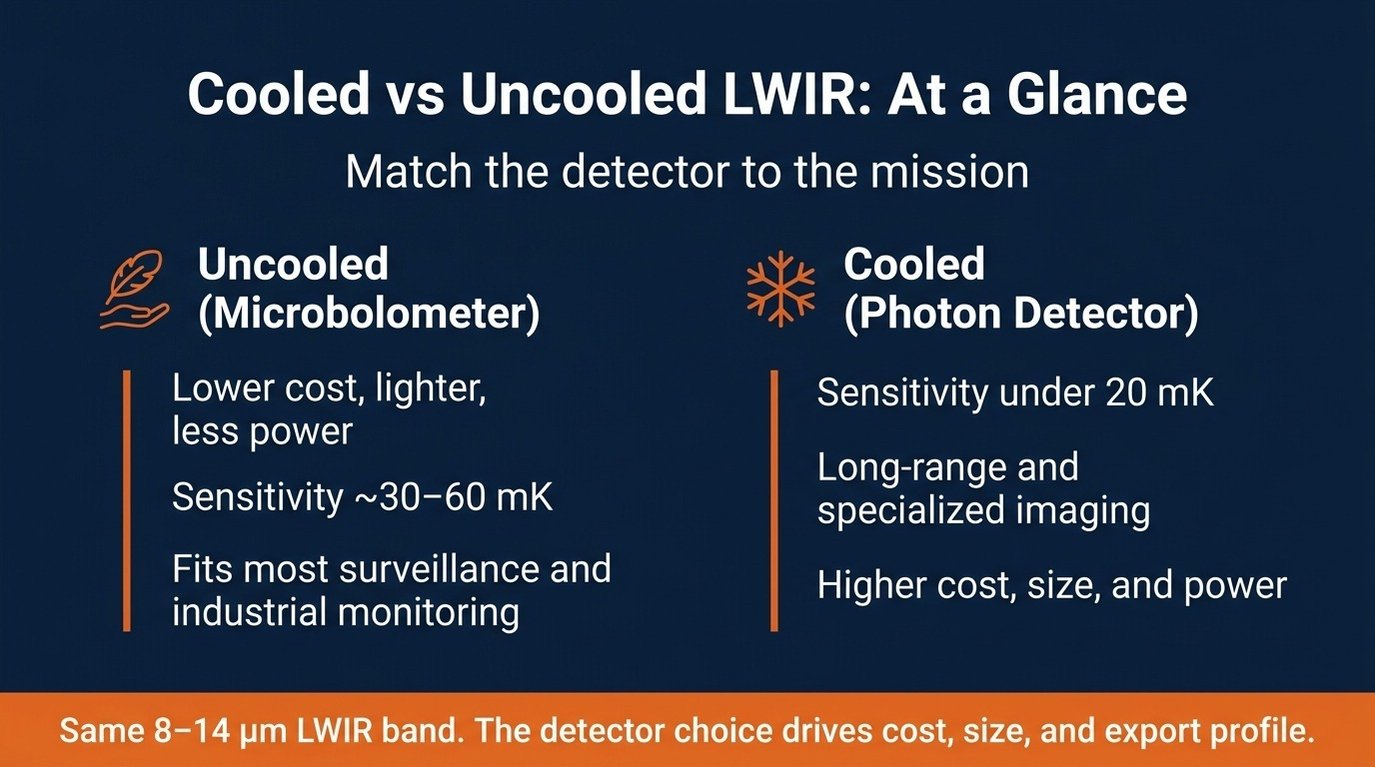
An uncooled LWIR camera uses a microbolometer detector, an array of tiny elements (usually vanadium oxide or amorphous silicon) that change electrical resistance as incoming infrared warms them. Processing electronics convert those resistance changes into a thermal image, all at room temperature. Because there's no cooler, the camera is compact, light, sips power, and powers up almost instantly.
That microbolometer vs cooled simplicity is the whole point. Typical thermal sensitivity for an uncooled camera lands in the 30–60 mK range, which is plenty for spotting people, vehicles, and equipment across most surveillance and monitoring tasks. You give up some fine sensitivity compared to a chilled detector, but you gain a passive, low-maintenance sensor that's easy to drop into a long-wave infrared camera system.
How Does a Cooled LWIR Sensor Work?
A cooled LWIR sensor pairs a photon detector with a cryocooler that drives the sensor down to very low temperatures, often below -150 °C. Stripping that thermal noise out of the equation lets the detector pull tiny signals from the scene, which is the foundation of LWIR cooling technology. The payoff is sensitivity that can dip under 20 mK and the ability to resolve faint temperature differences at long range.
The cooler adds bulk, weight, and power draw, with complete cooled assemblies often running in the rough range of 2–6 kg and 20–50 W. They also need a warm-up period of several minutes before the first image, and the cooler itself is a wear item with a finite service life. A precision-cooled long-wave infrared lens has to be carefully matched to that sensor, which is where engineering depth starts to matter.
When Does an Uncooled LWIR Camera Make Sense?
For most programs, an uncooled camera is the default answer. In the 2024 detector market, uncooled IR detectors were valued at roughly $3.61 billion against $1.55 billion for cooled, and a recent review of detector trends notes that uncooled production now far outpaces cooled, driven largely by demand outside the lab. For a huge share of real-world jobs, uncooled performance is simply good enough.
Uncooled tends to be the right call when:
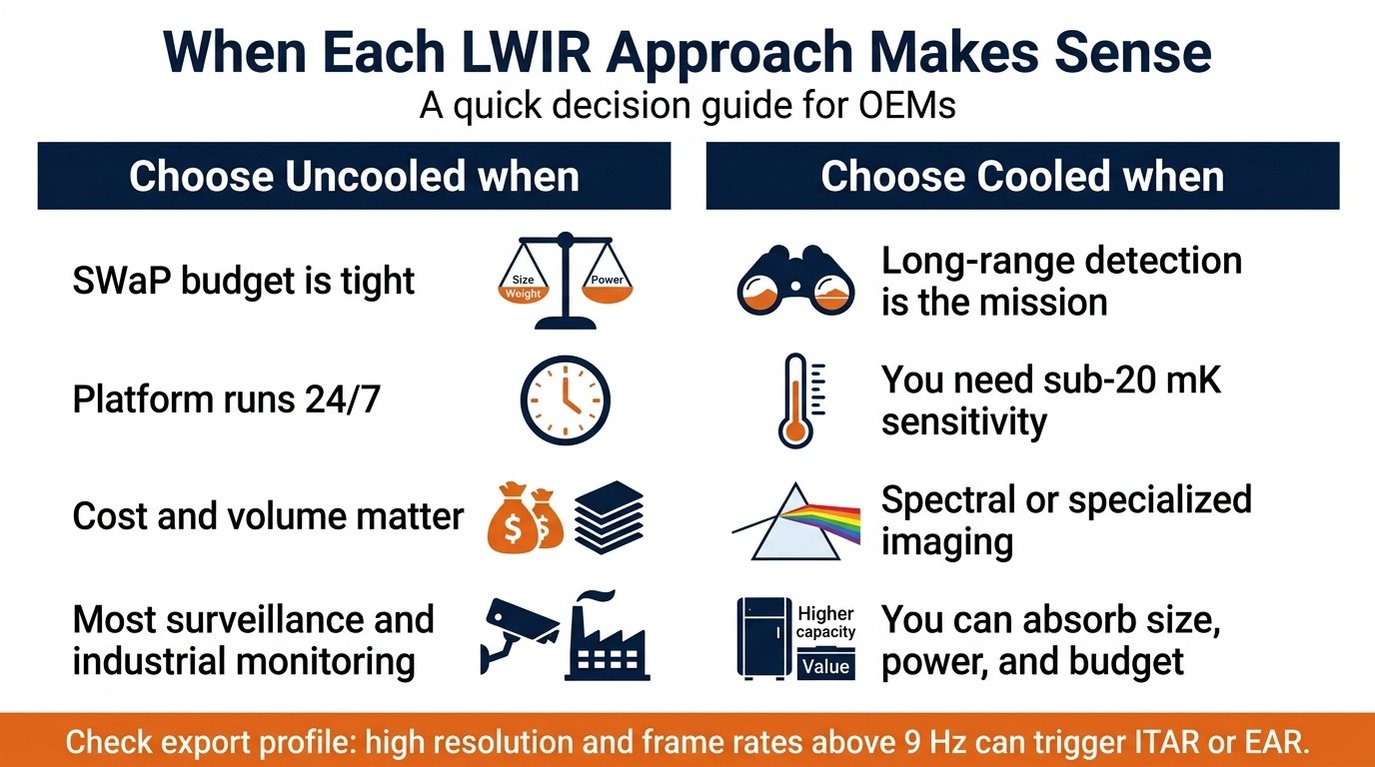
- Size, weight, and power are tight. Drone payloads, vehicle mounts, and man-portable gear can't carry a cooler's weight or power budget.
- The platform runs continuously. For 24/7 perimeter security or continuous industrial monitoring, low maintenance and long detector life beat peak sensitivity.
- Cost and scale drive the program. Higher production volumes and price-sensitive bids favor the simpler architecture.
This category covers the bulk of defense surveillance and nearly all industrial applications, from gas-leak monitoring to process and equipment inspection. The trick is sizing the optics and sensor correctly rather than reaching for a cooler. Getting the resolution your application needs right usually matters more than the detector class for these use cases.
When Is a Cooled LWIR Sensor Worth the Trade-Offs?
A cooled detector is the right tool when the mission genuinely demands it, and a defense program is the most common place that happens. If you need to detect, identify, or track targets at long standoff distances, the extra sensitivity and faster response unlocked by LWIR cooling technology translate into range and image quality you can't reach any other way.
Consider cooled when:
- Range is the mission. Long-range targeting and standoff ISR benefit from the sensitivity headroom a chilled detector provides.
- You're resolving faint or fast signals. Sub-20 mK sensitivity lets you separate subtle temperature differences that an uncooled sensor would blur together.
- You need spectral precision. Specialized imaging, including some gas and high-temperature analysis, leans on the spectral filtering that cooled systems support, paired with a cooled long-wave infrared lens designed for the band.
The same specifications that make cooled attractive can also trip export rules. High-resolution sensors and frame rates above 9 Hz are far more likely to fall under ITAR or EAR controls, so the export-control considerations belong in your decision early, not after you've committed to an architecture. And if your range need is really about hot targets rather than faint ones, it's worth weighing LWIR against MWIR before you assume cooled LWIR is the only path.
How Do Uncooled vs Cooled LWIR Compare Side by Side?
The microbolometer vs cooled choice is easiest to reason about as a set of trade-offs. Here's how the two stack up across the factors that shape a program.
|
Factor |
Uncooled LWIR (microbolometer) |
Cooled LWIR (photon detector) |
|
Detector temperature |
Ambient (room temperature) |
Cryogenically cooled |
|
Typical thermal sensitivity |
~30–60 mK |
Often under 20 mK |
|
Detection range |
Short to medium |
Long |
|
Size, weight, power |
Compact, light, low power |
Larger; roughly 2–6 kg and 20–50 W with the cooler |
|
Time to first image |
Near-instant |
Warm-up of several minutes |
|
Maintenance |
Minimal, long service life |
Cooler is a wear item |
|
Relative cost |
Lower |
Significantly higher |
|
Export profile |
Often simpler |
More likely to trigger controls |
|
Best fit |
24/7 monitoring, most surveillance, drones, vehicles |
Long-range targeting, high-sensitivity or specialized imaging |
Uncooled is the high-volume workhorse that keeps cost, weight, and complexity down. Cooled is the specialist you bring in when the mission justifies the premium. Neither is universally better, which is exactly why the spec sheet alone can't make the call for you.

5 Questions to Ask Before You Choose
Before you commit either way, run your requirements through these five questions. They'll surface the answer faster than any feature list.
- What's your real detection range? Be honest about the distance at which you must detect, recognize, or identify a target. If medium range covers it, uncooled almost always wins. If you're reaching for long standoff, cooled enters the conversation.
- How tight is your SWaP budget? A cooler's weight and power draw can break a drone or man-portable design. If every gram and watt counts, that pressure points hard toward uncooled.
- What sensitivity does the task actually demand? Detecting a warm human against a cool background is easy. Pulling faint thermal differences out of a busy scene is where sub-20 mK cooled performance starts to pay for itself.
- Where will this ship, and at what frame rate? International deployments and frame rates above 9 Hz raise export-control flags. Sort that out before you lock specs, not after.
- What's the total cost over the program's life? Factor in the cooler's maintenance and finite lifespan alongside the purchase price. Sometimes the cheaper sensor is also the cheaper system to keep running.
Defense vs Industrial: Which Way Should OEMs Lean?
The uncooled vs cooled LWIR answer shifts depending on what you're building. Defense and industrial programs pull in different directions, so it helps to map common applications to a starting recommendation.
|
Application |
Leans uncooled |
Leans cooled |
|
Perimeter and border surveillance |
Most deployments |
Only for very long standoff |
|
Counter-drone detection and tracking |
Common |
Specialized long-range variants |
|
Drone and vehicle payloads (SWaP-limited) |
Strong fit |
Rarely |
|
Long-range targeting and standoff ISR |
Strong fit |
|
|
Predictive maintenance and process monitoring |
Strong fit |
|
|
Optical gas imaging and spectral work |
Often preferred |
Defense Platforms
Defense buyers face the widest range. Most surveillance, counter-drone, and platform-mounted roles are well served by uncooled cameras, especially where SWaP and unit cost matter. Cooled gets the nod for long-range targeting and high-sensitivity ISR, where standoff distance is the whole reason the program exists. Whichever way you lean, the supplier relationship is as important as the detector, so it's worth looking at manufacturers offering integration support rather than catalog-only vendors.
Industrial Platforms
Industrial programs are far more uncooled-friendly. Predictive maintenance, electrical inspection, furnace and process monitoring, and continuous safety surveillance almost all run comfortably on uncooled cameras, where 24/7 uptime and low maintenance outrank peak sensitivity. The main exceptions are spectral applications like optical gas imaging and high-temperature research, where a cooled sensor's spectral precision genuinely changes the result.
Frequently Asked Questions About Cooled and Uncooled LWIR
Is cooled LWIR always better than uncooled?
No. A cooled system delivers higher sensitivity and longer range, but the LWIR cooling technology behind it also adds cost, size, weight, power draw, warm-up time, and maintenance. For most surveillance and industrial tasks, an uncooled system meets the requirement at a fraction of the complexity.
Why are most surveillance cameras uncooled?
Because surveillance usually means detecting people and vehicles across medium ranges in challenging visibility, and uncooled microbolometers handle that well. They're also passive, compact, low-maintenance, and far cheaper to deploy at scale, which suits the round-the-clock nature of the job.
What thermal sensitivity should I expect from each?
Uncooled LWIR cameras typically deliver about 30–60 mK, which is sufficient for most detection tasks. Cooled LWIR sensors can reach under 20 mK, letting them resolve much finer temperature differences for long-range or specialized work.
Does choosing cooled affect export compliance?
It can. High-resolution sensors and frame rates above 9 Hz are more likely to fall under ITAR or EAR controls. Because cooled systems often push into those higher-performance specs, it's smart to confirm the export profile before committing.
Can one supplier provide both uncooled and cooled LWIR?
Yes, and that flexibility is valuable. A vertically integrated supplier that builds the materials, the cooled long-wave infrared lens, and complete cooled and uncooled systems can help you match the architecture to the mission instead of forcing your design around a fixed catalog.
Match Your Platform to the Right LWIR Architecture
The smartest move you can make is to size the detector to the mission and resist the pull of the highest spec. Get your range, sensitivity, SWaP, and export picture straight, and the uncooled vs cooled LWIR answer usually reveals itself.
That's exactly the kind of trade-off LightPath helps OEMs work through, drawing on four decades of optical and infrared engineering and a vertically integrated line that spans materials, lenses, and complete cooled and uncooled cameras. For a clear, side-by-side look tailored to your platform, request a cooled vs uncooled spec comparison, and our engineering team will help you choose the architecture that lets your product win.