

Key Takeaways
For OEM procurement and engineering teams, choosing among LWIR camera manufacturers is less about specs and more about who can integrate, deliver, and sustain at program scale.
- LWIR thermal imaging accounts for the largest technology segment of the thermal imaging market, with uncooled LWIR representing nearly 72% of 2025 thermal imaging revenues.
- Custom integration support, including engineering collaboration, factory calibration, and interface compatibility, is one of the most consequential factors in reducing OEM development timelines.
- NDAA compliance and domestic supply chain traceability have become non-negotiable criteria for defense and government-adjacent programs as of 2025-26.
- Selecting the right LWIR OEM supplier means evaluating the full support ecosystem, not just the sensor spec sheet.
For teams evaluating LWIR camera companies for drone, defense, or industrial platforms, this guide covers what actually separates manufacturers worth shortlisting from those that will slow your program down.
When a program manager or procurement lead starts evaluating LWIR camera manufacturers, the first thing they typically request is a spec sheet. That is understandable, but it is also where many sourcing decisions go sideways. The cameras that look best on paper are not always the ones that integrate cleanly into your platform, clear your compliance requirements, or come with the engineering support your team needs when timelines compress.
Optical and thermal imaging systems built around long-wave infrared technology operate in the 8-14 µm band, detecting heat signatures emitted by objects rather than reflected light. That makes LWIR effective in darkness, fog, smoke, and dust, conditions where visible-spectrum cameras fall short. For OEMs building drone payloads, defense surveillance platforms, or industrial monitoring systems, LWIR has moved from a specialized option to a mainstream design requirement.
The thermal imaging systems market is projected to grow from $5.78 billion in 2025 to $8.71 billion by 2031, with uncooled LWIR retaining nearly 72% of 2025 market share, driven by cost advantages and broad applicability across platforms. That growth is creating both opportunity and sourcing complexity for engineering teams. This guide is written for OEM engineers, program managers, and procurement leads who need to understand which LWIR camera companies offer the depth of custom integration support that serious programs require. It is not a consumer comparison.
What Should OEM Teams Look for in LWIR Camera Companies?
The gap between LWIR camera companies with genuine custom integration capability and those selling off-the-shelf modules is significant. For a drone payload or defense EO/IR system, that gap can mean the difference between a 12-week integration and a 12-month one.
A few factors consistently distinguish the strongest lwir thermal camera manufacturers in the OEM space.
Engineering collaboration from day one. The best lwir oem suppliers engage before the purchase order. They review your platform constraints, optics requirements, interface specs, and SWaP budget before recommending a configuration. Manufacturers that skip this step tend to create problems downstream.
Factory calibration and non-uniformity correction. Thermal sensors require precise calibration to perform consistently. Manufacturers that handle this in-house, rather than passing the work to the integrator, compress timelines and reduce the risk of image quality issues that only surface during field testing.
Standardized interfaces with real flexibility. GigE Vision, USB3, and MIPI CSI-2 protocols are now table stakes. What separates good lwir camera companies from great ones is how cleanly those interfaces work with your embedded processor stack, and how much engineering support is available when compatibility issues arise.
Compliance documentation. For defense and government-adjacent programs, NDAA alignment, ITAR classification, and export control guidance have moved from afterthoughts to first-tier requirements. Manufacturers that cannot provide clear, documented answers on these questions represent a program risk.
Supply chain stability. Germanium, the traditional material for LWIR optics, has faced significant price volatility and export restriction risk due to concentrated global production. Manufacturers that have invested in germanium-free alternatives, including chalcogenide glass formulations, offer meaningfully better supply predictability for multi-year programs.
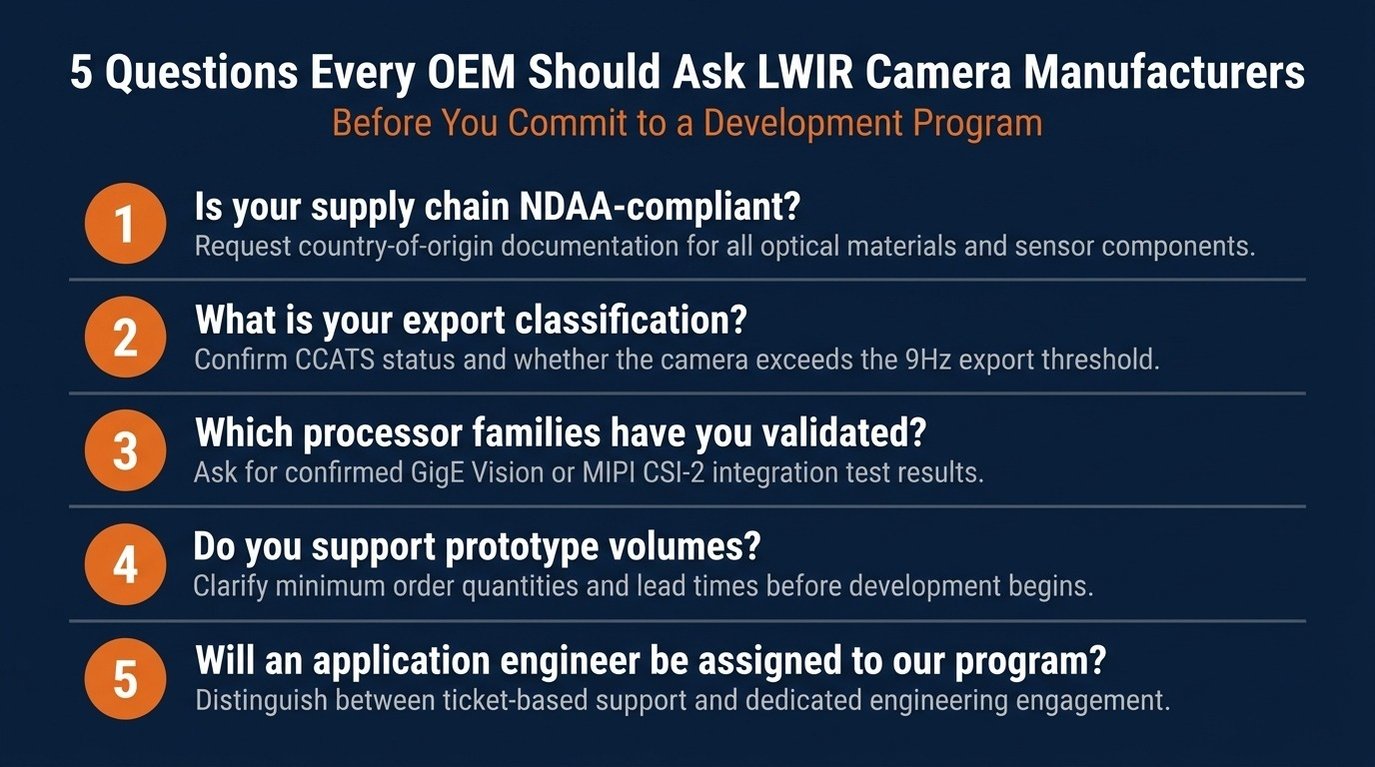
|
Key Evaluation Criteria |
What to Ask Manufacturers |
|
NDAA Compliance |
Can you provide country-of-origin docs for optical materials and sensor components? |
|
Export Controls |
What is the CCATS classification? Does the camera exceed the 9Hz export threshold? |
|
Interface Support |
Which embedded processor families have you validated GigE/MIPI integration with? |
|
Lead Time and MOQ |
What are standard lead times, and do you support prototype volumes? |
|
Custom Engineering |
Do you assign dedicated application engineers to new programs? |
Why NDAA Compliance Has Become a Baseline Requirement
If your program touches U.S. defense contracts, federal funding, or allied-nation procurement, the compliance landscape has shifted materially in the past 18 months. The FY2026 National Defense Authorization Act, signed into law in December 2025, requires the Department of Defense to eliminate reliance on optical glass and optical systems sourced from covered nations by January 1, 2030. Covered nations include China, Russia, Iran, North Korea, and Belarus.
For OEM procurement teams, this has two practical implications. First, any LWIR components with supply chain exposure to covered-nation materials, including raw IR glass or sensor substrates, carry program-level compliance risk. Second, programs that begin design today with non-compliant materials face expensive redesigns as the 2030 deadline approaches. A July 2025 Government Accountability Office report found that the Department of Defense has limited visibility into the vast majority of its 200,000-plus suppliers, particularly at the raw materials level, and recommended that programs contractually require country-of-origin documentation from suppliers.
When evaluating custom lwir integration partners for defense programs, asking for material traceability documentation is now a reasonable baseline requirement, not an unusual ask.
Top 10 LWIR Camera Manufacturers with Custom Integration Support
The following lwir thermal camera manufacturers have established reputations for supporting OEM integration programs, not just selling hardware. They range from broad-portfolio defense suppliers to specialized module makers, and the right fit depends on your platform, timeline, and compliance requirements.
1. Teledyne FLIR OEM
Teledyne FLIR OEM is the most widely integrated LWIR platform in the defense and drone market. Their Boson+ and Hadron 640 cores appear in everything from tactical sUAS to vehicle-mounted surveillance systems. For OEMs, the practical advantages are real: NDAA-compliant, ITAR-free configurations, customer-selectable USB3, CMOS, or MIPI interfaces, and an extensive developer ecosystem with SDKs and hardware reference designs. Factory-integrated lens options reduce integration complexity, and the volume manufacturing base means production-scale availability is predictable. The tradeoff is that their market dominance means many competing platforms share the same core, which can limit differentiation for OEMs building premium products.
2. Lynred
Lynred brings together two of Europe's most established infrared detector specialists, with a product range covering both cooled and uncooled LWIR solutions. For OEMs developing industrial monitoring platforms or defense surveillance systems where long-term supply stability matters, Lynred's vertically integrated detector manufacturing is a meaningful advantage. Engineering support is strong, particularly for European programs, and their experience across defense, aerospace, and industrial markets is reflected in thorough documentation and dedicated application support resources.
3. Sierra-Olympia Technologies
Sierra-Olympia has built a focused position as a drone and unmanned systems integration specialist. Their Viento camera series was designed with UAV SWaP constraints as the primary driver. For OEMs developing Group 2-3 tactical UAS platforms or commercial drone payloads, their application-specific integration boards and UAV interface guidance reduce the amount of custom platform-level engineering required. Export compliance documentation is clearly organized for drone applications, which matters given the complexity of 9Hz export threshold rules for frame-rate-sensitive payloads.
4. FLIR Integrated Imaging Solutions (IIS)
Distinct from the OEM core business, FLIR IIS targets machine vision and industrial integration applications. Their industrial-grade thermal modules are designed for automated inspection systems, process monitoring equipment, and predictive maintenance platforms. GigE Vision compliance and a mature SDK ecosystem mean integration into existing machine vision frameworks is significantly faster than building from scratch, and their modules have strong performance track records in demanding manufacturing environments.
5. Axis Communications
Axis focuses on fixed surveillance and critical infrastructure monitoring rather than mobile platforms. For OEMs building perimeter security systems, border surveillance towers, or utility monitoring networks, their integration support for network-connected LWIR cameras is mature and well-documented. ONVIF compliance and broad VMS compatibility make system-level integration more predictable than with smaller module suppliers. Their fixed-camera focus is a genuine tradeoff for any OEM evaluating mobile or payload applications.
6. Leonardo DRS
Leonardo DRS has deep roots in U.S. defense LWIR programs, with a portfolio built around military specification requirements from the ground up. For OEMs supporting Army, Navy, or Marine Corps programs, DRS brings supply chain compliance documentation and technical depth that directly-commercial suppliers often cannot match at the same level of program rigor. Their integration support model suits long-cycle acquisition programs well.
7. Xenics (part of Exosens)
Xenics brings multi-spectral breadth to the LWIR integration conversation. As part of the Exosens group, they offer SWIR, MWIR, and LWIR solutions through a unified engineering support structure. For programs that may need to offer both LWIR and MWIR configurations on a single platform, working with one engineering team that understands both bands reduces integration complexity and sourcing risk.
8. Seek Thermal OEM
Seek Thermal has carved out a position in the compact, cost-optimized end of the LWIR OEM market. Their modules are among the smallest available, intended for volume OEM integration into light-commercial and IoT-oriented applications. For industrial monitoring platforms, handheld inspection tools, or smart building systems where cost per unit is the primary constraint, their price-to-performance profile is competitive. Integration documentation is largely self-service, which works well for experienced teams but may not suit programs requiring hands-on engineering collaboration.
9. Pelco (Schneider Electric)
Pelco's thermal product line serves the fixed infrastructure and critical facilities market, with NDAA-compliant configurations and network integration support aligned to enterprise security and utility applications. Their long-established VMS partnerships simplify the software integration layer and reduce time-to-deployment for energy facilities, critical infrastructure, and campus security programs. Their engineering support model is best suited to fixed-installation programs.
10. Infratec
Infratec occupies a specialist position in high-accuracy thermographic and scientific LWIR applications. For OEMs in non-destructive testing, materials research, or precision industrial inspection where absolute radiometric accuracy is a core requirement, their calibration support and measurement precision are well-regarded. Integration is more engineering-intensive than with mass-market OEM modules, but for programs where temperature measurement accuracy is a primary design requirement, that investment is justified.
What Does Genuine Custom LWIR Integration Look Like?
Genuine custom lwir integration is an application engineer assigned to your program who reviews your mechanical drawings, optics requirements, and power budget before you buy anything. It is factory calibration tailored to your operating temperature range, not a default calibration profile. It is integration testing validated on your specific processor before you commit to a production design. The LWIR thermal imaging solutions that perform best in the field are almost always those where the manufacturer engaged early and treated system performance as a shared responsibility.
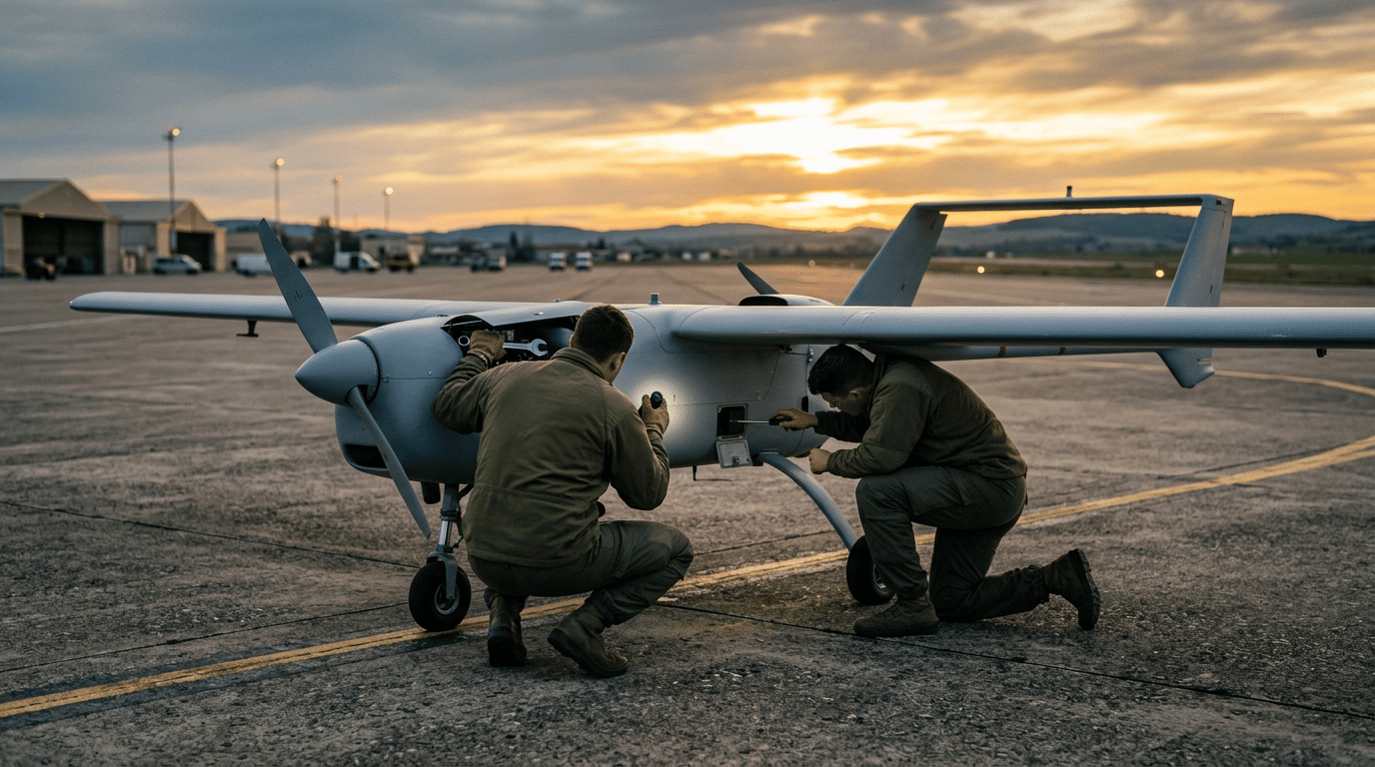
For programs integrating into drone payloads, the challenges multiply quickly. Frame rates above 9Hz trigger export control review. SWaP constraints eliminate most high-power options before performance specs are even compared. Lens selection interacts with sensor resolution in ways that significantly affect detection range, and getting that wrong late in a program is expensive. The best lwir thermal camera manufacturers for drone and UAV imaging programs treat these constraints as design inputs from the first conversation, not surprises to be resolved after purchase.
For industrial and fixed surveillance programs, the questions shift: radiometric calibration accuracy, continuous-operation reliability, VMS compatibility, and long-term component availability tend to drive integration outcomes more than raw sensitivity specs. Knowing which questions apply to your program before you start evaluating manufacturers saves weeks.
Why Vertical Integration Matters More Than It Used To
When comparing LWIR camera manufacturers, one attribute that often goes underweighted is vertical integration: how much of the system the manufacturer actually controls, from raw materials through finished assembly.
For LWIR programs, the lens-to-sensor interface has an outsized effect on image quality and detection range that only reveals itself when both are designed together. A manufacturer optimizing optical elements, detector housing, and system calibration as a single system can achieve performance that component-mixing approaches cannot match. Beyond performance, a vertically integrated manufacturer can provide origin traceability down to the material level. A downstream assembler often cannot, which creates compliance documentation risk for defense programs specifically.
This is why OEMs building resilient infrared optics supply chains increasingly treat vertical integration as a sourcing criterion, not just a nice-to-have. When germanium availability tightens or covered-nation sourcing becomes a compliance issue, manufacturers with proprietary non-germanium optical materials hold a structural advantage that catalog-based suppliers cannot replicate.
The aerospace and defense thermal imaging supply base capable of delivering that kind of full-stack integration is smaller than the market suggests.
Frequently Asked Questions
What is the 9Hz rule, and how does it affect LWIR camera procurement? Frame rates above 9Hz for LWIR cameras trigger export control review under U.S. Export Administration Regulations and related Wassenaar Arrangement provisions. For most commercial and industrial applications, this is not a practical constraint. For drone platforms and defense systems, it requires careful attention during specification and sourcing to ensure the configuration has the appropriate export classification for your program and end-customer locations.
How do I know if a manufacturer's LWIR camera is truly NDAA-compliant? Ask for a written attestation and a component origin declaration covering the sensor, optical materials, and electronic assemblies. NDAA compliance for infrared systems is increasingly about material origin, not just final assembly location. The FY2026 NDAA has explicitly extended compliance requirements to optical glass and IR materials sourced from covered nations.
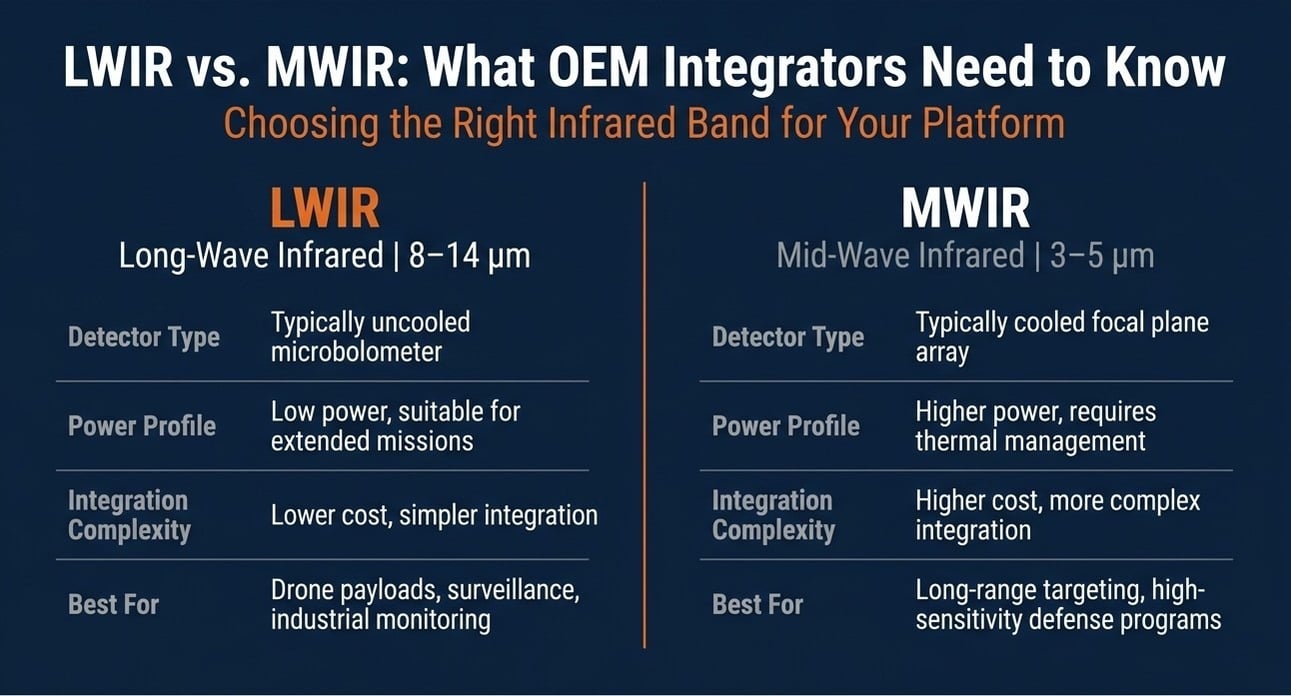
What is the difference between LWIR and MWIR for OEM integration purposes? LWIR operates in the 8-14 µm band and is typically delivered in uncooled format, offering lower power consumption, lower cost, and more straightforward integration. MWIR operates in the 3-5 µm band and generally requires cooled detectors, offering higher sensitivity and better atmospheric performance in certain conditions. For most drone, surveillance, and industrial monitoring applications, LWIR is the practical choice. The integration complexity and cost difference between the two is significant.
How does optics choice affect LWIR system performance? Sensor resolution gets most of the attention, but optical design determines how effectively that resolution is used in the field. Focal length, f-number, field of view, and lens coating quality all directly affect detection range and image clarity. Manufacturers who understand both the sensor and the optics, and can optimize them together as a system, consistently outperform configurations assembled from separate component vendors.
Ready to Shortlist Your LWIR Integration Partner?
The list of LWIR camera manufacturers is long. The list of manufacturers that can genuinely support an OEM integration program from requirements through production, while meeting the compliance and supply chain requirements that defense and industrial programs now demand, is considerably shorter.
For over 40 years, LightPath Technologies has been engineering optical and thermal imaging solutions for aerospace, defense, and industrial OEMs who need more than a catalog. With proprietary Black Diamond chalcogenide glass that reduces germanium dependency, vertically integrated production from raw materials through complete camera systems, and engineering teams that engage at the program level from the start, LightPath is built for the kind of custom LWIR integration that determines program outcomes. If your team is building the next platform that needs to perform in the field, connect with our experts to start the conversation.