
.webp?width=160&height=76&name=LightPath-Technologies-Logo-White-removebg-preview%20(1).webp)
UAV Cameras: Thermal Imaging Payloads for Drone Programs
Custom-engineered UAV cameras for defense, inspection, and search-and-rescue platforms, from sensor selection through full OEM integration.
Key Takeaways
A UAV camera is a subsystem decision, not a component purchase, and platform constraints settle it before sensor specs ever come into play.
- Cooled MWIR (3 to 5 µm) buys detection range at the cost of 10 to 20W of cryocooler power and a 2 to 4 minute cooldown. Uncooled LWIR (8 to 14 µm) buys instant-on operation, minimal power draw, and lower cost.
- Lens-to-sensor matching drives usable detection range more than raw pixel count. A matched lens on a modest array routinely outperforms a mismatched lens on a larger one, and downlink bandwidth limits how much of that data survives the flight.
- Component-level sourcing decides defense eligibility. The best OEM camera module for drone integration on a federal program is the one whose provenance survives review.
Lock your size, weight, power, and compliance envelope first. Then shortlist UAV cameras against it.
The FAA's 2025 commercial drone fleet forecast puts the U.S. commercial small drone fleet past one million aircraft, headed toward 1.118 million by 2029, while defense programs scale ISR and counter-drone work on a separate track. Both curves converge on the imaging payload, which is where an optical and thermal imaging manufacturer earns the program or loses it.
LightPath builds UAV cameras for unmanned platforms specifically. Whether you're integrating a cooled MWIR sensor into a tactical ISR payload, a lightweight LWIR module into an inspection drone, or a multi-spectrum thermal camera for drone-based CUAS missions, we engineer the optics, detector, and packaging around your platform constraints rather than asking you to design around ours.
How Are UAV Cameras Different From Ground-Based Thermal Systems?
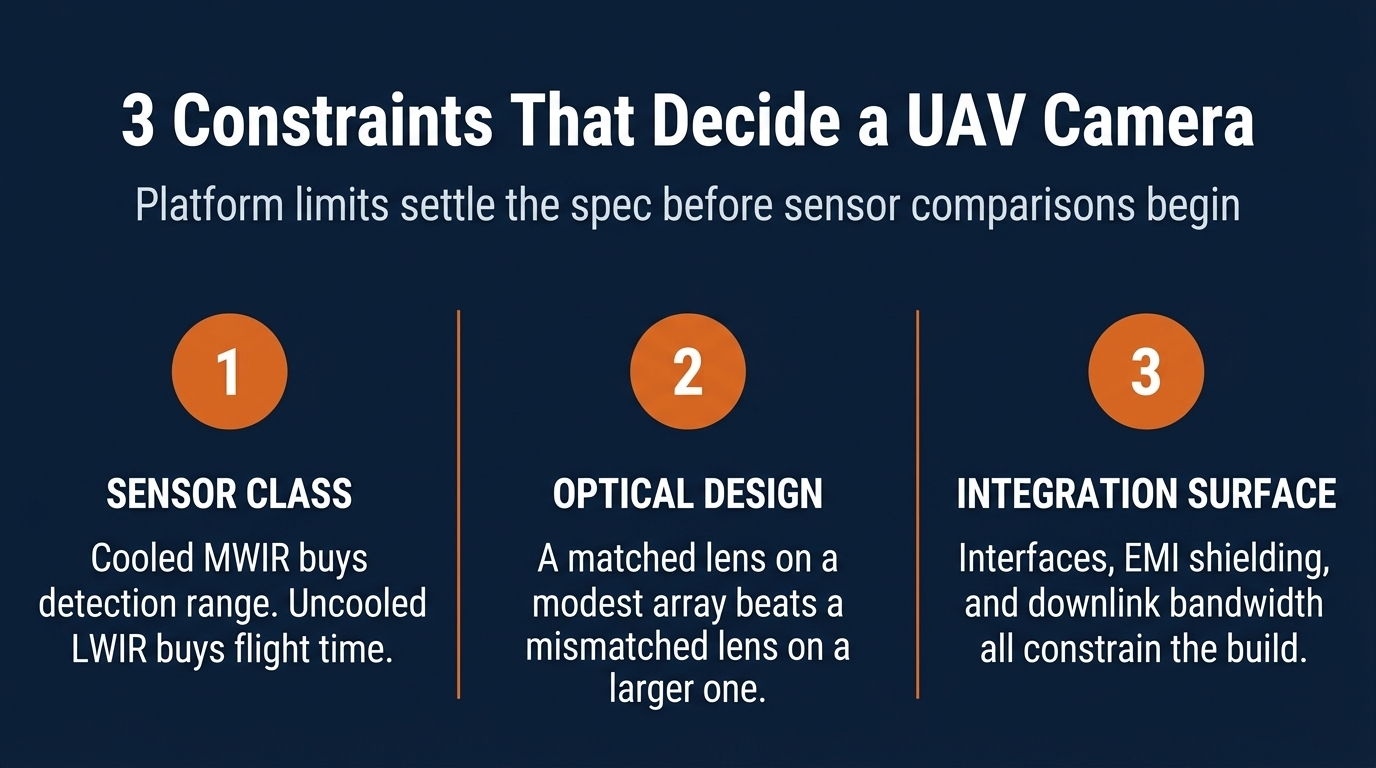
Ground-based thermal cameras have the luxury of weight, power, and thermal management. Drones don't. Every gram costs flight time, every watt shortens the mission, and every millimeter of gimbal envelope decides whether the camera fits. UAV cameras rarely look like scaled-down versions of their ground counterparts. The tradeoffs land in three places.
Sensor class. Cooled MWIR (3 to 5 µm) delivers the longest detection range and the sensitivity tactical ISR programs demand, but requires 10 to 20W of cryocooler power and a 2 to 4 minute cooldown. Uncooled LWIR (8 to 14 µm) gives you instant-on readiness, near-zero power draw, and lower cost, the default for inspection and search-and-rescue platforms where flight time outranks absolute range.
Optical design. Gimbals constrain lens diameter, length, and mass at once. In-house molded and diamond-turned optics let us build assemblies that meet your envelope instead of forcing your envelope to accommodate catalog geometry. This aspect is also where range is won or lost. A 320x240 array behind a correctly matched long focal length will out-detect a larger array behind a mismatched short lens, an expensive misconception in UAV payload imaging.
Integration surface. Your platform team cares about GMSL, CoaXPress, or MIPI CSI-2, your software team about GenICam compliance, your RF team about EMI shielding. Bandwidth belongs on that list too and usually surfaces too late. Radiometric video at 640x512 generates more data than many downlinks carry without compression, and some compression schemes destroy the accuracy that made the payload worth flying.
UAV Camera Applications by Mission Type
UAV cameras cluster into four mission families: defense ISR and counter-UAS, search and rescue, industrial inspection, and public safety. Mission profile should drive the shortlist ahead of budget, because what counts as the right drone thermal imaging camera changes completely between a border surveillance sortie and a rooftop inspection pass. Each family weights the tradeoffs above differently.
Defense ISR and Counter-UAS (CUAS)
For military ISR, counter-drone, and tactical surveillance, cooled MWIR remains the reference standard for long-range detection. These programs prioritize NETD performance, target discrimination at standoff, and ruggedization against vibration, salt spray, and thermal cycling.
Cold-shield efficiency deserves specific attention. The shield keeps the detector from seeing radiation emitted by warm housing and optics, so a design at full efficiency lets the array view only the external scene, preserving sensitivity and eliminating corner shading. A poor one gives back the advantage that justified the cooled architecture in the first place.
Counter-drone work adds one requirement. Small aerial targets are found through the heat their motors and batteries produce, often when they're visually indistinguishable against sky or terrain, so any shutter event opens a gap a fast mover can cross undetected. Shutterless operation is a requirement here, not a preference. Our MWIR camera systems cover short, mid, and long-range configurations as a core, an assembly, or a custom payload.
Common program types: counter-drone systems, perimeter and border surveillance, tactical ground robotics, airborne ISR, and EO/IR sensor fusion. Most begin on our aerospace and defense solutions page.
Thermal Drones for Search and Rescue
For most thermal drones for search and rescue, the answer is an uncooled LWIR sensor at 640x512 with 12 to 17 µm pixel pitch. Rescue teams need a thermal camera for drone operations that can find a human heat signature in the first minutes of a battery-powered sortie, and the calculus differs sharply from defense work: what matters is adequate range at the altitude the aircraft actually flies, typically 100 to 400 feet AGL, paired with maximum endurance and a defensible unit cost.
Our LWIR camera solutions balance 640x512 or 1280x1024 resolution against the weight budget a 25 to 40 minute mission demands. Thermal extends what teams can do at night, under canopy, and through wildfire smoke, though heavy rain and strong solar loading on terrain reduce contrast and should be planned for. Teams evaluating complete aircraft can start with our guide to the Best Thermal Drone for Search and Rescue.

Industrial Inspection and Asset Monitoring
Power line inspection, solar array audits, envelope thermography, pipeline survey, and turbine monitoring all depend on radiometric accuracy. These operators need a calibrated temperature reading at every pixel, not a picture that looks hot.
We deliver LWIR modules with radiometric output, GenICam-compliant streaming, and fixed-pattern noise correction suitable for engineering-grade analysis. For optical gas imaging, narrowband MWIR optics target the absorption bands associated with methane, SF6, and other regulated emissions, covered on our oil and gas imaging solutions page.
Law Enforcement and First Responder Drones
Public safety programs need compact UAV cameras that hold up through sustained duty cycles in darkness, smoke, and fog. Our LWIR cores run continuously with the dynamic range to track movement across urban terrain at night. Because these fleets are often bought with federal or state funds, sourcing documentation matters as much as image quality.
How LightPath Supports Drone OEM Programs
LightPath supports drone OEM programs at four levels: custom lens assemblies, integrated camera cores, full payload engineering, and OEM or ODM production. Teams evaluating the best OEM camera module for drone integration usually discover the constraint is optical rather than electrical. LightPath is an optics manufacturer first. We don't source lenses, we design and produce them, which matters when your payload needs a custom field of view, a specific transmission band, or an envelope no catalog lens can meet.
- Custom lens assemblies in molded chalcogenide, ground germanium, and silicon, built to your gimbal envelope.
- Integrated camera cores pairing LWIR or MWIR detectors with our optics, ready to integrate.
- Full payload engineering covering mechanical, thermal, electrical, and software integration at sufficient scale.
- OEM and ODM models, from white-label builds to co-engineered modules for primes.
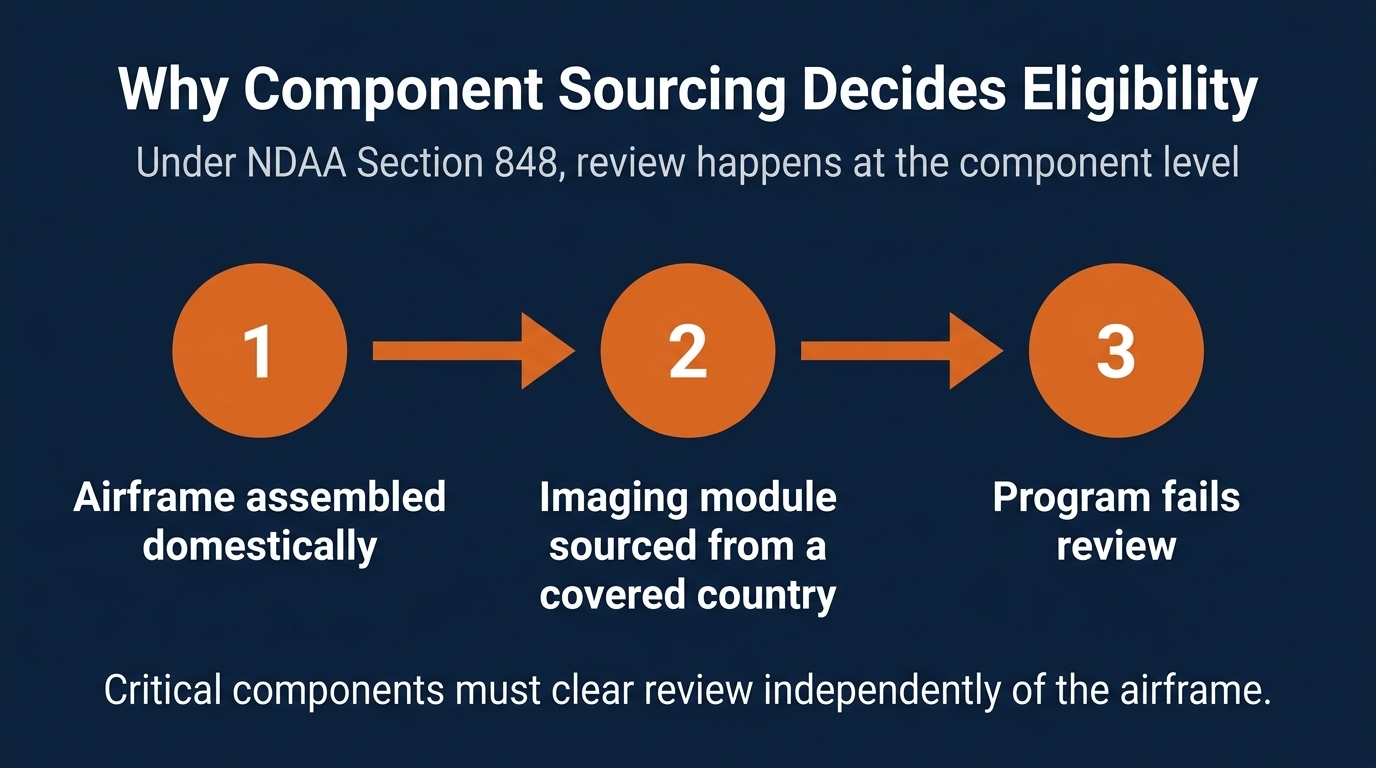
Compliance belongs in this conversation from day one. Under Section 848 of the FY20 NDAA and the statutes that followed, eligibility is judged at the component level, so a domestically assembled aircraft carrying a covered-country imaging module still fails. The Department's Blue UAS List, the trusted catalog of NDAA-compliant drones and components, exists because critical components must clear that review independently of the airframe. Management transferred from the Defense Innovation Unit to the Defense Contract Management Agency in December 2025.
How Do You Choose the Right UAV Camera for Your Platform?
Choosing a thermal camera for drones comes down to three inputs: mission range requirement, flight time constraint, and budget. Specifying a drone thermal imaging camera in any other order tends to produce a payload that fits the spec sheet and not the aircraft. Use the framework below as a starting point, then pressure-test it against your actual platform with an engineer.
|
If your mission is |
And flight time is |
Recommended sensor class |
Product family |
|
Long-range ISR or border surveillance |
Extended, large UAV |
Cooled MWIR, 640x512 or higher |
G5 IR Long Range |
|
Tactical ISR, Group 2 to 3 UAV |
30 to 90 min |
Cooled MWIR, compact |
G5 IR Mid Range |
|
Counter-UAS detect and track |
20 to 60 min |
Cooled MWIR or high-sensitivity LWIR |
G5 IR Short Range or High-Sensitivity LWIR |
|
Search and rescue |
25 to 40 min |
Uncooled LWIR, 640x512 |
LWIR Camera Solutions |
|
Industrial inspection |
20 to 30 min, radiometric |
Uncooled LWIR, radiometric |
LWIR Inspection Modules |
|
Optical gas imaging |
Mission-specific |
Narrowband MWIR |
OGI Camera Solutions |
If the choice comes down to architecture rather than product family, whether you're speccing thermal drones for search and rescue or a long-range ISR build, this is the short version:
|
Factor |
Cooled MWIR (3 to 5 µm) |
Uncooled LWIR (8 to 14 µm) |
|
Detection range |
Longer of the two |
Moderate, altitude dependent |
|
Power draw |
10 to 20W cryocooler |
Minimal |
|
Startup |
2 to 4 minute cooldown |
Instant-on |
|
Platform fit |
Gimbal-class and larger airframes |
Small to medium UAVs |
|
Typical mission |
Tactical ISR, CUAS, long-range detection |
SAR, inspection, public safetS |
SCHEDULE A PROGRAM CONSULTATION
Why OEMs Choose LightPath for UAV Payload Imaging
Four things come up repeatedly in program reviews: we manufacture our own optics, we can build infrared performance without germanium, we have supported these exact mission types before, and we produce in the US under ITAR. Here is what each one means for your program.
Vertically Integrated Optics Manufacturing
We design, mold, polish, and test our own lenses, removing supply chain dependency on the component that most determines camera performance. Most of our drone program revenue comes from custom-engineered work rather than catalog parts.
Material Stability Without Germanium
Germanium is the traditional infrared lens material, and it sits under Chinese export controls. A USGS analysis of germanium export restrictions found optical instrument and lens manufacturing would absorb the largest relative hit to value added under a full restriction scenario. Our proprietary BlackDiamond chalcogenide glass reduces that exposure without giving up performance.
Drone-Specific Engineering Experience
We've supported counter-UAS, ISR, SAR, and inspection programs across uncooled LWIR, cooled MWIR, and broadband infrared (BBIR) builds. We know the payload constraints, the qualification process, and where integration typically goes sideways.
US-Based, ITAR-Compliant Manufacturing
Our Orlando, Florida facility is built for mil-spec production and defense-sensitive work, and we scale from engineering prototypes through production volume without making you requalify suppliers.
Frequently Asked Questions About UAV Cameras
How do infrared UAV cameras actually work?
An infrared drone camera detects radiation emitted by objects rather than reflected visible light, so it needs no illumination source. True thermal systems operate in the LWIR (8 to 14 µm) or MWIR (3 to 5 µm) bands. Near-infrared cameras detect reflected light and behave more like visible-spectrum imagers, making them a different technology with different export classifications.
What's the difference between cooled MWIR and uncooled LWIR for drones?
Cooled MWIR delivers better thermal sensitivity and longer detection range but requires a cryocooler drawing 10 to 20W plus a 2 to 4 minute cooldown. Uncooled LWIR starts instantly, draws negligible power, and costs far less, making it the right call for most commercial and SAR platforms. Defense programs favor cooled MWIR when range drives the requirement.
What resolution UAV camera do I need?
For SAR and inspection, 640x512 is the current sweet spot, enough to identify targets at typical altitudes without overwhelming the downlink. Defense programs needing identification at longer range generally start at 1280x1024. Pixel pitch matters as much as total resolution, and lens focal length matters more than either.
What makes the best OEM camera module for drone integration?
Fit against your platform, not headline specs. The strongest candidates match your gimbal envelope and SWaP budget, expose an interface your compute stack already speaks, hold radiometric accuracy through your downlink, and carry sourcing documentation that survives compliance review. A module that wins on paper and fails any one of those costs you a program cycle.
What interfaces do your UAV cameras support?
Standard cores support GMSL2, CoaXPress, USB3 Vision, and GigE Vision. For custom builds, we work with platform vendors on proprietary interfaces, MIPI CSI-2 for onboard compute, and radiometric streaming for engineering applications.
Are LightPath UAV cameras ITAR-compliant?
Yes. LightPath is US-based and ITAR-registered, and we regularly support defense programs requiring controlled component sourcing. Many of our MWIR products fall under ITAR classification and ship through the appropriate export controls.
Does LightPath meet Blue UAS and NDAA sourcing requirements?
Eligibility is judged at the component level, so a domestically assembled aircraft carrying a covered-country imaging module still fails review. Section 848 of the FY2020 NDAA names cameras and gimbals directly, alongside flight controllers, radios, and data transmission devices, as components that trigger the prohibition. As of November 2025 the Blue UAS List had provided more than 39 certified systems and 165 components to federal users. LightPath designs and manufactures its optics and assembles its camera products in the United States, which is the sourcing position your compliance team needs to document. Bring us your specific program requirements and we will supply the provenance record to support it.
Do you support counter-UAS (CUAS) detection applications?
Yes, and it is an active program area. We build thermal sensors engineered for small drone detection at range, including high-sensitivity LWIR and compact cooled MWIR configurations with shutterless operation so no frame gap opens during a track.
What's the typical timeline from consultation to production payloads?
For custom programs, expect 4 to 8 weeks for optical design and prototype, 8 to 16 weeks for integration and qualification, then a ramp matched to your platform. Catalog products ship from stock or build-to-order within weeks.
Ready to Spec Your UAV Camera Payload?
Whether you're early in platform design or scaling to production, this decision gets easier with an optics manufacturer in the room before the envelope is frozen. Bring us your SWaP budget, mission profile, and compliance requirements, and we'll tell you straight what's achievable.