
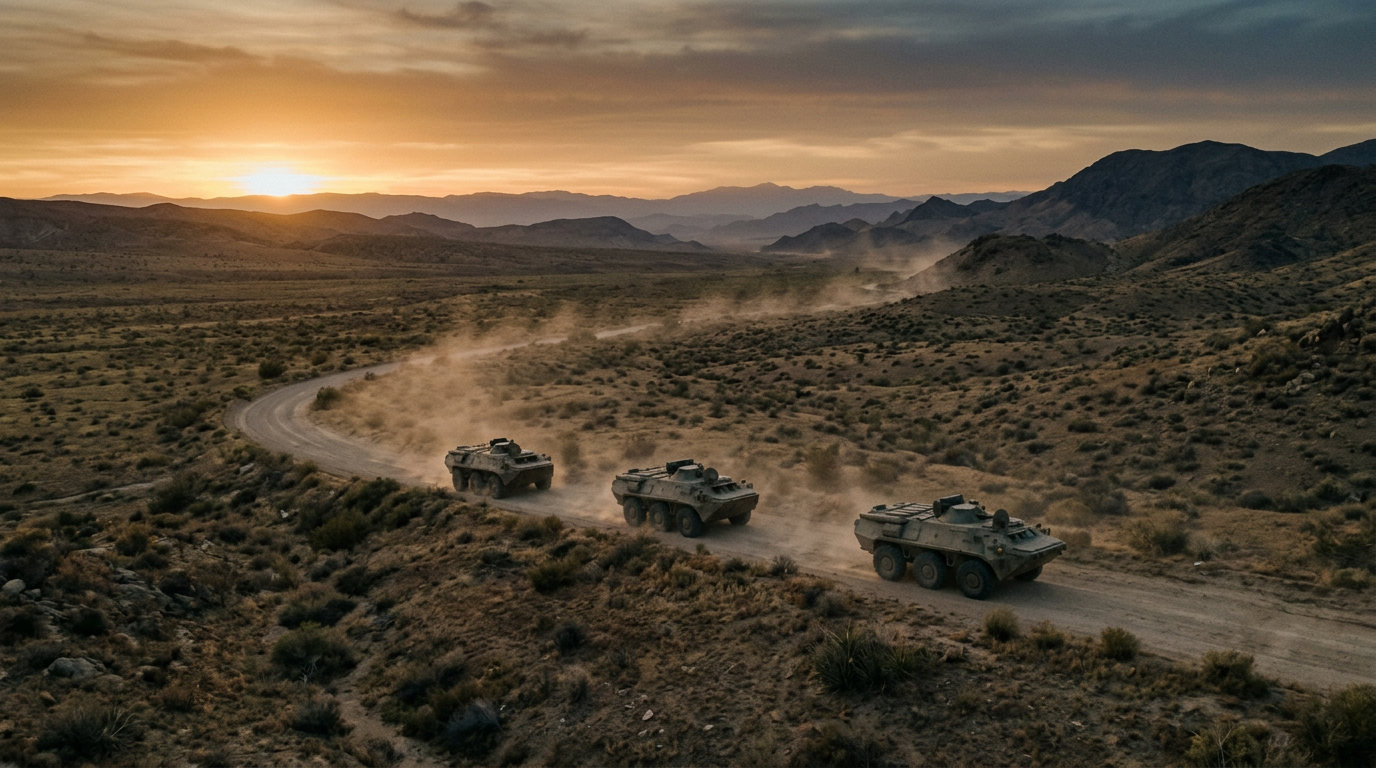
Thermal imaging defense vehicles keep crews oriented when dust, smoke, and darkness take away what the human eye depends on.
- Driver vision enhancement (DVE) and local situational awareness systems show up across new-build and retrofit programs alike, covering both night and daylight operation.
- Uncooled long-wave infrared sensing in the 8 to 14 µm band handles most degraded-visibility conditions well, though heavy rain and high-radiance backgrounds remain real limits.
- Program risk has shifted from optical performance toward supply chain provenance, with new federal sourcing rules reshaping how programs qualify optical materials.
- Supplier selection matters more than any single specification, because integration support is what keeps a vehicle program on schedule.
If your program treats the vision system as a late-stage bolt-on, move that conversation forward a year and handle it as an architecture decision.
Ground vehicle crews spend a surprising amount of their operational life unable to see. Convoy dust, smoke from a nearby engagement, a driver buttoned up behind armor with a vision block the size of a mail slot. Each degrades the single input keeping a heavy armored vehicle on the road and out of a ditch. That is the problem infrared and thermal imaging systems were brought onto ground platforms to solve, and why thermal imaging defense vehicles are designed today with crew visibility treated as core equipment rather than an accessory.
The stakes are not abstract. A New America report on military vehicle safety documented that more service members die in training than in combat, with tactical vehicle rollovers a persistent contributor. That analysis credits human factors more than environmental conditions, a caveat worth keeping in view. Vision systems are one layer of a larger safety picture, and the layer programs can actually engineer.
What Do Thermal Imaging Defense Vehicles Actually Need to See?
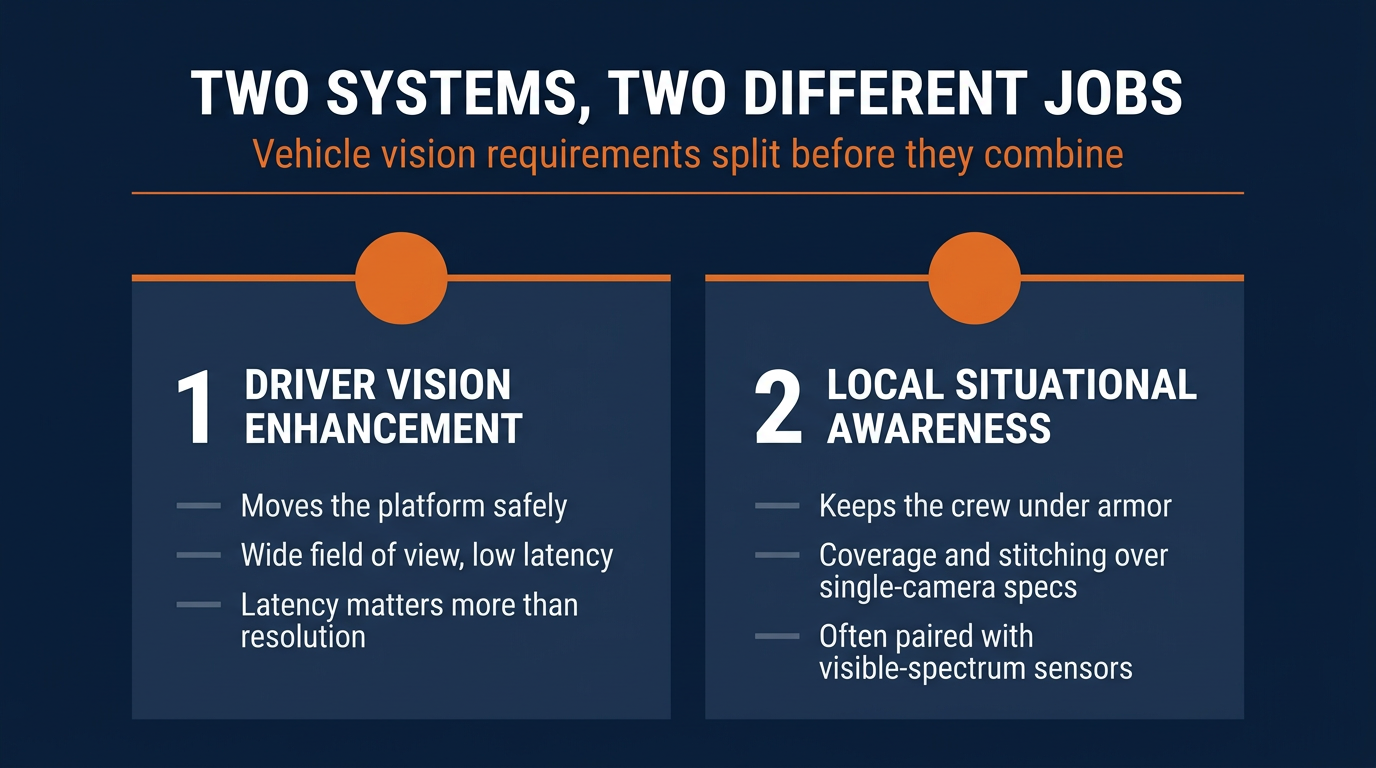
The question sounds obvious until you break a vehicle mission into its parts. Driving, backing into a hide position, watching a flank, and identifying whether the shape at 200 meters is a person or a fence post are different visual tasks. Programs treating them as one problem over-specify in places and leave gaps elsewhere. Thermal imaging defense vehicles handle these tasks through two distinct system types.
Driver Vision Enhancement for Safe Maneuver
Driver vision enhancement covers the forward and rearward views a driver needs to move the platform. The requirement is wide field of view, low latency, and an image that stays usable while the vehicle bounces over broken ground. A driver does not need to identify a target at range. They need to see the culvert, the ditch edge, the vehicle ahead, and the person walking into their path. Latency matters more than resolution here, since a delayed image is worse than none when correcting steering at speed.
Local Situational Awareness for the Crew
Local situational awareness systems ring the vehicle with sensors so the crew can observe their surroundings while staying under armor. This replaced the old habit of opening a hatch to see what was happening. Coverage and stitching matter more than any individual camera here, and the picture has to stay coherent for a crew member already doing three other jobs. Ground vehicle thermal imaging in this role is often paired with visible-spectrum sensors, giving operators color context by day and heat contrast at night.
Many programs now share sensors and displays across both functions rather than fielding two independent systems. That saves weight and cabling while raising the integration bar, since a shared ground vehicle thermal imaging architecture becomes a platform-level decision.
How Do Thermal Imaging Defense Vehicles Handle Degraded Visibility?
A DVE thermal system detects emitted heat rather than reflected light, which is why it keeps working when visible cameras and the naked eye go blind. That advantage is real and well proven, though not universal.
|
Condition |
How thermal helps |
Practical limits |
|---|---|---|
|
Total darkness |
Full performance, no illumination needed |
None significant |
|
Dust and sand |
Strong penetration of particulates |
Dense sustained clouds reduce contrast |
|
Smoke and haze |
Sees through most battlefield smoke |
Some engineered obscurants defeat IR |
|
Fog and mist |
Clear improvement over visible cameras |
Water droplets scatter long-wave energy |
|
Heavy rain |
Partial benefit |
Real degradation, plan for it |
|
Direct sun, hot surfaces |
Unaffected by visible glare |
High-radiance sources can saturate a scene |
The takeaway for any military vehicle thermal camera specification is that "sees through obscurants" belongs in a requirements document with qualifiers attached. Absolute performance language ends in failed acceptance testing or a quietly relaxed requirement. Condition-specific language gets systems that perform as promised.
What Separates a DVE Thermal System From a Commercial Camera?
Plenty of capable thermal cameras exist on the commercial market. The gap is rarely raw image quality anymore. It is everything surrounding the sensor, and why a qualified military vehicle thermal camera costs what it does.
Environmental qualification is the first divide. A vehicle-mounted unit lives through continuous vibration, thermal shock from desert day to desert night, dust and water ingress, and interference from its own vehicle electronics. Commercial units are rarely tested against that profile, as this breakdown of thermal cameras built for harsh environments explains.
Power and interface conformance is the second. Military vehicle electrical systems carry transients a commercial camera will not survive, and interfaces have to match what the platform already uses rather than forcing a new bus onto it.
The third is lifecycle. Ground vehicle programs tend to field systems for decades, which means spares, obsolescence management, and a supplier still producing the part when the fleet reaches its next overhaul cycle. Commercial product lines turn over far faster. Those tradeoffs appear in this comparison of military and commercial thermal camera sourcing.

Five Things to Weigh When Sourcing a Military Vehicle Thermal Camera
Vehicle programs run vision system selection off a specification matrix. Specifications matter, though they rarely explain why one supplier relationship succeeds and another stalls. These five considerations predict that better, and context on aerospace and defense imaging programs helps frame it.
- Integration depth over order fulfillment. Ask whether a supplier engages during requirements definition or only responds to a finished RFP. The first catches architecture mismatches while they are cheap to fix. The second finds them in integration testing.
- Field of view and latency for the driving task. A wide, low-latency image serves a driver better than a narrow, high-resolution one. Match the optical configuration to the maneuver task, not a surveillance specification.
- Material and manufacturing provenance. Know where optical materials originate, where they are processed, and whether that chain stays compliant in five years. This is a gating item now.
- SWaP against real platform budgets. Weight, power, and volume on an armored vehicle are already allocated. A vision system needing more of any of the three forces a tradeoff elsewhere.
- Production capacity at volume. Prototype performance and fleet-scale delivery are different problems. Confirm a supplier holds quality across thousands of units on schedule.
Why Does Supply Chain Provenance Now Shape Armored Vehicle Thermal Camera Programs?
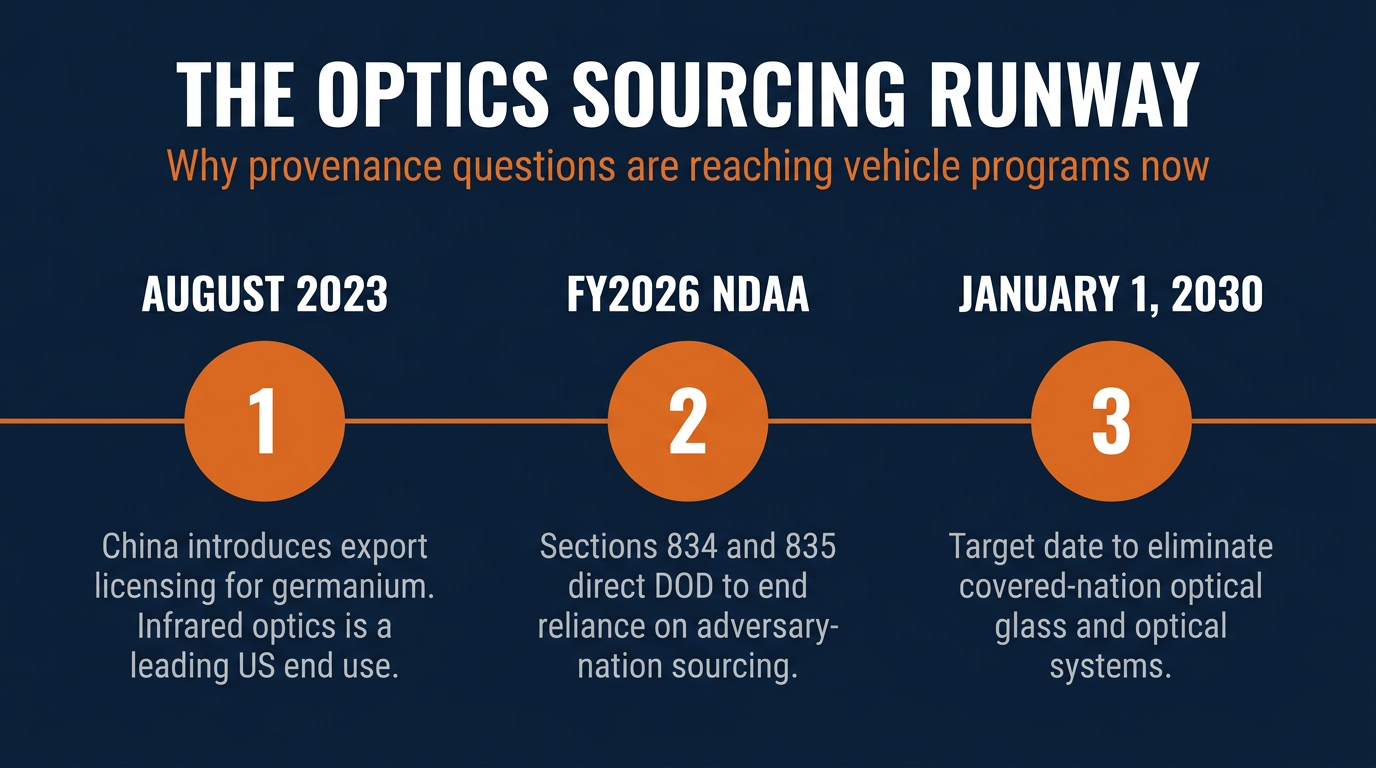
Infrared optics for defense platforms have long leaned on germanium. That dependency became a program risk when export controls tightened. The U.S. Geological Survey reported that China implemented an export licensing program for germanium in August 2023, followed by sharp declines in export volumes, with infrared optics among the leading domestic end uses. Alternative infrared glass formulations have since moved from engineering curiosity to procurement hedge.
Federal policy moved the same direction. Analysis of the FY2026 National Defense Authorization Act notes that Sections 834 and 835 direct the Department of Defense to develop strategies ending reliance on adversary nations for certain products, with optical glass and optical systems targeted for elimination by January 1, 2030. Any program entering development now will still be in production when that deadline arrives, which is why provenance questions tend to surface long before a hard cutoff. A fuller walkthrough sits in this overview of NDAA readiness for optical systems.
The practical response is to understand what kind of supplier you are actually buying from.
|
Supplier model |
What they control |
Program implication |
|---|---|---|
|
Camera assembler |
Final assembly and packaging |
Fast to quote, thin visibility into material origin |
|
Component specialist |
One layer, optics or detectors |
Deep expertise, integration burden falls on you |
|
Vertically integrated |
Raw material through finished camera |
Traceable provenance, single-point accountability |
None of these models is wrong. They carry different risk profiles, and the right choice depends on how much integration engineering your team owns. Armored vehicle thermal camera programs with compliance exposure and long production tails increasingly favor suppliers who document the chain from material to finished unit, as this look at selecting domestic thermal camera manufacturers covers.
Frequently Asked Questions
What is a driver vision enhancement system?
DVE is the vehicle subsystem responsible for keeping a driver oriented when outside visibility fails. It combines infrared sensors, processing, and a crew display into one qualified assembly, and it is specified separately from targeting or surveillance optics because the performance priorities are different.
Why do thermal imaging defense vehicles use long-wave infrared instead of mid-wave?
Long-wave infrared in the 8 to 14 µm band aligns with heat emitted by people, vehicles, and terrain at ambient temperatures, and uncooled sensors avoid the size, power, and maintenance burden of cooling. Mid-wave infrared at 3 to 5 µm suits long-range detection, so it appears more often in targeting roles than driving applications.
Can a DVE thermal system be retrofitted to an existing fleet?
Yes, and retrofits are common. The constraints are mounting provisions, available power, and whether the existing display architecture accepts new inputs. Retrofits benefit from suppliers who adapt an optical and mechanical configuration rather than requiring the platform to accommodate a fixed product.
How does ground vehicle thermal imaging differ from airborne or handheld systems?
Each platform stresses the system differently. A drone payload is weight-critical but rides relatively smoothly, while an armored vehicle thermal camera faces far less weight pressure and far more shock, dust, and electrical transient exposure. Field of view also skews wider on vehicles, since the job is supporting maneuver rather than long-range detection.
Get Your Vehicle Vision Architecture Right the First Time
Ground vehicle programs live or die on decisions made early, and the vision system deserves a seat at that table alongside armor, mobility, and power. Defining the visual tasks, qualifying the performance language, and mapping the supply chain before interfaces freeze keeps a program on schedule.
LightPath Technologies builds infrared optics, assemblies, and complete thermal camera systems for defense platforms, with proprietary Black Diamond chalcogenide glass and North American manufacturing that give programs traceable provenance from raw material through finished unit. If you are defining vision requirements now, start the conversation with our engineering team while the architecture is still open.