

- The FY2026 NDAA sets a January 1, 2030 target for ending Defense Department reliance on optical glass from covered nations. Design decisions made now will be judged against it.
- ITAR registration, ISO 9001 certification, and documented environmental qualification are the baseline evidence procurement teams should request.
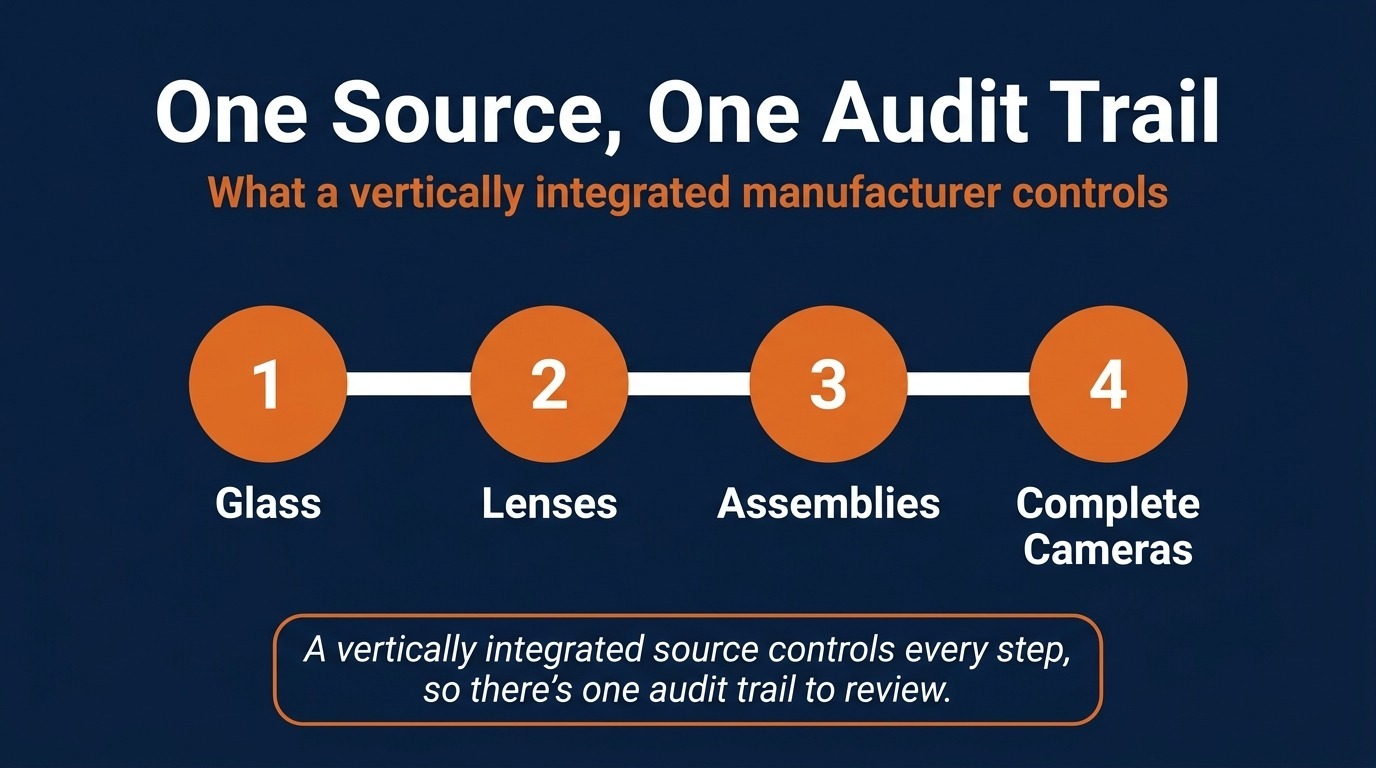
- Vertically integrated suppliers that control glass, lenses, assemblies, and cameras give you one compliance audit trail instead of several.
- Germanium-free infrared glass reduces exposure to a material that Congress has now restricted from adversary sources.
Qualify your optics source at the same time you qualify your sensor, not after.
IR optics for defense and aerospace come from component fabricators, catalog camera makers, and a smaller group of vertically integrated manufacturers that also make the infrared glass. If you're asking which vendors supply IR optics for defense and aerospace, the better question is which ones can document compliance through production.
Section 834 of the FY2026 NDAA, signed December 18, 2025, directs the Defense Department to eliminate reliance on covered nations for optical glass and optical systems by January 1, 2030. Those nations are China, Russia, Iran, North Korea, and Belarus, and an interim progress report is due to Congress by March 15, 2027. As a vertically integrated infrared optics manufacturer making glass since before that law existed, we answer the question with documents.
Which Vendors Supply IR Optics for Defense and Aerospace Programs Today?
Defense optronics suppliers fall into three groups, and for NDAA-sensitive programs, the lowest risk group is the one that makes its own glass. Each type can be the right fit, but they carry very different sourcing and integration risks for advanced tactical imaging systems.
|
Supplier Type |
What They Deliver |
What to Verify |
|
Component fabricators |
Lenses, windows, and coatings built to your print |
Origin of the raw optical material |
|
Catalog camera makers |
Standard camera cores and modules |
Flexibility for custom platform constraints |
|
Vertically integrated manufacturers |
Glass, lenses, assemblies, and complete cameras |
Capacity and domestic manufacturing footprint |
Component shops often buy the glass itself on the open market, and catalog cameras rarely flex around your SWaP envelope. A vertically integrated source controls every step, so there's one audit trail to review.
What Should an IR Optics Defense Supplier Prove Before Qualification?
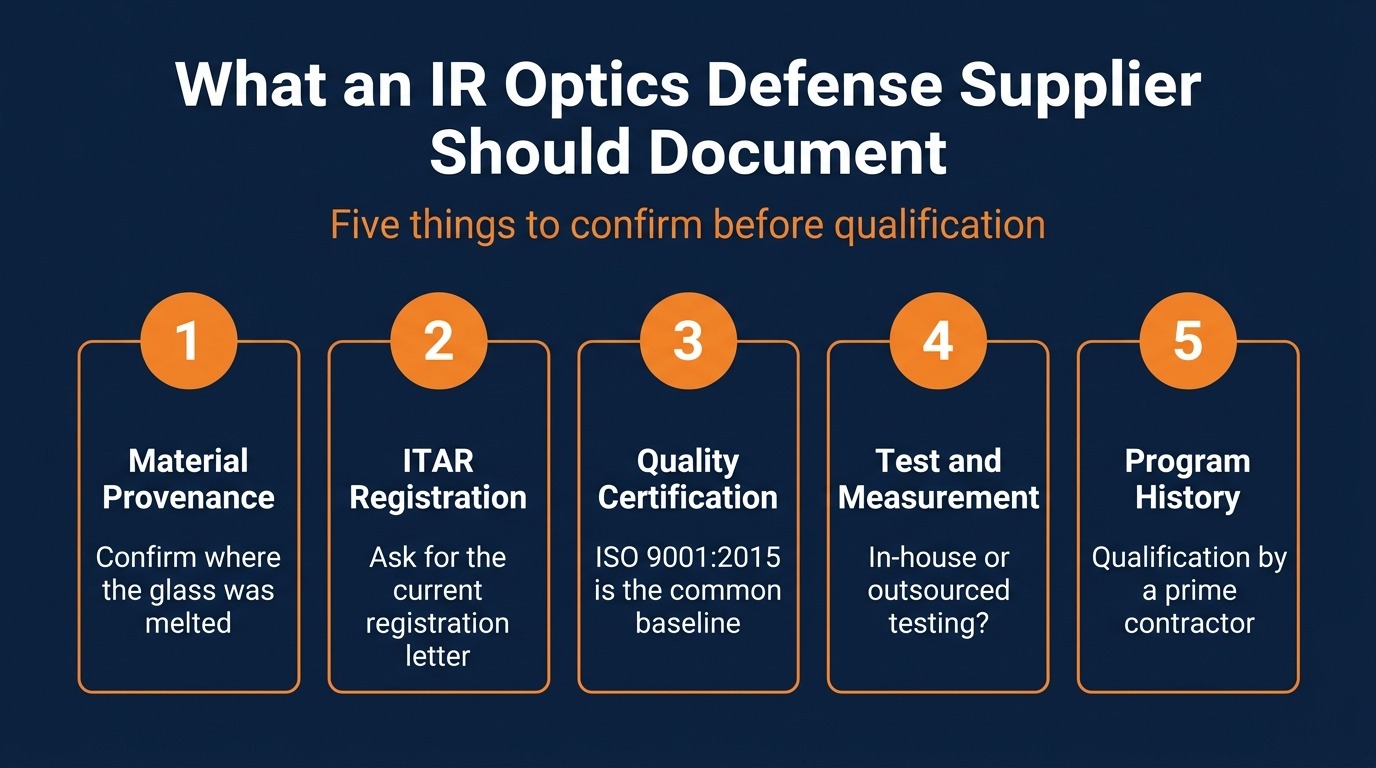
An IR optics defense supplier should document five things before qualification: material provenance, ITAR registration, a certified quality system, in-house test capability, and prime-level program history.
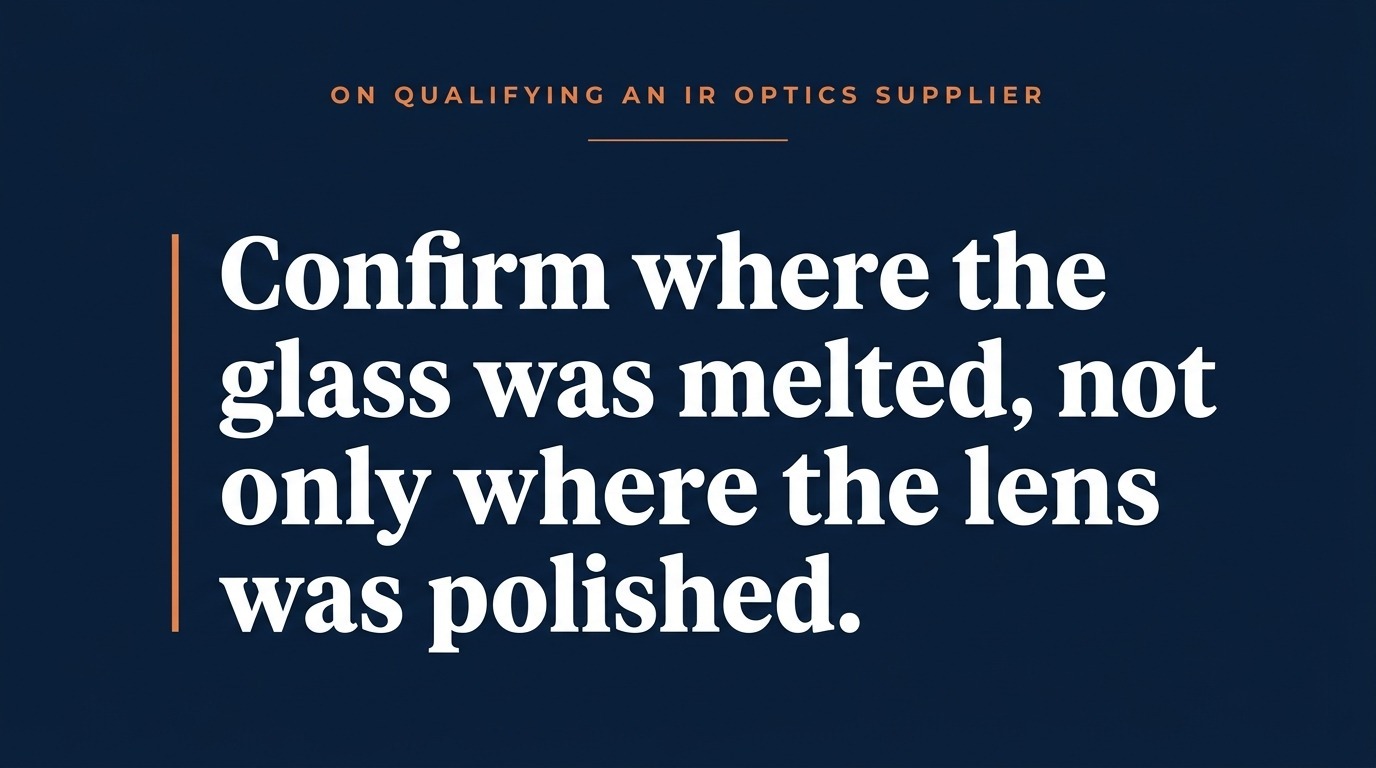
- Material provenance. Confirm where the glass was melted, not only where the lens was polished. The FY2026 NDAA also adds germanium to restricted strategic materials that can't come from adversary nations.
- ITAR registration. Federal rules state that a manufacturer of defense articles must register even if it never exports. Ask for the current registration letter.
- Quality certification. ISO 9001:2015 is the common baseline. Our current certificates, ITAR letter, and conflict minerals statement are posted on our certifications and compliance page.
- Test and measurement capability. If you're evaluating an optical systems measurement solution for defense programs, ask whether performance and environmental testing happens in-house or is outsourced.
- Program history. Qualification by a prime contractor tells you more than any datasheet.
For a deeper look at the regulation itself, read NDAA Compliance and Readiness for Optical and Infrared Systems.
Where Do Our Infrared Optics and Cameras Serve Defense Programs?
Our optics and cameras serve airborne and missile, persistent surveillance, and naval and ground programs, with published qualifications and orders behind each. Here's what that looks like by platform.
Airborne and Missile Platforms
For airborne and missile programs, we supply SWaP-optimized cameras with lenses and cores matched as one system. In July 2024, our advanced thermal camera system passed qualification with Lockheed Martin as part of a U.S. Army missile program bid, which moved the work to flightworthy hardware. Matching the lens to the core in-house also shortens lead times because you aren't coordinating two vendors.
Persistent Surveillance and Border Security
For towers, perimeters, and tactical drones, we supply cooled long-range cameras and uncooled cameras with true shutterless operation, so the feed doesn't pause for calibration. Most persistent surveillance programs use LWIR (8 to 14 µm) for ambient-temperature targets, while MWIR (3 to 5 µm) is often favored for long-range detection and hot targets. In February 2026, an existing defense customer placed a repeat purchase order for our cooled infrared cameras for defense and security use, with production split between our Florida and New Hampshire facilities.
Thermal imaging performs well in darkness, smoke, and many low-visibility environments, though heavy rain and direct sunlight can reduce contrast. We'll help you plan for those limits. If your surveillance payload rides on an unmanned platform, our drone and UAV thermal imaging page covers airframe-specific integration.
Naval and Ground Platforms
For naval and ground platforms, we supply cooled infrared cameras and cold-shield-efficient optical designs packaged for salt, shock, and constant vibration. In April 2025, L3Harris awarded us an initial $2.2 million engineering development model order for infrared cameras supporting the U.S. Navy's Shipboard Panoramic Electro-Optic/Infrared (SPEIR) program. Ground vehicle programs draw on the same optical designs and ruggedized packaging.
How Does Our Supply Chain Posture Compare to Program Requirements?
We meet each core sourcing requirement with documentation you can review before a purchase order. Here's how we map to what an IR optics defense supplier should show.
|
Requirement |
Our Position |
|
Covered-nation optical glass |
Proprietary BlackDiamond chalcogenide infrared glass, melted at our Florida facility |
|
Glass capacity |
Up to 10 metric tons per year, in diameters up to 120 mm, per our in-house optical manufacturing capabilities |
|
Material licensing |
Exclusive license, secured in 2021, from the U.S. Naval Research Laboratory for a new class of chalcogenide glasses |
|
Germanium dependence |
Germanium-free optics already qualified by an existing defense customer |
|
Domestic production |
Defense camera production in Florida and New Hampshire, plus a second domestic glass-melting site |
|
Export control |
Current ITAR registration |
|
Quality system |
ISO 9001:2015 certified |
|
Product breadth |
Materials, thermal imaging lens assemblies, and cooled and uncooled cameras |
When requirements shift mid-program, you won't need to requalify a new vendor for every layer of advanced tactical imaging systems.
Frequently Asked Questions
Which vendors supply IR optics for defense and aerospace with a domestic source?
Several domestic fabricators and a smaller group of vertically integrated manufacturers do. The key difference is whether the vendor also produces the infrared glass, since the NDAA's optical glass provision reaches the material itself.
Is ITAR registration the same as export authorization?
No. Registration tells the government who manufactures or exports defense articles, but it doesn't grant export rights. Exports still need separate licenses or approvals.
Do you supply standard parts or only custom builds?
Both. We offer standard IR lens assemblies alongside custom optics and cameras designed to your platform, from prototype through production.
Should we choose cooled or uncooled cameras?
It depends on range and SWaP. Cooled cameras suit long-range ISR and targeting, while uncooled cameras suit SWaP-limited and continuous-coverage missions.
Can germanium-free optics match defense performance requirements?
In many LWIR and broadband designs, chalcogenide glass is a practical alternative. Qualification should confirm performance for your specific waveband and environment.
Start Your Supplier Qualification Conversation
The best time to lock in a compliant IR optics defense supplier is before your design freezes, when changes are cheap and defense optronics decisions are still open. LightPath has built optics since 1985 and brings proprietary glass and in-house manufacturing to programs that can't afford a sourcing surprise. Talk with our defense program team to request qualification documents and start scoping your system.