

The right infrared drone camera is matched to your mission, not the one with the longest spec sheet.
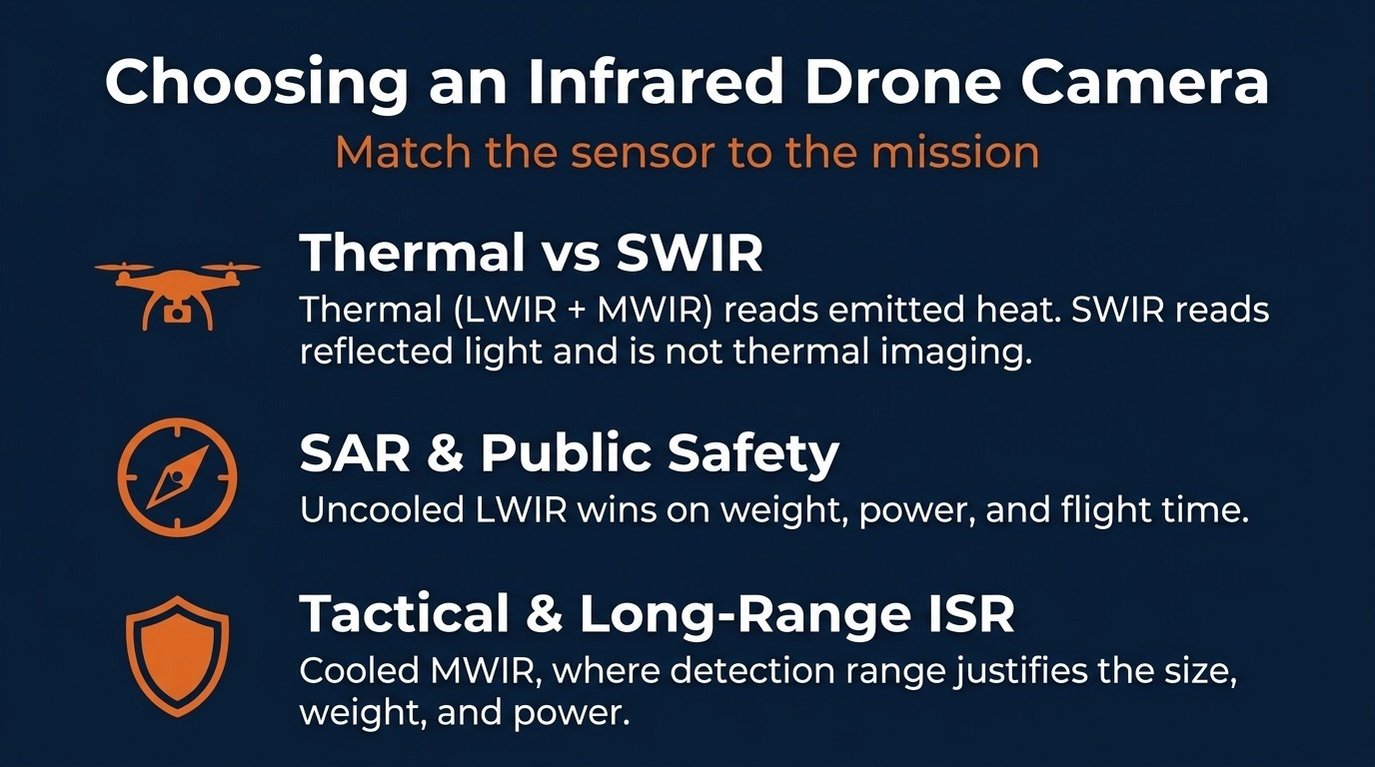
- Thermal sensors (LWIR and MWIR) read emitted heat and work in darkness, smoke, and light fog. SWIR reads reflected light and is not thermal imaging, so the two solve different problems.
- For most search-and-rescue and public-safety drones, uncooled long-wave infrared wins on weight, power, and flight time.
- Tactical and long-range ISR programs lean toward cooled mid-wave infrared, where detection range justifies the added size, weight, and power.
- Sensor band, platform SWaP, integration path, and supply chain all shape the decision before resolution ever enters the conversation.
Start with the mission and the platform, then let those constraints narrow the band and architecture before you compare individual cameras.
Choosing an infrared drone camera looks simple until you realize the term covers several very different technologies, each suited to a different job. A camera tuned to find a missing hiker at night runs on different physics than one tracking a small drone at the edge of a perimeter.
According to a national public-safety communications study, the share of respondents expecting to use drones and robotics daily is set to climb from 15% today to 48% within 5 years. That growth is pulling drone OEMs, public safety buyers, and defense integrators into sensor decisions they didn't have to make a few years ago. The teams building integrated infrared imaging solutions for these platforms know that the sensor decides whether the mission succeeds.
This guide walks through how thermal and SWIR sensors differ, which infrared band fits which mission, and what factors belong in a drone infrared camera comparison before you commit to a design.
What Is an Infrared Drone Camera, and Why Does the Sensor Decide the Mission?
An infrared drone camera is an imaging payload that detects infrared energy instead of visible light, mounted on an unmanned platform to see what the human eye and standard cameras cannot. "Infrared" is a wide slice of the spectrum, and the sensors inside these payloads don't all work the same way. Some read the heat that objects give off. Others read infrared light that bounces off surfaces, much the way a regular camera reads visible light.
This distinction matters most to the people specifying and building these systems: drone OEMs designing payloads, public safety procurement teams writing requirements, and defense integrators fitting sensors into larger platforms. If you operate a finished drone, the manufacturer has already made these choices for you. If you build the product, the choice is yours, and it shapes everything downstream.
Two families dominate. Thermal imaging, which includes long-wave infrared systems and cooled mid-wave infrared cameras, detects emitted heat and needs no external light. Short-wave infrared, or SWIR, sits within the infrared spectrum but detects reflected light and is not thermal imaging. Treating the two as interchangeable is the most common and most expensive mistake in sensor selection.
Thermal vs SWIR Drone Sensors: What's the Difference?
Thermal vs SWIR drone questions often come up in procurement because both fall under the "infrared" umbrella, so buyers assume they compete head-to-head. They rarely do. They answer different questions about a scene, and the better way to frame it is to figure out which question your mission is actually asking.
How Thermal Sensors See Heat
Thermal sensors detect the infrared energy that every object above absolute zero emits. Because they read emitted heat rather than reflected light, they work in complete darkness and hold up in smoke, haze, and light fog. That passive operation is why thermal dominates missions where you need to find a warm body against a cooler background. A person, a running engine, or a recently parked vehicle all stand out clearly. For most aerial work, this band "sees in the dark" without any help, which is exactly what a SAR or surveillance drone IR camera needs to do.
How SWIR Sensors See Reflected Light
SWIR sensors work differently. They detect short-wave infrared light reflecting off surfaces, which makes them behave much more like a visible-light camera than a heat camera. SWIR needs an illumination source, whether natural starlight or an active laser, and it can't measure temperature. Where it shines is cutting through certain atmospheric haze and reading detail, labels, and materials that thermal cannot resolve.
|
Attribute |
Thermal (LWIR / MWIR) |
SWIR |
|
What it detects |
Emitted heat |
Reflected IR light |
|
Works in total darkness |
Yes, passively |
Needs illumination |
|
Measures temperature |
Yes |
No |
|
Strong in smoke and light fog |
Yes |
Limited |
|
Typical drone use |
Finding people, vehicles, heat sources |
Material ID, haze penetration, fine detail |
Which Infrared Band Should You Build Your Drone Around?
Once you have settled on thermal imaging for a mission, you still face a band decision: long-wave or mid-wave, and in some cases a broadband sensor that spans both. Each carries real trade-offs in cost, weight, power, and range, and the right answer depends on what your drone needs to do and how it flies.
Long-Wave Infrared (LWIR): The Drone Workhorse
Long-wave infrared operates in the 8–14 µm range and detects the heat that people, vehicles, and machinery emit at ambient temperatures. LWIR sensors are uncooled, which keeps them lightweight, low-power, and largely maintenance-free. For a drone, that combination is decisive: less weight and lower draw mean longer flights and simpler integration. Uncooled LWIR is the default for the majority of SAR, public safety, and surveillance drones, which is why it leads the largest segment of the infrared imaging market.
Mid-Wave Infrared (MWIR): Reach and High-Heat Targets
Mid-wave infrared operates in the 3–5 µm range and typically requires a cooled detector. Cooling adds size, weight, power, and a mechanical component that needs occasional service, so MWIR is not a casual choice. What you get in return is greater sensitivity, longer detection range, and stronger performance against high-temperature targets and in humid conditions. For long-range ISR, precision targeting, or counter-drone work where reach justifies the added complexity, an IR camera for drone use built on MWIR earns its place.
Broadband Infrared (BBIR): Multi-Mission Flexibility
Broadband infrared is a legitimate category in its own right, covering roughly 2–12 µm for drone imaging systems and capturing energy across more than one band. BBIR suits multi-mission platforms that can't afford to swap payloads between sorties, or programs that need both subtle thermal signatures and very hot targets in the same frame. It's a flexibility play rather than a single-band optimization. Specifying a broadband IR camera for drone use makes sense when one platform has to cover a wider range of scenarios in a single flight.

How Do You Match a Drone IR Camera to SAR, Public Safety, and Tactical Missions?
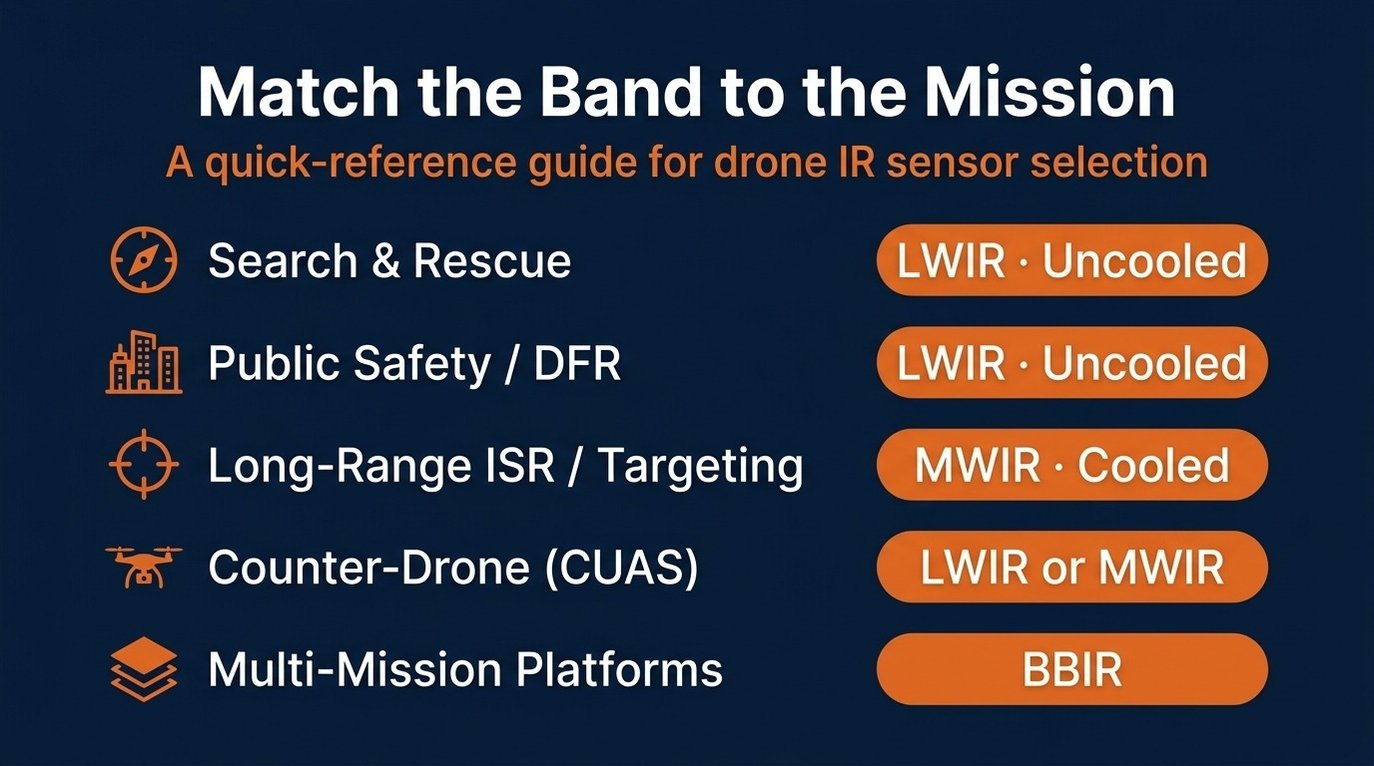
The cleanest way to choose is to start from the mission because each one weights the trade-offs differently. A drone IR camera that is perfect for a county search-and-rescue team can be the wrong call for a border surveillance program, even though both are "infrared." Here is how the three big mission categories tend to break down.
Search and Rescue (SAR)
SAR relies on time aloft and fast human detection. Crews need to quickly put eyes on a heat signature, often at night or in terrain where ground search is slow and dangerous. Uncooled LWIR fits well here because it maximizes flight time and picks out warm bodies against cooler ground, fog, or canopy. Weight and cost matter more than extreme range, since SAR drones usually fly low over a defined search area. Our deeper look at thermal cameras for search and rescue covers how teams balance these priorities.
Public Safety and Drone-as-First-Responder Programs
Cities are establishing drone-as-first-responder programs that launch a drone to a 911 call before officers arrive, and adoption is spreading across the U.S. These missions value rapid launch, wide situational awareness, and reliable thermal detection day or night. Uncooled LWIR tends to win on flight time and cost, though agencies running longer perimeter or overwatch missions sometimes step up to higher-sensitivity systems. The federal effort to standardize first-responder drone operations, including NIST first-responder UAS programs, is making procurement requirements more consistent for the IR drone camera buyers writing them.
Tactical and Defense Operations
Tactical and defense missions are where the decision shifts toward cooled systems. Long-range ISR, precision targeting, and counter-drone detection often need to identify small or distant targets that uncooled sensors can't resolve at range. Here, the size, weight, and power penalty of cooled MWIR is acceptable because detection range is the whole point. Integrators building these platforms also weigh export considerations and supply chain security more heavily, since defense programs carry compliance requirements that commercial work does not.
|
Mission |
Recommended band |
Architecture |
Top priority |
|
Search and rescue |
LWIR |
Uncooled |
Flight time and fast detection |
|
Public safety / DFR |
LWIR |
Uncooled |
Rapid launch and cost |
|
Long-range ISR / targeting |
MWIR |
Cooled |
Detection range |
|
Counter-drone (CUAS) |
LWIR or MWIR |
Mission-dependent |
Small-target detection |
|
Multi-mission platforms |
BBIR |
Cooled or uncooled |
Spectral flexibility |
7 Factors to Weigh When Comparing Infrared Drone Cameras
Spec sheets invite apples-to-oranges decisions. A useful drone infrared camera comparison starts with how the camera will live on your platform and in your program. These seven factors tend to decide the outcome:
- Mission profile. Define what you need to detect, at what range, and in what conditions, before anything else. The mission sets the band, and the band sets most of the rest.
- Platform SWaP. Weight, size, and power draw cap what your drone can carry and how long it can stay up. Cooled systems cost you on all three.
- Detection range versus endurance. More range usually means more weight and power, which means less time aloft. Pick the side your mission actually needs.
- Resolution and field of view. Higher resolution helps identify targets farther out, while a wider field of view can find them faster. Balance the two for your altitude and search pattern.
- Integration path. Gimbal fit, data interfaces, and software compatibility decide how quickly you reach a working payload. A sensor that fights your architecture can cost you months.
- Supply chain and materials. Germanium shortages have pushed many programs toward chalcogenide-glass alternatives and vertically integrated suppliers that can secure materials, lenses, and assemblies from one source.
- Compliance and export. Frame rates above 9 Hz can trigger export-control considerations under ITAR and EAR, and defense programs add NDAA and domestic-sourcing requirements. Factor these in early, not after design freeze.
For a structured walk-through of these trade-offs, our drone sensor evaluation guide for OEMs is a good next step, and the broader drone and UAV imaging payloads overview maps how each band fits specific platforms.
Frequently Asked Questions
Is an infrared drone camera the same as a thermal camera?
Not always. Every thermal camera is an infrared camera, but not every infrared camera is thermal. Thermal imaging (LWIR and MWIR) detects emitted heat, while SWIR detects reflected infrared light and does not measure temperature. When a mission calls for finding warm bodies in the dark, you want thermal.
For a thermal vs SWIR drone decision, which is better for search and rescue?
For SAR, thermal imaging is almost always the answer. You are looking for a person's heat signature against a cooler background, often at night, and only thermal reads emitted heat passively. SWIR can add detail in a multi-sensor payload, but it should not be the primary SAR sensor.
Should I choose cooled MWIR or uncooled LWIR for my drone?
Start with the mission. Uncooled LWIR fits most SAR, public safety, and surveillance drones because it's lighter, lower power, and longer flying. Cooled MWIR makes sense when you need a long detection range or high-temperature target sensitivity and can absorb the added size, weight, and power.
What spectral ranges do these infrared bands cover?
LWIR operates in the 8–14 µm range and MWIR in the 3–5 µm range. Broadband infrared for drone imaging systems spans roughly 2–12 µm. SWIR sits at much shorter wavelengths and behaves more like reflected-light imaging than heat detection.
Do export controls affect infrared drone camera selection?
They can. Thermal systems with frame rates above 9 Hz may fall under ITAR or EAR export controls, and defense programs often add NDAA compliance and domestic-sourcing requirements. Confirm the regulatory picture early, since it can shape which IR drone camera options are even available to your program.
Ready to Spec the Right Infrared Payload for Your Drone?
The best sensor decision is the one made early with the mission, the platform, and the supply chain all on the table at once. Lock the band before you compare cameras, and let your flight profile and integration constraints do the narrowing. That discipline saves redesigns later.
Look for a partner who can take you from material to lens assembly to a finished cooled or uncooled module. LightPath builds vertically integrated infrared imaging systems with germanium-free Black Diamond™ glass and domestic manufacturing built in. Reach out to the LightPath team to talk through your platform and find the right infrared drone camera for your mission.