

Choosing a drone thermal camera is an architecture decision that shapes your entire platform, so the right starting point is mission profile rather than a spec sheet ranking.
- Four system architectures cover nearly every UAV program: compact uncooled LWIR, stabilized LWIR gimbals, cooled MWIR, and broadband multi-mission systems.
- SWaP is the first filter. Weight and power budgets eliminate most options before performance comparison even starts.
- Compliance is a gate, not a feature. Component-level sourcing and country-of-origin documentation now decide which systems are eligible for federal and defense work.
- Supplier structure matters as much as sensor choice. Who controls the optics determines how fast you can customize and how exposed you are to supply disruption.
Start your evaluation by writing down the detection range and endurance your mission actually requires, then work backward. That single step eliminates most of the market for you.
Buyers evaluating a drone thermal camera today face a market built almost entirely for the wrong customer. Most published comparisons rank finished consumer and enterprise drones by price and flight time, which is useful if you are purchasing a platform off the shelf. It is close to useless if you are an OEM designing a UAV and need to specify the imaging payload that will define what your platform can do. Demand on the program side keeps climbing: Congress provided $512.8 million for Army small UAS procurement and development in the DOD Appropriations Act, 2026, and every one of those platforms carries an imaging decision that somebody has to make.
This guide takes the OEM view. It compares the thermal imaging system architectures that show up in real UAV programs, explains where each one fits, and lays out the questions that separate a payload decision you can defend from one that unravels during qualification testing. The comparison stays at the system level on purpose, because the spec sheet arguments that dominate procurement conversations usually matter least.
What Makes a Drone Thermal Camera "Best" for a UAV Program?
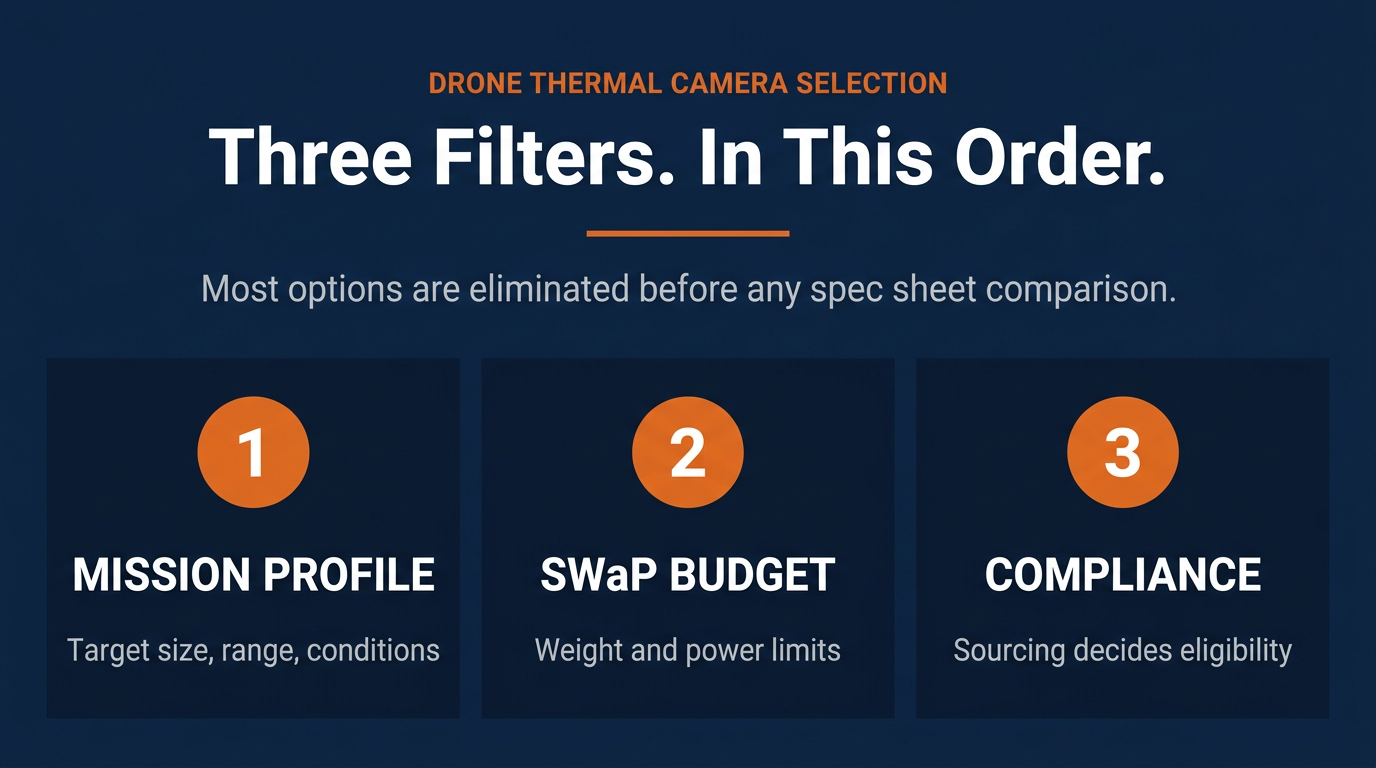
There is no universally best drone thermal camera, and any comparison that claims otherwise is selling something. The right system is the one that satisfies your detection requirement inside your platform's physical constraints while clearing whatever compliance regime your customer operates under. Three filters do most of the work.
Mission Profile Comes Before Specifications
A search and rescue platform scanning a hillside at 400 feet and a counter-UAS system tracking a small aircraft at three kilometers are solving different physics problems. The first needs wide-area coverage and useful imagery in fog and darkness. The second needs the thermal sensitivity to separate a small, cool target from background clutter at long standoff. Writing down the target size, the range, and the atmospheric conditions your platform will actually operate in narrows the field faster than any feature matrix.
The Platform Sets the Budget
Size, weight, and power are not negotiable on an aerial platform, and they constrain a drone thermal camera more tightly than almost any other subsystem. Every gram of payload displaces battery capacity, and every watt drawn shortens the mission. A cooled system that delivers exceptional range performance while cutting your endurance below the mission requirement has not solved your problem. This is why experienced program teams treat SWaP as the opening filter in any UAV thermal camera comparison rather than a constraint to reconcile later.
Compliance Is a Gate, Not a Feature
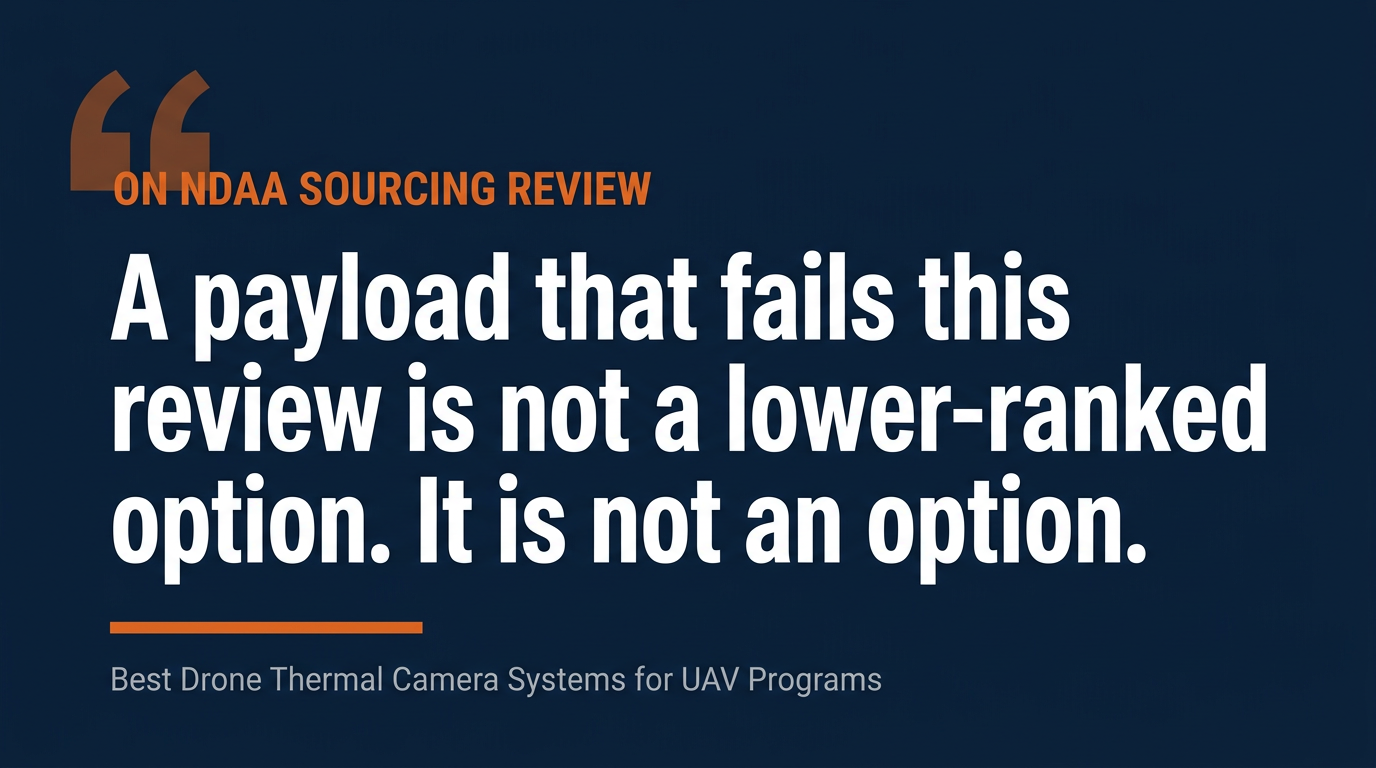
For programs touching federal money or defense customers, sourcing rules determine eligibility before performance ever enters the conversation. The Defense Innovation Unit's assessment process reviews supply chain provenance and component-level sourcing, including country-of-origin documentation, when evaluating platforms and components. A payload that fails this review is not a lower-ranked option. It is not an option.
How Do Drone Thermal Camera Architectures Compare?
Any useful UAV thermal camera comparison starts here, because most UAV programs land on one of four architectures. The table below frames the tradeoffs at the level that matters for platform planning, and the sections that follow expand on where each one earns its place.
|
Architecture |
Spectral band |
Typical fit |
Primary tradeoff |
|---|---|---|---|
|
Compact uncooled |
LWIR, 8–14 µm |
Small tactical and inspection UAVs |
Lowest SWaP, shorter detection range |
|
Stabilized uncooled gimbal |
LWIR, 8–14 µm |
Surveillance, SAR, security patrol |
Added weight for pointing stability |
|
Cooled |
MWIR, 3–5 µm |
Long-range ISR, targeting, CUAS |
Highest sensitivity, significant power draw and cooldown time |
|
Broadband |
2–12 µm for drone systems |
Mixed-mission and multi-spectral platforms |
Wider capability, more complex optical design |
Two points get lost in most published comparisons. First, resolution predicts field performance less reliably than the optics in front of the sensor, and a well-matched lens assembly on a moderate detector routinely outperforms a higher-resolution sensor behind mediocre glass. Second, thermal imaging has real limits. It performs well in darkness, smoke, haze, and light fog, and degrades in heavy rain, dense spray, and against high-radiance backgrounds. Any comparison of drone thermal imaging systems that implies all-condition performance should be treated with skepticism.
Which Drone Thermal Camera Fits Your Program? Five System Profiles
Rather than rank products, it is more useful to rank profiles. These five drone thermal imaging systems cover the large majority of defense and industrial UAV programs.
- Compact uncooled LWIR for small platforms. The workhorse of the category. Lightweight, low-power, and suitable for platforms where every gram counts. Best for close-range inspection, agricultural survey, and small tactical reconnaissance where detection range is not the binding constraint.
- Stabilized LWIR gimbal for persistent surveillance. Two- or three-axis stabilization costs weight but transforms usable imagery at altitude and in wind. This is the default for security patrol, border monitoring, and search and rescue, where operators need to hold a target while the aircraft moves.
- Cooled MWIR for long-range detection. The right answer when standoff distance drives the mission. Cooled systems deliver the thermal sensitivity that extended-range ISR programs require, at the cost of a cryocooler, meaningful power draw, and cooldown time. These belong on larger platforms with the lift and electrical budget to support them.
- Broadband systems for mixed-mission platforms. When a single airframe has to serve several roles, broader spectral coverage reduces the need for swappable payloads. This suits programs where the operator cannot predict which mission the aircraft will fly on a given day.
- Custom-engineered systems for program-specific requirements. When gimbal envelope, interface protocol, or detection requirement falls outside what catalog products address, a purpose-built drone thermal camera is often faster and cheaper than forcing a stock product to fit. Programs that discover this late usually pay for it twice.
What Separates Defense and Industrial UAV Requirements?
A defense drone thermal camera and an industrial drone thermal camera can share detector technology and still be entirely different products by the time they reach qualification. The divergence starts with what the customer is willing to accept.
|
Consideration |
Defense programs |
Industrial programs |
|---|---|---|
|
Primary driver |
Detection range and target discrimination |
Measurement consistency and uptime |
|
Environmental spec |
Military standards, wide temperature range, shock and vibration |
Site-specific, often continuous duty |
|
Compliance gate |
NDAA sourcing, export classification |
Site safety and sector regulation |
|
Procurement horizon |
Multi-year program cycles |
Faster commercial timelines |
|
Customization tolerance |
High, expected |
Moderate, cost-sensitive |
Where Defense Programs Concentrate Their Risk
Teams specifying a defense drone thermal camera are usually working against a threat that is getting harder to see. Counter-UAS applications in particular demand systems that can separate a small drone from birds and thermal clutter, which depends far more on optical design and image processing than on raw pixel count. Programs supporting aerospace and defense imaging requirements also carry export and sourcing obligations that shape the supplier list before technical evaluation begins.
Where Industrial Programs Concentrate Theirs
Teams specifying an industrial drone thermal camera are designing for customers who care above all about repeatability. A leak detection or predictive maintenance workflow depends on the system returning comparable data across flights and seasons. Regulatory movement is expanding this market: the FAA's proposed framework for beyond visual line of sight operations is intended to provide a clearer pathway for routine, scalable UAS operations including aerial surveying and inspection. Platforms built for industrial thermal imaging applications with longer autonomous missions in mind will need payloads specified accordingly.
How Should OEM Teams Evaluate Suppliers?
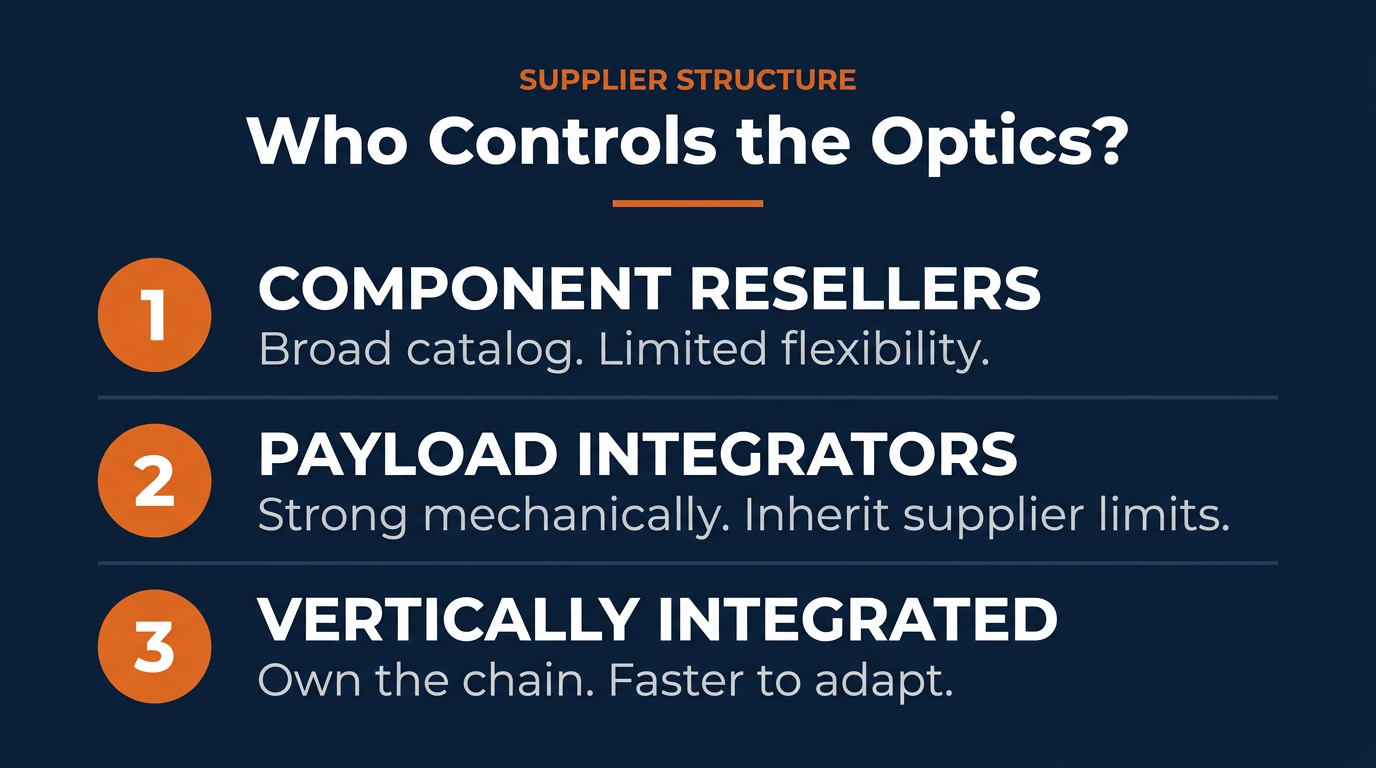
A UAV thermal camera comparison that stops at hardware misses half the picture. Once you know which architecture you need, supplier structure becomes the deciding variable. Three types exist, and the differences show up under pressure.
Component resellers aggregate cores and modules from multiple sources. They offer breadth and speed on standard configurations, with limited ability to adapt when your requirement shifts.
Gimbal and payload integrators package third-party sensors into stabilized assemblies. Strong on mechanical integration, though they inherit whatever constraints and lead times their sensor suppliers impose.
Vertically integrated manufacturers control the chain from optical materials through finished camera assemblies. This structure supports faster customization, tighter optical matching, and clearer sourcing documentation, which matters when a compliance review asks where each component came from. For teams working through drone payload integration decisions, this distinction often determines whether a schedule holds.
The practical test is simple. Ask a prospective supplier what happens if your detection requirement changes by twenty percent after design review. The answer tells you more than any datasheet.
Frequently Asked Questions
What is the best drone thermal camera for defense UAV programs?
There is no single answer, because a defense drone thermal camera is specified against detection range requirements that vary enormously across missions. Cooled MWIR systems generally serve long-range ISR and targeting programs, while stabilized uncooled LWIR systems serve surveillance, CUAS, and search and rescue applications where payload efficiency matters more than maximum standoff.
How much does a thermal payload weigh on a typical UAV?
It varies widely by architecture. Compact uncooled systems are the lightest option and suit small platforms, while cooled systems are substantially heavier and require larger airframes with the electrical capacity to support a cryocooler.
Does NDAA compliance apply to camera components or only to the drone?
It reaches component-level sourcing. Compliance assessments review supply chain provenance and country-of-origin documentation across relevant components, so the imaging payload is squarely in scope for programs pursuing federal eligibility.
Should we choose LWIR or MWIR for an industrial drone thermal camera?
Most industrial inspection and monitoring applications are well served by LWIR, which offers a strong balance of sensitivity, size, and power draw. MWIR becomes relevant when the application involves higher-temperature targets or requires longer detection range.
When does a custom system make more sense than a catalog product?
When platform constraints, interface requirements, or detection specs fall outside what standard products address. Forcing a stock product into a poor fit surfaces later as integration cost, schedule slip, or field performance gaps.
Pressure-Test Your Payload Decision Before You Commit
The best drone thermal camera for your program is the one that clears your detection requirement, fits your platform's SWaP budget, and satisfies your customer's sourcing rules. Getting that alignment right early is far cheaper than discovering a mismatch during qualification.
LightPath Technologies designs and manufactures complete drone thermal imaging systems for OEMs and system integrators, from proprietary Black Diamond chalcogenide glass through finished cooled and uncooled camera assemblies, with domestic manufacturing and vertically integrated supply chain control. If you are specifying a payload or reworking one that is not meeting requirements, connect with our engineering team to pressure-test the decision against your actual platform constraints.