

The purchase order for a thermal camera system describes a fraction of what your program will actually spend on it.
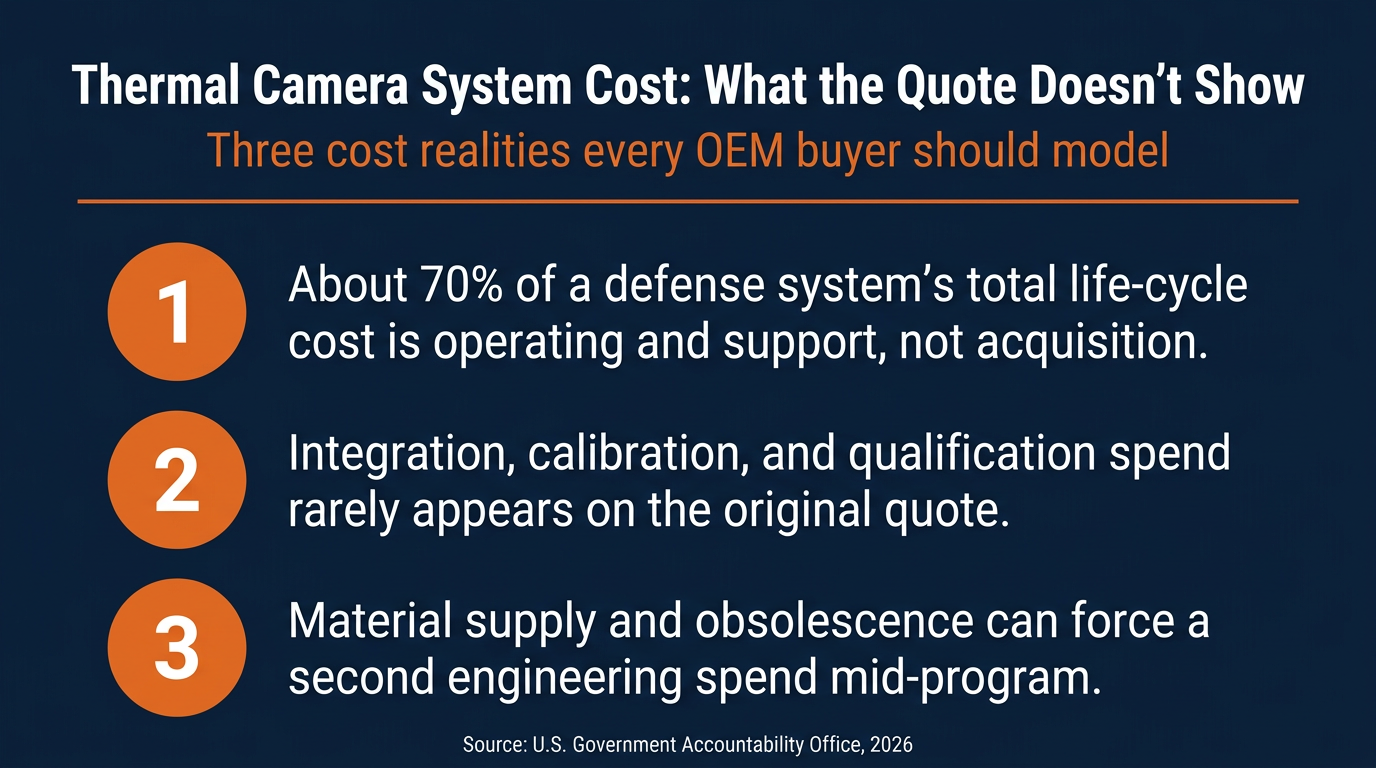
- Sustainment dominates. Federal cost data puts operating and support at roughly 70 percent of a defense system's total life-cycle cost, a pattern worth testing against your own program assumptions.
- Integration is the quiet budget killer. Engineering hours, calibration, and environmental qualification routinely consume spend that never appeared on the original quote.
- Material sourcing is now a cost variable. Infrared-grade germanium has been subject to export restrictions and steep price movement, which flows straight into your bill of materials.
- Obsolescence forces a second spend. A supplier discontinuation mid-program can put you back into a design refresh you already paid for once.
Model thermal camera system cost across the full program life before you compare quotes, because the lowest unit price is frequently the most expensive decision on the table.
Procurement teams evaluating thermal camera system cost tend to start with the same artifact: a quote with a unit price and a lead time. It's a reasonable place to begin and a terrible place to stop. The Government Accountability Office reports that operating and support spending accounts for roughly 70 percent of a system's total life-cycle cost, which means the number on your quote is describing a minority of the actual financial commitment. If you're specifying infrared imaging solutions into a platform your company will build, sell, and support for the next decade, the quote is a starting coordinate. The rest of the map matters more.
Why Does Thermal Camera System Cost Extend Beyond the Purchase Order?
A thermal camera is a component when you buy one. It becomes a system commitment the moment you design your product around it. That shift is where most cost models break down, because the categories that grow fastest are the ones nobody assigned an owner to during the sourcing phase.
The Quote Is a Snapshot, the Program Is a Commitment
Your quote reflects a single moment: current material pricing, current production capacity, current detector availability. Your program reflects years of production runs, field returns, spares provisioning, and eventual refresh. Anything that shifts across that span, whether supplier ownership, material availability, or regulatory posture, becomes a cost event you absorb. A rigorous view of thermal imaging total cost of ownership treats the quote as one line among many rather than the headline figure.
Where OEM Thermal Camera Cost Actually Accumulates
Once you map spending across a full program, a pattern emerges quickly. Acquisition is visible and easy to budget. Everything downstream is harder to see and considerably larger in aggregate. The table below shows where OEM thermal camera cost typically lands across a platform lifecycle.
|
Cost Category |
When It Hits |
Primary Drivers |
Typically Underestimated? |
|---|---|---|---|
|
Acquisition |
Program start |
Unit price, volume tier, tooling |
No |
|
Integration engineering |
Design through first article |
Interface work, mechanical fit, firmware |
Yes |
|
Qualification and test |
Pre-production |
Environmental testing, retest after failures |
Yes |
|
Calibration and yield |
Production ramp |
Unit-to-unit repeatability, rework |
Yes |
|
Sustainment and spares |
Field deployment |
Repairs, RMA logistics, inventory carry |
Yes |
|
Obsolescence and refresh |
Mid-to-late program |
Last-time buys, redesign, requalification |
Severely |
Stop at the top two rows and your thermal imaging total cost of ownership will understate the program by a wide margin.
What Hidden Costs Show Up After Integration Begins?
Integration is where a favorable thermal imaging system price stops looking like a bargain. The component arrived on budget. The program didn't. Three categories account for most of that drift, and all three are predictable if you know to ask.
Engineering Hours You Did Not Budget
Every interface mismatch between a thermal module and your platform gets resolved by an engineer on your payroll. Mechanical envelope adjustments, thermal management rework, power sequencing, and image pipeline tuning all consume design cycles. When a supplier delivers a component rather than a configured system, that gap transfers to your team, and programs that price only the hardware can find internal engineering labor rivals it.
Calibration and Repeatability Across Production Units
A single evaluation unit performing well tells you little about what unit four hundred will do. Production consistency is an economic question before a technical one, because every unit outside spec becomes rework, scrap, or a warranty claim. Suppliers that control optics, coatings, and assembly under one roof have more levers to hold that consistency, which shows up in your yield numbers rather than your quote.
Documentation and Environmental Qualification
Environmental qualification is expensive in both dollars and calendar time. The Institute of Environmental Sciences and Technology notes that comprehensive qualification testing demands significant resources and that unanticipated damage during vibration and shock testing can force costly repairs and schedule delays. Compliance documentation adds a further labor line that most cost models omit entirely. Any credible thermal camera TCO estimate should carry a qualification contingency rather than a single optimistic pass-through figure.
How Does Supply Chain Risk Change Thermal Camera Lifecycle Cost?
Material availability moved from a background assumption to an active line item over the past few years, and infrared optics sit near the center of that shift. Germanium is a primary material in conventional infrared lens design, and its supply picture has changed considerably.
According to the U.S. Geological Survey's mineral commodity assessment, China banned all germanium exports to the United States in December 2024, and the annual average price of germanium metal climbed from roughly $1,392 per kilogram in 2023 to an estimated $2,100 per kilogram in 2024. The same assessment identifies chalcogenide glass as an established substitute for germanium in infrared applications. For an OEM, that is a straightforward risk calculation: a platform designed around a constrained material carries a different thermal camera lifecycle cost than one designed around an alternative with a stable domestic supply.
Supply assurance also affects cost through schedule. A material shortage that delays production carries downstream costs in missed delivery windows and contractual penalties that no bill of materials captures. Factoring sourcing risk into your thermal camera TCO model is less about predicting the next disruption and more about knowing which designs can absorb one. Reviewing OEM integration requirements early clarifies where that flexibility exists.
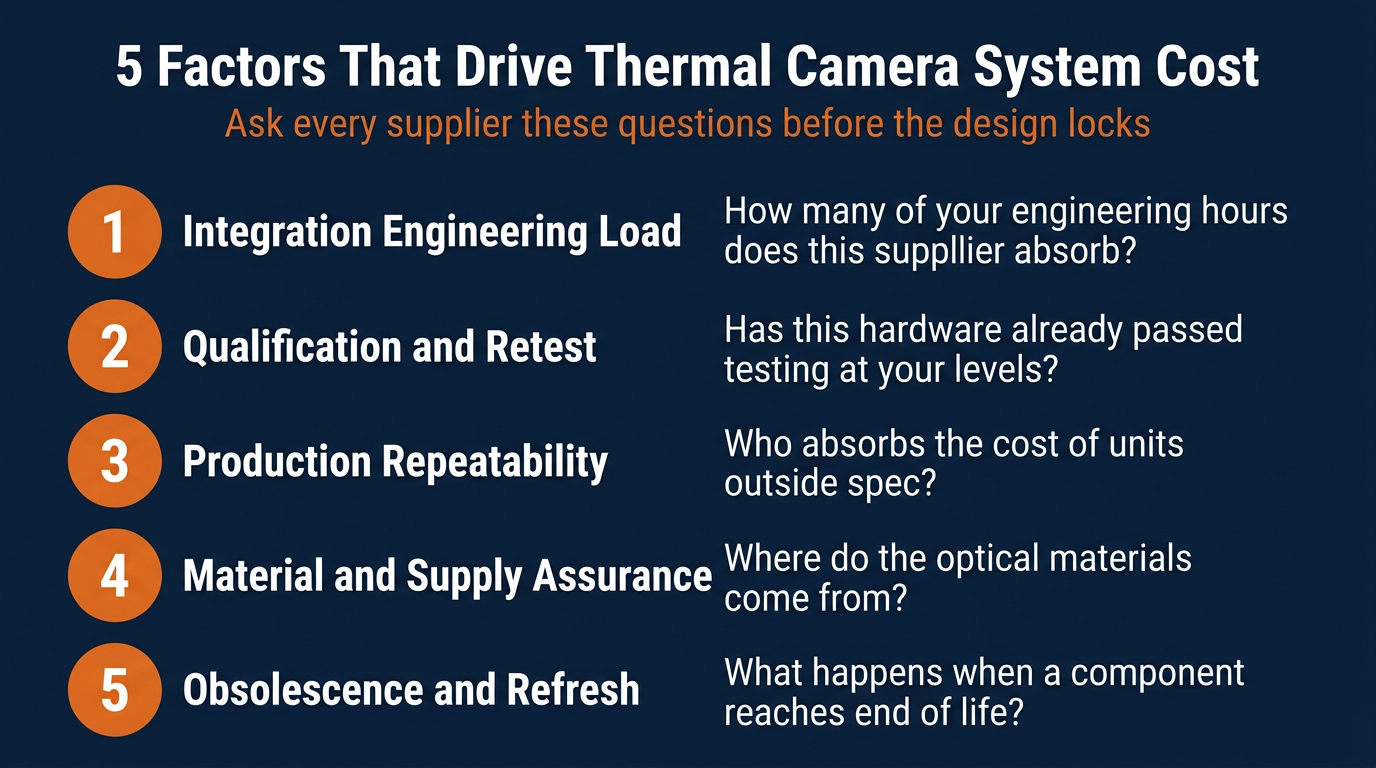
5 Factors That Drive Thermal Camera System Cost Across a Program
If you are building an internal business case, these five factors will move your number more than anything else. Each one is a question you can put to a prospective supplier before you commit.
1. Integration engineering load. How much design work lands on your team versus theirs? A configured, tested system delivered ready for integration shifts labor off your books. Ask for a realistic estimate of your engineering hours alongside theirs.2. Qualification path and retest exposure. Has the supplier's hardware already survived environmental testing at the levels your platform requires? Prior qualification evidence reduces both the probability and the cost of a failed test cycle.
3. Production repeatability. What is the unit-to-unit variance across a full production lot, and who absorbs the cost of units that fall outside spec? Get the answer to that second question into the contract, because yield disputes are expensive to settle after a ramp has started.
4. Material and supply assurance. Where do the optical materials originate, what alternatives exist, and how exposed is the design to a single-country supply chain? Domestic manufacturing and material independence carry a real premium in reduced program risk.
5. Obsolescence and refresh planning. What is the supplier's commitment on product availability, and what does a design refresh look like if a detector or module reaches end of life mid-program? Understanding thermal imaging system architecture at this level early makes the refresh question answerable instead of alarming.
What Should Your Internal Business Case Actually Contain?
Finance teams approve numbers they can defend. A defensible thermal camera TCO comparison needs structure rather than assertion, and it should weigh sourcing approaches rather than individual quotes.
Compare Sourcing Models Rather Than Line Items
Most OEM programs choose between two broad supplier profiles, and the distinction isn't components versus systems. It's how many vendors you're coordinating. The comparison below isn't about which model is universally better, since low-volume programs with standard requirements often do well sourcing parts individually. It's about knowing which cost profile you're signing up for, and teams working through custom camera system tradeoffs usually find the decision clarifies once these answers are on paper.
|
Evaluation Factor |
Multi-Vendor Component Sourcing |
Single-Source Integrated Sourcing |
|---|---|---|
|
Initial thermal imaging system price |
Lower per unit |
Higher per unit |
|
Integration engineering burden |
Falls on your team |
Largely absorbed by supplier |
|
Number of supplier relationships |
Multiple, coordinated by you |
Single point of accountability |
|
Qualification support |
Limited |
Typically included |
|
Material supply visibility |
Fragmented across vendors |
Traceable through one chain |
|
Customization capability |
Constrained by catalog |
Designed to your specification |
Whichever column describes your program, the discipline is the same: get the answers in writing before the design locks, because every one of these rows becomes considerably more expensive to change afterward.
Frequently Asked Questions About Thermal Camera System Cost
What is included in thermal imaging total cost of ownership? It covers acquisition, integration engineering, qualification and environmental testing, calibration and production yield, spares and sustainment, and eventual obsolescence or refresh. Acquisition is the most visible of those categories and rarely the largest across a full program.
Why does the thermal imaging system price vary so much between suppliers? Quotes differ based on what they include. Some cover the module alone, while others bundle optics, coatings, assembly, qualification support, and engineering hours. Comparing quotes without normalizing scope produces misleading results.
How much should we budget for integration? It depends heavily on whether you receive a component or a configured system. The practical approach is to ask each supplier for a written estimate of your internal engineering hours and treat the difference between answers as a real cost delta.
Does uncooled or cooled detector choice affect thermal camera lifecycle cost? Yes. Cooled systems deliver sensitivity advantages for long-range and specialized applications but carry higher maintenance and power demands. Uncooled systems in the 8 to 14 µm band generally reduce sustainment spend and simplify integration, which matters for platforms deployed at scale. Weighing LWIR camera capabilities against your actual detection requirements helps prevent overspecification, a common source of avoidable OEM thermal camera cost.
How do we protect a program against material supply disruption? Evaluate the optical materials in the design, confirm whether alternatives exist, and favor suppliers with domestic manufacturing and material independence. Designing around a single constrained input is a risk you carry for the life of the platform.
Get the Cost Picture Before You Commit the Design
Thermal camera system cost is a program decision disguised as a purchasing decision. Teams that get it right build the model early, ask suppliers uncomfortable questions, and weigh integration support and supply assurance alongside unit price. That work is far cheaper than finding the gaps during qualification.
LightPath Technologies builds thermal camera systems from proprietary Black Diamond chalcogenide glass through finished, qualified assemblies, with domestic manufacturing and engineering support that reduces what your team has to absorb. If you are building the business case for a full system, talk with our engineering team about what your program will actually cost.